
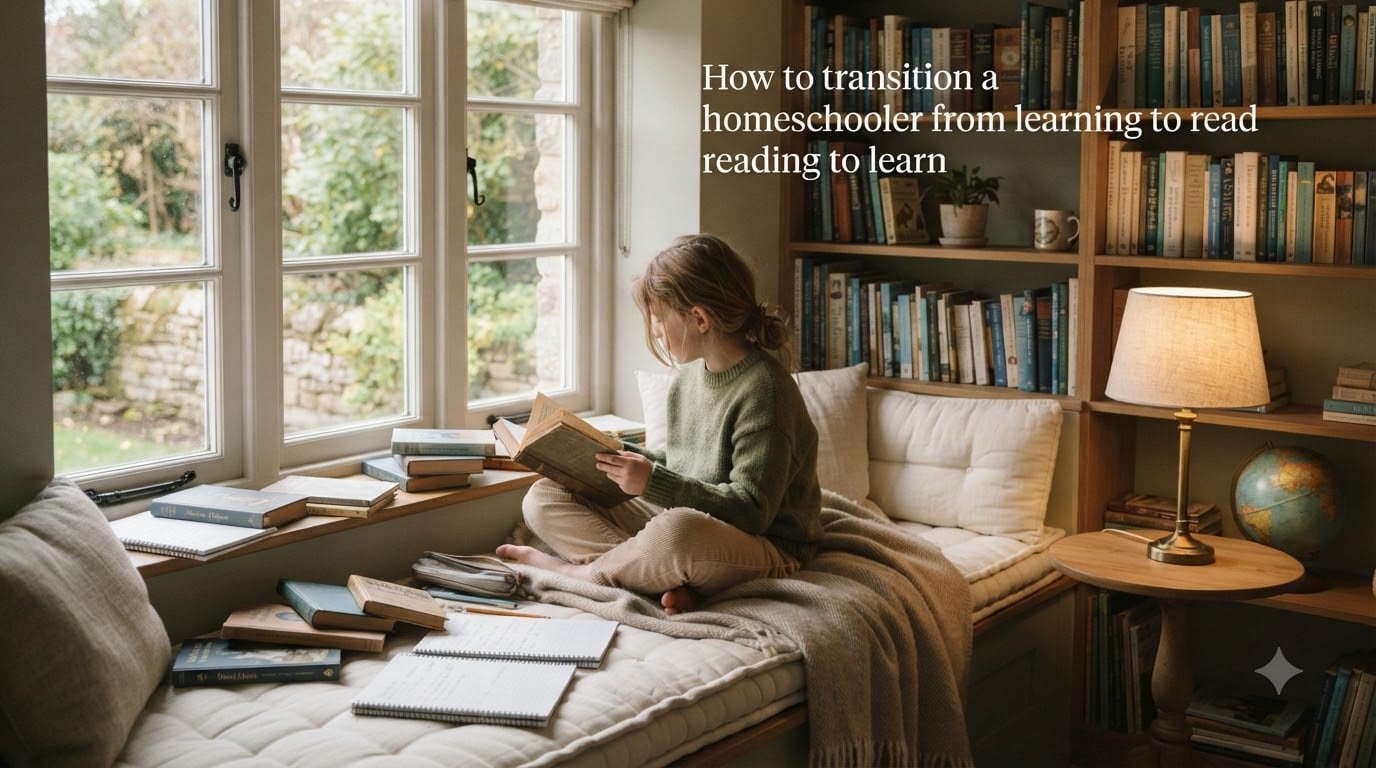
If you have ever wondered when your homeschooler will stop sounding out every word and start reading for meaning, you are not alone. Most children make the shift from “learning to read” to “reading to learn” around grade 4 (ages 8 to 10), though homeschool families often have the freedom to follow their child’s readiness rather than a strict grade label.
I have walked three of my own children through this transition, and I have coached dozens of homeschool families through it too. The truth is, this is one of the most exciting milestones in your child’s literacy journey, but it can also feel uncertain if you do not know what to look for.
In this guide, I will break down exactly what this transition looks like, how to spot readiness signs, and what specific strategies you can use at home to help your child cross the bridge from decoding words to using reading as a tool for learning everything else.
Table of Contents
What Does It Mean to Move From Learning to Read to Reading to Learn?
Learning to read and reading to learn are two distinct phases in your child’s literacy development. Understanding the difference helps you know what to focus on at each stage.
During the “learning to read” phase (typically kindergarten through grade 3), your child is mastering the mechanics of reading. They are decoding words, learning phonics rules, building sight word vocabulary, and developing fluency. Reading itself is the subject.
Once your child enters the “reading to learn” phase (usually around grade 4), reading becomes a vehicle for everything else. Your child uses their reading skills to absorb history, science, math concepts, and new ideas. The focus shifts from how to read to what reading can teach them.
This distinction matters because the instructional focus changes too. In the early phase, you teach decoding. In the later phase, you teach comprehension strategies, vocabulary building, and critical thinking through text.
What Grade Does the Reading Transition Typically Happen?
The transition from learning to read to reading to learn most commonly happens around grade 4, which is typically ages 8 to 10 in homeschool settings. By this point, most children have enough decoding fluency to read grade-level text without constant effort.
Research from the International Multisensory Structured Language Education Council and other literacy organizations confirms that grade 4 is the critical pivot point. Before grade 4, children are learning to read. After grade 4, they need to read to learn across all subjects.
Homeschool families have a unique advantage here. You are not bound by a school’s rigid grade-level timeline. If your child is decoding fluently at age 7, you can introduce comprehension-heavy material earlier. If they need more time with phonics at age 9, that is fine too.
The benchmark I use with my own kids is this: if your child can read a chapter book aloud at roughly 90 words correct per minute with good expression, they are likely ready to shift the focus toward comprehension and content learning.
Signs Your Homeschooler Is Ready to Read to Learn
Not every child follows the textbook timeline. Here are the readiness signals I look for before pushing a child toward textbook-style reading.
Fluent decoding without frustration. Your child reads aloud smoothly, pausing only at unfamiliar vocabulary rather than struggling through every sentence. If reading feels exhausting rather than enjoyable, more phonics review may be needed.
Reading for pleasure appears. The magic moment comes when your child picks up a book on their own and reads for fun. This voluntary reading is the clearest sign they have crossed the threshold.
Comprehension matches decoding. Your child can explain what they just read, make predictions, and connect ideas across paragraphs. If they can decode every word but cannot tell you what the chapter was about, comprehension work is the next priority.
They start rereading favorite books. One mom in our homeschool co-op put it perfectly: “The secret sauce is when your child starts rereading things for pleasure.” Rereading builds fluency and shows genuine engagement.
Vocabulary grows through context. Rather than asking you what every word means, your child starts figuring out new words from context clues. This is a huge cognitive leap.
Reading stamina increases. They can sit with a chapter book for 20 to 30 minutes without complaint. Short attention is normal for developing readers, but sustained focus signals readiness.
Homeschool-Specific Strategies for the Reading Transition
Traditional schools often force this transition at a fixed grade level. Homeschool gives you the flexibility to make it smoother and more individualized. Here is what has worked for our family and the families I mentor.
Follow the child, not the calendar. If your 7-year-old is devouring chapter books, do not hold them back with easy readers just because of their age. If your 10-year-old still loves picture books, that is okay too. Readiness matters more than grade placement.
Integrate reading across subjects. Once your child can read fluently, make reading the gateway to every subject. Read biographies for history, primary sources for science, recipes for math, and field guides for nature study. This is where homeschool shines because you control the whole curriculum.
Use real-world reading daily. Read menus together, follow written directions for a craft, read road signs on a trip, study instructions for a game. Functional reading builds confidence and shows your child that reading has purpose beyond textbooks.
Allow audiobook bridges. Listening to audiobooks above your child’s reading level exposes them to richer vocabulary and complex stories while building comprehension. Many homeschool families use this as a scaffold during the transition.
Read aloud together, even with older kids. Family read-aloud time does not end when kids can read independently. Reading chapter books together lets you model expression, pause for discussion, and tackle books that might be just beyond their independent reading level.
How to Build Comprehension Skills During the Transition
Once your child is decoding fluently, comprehension becomes the focus. These practical strategies help build the deeper understanding that reading-to-learn requires.
The 5 Finger Rule for book selection. Open to any page in the book. For each word your child cannot read or does not know, hold up one finger. Five fingers up means the book is too hard right now. Four fingers suggests they can read it with some help. Three or fewer means it is at an independent reading level.
The 5-4-3-2-1 reading strategy for reflection. After your child finishes a chapter or book, have them write or share: 5 things they remember, 4 things they found interesting, 3 questions they still have, 2 things they want to learn more about, and 1 main idea to take away. This simple framework builds active reading habits.
Discuss before, during, and after reading. Before reading, preview the chapter and make predictions. During reading, pause to ask what they think will happen next. After reading, talk about favorite parts and connections to real life. Discussion turns passive reading into active learning.
Build background knowledge intentionally. Comprehension depends heavily on what your child already knows. If they are reading about ancient Egypt, spend a day looking at pictures, watching a documentary, or visiting a museum exhibit first. The richer their background, the more they will get from the text.
Teach annotation habits. Show your child how to mark interesting passages, jot questions in margins, or highlight unfamiliar vocabulary. These small habits prepare them for the kind of reading they will do in middle school, high school, and beyond.
What to Do When Your Child Resists the Transition
Some children cling to easy readers or being read to long past the typical timeline. Others resist moving from phonics work to chapter books. Here is how I handle the resistance in our homeschool.
Honor their pace without giving up. One child may leap from picture books to 300-page novels in a single summer. Another may take two years to make that same jump. Pushing too hard creates reading aversion. Keep offering richer material and let them come to it.
Offer choice. Resistance often fades when kids pick their own books. Stock your shelves with a variety of genres, topics, and difficulty levels. Comic books, graphic novels, magazines, and nonfiction count as reading, even if they are not traditional chapter books.
Use audiobooks as a bridge. A child who refuses to read chapter books independently will often happily listen to them. Audiobooks build vocabulary, model fluent reading, and create a love of longer stories without the decoding struggle.
Review phonics without pressure. If your child still struggles with decoding, do not force them into harder text. Instead, slip in 10 to 15 minutes of phonics review through games, apps, or multisensory activities. Build the foundation first.
Connect reading to their passions. A child obsessed with dinosaurs will read dense nonfiction about paleontology. A child who loves horses will devour horse-care manuals. Find their spark and feed it with books.
Creating a Reading-to-Learn Home Environment
Your home environment plays a bigger role than any curriculum. A few intentional changes can support this transition beautifully.
Fill your home with accessible books. Keep books at your child’s eye level in every room. A well-stocked bookshelf invites reading the same way a well-stocked kitchen invites cooking.
Build daily reading routines. A consistent 20 to 30 minutes of independent reading time, ideally after lunch or before bed, builds the habit. Our family does “book basket” time where everyone, including parents, reads silently together.
Model reading yourself. Kids who see their parents reading for pleasure and learning tend to follow suit. Let your child catch you reading novels, newspapers, instruction manuals, and research articles.
Make reading a tool, not a task. Cook from a recipe together. Read driving directions aloud. Look up answers to questions in books or online together. Show your child that reading is how we navigate the world.
Talk about what you are reading. Share interesting facts from your own reading at dinner. Ask your child what they learned today from a book. Conversation reinforces that reading connects to real life.
Tracking Progress Through the Transition
You do not need formal tests to track this transition. Simple observations and informal check-ins tell you everything you need to know.
Watch WCPM (words correct per minute). Have your child read aloud for one minute from a grade-level passage. Count the errors and subtract from total words read. By grade 4, most children should read 120 to 200 words per minute with 95 percent accuracy.
Use casual comprehension checks. After your child reads a chapter, ask them to summarize it in their own words. If they can retell the main events and explain the big idea, comprehension is on track.
Keep a reading journal or portfolio. Let your child write short reflections, draw scenes from books, or create simple book reviews. This documents growth over time and becomes a keepsake.
Pay attention to confidence. The biggest sign of success is a child who says “I can read this” and means it. Confidence signals that reading has shifted from work to tool in their mind.
Know when to slow down. If your child is struggling despite consistent practice, slow the transition and revisit foundational skills. Forcing a struggling reader into complex text creates lasting negative associations with reading. Trust your instincts.
Frequently Asked Questions
What grade does it change from learning to read to reading to learn?
The transition from learning to read to reading to learn most commonly happens around grade 4, typically between ages 8 and 10. By this point, most children have developed enough decoding fluency to read grade-level text without excessive effort, allowing them to shift focus toward using reading as a tool to learn across all subjects.
What is the 5 finger rule for reading?
The 5 finger rule is a quick way to check if a book is at the right reading level for your child. Open to any page and hold up one finger for each word your child cannot read or does not know. Five fingers up means the book is too hard right now, four fingers means they can read it with some help, and three or fewer fingers means it is at an independent reading level.
How do homeschool kids learn to read?
Homeschool kids learn to read through a variety of approaches including phonics-based programs, whole language methods, literature-rich environments, and structured literacy curricula. Many homeschool families use a mix of explicit phonics instruction in the early years, abundant read-aloud time, decodable readers, and gradual exposure to chapter books as the child develops fluency and comprehension skills.
What is the 5 4 3 2 1 reading strategy?
The 5-4-3-2-1 reading strategy is a reflection framework students use after finishing a chapter or book. They write or share 5 things they remember, 4 things they found interesting, 3 questions they still have, 2 things they want to learn more about, and 1 main idea to take away. This simple routine builds active reading habits and strengthens comprehension and critical thinking.
Final Thoughts on This Reading Transition
Transitioning a homeschooler from learning to read to reading to learn is a milestone worth celebrating, but it does not have to feel stressful. Watch for readiness signs, follow your child’s pace, and use the strategies that work for your family’s style.
Remember that homeschool gives you something a classroom cannot: the freedom to tailor this transition to your unique child. Some kids will leap ahead. Others will need more time. Both paths lead to confident, capable readers who use books as tools for a lifetime of learning.
Trust the process, keep reading aloud together, and savor this stage. Before you know it, your child will be curled up with a novel they chose, asking you only for the occasional snack refill.