
Picture books are read by adults to children, while early readers are books children read independently as they learn to decode words on their own. That single distinction drives almost every other difference between the two formats, from vocabulary and font size to illustration style and page count. If you have ever stood in a library or bookstore unsure which shelf to browse, you are not alone. Parents, teachers, and even children’s book authors ask this question constantly.
Our team has spent years working with early literacy materials, and we kept seeing the same confusion in forums and parent groups. The picture book vs early reader distinction matters because choosing the right format helps a child build confidence instead of frustration. In this guide, we break down exactly how to tell the difference, share practical tips like the 5-finger rule, and help you recognize when a child is ready to make the leap from being read to, to reading on their own.
Table of Contents
What Is a Picture Book?
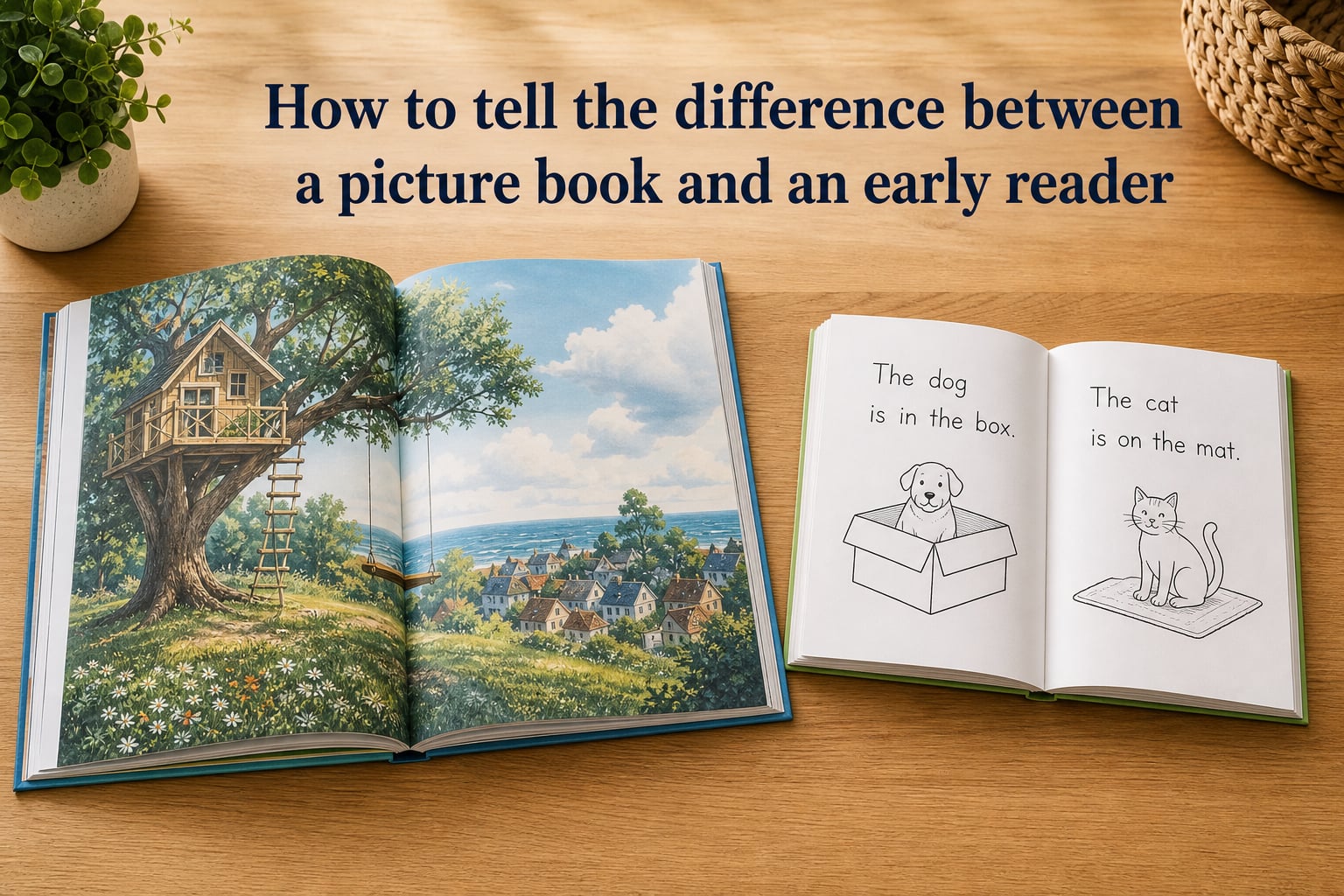
A picture book is an illustrated story where the pictures and text work together to tell the story. The illustrations are not decorative. They carry meaning, and sometimes they even tell parts of the story the words leave out. Think of classics like “Where the Wild Things Are” or “The Very Hungry Caterpillar.” Remove the pictures and the experience falls apart.
Picture books are typically 32 pages long, including front and back matter. They usually run between 500 and 600 words of actual story text. The vocabulary can be rich and complex because the adult is doing the reading aloud. The child is listening, absorbing the story through both the words they hear and the images they see on the page.
The target audience for picture books ranges from preschool through early elementary, roughly ages 3 to 8. But the reading is done by an adult, which means the text does not need to be simplified for a beginner reader. That freedom lets picture book authors use poetic devices like alliteration, repetition, simile, and metaphor to create a read-aloud experience that is genuinely fun to perform.
The Caldecott Medal, awarded annually by the American Library Association, recognizes the most distinguished American picture book for children. It is one of the highest honors in children’s literature and a reliable indicator of quality if you are building a picture book collection.
What Is an Early Reader?
An early reader, sometimes called a beginning reader or easy reader, is a book designed for children who are learning to read on their own. The child is the reader here, not the adult. Everything about the book, from word choice to font to layout, is built to help a new reader succeed at decoding text independently.
Early readers use controlled vocabulary. That means publishers limit the words to those a child at a specific reading level is likely to know or be able to sound out. Sentences are short. The structure is often repetitive so children can practice the same patterns. As one Reddit parent described it, early reader text feels like: “Hi Tom! Tom has a treasure map!” Simple, direct, and easy to sound out.
The target age range for early readers is roughly 5 to 8 years old, covering kindergarten through third grade. The Geisel Award, named after Theodor Geisel (Dr. Seuss), honors the most distinguished American book for beginning readers published in English in the United States. If you want award-winning early readers, start with the Geisel list.
Picture Book vs Early Reader: The Key Differences
Here is a side-by-side breakdown that shows how the two formats compare across every important category. No competitor we reviewed presents this information in a comparison format, so we built one.
Reading level: Picture books use natural, unrestricted vocabulary because an adult reads them aloud. Early readers use controlled vocabulary matched to a specific reading level.
Who reads: In a picture book, the adult reads to the child. In an early reader, the child reads to the adult or reads independently.
Word count: Picture books typically run 500 to 600 words. Early readers range from around 200 to 2,000 words depending on the level, with the simplest ones using very few words per page.
Page count: Picture books are almost always 32 pages. Early readers can be 32 to 64 pages and sometimes longer for more advanced levels.
Illustration purpose: Picture book illustrations are essential to the story and often take up full pages or spreads. Early reader illustrations support the text by giving visual clues but are usually smaller and may be in black and white to keep focus on the words.
Font and layout: Picture books use varied, artistic fonts that match the mood of the story. Early readers use large, clear, consistent fonts with generous white space to make decoding easier.
Age range: Picture books target ages 3 to 8 for read-aloud purposes. Early readers target ages 5 to 8 for independent reading.
Award recognition: The Caldecott Medal honors picture books. The Geisel Award honors early readers.
Who Reads to Whom
This is the single most reliable test for telling the two formats apart. Ask yourself one question: who is doing the reading?
If the answer is the adult reading to the child, you are holding a picture book. The text can be as complex and lyrical as the author wants because the child is not decoding it. The child is building listening comprehension, vocabulary, and a love of stories.
If the answer is the child reading to the adult, or the child reading alone, you are holding an early reader. Every element of the book exists to support that child’s decoding effort. The vocabulary is controlled. The sentences are short. The illustrations confirm what the words say so the child can check their own understanding.
Parents on Reddit and in homeschool forums frequently mention books that blur the line. They call these “read together books” because a title works as a picture book when the child is young and later becomes an early reader when the same child starts reading it back to the parent. This overlap is normal and does not mean the categories are meaningless. It just means some well-designed books serve double duty.
Illustration Purpose Differences
The way illustrations function in each format is one of the clearest ways to tell them apart. In a picture book, illustrations are co-equal partners with the text. They carry story weight. Sometimes a page turn reveals a plot twist shown only in the picture, with no words at all. The art is typically full color and fills the page or spread.
In an early reader, illustrations play a supporting role. They exist to give the child visual context clues that confirm what they are reading. If the text says “The cat sat on the mat,” the picture shows a cat on a mat so the child can verify they decoded the words correctly. These illustrations are often simpler, sometimes black and white line drawings, and they take up less page space than the text itself.
One parent in a children’s books forum pointed out that early reader illustrations get noticeably smaller and sparser as the reading levels progress. The earliest early readers have pictures on nearly every page. By the time a child reaches the hardest early reader levels, the text dominates and illustrations appear less frequently. This gradual shift mirrors how picture books give way to chapter books, which have even fewer illustrations.
Word Count, Page Count, and Layout
Picture books follow a strict production standard of 32 pages. This includes the title page, copyright page, and any front or back matter. The story itself uses roughly 24 to 28 of those pages. Most picture books contain 500 to 600 words of actual story text, though some go lower. Authors who write picture books will tell you the tight word count is one of the hardest constraints to master.
Early readers are more flexible. They can be 32, 48, or 64 pages, and at the higher levels they are sometimes divided into short chapters. The word count varies widely by level. The simplest early readers might have 50 to 200 total words. More advanced early readers can reach 2,000 words. The key is that every word is chosen for readability, not just for story.
Layout differences are easy to spot once you know what to look for. Early readers use larger fonts, more white space, and short sentences that rarely wrap across lines. Picture books use a wider variety of font sizes and styles, and the text is often integrated into or placed around the illustrations in artistic ways that would confuse a new reader.
Signs Your Child Is Ready for Early Readers
One of the biggest content gaps we found is that no competitor offers a practical readiness checklist. Parents in forums constantly ask when their child should make the transition. Based on our work with early literacy materials, here are five signs a child is ready for early readers.
1. They recognize sight words. If your child can identify common words like “the,” “and,” “said,” and “you” on sight without sounding them out, they have a foundation for early reader text.
2. They can sound out simple words. When your child encounters a simple three-letter word and attempts to blend the sounds together, they are beginning to decode. Early readers are built for exactly this kind of practice.
3. They ask to read by themselves. A child who picks up books and tries to read on their own is signaling readiness. Follow their lead and provide early reader options.
4. They understand print concepts. They know we read left to right, top to bottom, and that words are made of letters. These basic concepts are prerequisites for independent reading.
5. They can retell a story they heard. Comprehension comes before decoding. If your child can listen to a picture book and then retell the main events, their listening comprehension is strong enough to support early reader decoding.
Keep in mind that readiness varies widely. One parent in a homeschool forum noted their child read fluently before pre-K at age 4, while another started at 5. There is no single right timeline. The goal is to watch for the signs above and offer early readers when you see them emerging.
The 5-Finger Rule for Choosing the Right Book
None of the competitors we analyzed cover the 5-finger rule, but parents search for it all the time. It is one of the simplest, most practical tools for matching a child to the right reading level. Here is how it works.
Have your child open a book to any page with mostly text. Ask them to read it aloud. For every word they do not know or cannot sound out, they hold up one finger.
Zero or one unknown word means the book is too easy. Your child will not be challenged, though it can still be fine for building fluency and confidence. Two to three unknown words means the book is just right. This is the sweet spot for independent reading. Four unknown words means the book is challenging and probably best read with help. Five or more unknown words means the book is too hard for now and will likely cause frustration.
This rule works whether you are choosing between a picture book and an early reader, or deciding between early reader levels. It takes about 30 seconds per book and removes guesswork entirely.
FAQs
What’s the difference between an early reader and a picture book?
Picture books are read aloud by adults to children and use rich vocabulary with full-color illustrations that carry the story. Early readers are read independently by children who are learning to decode text, so they use controlled vocabulary, larger fonts, and simpler supporting illustrations.
What is the rule of three in picture books?
The rule of three in picture books is a storytelling technique where an event, character, or phrase is repeated three times for comedic or dramatic effect. The third instance usually brings a twist or resolution. It helps young listeners recognize patterns and anticipate what comes next during read-aloud sessions.
What is the 5 finger rule for books?
Have a child read one page aloud and hold up a finger for each unknown word. Zero or one finger means the book is easy, two to three is just right, four is challenging, and five means it is too hard. This quick test helps match children to books at the correct reading level.
What age is considered an early reader?
Early readers typically target children ages 5 to 8, covering kindergarten through third grade. However, readiness varies by child. Some start at age 4 and others later. Watch for signs like sight word recognition, decoding simple words, and asking to read independently rather than relying strictly on age.
Conclusion
The quickest way to tell the difference between a picture book and an early reader is to ask who reads it. If the adult reads to the child, it is a picture book. If the child reads independently, it is an early reader. That difference in reader drives every other distinction, from controlled vocabulary and font size to illustration purpose and word count. Use the 5-finger rule and the readiness signs above to match your child to the right format, and remember that some books serve both purposes beautifully as your child grows from listener to reader.