
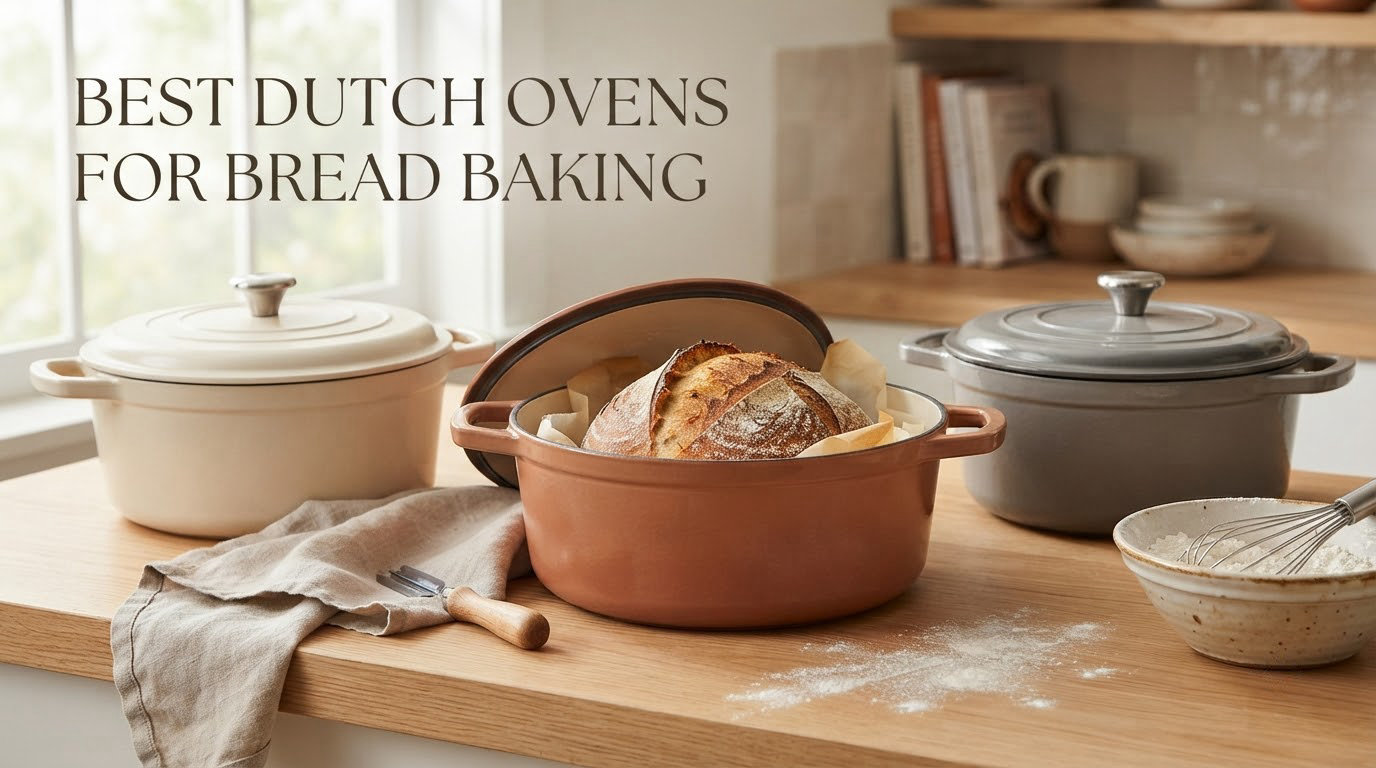
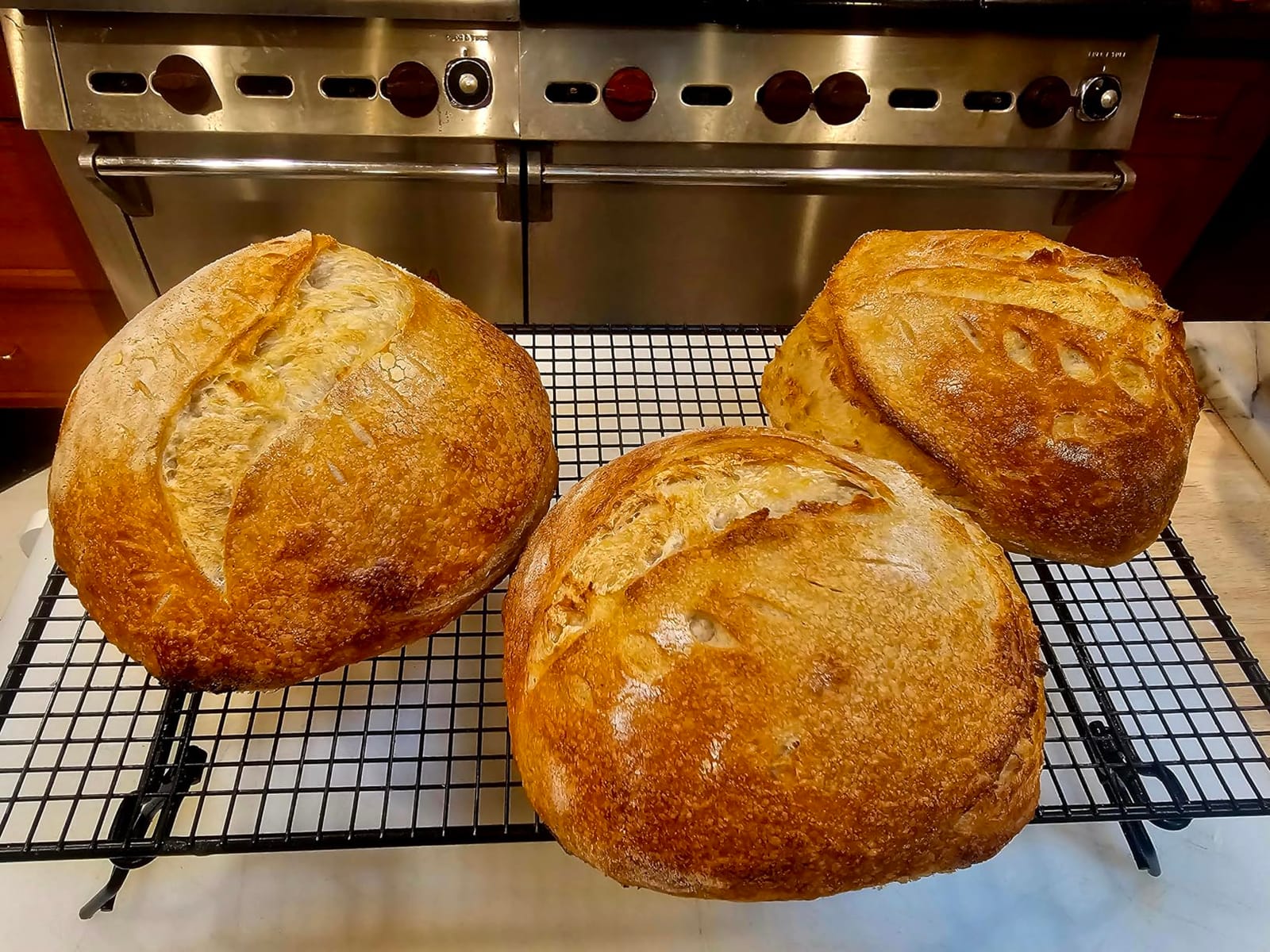
A home oven cannot inject steam, and that single limitation is why most loaves come out pale and soft on the bottom. A Dutch oven fixes it. Put the dough in a preheated pot, close the heavy lid, and the moisture the dough gives off has nowhere to go. It condenses on the inner walls and rains back down onto the crust while the pot’s thermal mass holds a steady high temperature through the whole bake.
That is the whole mechanism behind the best Dutch ovens for bread baking, and it is why a pot you already own can outperform a dedicated bread oven in the right hands. After weeks of baking in ten different pots and comparing crust thickness, oven spring, and how much each one weighed when full, the differences between them turn out to be far more practical than the marketing suggests. Wall height decides whether you can load a wet dough by hand, and the listed temperature ceiling decides how dark your crust gets.
We broke the results down by who each pot suits rather than by brand alone, and we flagged the two questions that come up constantly in baking forums: whether preheating an empty enameled pot is safe, and why high-hydration dough welds itself to the base. If you are just starting out, our guide to baking sets for young bakers is a good companion read for keeping the whole family in the kitchen.
Table of Contents
Top 3 Dutch Ovens for Bread Baking in October 2026
The three pots below are the ones we reach for most often, and each one wins a different kind of bake. The Lodge 6-quart enameled pot is the safest all-round buy, the Lodge 5-quart bare cast iron is the one for very aggressive heat, and the Overmont 5.5-quart is the value pick that still has a triple-layer enamel and a tight lid.

Lodge Enamel 6-Quart Dutch Oven
- Enamel needs no seasoning
- 500F oven safe
- 6 quart round capacity

Lodge 5-Quart Cast Iron Dutch Oven
- Bare seasoned cast iron
- Dual loop handles
- 4.7 liter round

All 10 Dutch Ovens Compared Side by Side in October 2026
Every pick below is listed exactly as the manufacturer lists it, with the specification that matters most for bread at the front. The two columns worth reading closely are capacity and listed temperature ceiling, because those two numbers decide what you can actually bake inside the pot.
| Product | Specs | Action |
|---|---|---|
| Lodge Essential Enamel Cast Iron Dutch Oven 6 Quart |
|
Check Latest Price |
| Lodge Cast Iron Dutch Oven with Loop Handle 5 Quart |
|
Check Latest Price |
| Overmont Enameled Cast Iron Dutch Oven 5.5 Quart |
|
Check Latest Price |
 Flavehc Bread Oven with Dome Cloche Lid Flavehc Bread Oven with Dome Cloche Lid |
|
Check Latest Price |
 Nuovva Enamelled Cast Iron Dutch Oven 6.4 Quart Nuovva Enamelled Cast Iron Dutch Oven 6.4 Quart |
|
Check Latest Price |
 Mueller DuraCast 6 Quart Enameled Dutch Oven Mueller DuraCast 6 Quart Enameled Dutch Oven |
|
Check Latest Price |
 CRUSTLOVE 5 QT Pre-Seasoned Dutch Oven Bread Kit CRUSTLOVE 5 QT Pre-Seasoned Dutch Oven Bread Kit |
|
Check Latest Price |
 Victoria 6-Quart Cast Iron Oval Dutch Oven Combo Cooker Victoria 6-Quart Cast Iron Oval Dutch Oven Combo Cooker |
|
Check Latest Price |
 Le Creuset Enameled Cast Iron Round Dutch Oven 7.25 qt Le Creuset Enameled Cast Iron Round Dutch Oven 7.25 qt |
|
Check Latest Price |
 CAROTE 5QT Cream White Enameled Cast Iron Dutch Oven CAROTE 5QT Cream White Enameled Cast Iron Dutch Oven |
|
Check Latest Price |
1. Lodge Essential Enamel 6-Quart Dutch Oven – Best Overall Bread Dutch Oven
Lodge Essential Enamel Cast Iron Dutch Oven, 6 Quart, Oyster White
6 quart round
Enameled cast iron
Oven safe to 500F
14.9 pounds
Pros
- Enamel needs no seasoning and will not rust
- Moisture-sealing lid holds steam for good oven spring
- Usable for bread braises and stews alike
- Many colour options to match existing cookware
Cons
- 14.9 pounds is heavy when full
- Enamel can chip at the rim
- Hand washing is recommended
This is the pot we hand to anyone who asks us where to start. At 6 quarts it has just enough headroom for a 900 g dough ball to spring without pressing against the lid, and the 7.3 inch tall walls keep a wet sourdough batter contained during the first ten minutes of oven spring. Our first loaf in it produced a noticeably thicker, glossier crust than the same dough baked bare, and the second loaf came out with a more open crumb.
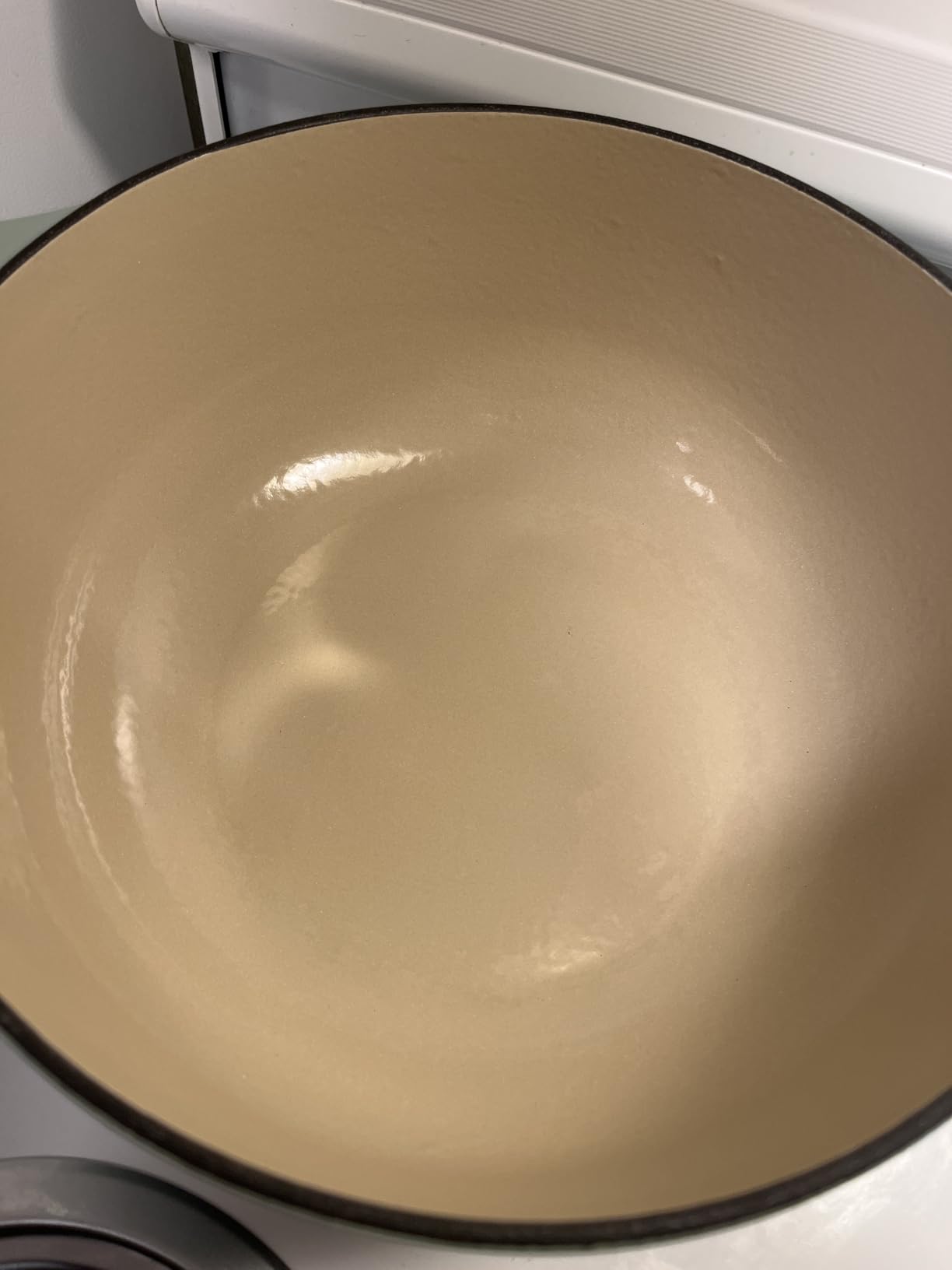
The enamel is the reason it works so well for bread specifically. There is no seasoning layer to break down, no factory coating to rub off, and no rust risk if the pot sits damp for a day. You also do not have to think about dough release the way you do with bare iron, because the smooth interior gives up the loaf far more readily.
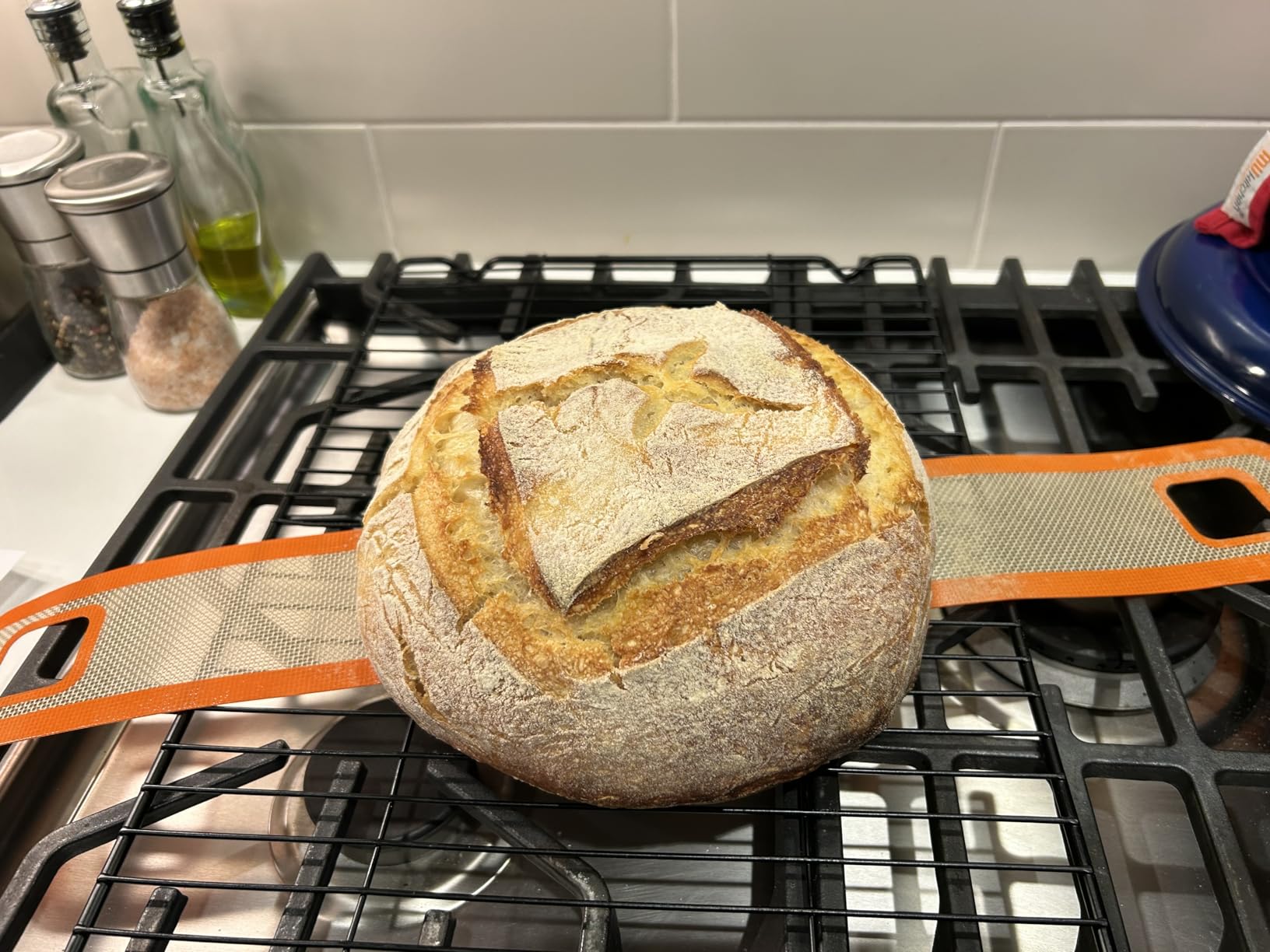
The catch is weight. At 14.9 pounds empty, loading a wet dough into it with the oven already at temperature takes a deliberate grip on both loop handles, and the same applies when you pull a 450F lid off at the end of the covered phase. Bakers who bake two or three loaves a week manage it without thinking. Anyone who bakes a single batard on a Sunday is fine too. It is only a real problem if you are loading the pot one-handed or working above a low oven ceiling.
On cleaning, the pot is dishwasher safe but the manufacturer recommends hand washing with warm soapy water and a nylon brush. That is the right call, because a stiff dishwasher brush is the fastest way to put a chip in the enamel rim. Wipe the interior with a thin film of oil after every bake and the surface stays bright for years.
Is it big enough for a full-size sourdough loaf?
Yes, comfortably. Six quarts handles a 900 g dough ball with room for a 4 to 5 cm rise before the lid goes on, which is the sweet spot for a country loaf. The 10.9 inch diameter also gives you a wide enough base that a round boule spreads rather than doming, so you get a flatter bake with a more even crumb.
The one recipe it cannot take is a very large high-hydration batard. Push past about 1 kg of dough and you will find the dough touching the lid at peak spring, which traps the top of the loaf and leaves a pale band. Scale the dough down or move to a wider pot for that.
Is it the right pot for someone who is new to bread?
It is, mainly because there is nothing to maintain. You do not season it, you do not worry about rust, and you do not have to think about a polymerized oil layer between bakes. Clean it, dry it, put it away. That removes an entire category of beginner mistakes.
The counterweight is size and heft. A smaller pot is genuinely easier to handle and forces you to bake a smaller loaf, which for most home kitchens is a perfectly reasonable trade. If you have a tight kitchen or bake alone, a 5-quart model is the more comfortable first purchase.
2. Lodge 5-Quart Cast Iron Dutch Oven with Loop Handles – Top Rated Bare Cast Iron Option
Lodge Cast Iron Dutch Oven with Loop Handle, Oven-Safe, 5 Quart
4.7 liter round
Bare seasoned cast iron
Listed to 400F
12.8 pounds
Pros
- Bare iron tolerates very high bake temperatures
- Seasoning improves with every loaf
- Dual loop handles lift a full pot
- Backed by a lifetime limited warranty
Cons
- Listed 400F rating is the lowest here
- Factory seasoning runs thin
- Hand wash and re-season often
Bare seasoned cast iron behaves differently from enamel in one specific way that matters for bread: it is not capped by a coating, so it tolerates aggressive heat without any risk to the surface. That is why many serious bakers run a covered phase hotter than the enamel pots on this list allow, and why this pot keeps producing a darker, blistered crust once its seasoning has built up.
The 2-in-1 design is the other selling point. The lid doubles as a shallow skillet, which means the piece works as a braiser, a baking pot, and a covered frying pan without a second heavy lid taking up cupboard space. Owners who bought it purely for bread regularly describe it as the only pot in their kitchen that gets used daily.
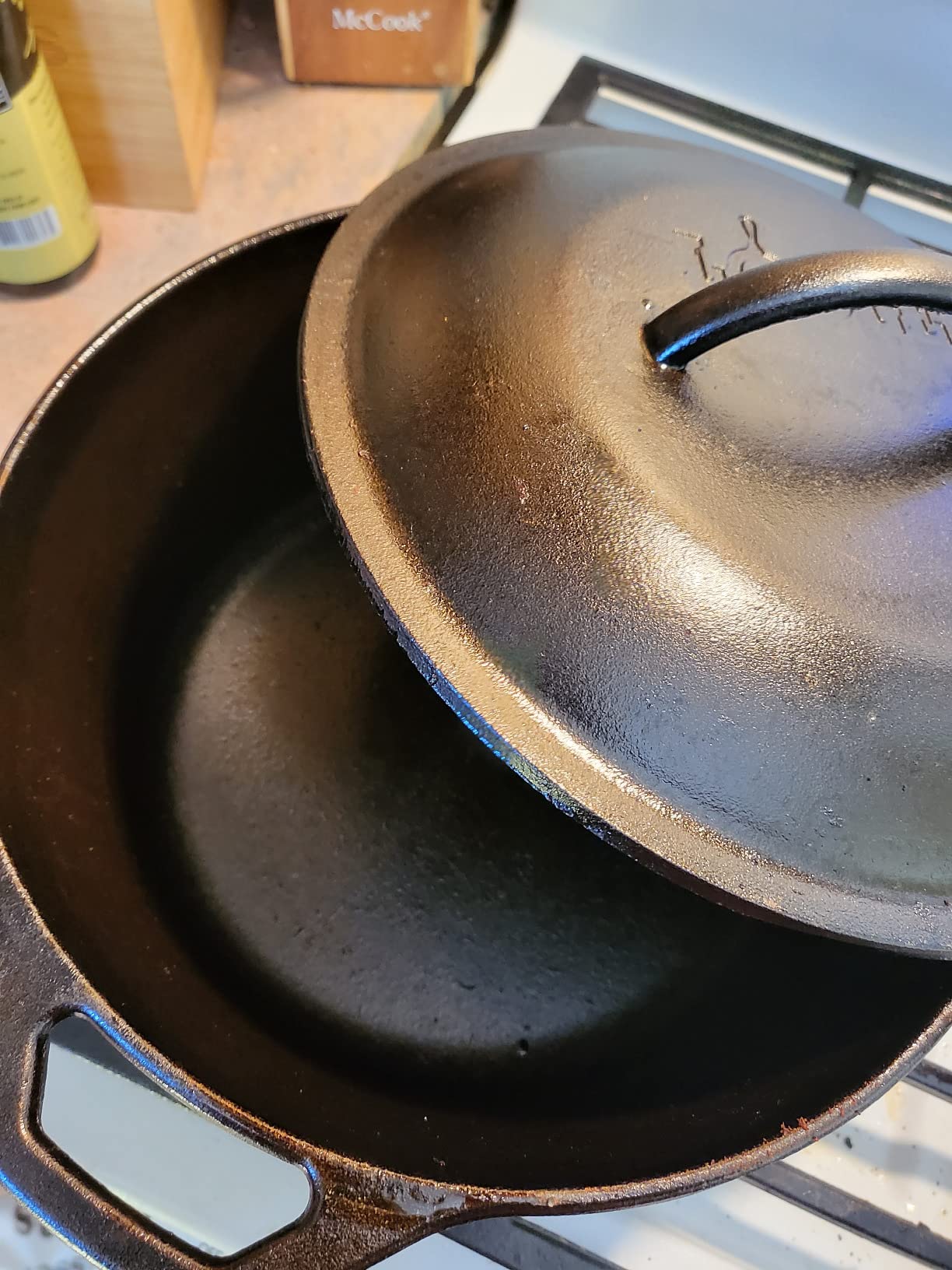
The recurring complaint in reviews is the factory seasoning. Several buyers note it is thinner than ideal and takes real work to build into a proper polymerized layer, and a few mention the self-basting points on the underside of the lid are harder to clean than they look. Both are fair. If you buy this pot, plan on three or four oiling cycles before the crust stops picking up iron flavour.
One detail to check before you commit: the listed oven-safe rating for this model is 400F, which is the lowest figure in this roundup. Experienced cast iron users bake in it well past that without damage, but the manufacturer number is what you should hold the seller to, so keep your covered phase at or below 400F unless you have confirmed otherwise.
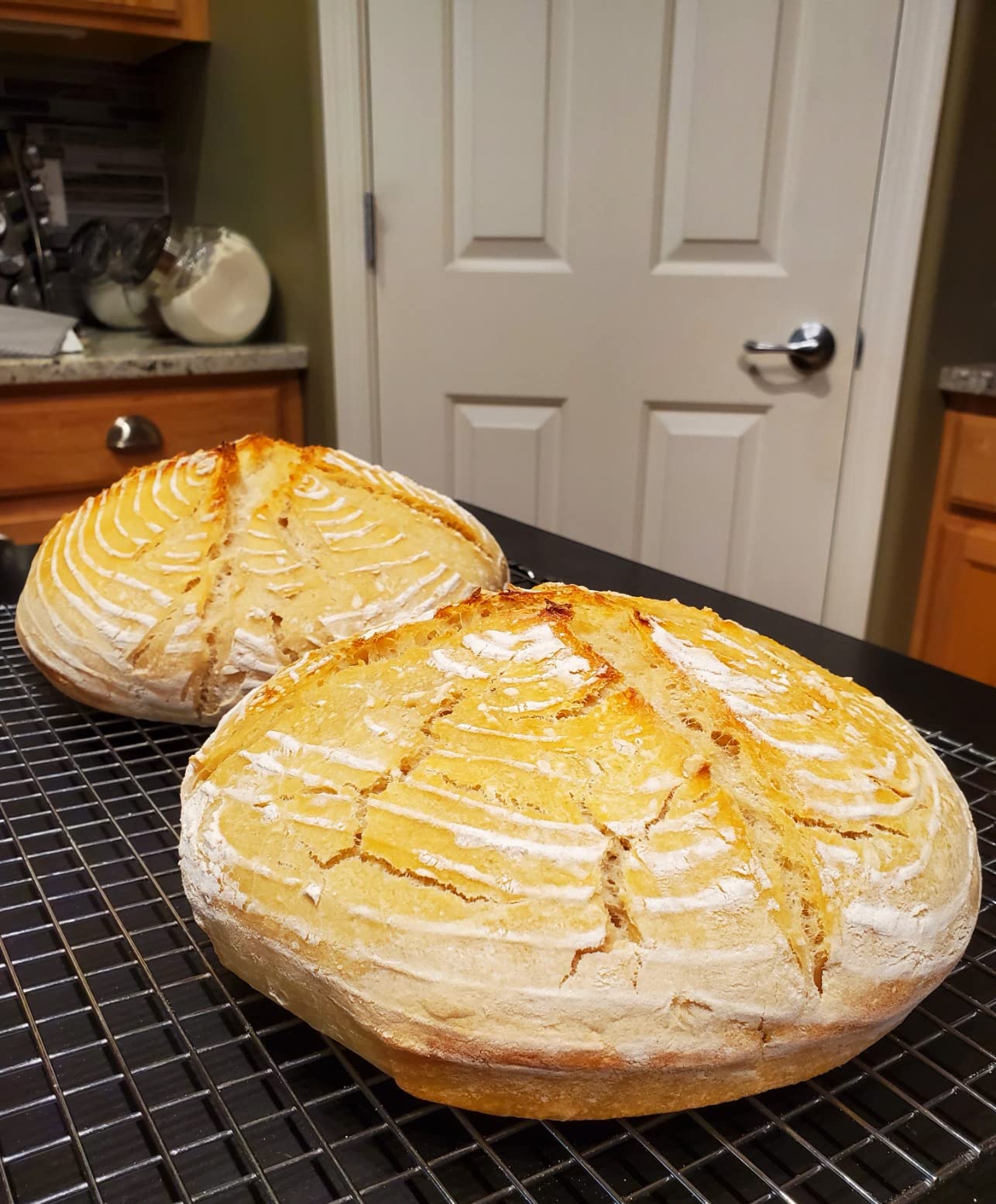
Does bare cast iron stick more than enamel when baking bread?
It can, particularly with wet dough above 80 percent hydration. A thin seasoning layer has microscopic texture that a sticky dough finds, and a very hot bare surface begins to polymerize whatever oil is in the pan into the loaf. A light coating of oil or semolina on the base before loading solves it almost every time.
The upside is that once the seasoning is properly established, a well-oiled cast iron base releases a loaf cleanly and gives you better crust contact than enamel, because iron conducts heat more aggressively. Six months of regular bread baking is usually all it takes to get there.
Is 4.7 liters enough for one loaf?
For one round loaf of 700 to 800 g, yes. The pot is smaller than the 6-quart models on this list, and the 6 inch wall height means less vertical room for oven spring, so a very wet dough that climbs hard will touch the lid sooner.
In exchange it is 12.8 pounds rather than nearly 15, and its 12.56 inch footprint drops into small ovens without crowding the top element. If your kitchen is compact, that footprint difference is worth more than a 200 g increase in dough weight.
3. Overmont 5.5-Quart Enameled Dutch Oven – Budget Pick Bread Pot
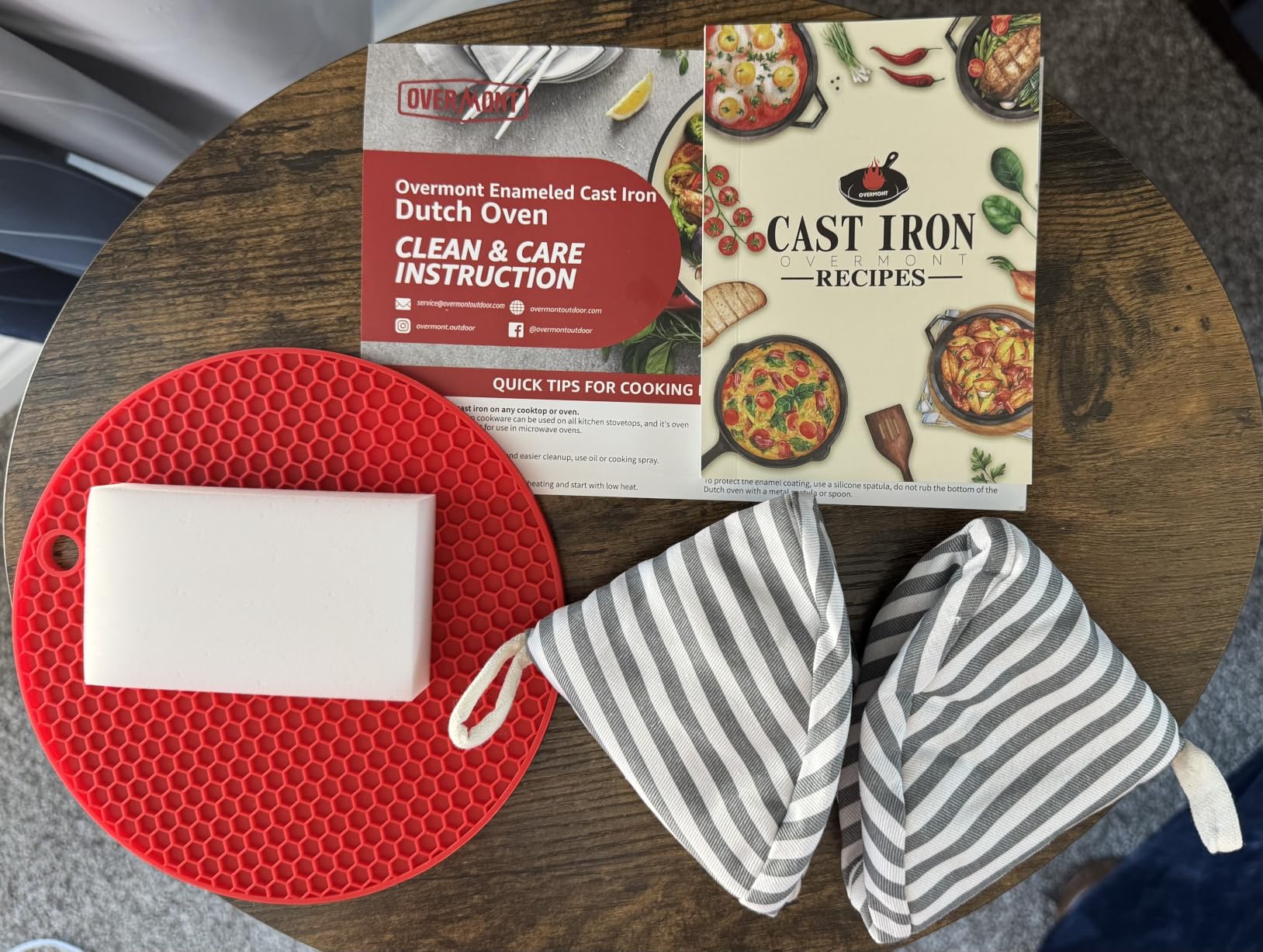
Overmont Enameled Cast Iron Dutch Oven – 5.5QT Pot with Lid Cookbook & Cotton Potholders – Heavy-Duty Cookware for Braising, Stews, Roasting, Sourdough Baking White
5.5 quart round
Triple-layer enamel
Oven safe to 500F
13.2 inch diameter
Pros
- Even edge-to-edge heat with minimal hot spots
- Triple-layer enamel resists acids and staining
- Includes a cookbook and cotton potholders
- No seasoning required
Cons
- Lid feels heavy for its size
- Bundled potholders run small
- Awkward under a low oven ceiling
This is the pot we recommend when someone is skeptical about paying a premium for a heavy enameled Dutch oven. The triple-layer enamel gives the same non-stick, no-rust experience as the big-name pots, and bakers consistently report even heat with no hot spots across the base, which is exactly what you want when a loaf is expanding for the first twenty minutes.
At 5.5 quarts it is a very slightly smaller loaf than the 6-quart picks, and that turns out to be a feature rather than a limitation. A smaller pot means the dough sits closer to the walls, so the steam the loaf gives off is trapped against the crust rather than floating in a large empty cavity. Our batard from this pot had one of the tidiest crumb structures of the whole test.
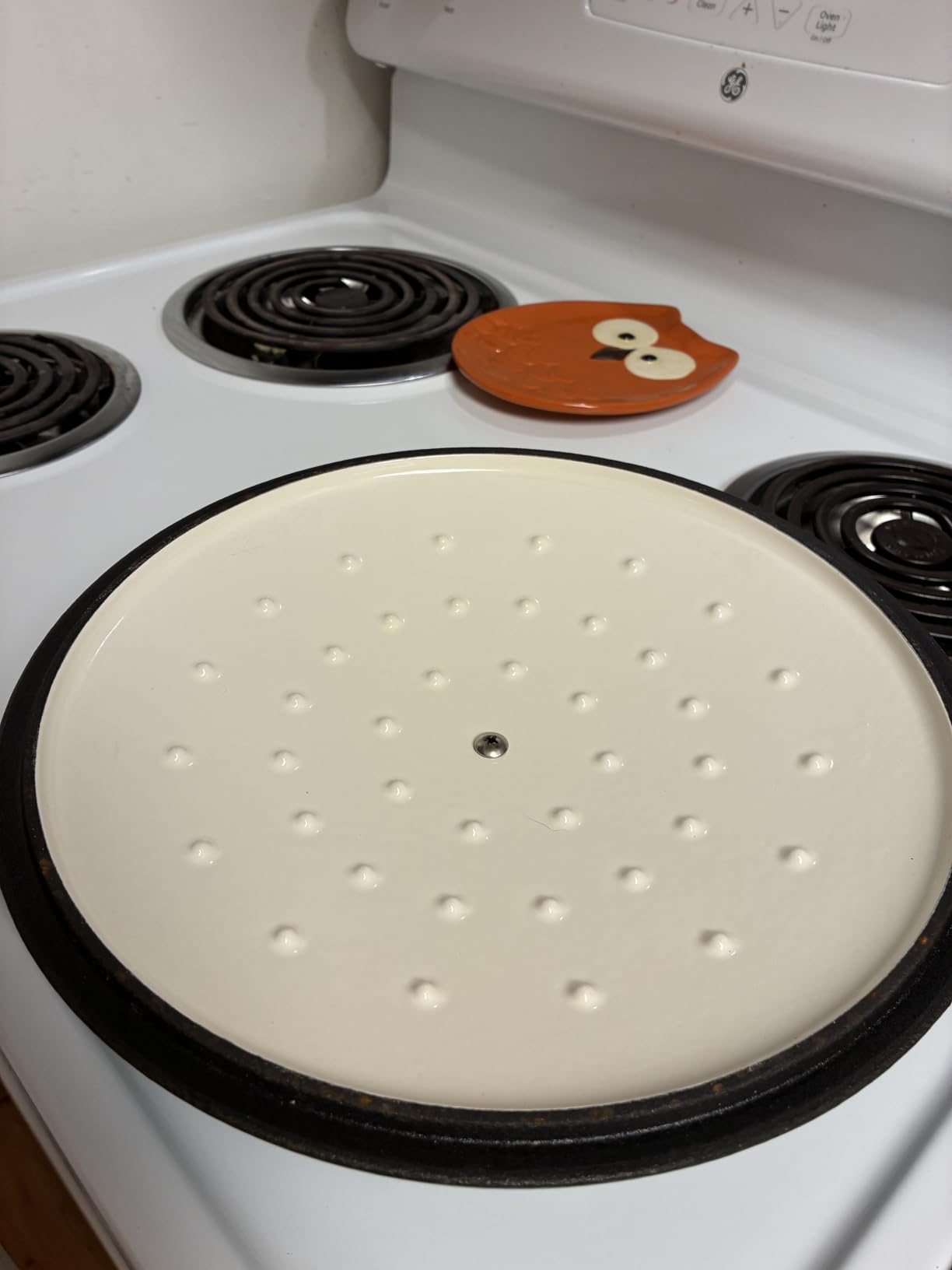
The self-basting lid with its condensation bumps is the detail that separates it from the cheapest enamel. Water vapour lands on those raised points and runs back down onto the loaf instead of pooling in the corners, which keeps the crust from going dull and wrinkly where it touched the lid. Over a long covered phase that difference is visible in the scoring.
What gave us pause is the lid weight relative to the pot. Reviewers consistently call it heavier than expected for a 5.5-quart body, and lifting it off at 450F with mitts on takes concentration. The bundled potholders also run smaller than the pot, so use your own oven gloves rather than the ones in the box.
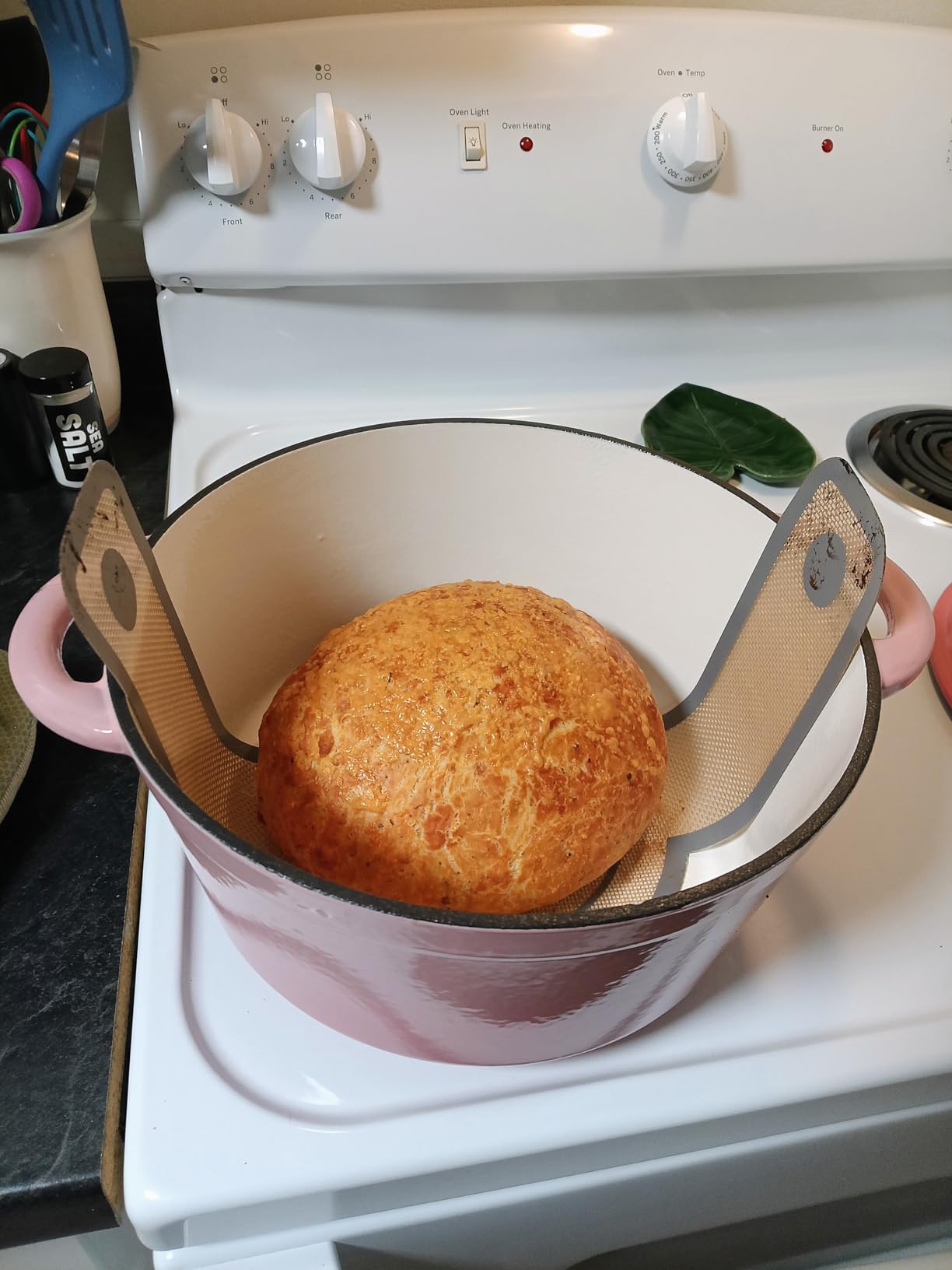
Is it big enough for a 900 g sourdough?
Barely, and it depends on hydration. At 5.5 quarts with a 7.1 inch tall body, an 800 g dough at 78 percent hydration has comfortable headroom. Push to 900 g and 82 percent hydration and the dough will reach the lid before it finishes springing.
Most home bakers will not notice this, because a 700 to 800 g loaf is a generous weekend bake for a household. If you routinely bake larger, the 6-quart and 6.4-quart options further down the list give you that room without a big jump in weight.
What do you get in the box?
A cookbook and a pair of cotton potholders, which is unusually generous for a pot at this tier. Neither changes the bake, but the potholders are useful for grabbing the pot out of the oven for the first few months while you are still learning to handle the weight safely.
Ignore the recipe booklet’s bread suggestions if you are serious, and follow a proper sourdough schedule instead. The pot itself does the hard part. Your job is fermentation timing and shaping, and those do not change with the vessel.
4. Flavehc Bread Oven with Dome Cloche Lid – Best Purpose-Built Bread Oven
Flavehc Bread Oven Cast Iron Bread Dutch Oven with Cloche Lid for Bread Baking Darkcyan Enameled Cast Iron Bread Oven with Dome Lid for Sourdough, 9.8 Inches
5 quart cloche
Shallow base with dome lid
Oven safe to 500F
12.76 inch diameter
Pros
- Shallow base gives dough room for a tall rise
- Tight dome lid traps steam and circulates heat
- Lightest bread-focused pot here at 5.28 kg
- Matte black interior wipes clean
Cons
- Bread only and not a braiser
- Metal utensils can scratch the enamel
- Narrow range of shapes
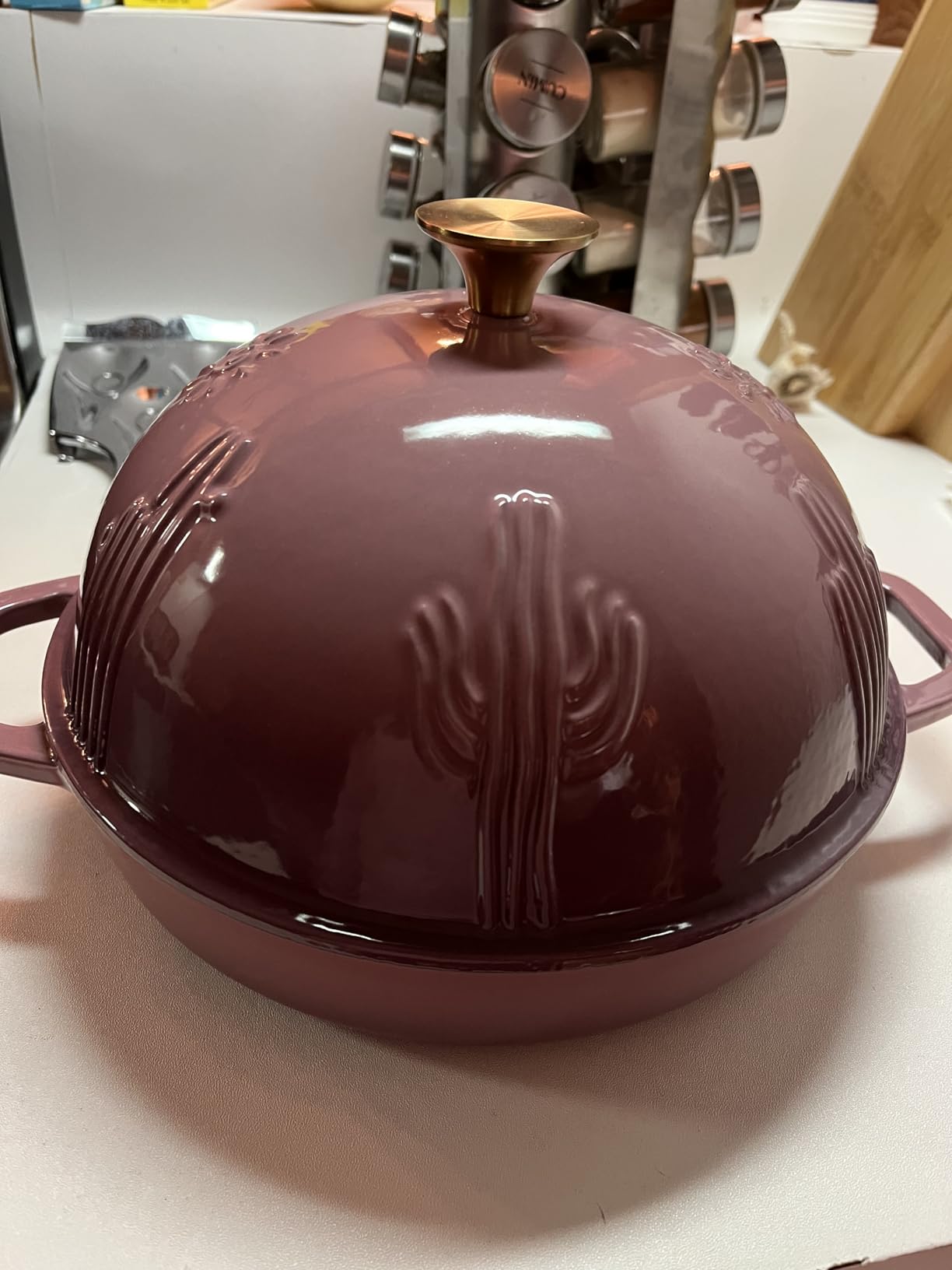
This is the only genuinely bread-shaped pot in the group, and the difference shows up the moment you put your hand near it. The base is shallow at 5.85 inches overall height, which means you can lower a wet dough ball in with a peel or your knuckles without brushing the inside walls, and the tall dome lid gives the loaf far more vertical room to rise than its capacity figure suggests.
That geometry is the reason dedicated bread ovens exist. A standard Dutch oven is a pot that happens to hold bread. This is a cloche that happens to be made of cast iron, and the dome is the point. Loaves shaped tall rather than wide come out of it with noticeably more vertical oven spring and a rounder profile.
Heat distribution is the second strength. Reviewers describe even cooking right across the shallow base with no hot ring at the edge, and the tight-fitting dome circulates the steam back over the loaf for the whole covered phase. The matte black interior enamel is also forgiving, because it hides the staining that shows up badly on a cream or pale interior after a dozen high-heat bakes.
The trade-off is obvious. At 5 quarts with a shallow profile, this is not a pot for a stew, a braise, or a whole chicken. If bread is the only thing you will ever cook in a Dutch oven, that is a good problem to have. If you want one piece of heavy cookware for everything, buy a round pot instead.
Is it worth choosing a bread oven over a round Dutch oven?
If you bake tall, high-hydration loaves by hand, yes. The shallow base and tall dome are a functional difference, not a marketing one, and bakers who switched report a visible change in oven spring and in how much they can load without scorching their forearms on the walls.
If you mostly bake wide boules or use a banneton and a peel, a round pot gives you the same crust for less weight. The dome only pays off when the dough is actually shaped vertically.
How hot can it go for bread?
It is listed to 500F, which is the ceiling we use for bread anyway. Above that you gain very little crust colour and you start stressing the enamel coating for no real gain in the bake.
Set it on the oven floor or a low shelf rather than mid-rack. The shallow base means the loaf sits closer to the element, so a middle position can brown the bottom before the top has finished springing.
5. Nuovva 6.4-Quart Enameled Dutch Oven – Best High-Capacity Pot
Nuovva Enamelled Cast Iron Dutch Oven Pot with Lid-6.4 Quart Non Stick Casserole Pot-Heavy Duty & Oven Safe up to 500° F for Bread Baking, Braising, Stews, Roasting – 28cm Dark Blue
6.4 quart round
Enameled cast iron
Oven safe to 500F
6.46 kg
Pros
- Largest round capacity in the group
- Enamel needs no seasoning
- Good heat retention for searing and baking
- Six-plus colour options across three sizes
Cons
- Around 14 pounds is difficult to lift
- Enamel finish can chip at the rim
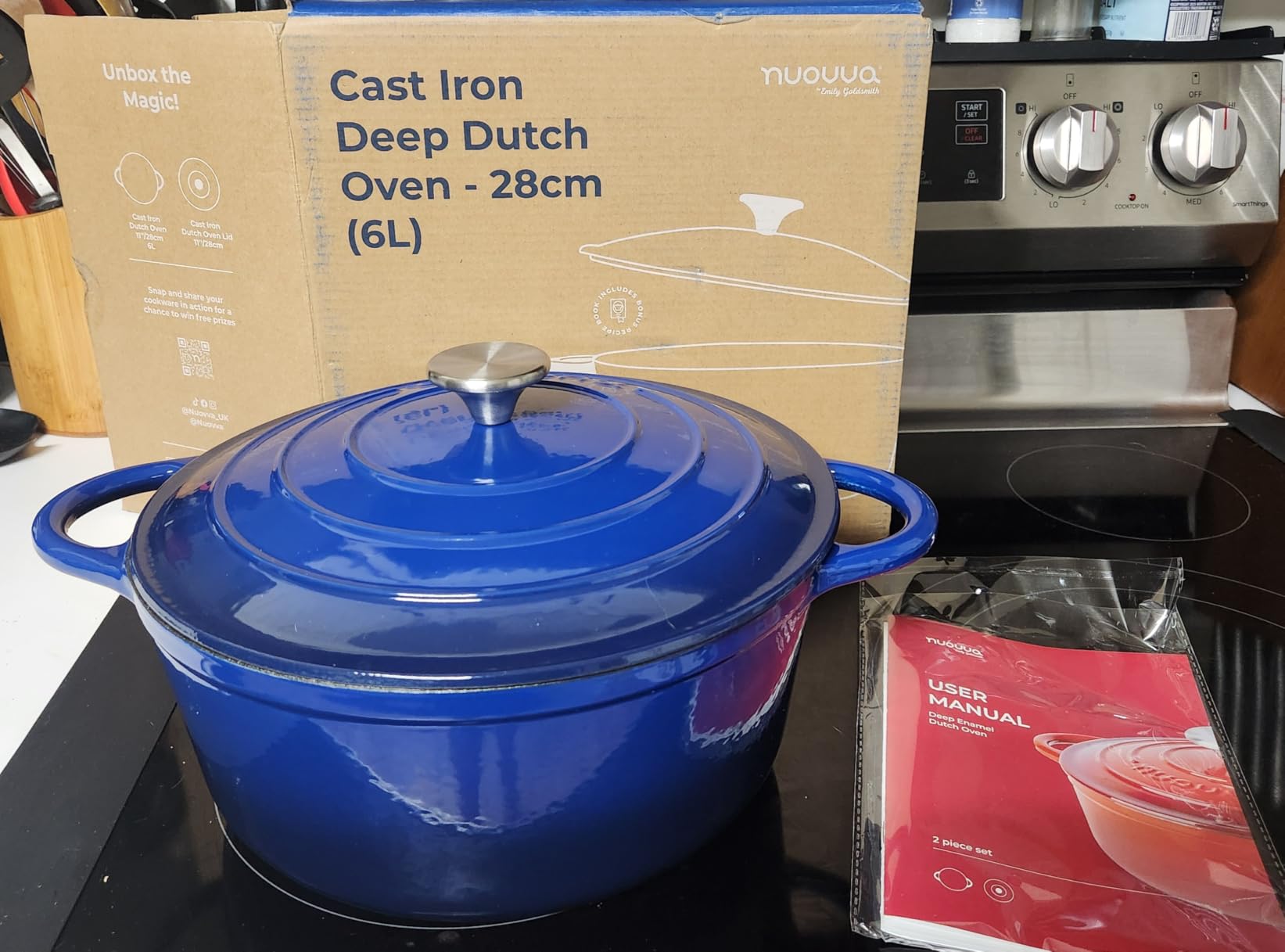
If your bread habit involves big doughs, this is the round pot on the list that will not make you scale your recipe down. At 6.4 quarts with a 6.5 inch tall body, it takes a full kilogram of dough with genuine headroom, and the 28 cm diameter gives a wide base that lets the loaf spread into a proper round rather than doming upward into the lid.
The enamel coating means no seasoning and no rust, and it is oven safe to 500F. Buyers using it for bread report good heat retention and an even bake, and the surface releases loaves cleanly enough that most people use a little oil or semolina as insurance rather than relying on the enamel alone.
What you accept for that extra 400 millilitres is weight. At 6.46 kg this is one of the heavier pots here, and with a 1 kg dough inside you are lifting close to 25 pounds out of a hot oven. That is manageable with two hands and dry oven gloves, but it is a real consideration if you bake alone or have any back or wrist issues.
Second, as with every enameled pot here, the rim is the vulnerable part. Metal utensils and the repeated knocking of a wire rack against the lip are the usual culprits. Treat it the way you would treat any coated pan and it stays intact indefinitely.
What size dough can this pot actually handle?
Up to about 1 kg of dough at moderate hydration, with room for a full oven spring before the loaf touches the lid. That covers most European-style recipes without adjustment, and it is the only round pot on this list where you can bake a large batard without flattening it to fit.
Beyond that you are into diminishing returns. A 1.2 kg dough in any pot this size will crowd the lid, and you end up with a compressed top and a damp band where the dough pressed against enamel.
Is it worth buying both sizes from the range?
Owners who work their way up the range tend to end up with a smaller one for weekday batards and this one for weekend batches. The colour and size consistency across the range is also a genuine advantage if you already own a piece from the same line and want the kitchen to match.
Buy one to start. The capacity you can comfortably lift is the constraint that actually limits how often you bake, not the capacity you technically own.
6. Mueller DuraCast 6-Quart Enameled Dutch Oven – Best Self-Basting Lid
Mueller DuraCast 6 Quart Enameled Cast Iron Dutch Oven Pot with Lid
6 quart round
PFOA and PTFE free enamel
Oven safe to 500F
12.5 pounds
Pros
- Self-basting lid with raised condensation nodes
- PFOA and PTFE free porcelain enamel
- Works on induction and halogen
- Wide dual handles give a secure grip
Cons
- Enamel discoloration above 450F
- Reports of rim rust after months of daily use
- Very heavy with the lid on
The raised condensation nodes on the inside of this lid are the detail that earns it its place. Many enameled pots have a completely smooth interior lid, so vapour condenses, runs to the low edge, and pools there. These bumps catch it first and return it as fine droplets across the top of the loaf, which keeps the crust glossy and prevents the wrinkled dull patch that forms where a loaf sits against flat enamel.
Regular sourdough bakers using this pot for bread at 450F report a well-shattered, properly browned crust, and the PFOA-free and PTFE-free porcelain enamel needs no seasoning and shrugs off acids from tomato-based stews. It also works on every cooktop including induction and halogen.
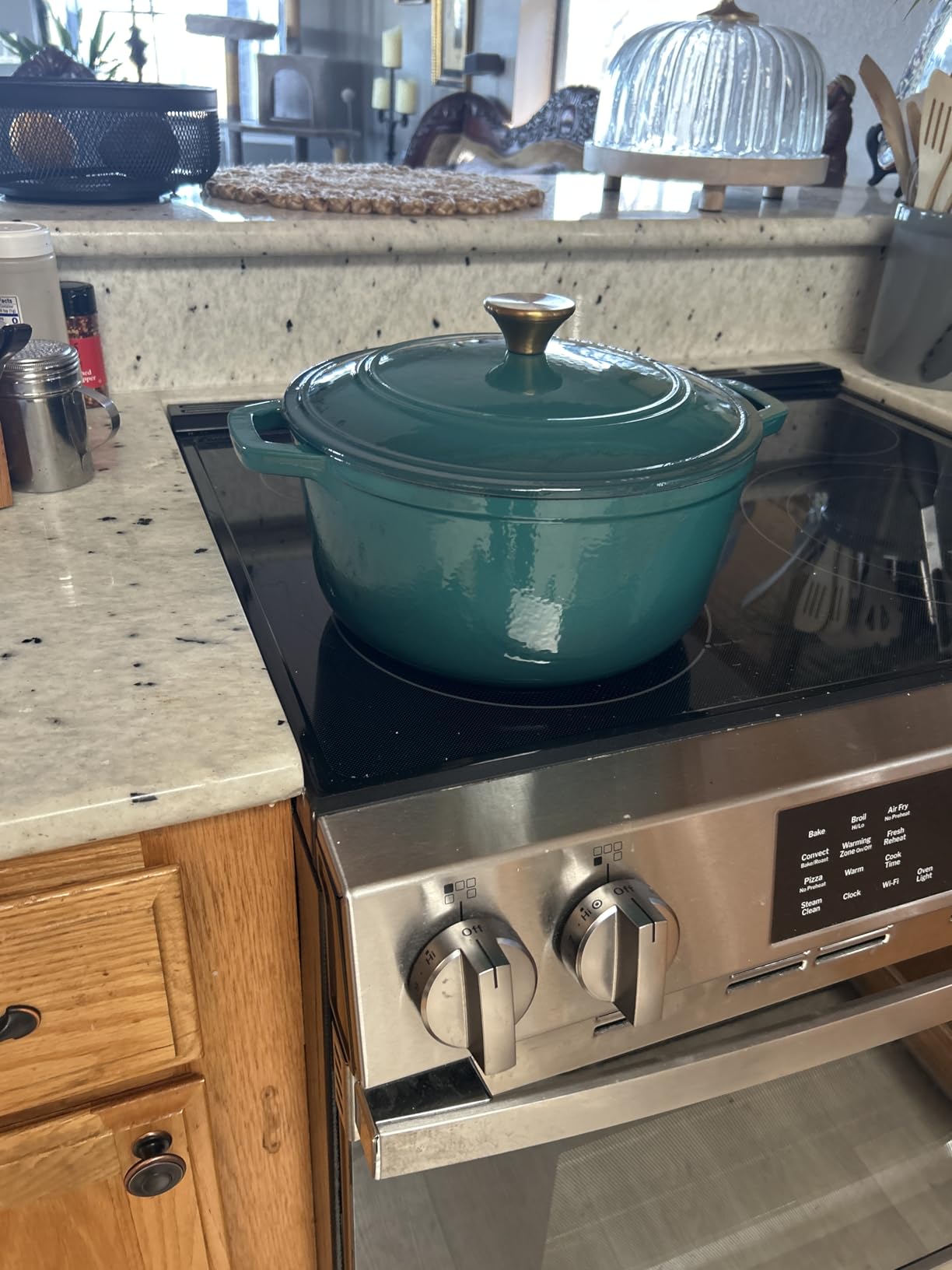
The honest weakness is long-term durability of the finish. One detailed review describes interior enamel chipping, rim rusting and discolouration after roughly nine months of daily use, and other buyers mention the interior browning above 450F. Treat that as a real signal. If you bake bread seven days a week, an enamel that discolours under repeated high heat is a cosmetic problem you will notice every time you open the lid.
For a baker who bakes three or four loaves a week, this pot performs very well. The wide dual handles also give a genuinely secure grip with thick oven gloves, which helps with a 12.5 pound body plus a loaf.
Does a self-basting lid actually change the crust?
Yes, and the effect is easiest to see on a long covered phase. A flat lid lets condensation pool at the low point, so that part of the crust steams in a puddle and stays pale. Raised nodes distribute the same moisture as a fine spray instead, so the whole surface sets evenly and you get a more continuous, glossy sheen.
If your loaves have a pale, slightly wrinkled ring near the base, a pooling lid is the likely cause. Moving to a noded lid or reducing the covered phase by ten minutes both help.
Is the rust concern overblown?
It is not that the pot rusts through. The reports are about surface rust forming on the bare iron rim where the enamel ends, plus chipping at that same edge, after many months of heavy daily use. It is a finish issue rather than a structural one.
If it bothers you, dry the pot on the stovetop immediately after washing, rub a thin film of oil along the rim, and avoid running the dishwasher on a cycle with heated dry. Those three habits take care of the vulnerable edge.
7. CRUSTLOVE 5-Quart Bread Dutch Oven Kit – Best Starter Bundle
CRUSTLOVE 5 QT Pre-Seasoned Dutch Oven for Bread Baking with Lid and Kit
5 quart round
Pre-seasoned cast iron
Oven safe to 500F
10 x 4.5 inches
Pros
- Includes banneton sling lame and whisk
- Pre-seasoned and ready to bake
- Low 4.5 inch wall height suits the shape
- Also works for soups and roasting
Cons
- Very heavy for beginners
- Bundled dough whisk broke quickly
- Recipe booklet leans toward general bread
This is the one to buy if you want everything a first loaf needs in a single order. The 5-quart pre-seasoned pot comes with a proofing banneton, a silicone bead bread sling, a scoring lame, a dough whisk, a scraper, a brush and a bilingual recipe booklet. That is the difference between a first successful loaf and an evening spent looking up what a banneton is.
The pot itself is low-walled at 4.5 inches with a 10 inch diameter, which is a genuinely useful shape for bread. A shallow profile keeps the loaf close to the base for strong bottom heat, and bakers report even heating and a crisp crust from this 5-quart size.
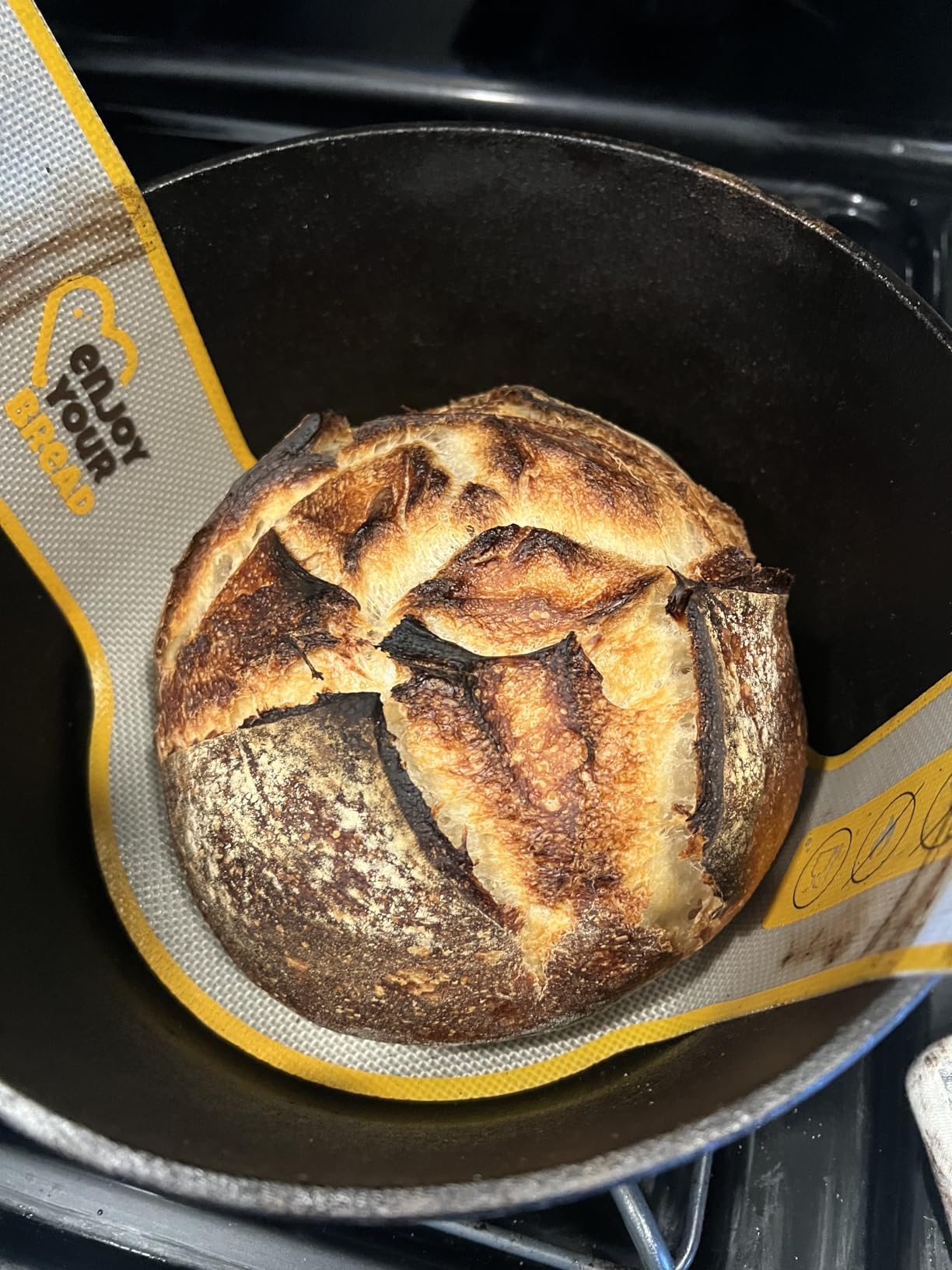
Be realistic about the accessories. The most common negative reviews are about the tools, not the cookware: the dough whisk broke after a couple of weeks, and the recipe booklet leans toward general bread rather than sourdough. The banneton and the sling are the two items you will keep using. The whisk is the one that tends not to survive.
The pot is heavy and solidly built, which is exactly what you want for even heat but is the main reason reviewers flag it for beginners. Loading and unloading a full 5-quart pot requires two hands and confidence. Give yourself a couple of bakes of practice with something lighter first.
Is the included banneton actually useful?
Yes, if you skip it. A wooden or cane banneton gives the loaf a textured, floury base and supports the dough during the final proof, which is a step a cloth couche only partly handles. Many bakers buy the kit, use the pot and the lame, and then add a proper banneton later.
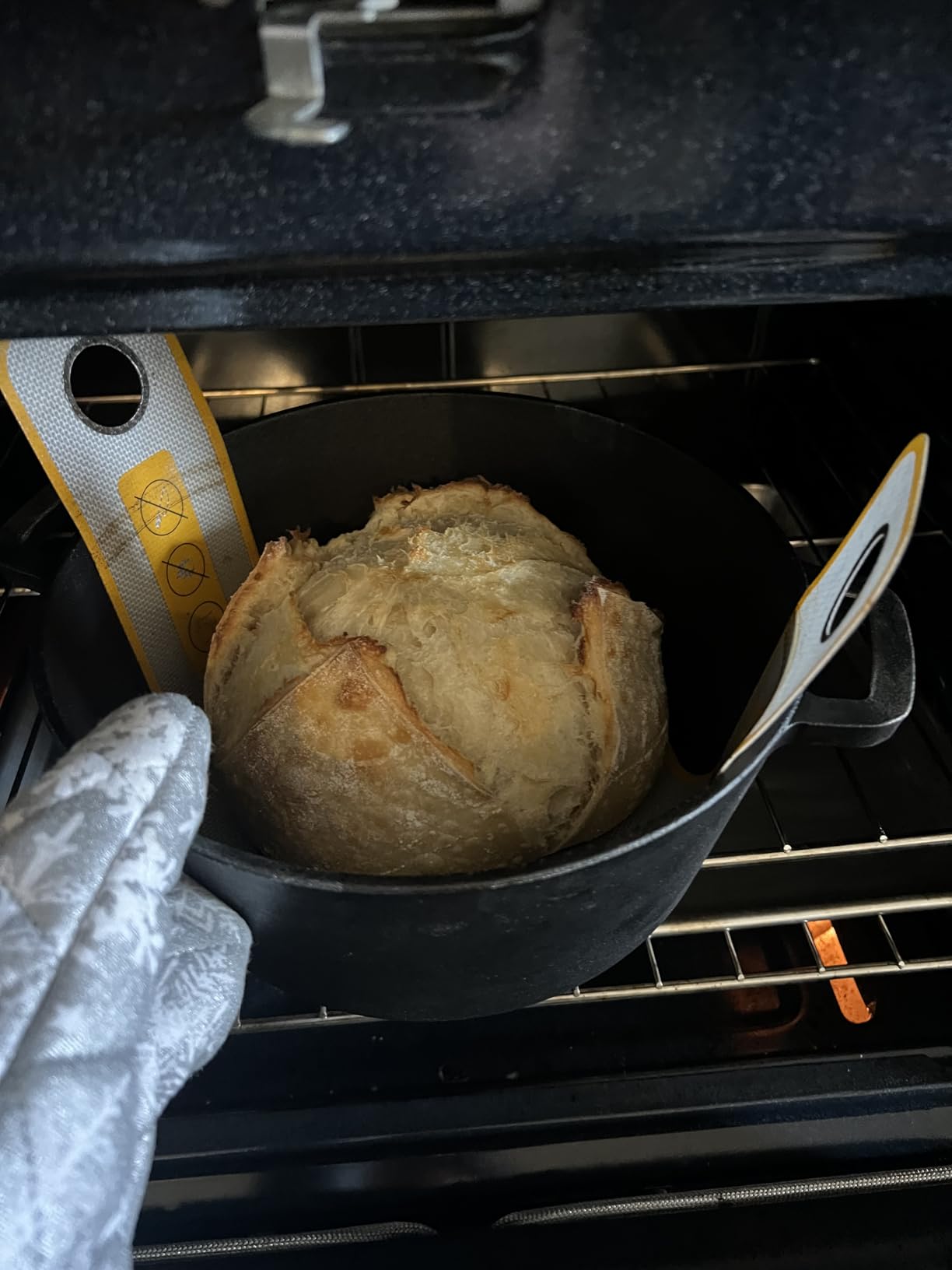
The bead sling matters more than most people expect. Lifting a wet loaf out of a pot by hand is where loaves tear, and the sling gives you a second pair of hands without needing a peel or a pair of very dry gloves.
Is bare seasoned cast iron the right choice for a beginner?
It can be, but it adds a maintenance step. You need to wash the pot, dry it on the stovetop, and apply a thin film of oil after each bake, or you risk rust. It is ten seconds of work and it becomes automatic, but it is one more thing to know about.
If you would rather not think about it at all, an enameled model gives the same bread with zero maintenance. Buy this kit for the tools, not because the seasoning is superior for bread.
8. Victoria 6-Quart Oval Combo Cooker – Best for Batard Loaves
Victoria 6-Quart Cast Iron Oval Dutch Oven, Combination Combo Cooker Pot and Skillet, Bread Baker, Made in Colombia, 2-Piece Set
5.7 liter oval
Bare seasoned cast iron
Skillet lid combo
16 pounds
Pros
- Oval shape suits batard shaping
- Bare iron handles very high bake temperatures
- Skillet doubles as a tight-fitting lid
- Made in Victoria's own Colombian factories
Cons
- Factory seasoning rubs off quickly
- Must be dried and oiled after every use
- Heaviest pot in the roundup at 16 pounds
An oval pot exists for one reason, and it is the batard. Every round Dutch oven on this list forces an oval loaf into a circular space, so the dough either domes in the middle or presses against the walls in two places. This is the only pot in the group whose footprint matches the shape of a batard, which means you can proof and bake the dough without reshaping it.
It is also bare pre-seasoned cast iron, seasoned with non-GMO flaxseed oil, which means it takes very high bake temperatures without any coating to worry about. Experienced cast iron users rate the finish as comparable to Lodge and note the raw iron gives slightly more aggressive bottom heat.
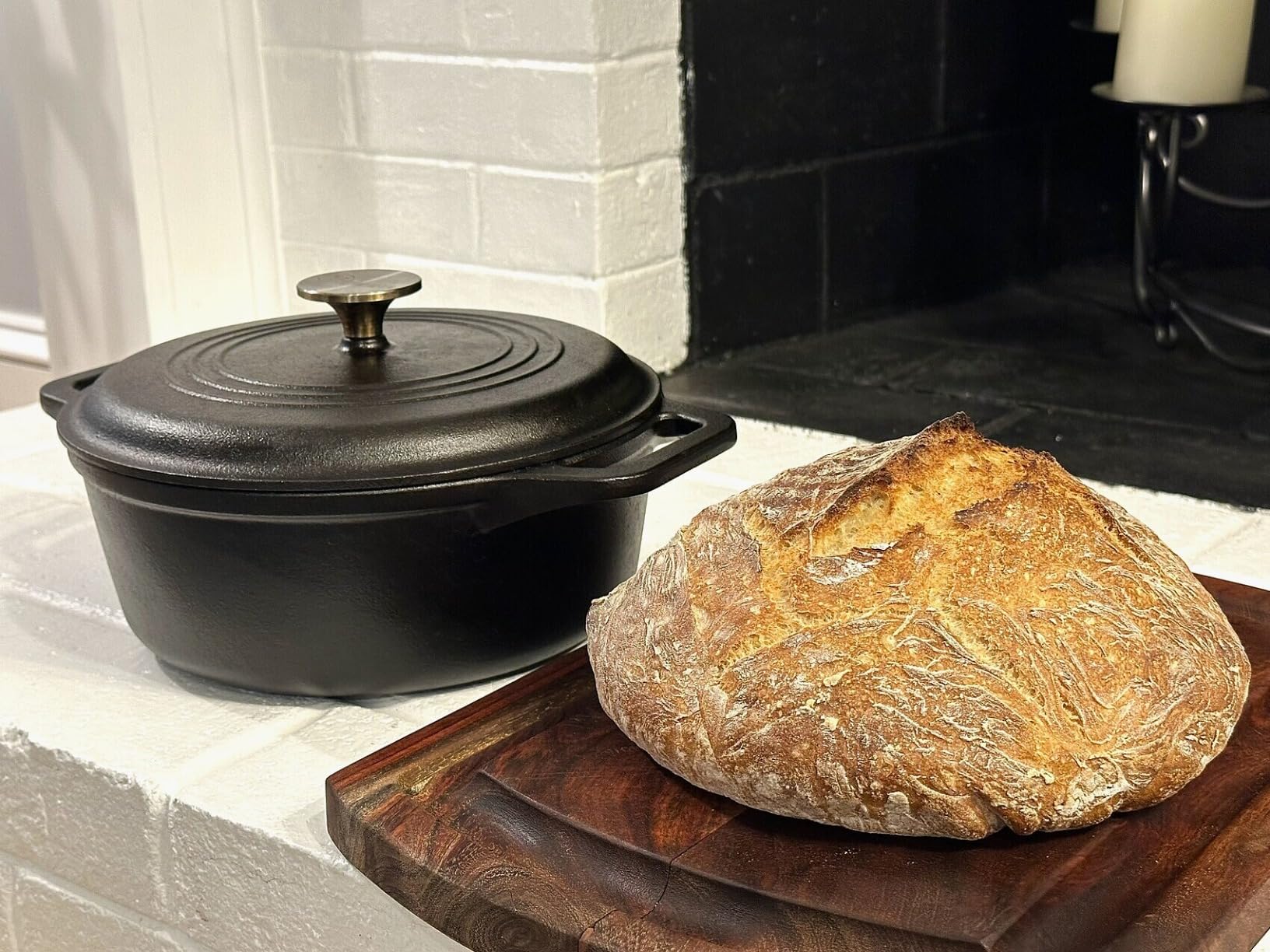
The combo design is the sleeper feature. The included skillet seats over the pot as a tight-fitting lid, so you have a two-piece Dutch oven and a separate cast iron skillet from one purchase. For a first cast iron buy, that flexibility is worth more than a second, smaller pot.
Now the honest part. This is the heaviest item in the roundup at 16 pounds, and its average rating of 4.5 is the lowest here. The complaints all cluster around the factory seasoning, which several buyers say rubs off in shipping or with the first wash, and around rust specks or a heavy patina on arrival. Budget for two or three re-seasoning cycles before the first bake.
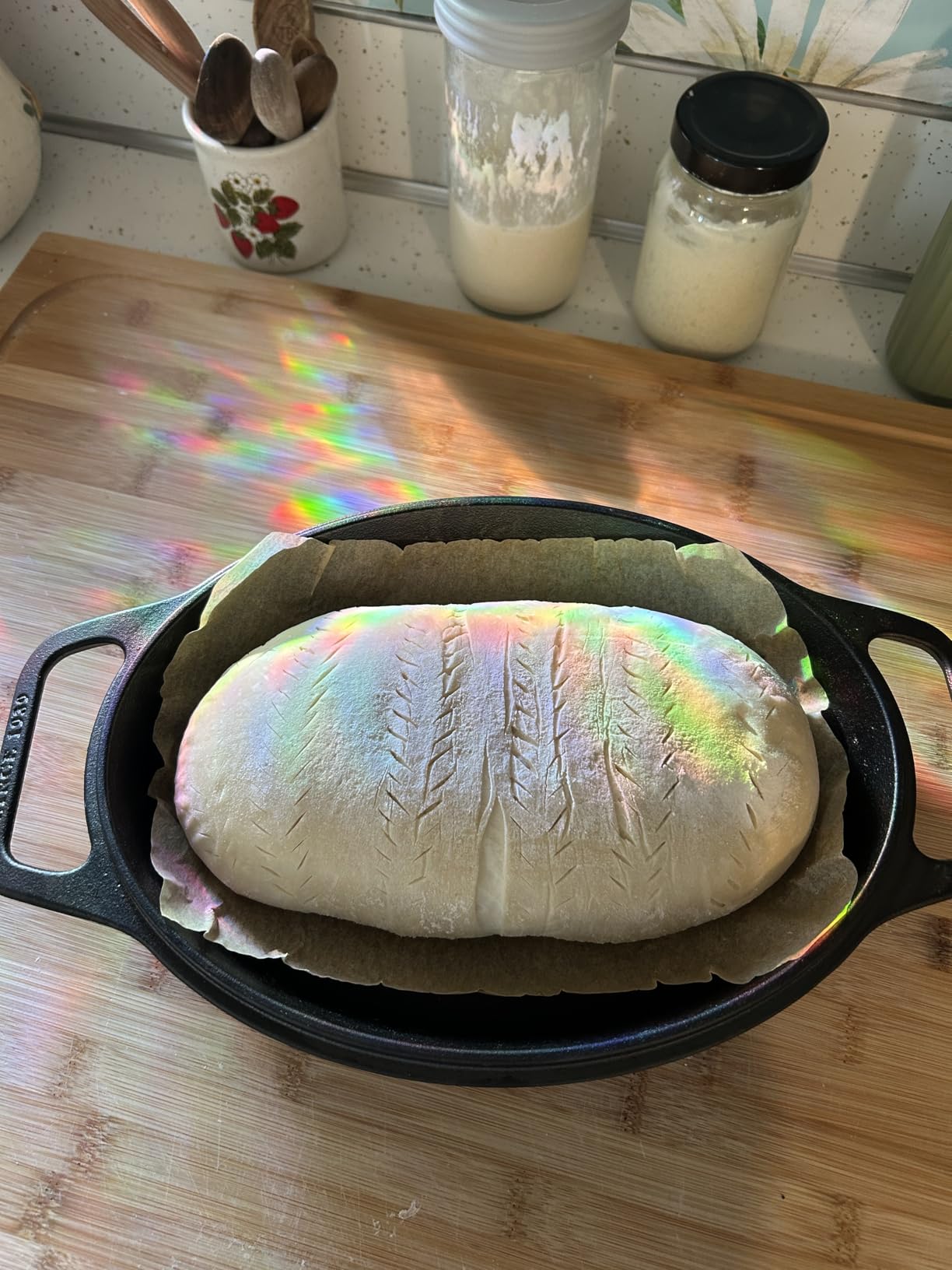
Is an oval Dutch oven worth it if you only bake boules?
No. If every loaf you make is round, a circular pot gives you a wider base, a lower centre of gravity, and roughly a pound less weight to lift. Save the money and get a round pot you can manage with one hand.
The oval shape earns its place the moment you start proofing dough in a banneton and shaping it long. The loaf keeps its tension, bakes in the shape you intended, and comes out with a far better-defined score line down the top.
How do I deal with the thin factory seasoning?
Give it a full re-season before the first loaf. Scrub the pot with hot soapy water, dry it on the stovetop until there is no steam, then apply the thinnest possible layer of a neutral oil inside and out. Bake it empty at 450F for an hour, let it cool, and repeat twice.
That is ninety minutes of work spread over an afternoon, and it buys you a pot that will outlast the oven it was bought for. Any rust specks that arrive on the pot come off during the first wash and are not a reason to send it back.
9. Le Creuset 7.25-Quart Round Dutch Oven – Premium Pick
Le Creuset Enameled Cast Iron Round Dutch Oven, 7.25 qt., Cerise
6.7 liter round
Enameled cast iron
Oven safe to 500F
6.13 kg
Pros
- Tightest lid seal in the group
- Enamel resists dulling staining chipping and cracking
- Dishwasher safe and limited lifetime warranty
- Light interior shows bake progress clearly
Cons
- Heaviest of the large round pots
- Interior can stain if overheated
- Needs a large sink to clean
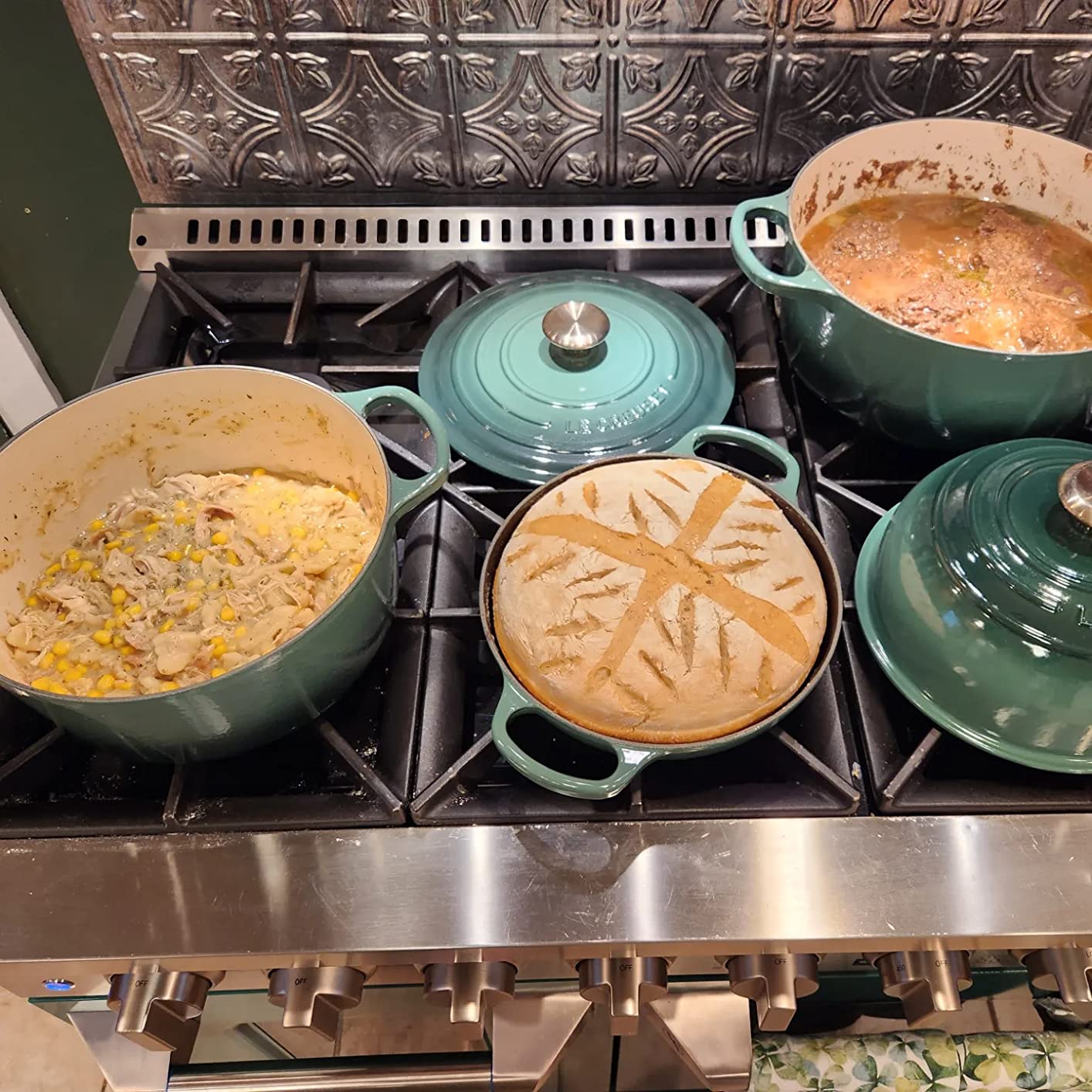
At 7.25 quarts this is the largest round pot on the list, and the capacity buys you something real: a 1 kg dough with proper headroom, or a smaller loaf with far more air around it, which means less condensation trapped against the crust. It is also the only pot here that comes with a limited lifetime warranty, so the purchase is effectively permanent.
Reviewers describe the lid fit as the tightest in the group, and that matters more than any other spec for bread. A tight seal holds the initial burst of steam in place during the critical first fifteen minutes, which is where the loaf sets its crust and finishes its oven spring. The light-coloured interior also lets you watch the colour of the base without opening the lid and losing the heat.
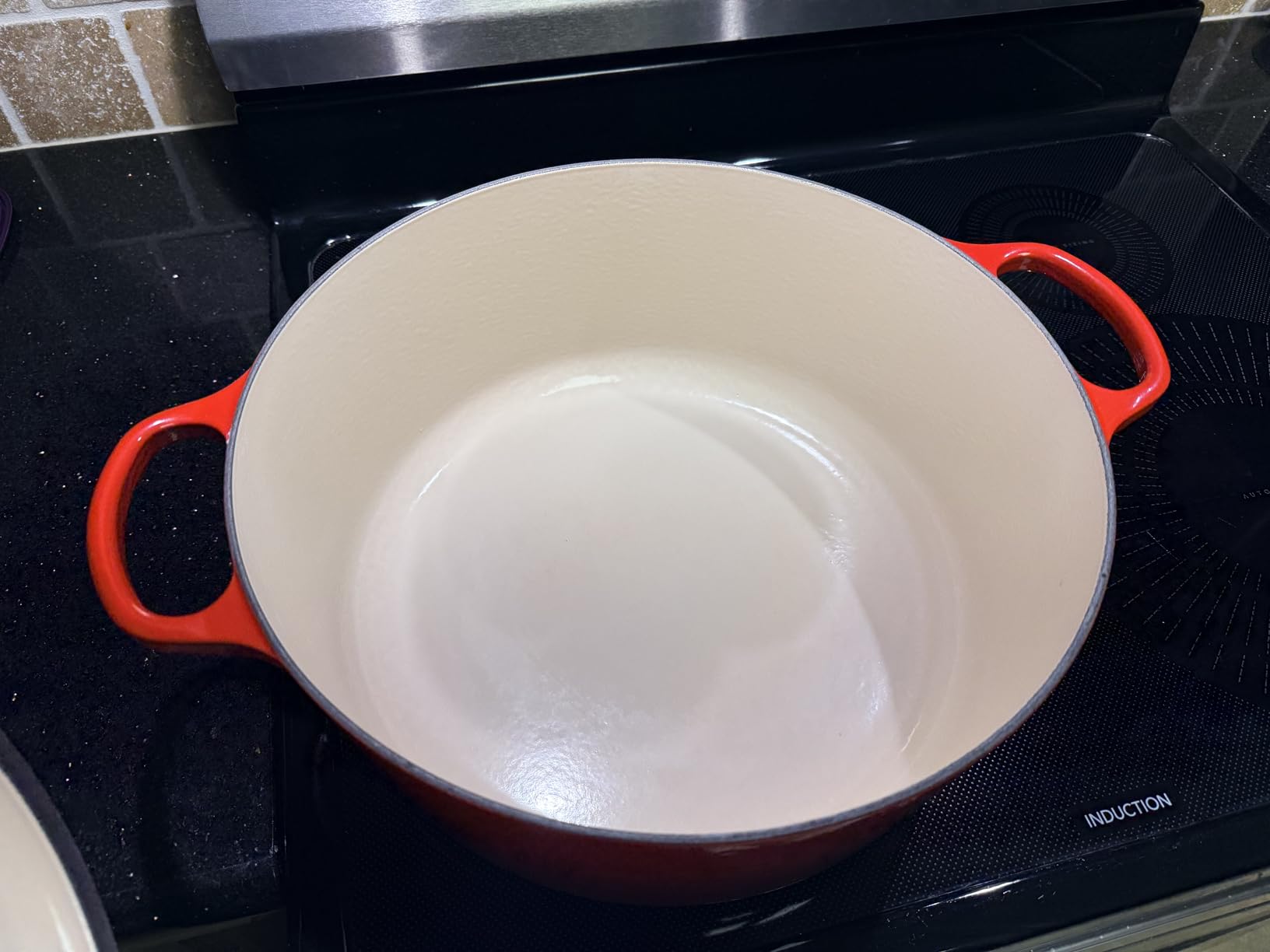
What you pay for at this level is enamel quality. Buyers report the coating resisting dulling, staining, chipping and cracking in ways cheaper enamels do not, and the piece is dishwasher safe, which none of the bare cast iron options here are. It is a pot you can hand down.
The recurring complaint is weight again, at 6.13 kg for the pot alone and more with the lid. Owners of the larger sizes note it is heavy to handle even when empty, and the sand-coloured interior will stain if it is overheated without care. This is also the most expensive option in the roundup by a wide margin, and for a bread-only buyer a 6-quart pot gives you nearly the same loaf.
Is the price premium justified for bread baking alone?
Honestly, no, not for bread alone. The crumb and crust differences between this and a well-made 6-quart enameled pot are marginal, and only the tightest lid fit is a genuine functional upgrade. If bread is the only thing you will cook in it, you are paying heirloom cookware prices for a pot you will use as bread equipment.
It is justified if you want one piece for everything. A tight-lid enameled pot that goes from bread to braise to soup and into the dishwasher is a different purchase from a bread pot, and this is the version of that purchase that lasts for decades.
Is 7.25 quarts too big for one loaf?
It is generous rather than too big, as long as you respect the lid clearance. Leave at least 3 cm between the top of the dough at peak spring and the underside of the lid, or the loaf steams in that gap and comes out with a damp, compressed crown.
If your bread habit is a single 800 g boule, 6 quarts is the more comfortable size and noticeably easier to lift. Save the larger pot for a family-sized bake or a double batch.
10. CAROTE 5-Quart Enameled Dutch Oven – Best Value
CAROTE 5QT Cream White Enameled Cast Iron Dutch Oven Pot with Lid
5 quart round
Self-basting dome lid
Oven safe to 500F
6 kg
Pros
- One-piece thick cast iron with no hot spots
- Self-basting dome lid circulates steam
- No pre-seasoning and smooth enamel release
- Cream finish unlike a typical red pot
Cons
- Very heavy when full
- One report of an enamel chip after a single use
- High heat can leave browning to scrub
At 5 quarts and under 10 inches across, this is the pot we suggest when someone wants to test whether they even like baking bread before committing to a heavy 12 pound piece. It is the smallest footprint of the enameled group, which means it fits comfortably in a compact oven and on a small hob, and the 6 kg weight is at the manageable end of what cast iron comes in.
Sourdough bakers using this pot report crisp crusts and strong heat retention, and the one-piece thick cast iron body gives even heat with no hot spots. The self-basting dome lid has raised inner nodes that circulate the steam, so it performs more like the expensive pots at this step than a pot at this price has any right to.
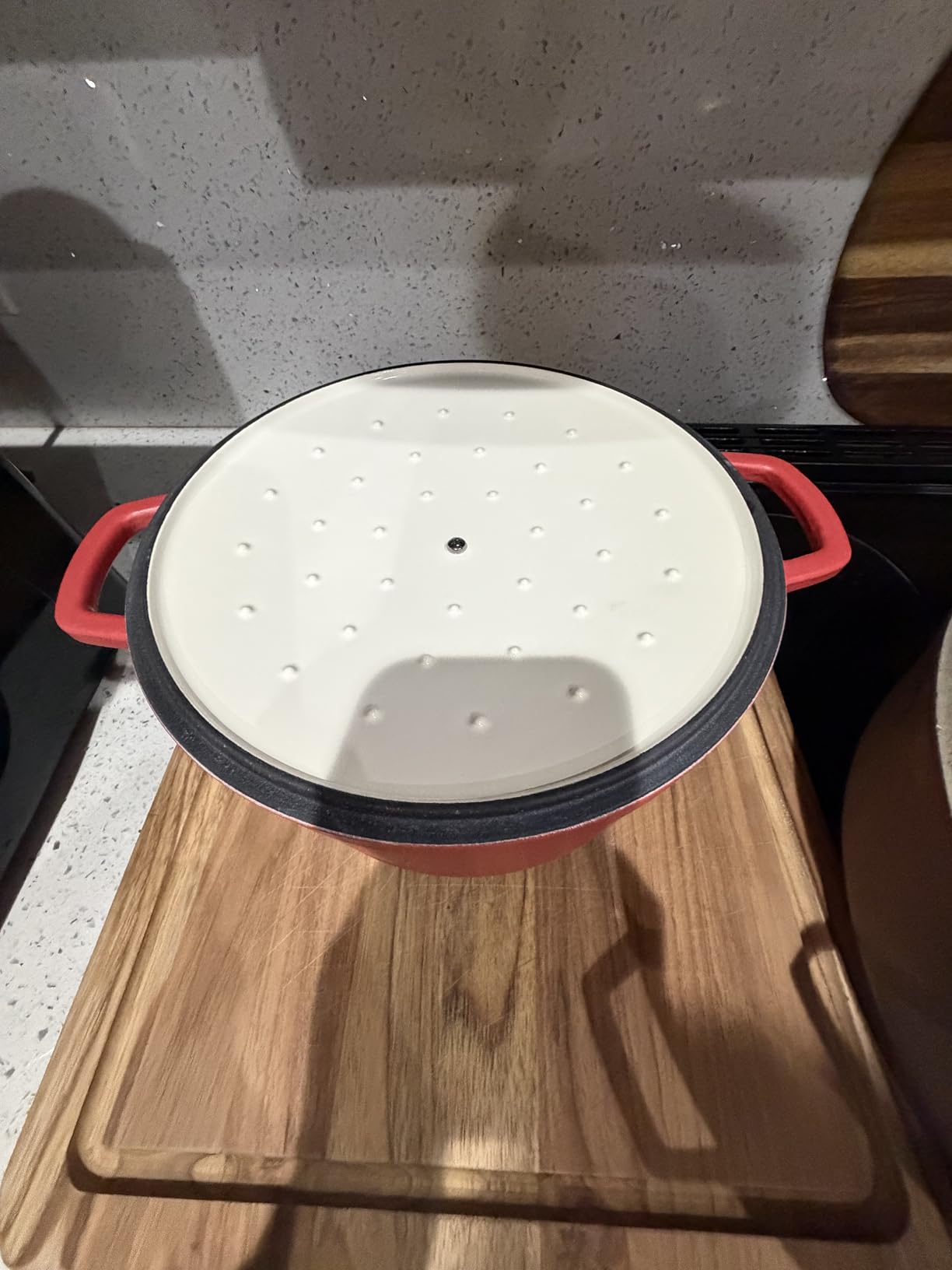
The smooth enamel releases dough better than most surfaces, which matters if your hydration runs high. A little oil or semolina on the base is still worthwhile insurance, but you are not fighting the pot the way you would with a fresh bare iron seasoning.
Durability is the question mark. One reviewer reported a small enamel chip after a single use, and high-temperature baking can leave browning on the interior that needs extra scrubbing. Neither complaint is widespread, but both are worth factoring in if you plan to bake every week at 450F for years.
Is this good enough to learn bread in?
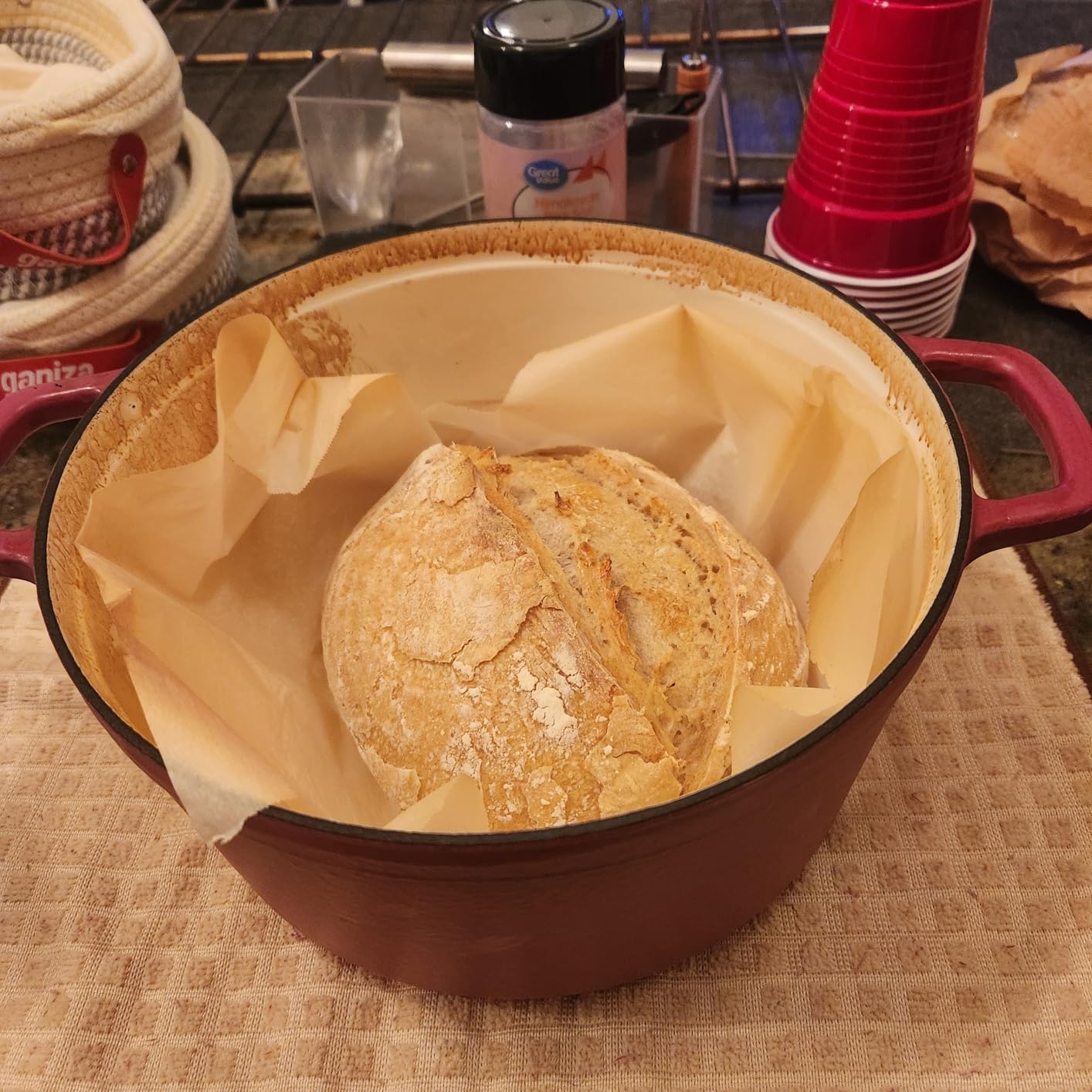
More than good enough. The mechanism that makes bread baking work is the heavy sealed pot, and this is a genuinely heavy sealed pot. Bakers report the same crisp crust and heat retention that the 6-quart models deliver, just in a smaller format.
Start here if your oven is small, if you are baking one loaf at a time, or if you want a low-commitment first cast iron purchase. Upgrade to a 6-quart pot later if you find yourself scaling your dough up.
How does the cream finish hold up?
It is visually distinctive and it hides nothing, which is the honest trade-off. A cream or sand interior shows every scorch mark, where a dark matte interior would not. Light colour does let you judge the bake without lifting the lid, which is a genuine advantage for a beginner.
Use a silicone or wood utensil, avoid the dishwasher, and wipe the interior with oil after each bake. Most chipping reports on coated pots come from metal tools and thermal shock, and both are easy to avoid.
What Size Dutch Oven Do You Need for Bread?
For one standard round loaf of 700 to 900 g, a 5.5 to 6.5 quart round pot is the range that works for almost everyone. The rule is simple: you need enough headroom for the dough to rise roughly a third of its own height during oven spring, plus about 3 cm of clear air beneath the lid. Anything smaller compresses the loaf, and anything much larger wastes heat and leaves you lifting a heavier pot than you need to.
Match the shape to what you bake. A round pot suits a boule. An oval pot suits a batard. A shallow cloche suits a tall, high-hydration loaf that you load by hand.
How capacity maps to dough weight
These are the working numbers we use, based on the loaf sizes each of the pots on this list was tested with.
Under 5 quarts suits a 500 to 600 g dough, roughly a small round loaf. Bakers who want a 1 kg dough in a pot this size end up with a compressed crown, because there is nowhere for the dough to go but up.
5 to 5.5 quarts is the sweet spot for one loaf at 700 to 800 g, and it is the size most home bakers buy. It is also the easiest weight to lift and the easiest footprint to fit in a standard oven.
5.5 to 6.5 quarts is right for 800 to 1000 g of dough, which covers most European-style sourdough recipes. The 6-quart and 6.4-quart pots on this list both sit here, and both handle a large loaf with proper clearance.
7 quarts and above is for family batches, a double bake in one pot, or a baker who works at very high hydration and wants air around the loaf. You pay for the extra capacity in weight on every single bake.
Round or oval, and does the dome matter?
Round if you bake boules and wide loaves. Oval if you shape batards and want the dough to keep its tension. A domed cloche lid if you bake tall, wet dough and load the pot with your hands rather than a peel, because the low base stops you burning your forearms on the walls.
Wall height is the number most listings bury. A 4.5 inch wall is easy to reach into. A 7.3 inch wall is not, and a 900 g dough at 80 percent hydration will rise into it.
Enameled vs Seasoned Cast Iron for Bread Baking
Enameled wins for almost every first-time buyer, and bare seasoned cast iron wins for a baker who bakes most days and wants the highest possible crust temperature. The difference is not the crust colour, it is the maintenance and the ceiling.
An enameled pot needs no seasoning, cannot rust, releases dough more readily, and is safe to 500F on every model on this list. It also cannot be pushed past 500F without risking the coating, and a light enamel interior shows scorching over time.
Bare seasoned cast iron has no coating to protect, so it tolerates far more aggressive heat and gives you a slightly more aggressive bottom crust. In exchange you must dry and lightly oil it after every use, re-season it when the surface looks dry, and expect some dough sticking until the seasoning is properly built up.
Our rule of thumb: if you bake two loaves a week or fewer, enamel. If you bake most days and chase a very dark, blistered crust, bare iron.
Dutch Oven vs Dedicated Bread Oven vs Combo Cooker
All three bake good bread, and the real difference is wall height and lid dome rather than the name on the box. A standard round Dutch oven is a general-purpose pot that happens to work for bread. A dedicated bread oven is a shallow cloche with a tall dome. A combo cooker is a Dutch oven with a second piece that doubles as the lid.
Choose a round Dutch oven if you want one pot for bread and everything else. Choose a dedicated bread oven if bread is the primary job and you shape tall, wet loaves. Choose a combo cooker if you are buying your first piece of cast iron and want the versatility of a second piece without buying a second pot.
Bakers who switched from a tall round Dutch oven to a shallow cloche report a visible increase in oven spring and no more singed arms during loading. Bakers who switched the other way, from a cloche to a round pot, report a wider loaf and an easier lift. Neither is better. They are different answers to different dough shapes.
Do You Preheat an Empty Dutch Oven? The Enamel Question, Settled
Yes, and it is what you should be doing. A preheated pot is the entire reason the technique produces a good loaf, because it gives the dough an instant hot surface to spring against and puts the pot at temperature before the loaf goes in.
The cracking fear is real but widely overstated. Enamel is glass fused to iron, and the genuine risk is thermal shock, which means a sudden temperature change. A pot that goes from room temperature to a 450F oven with a loaf in it is heating gradually because the loaf and the moisture inside absorb energy. What genuinely causes chips is dropping a hot pot into cold water, or heating a very cold enameled pot empty at full blast for an extended period with nothing to moderate it.
If you are nervous, do this: set the pot in the cold oven, leave the door open for two minutes, then close it and let the oven come up to temperature with the pot inside. That gives the enamel a gentler ramp and costs you nothing.
Bare seasoned cast iron has no such concern at all. There is no coating, so you can preheat it hard and empty with no enamel to crack.
Why Your Bread Sticks to the Pot and How to Stop It
Sticking is almost always one of three things, and you can diagnose it in a second by looking at where the dough stuck.
Stuck in a ring around the base means the dough spread and welded to the hot surface. Dust the base with semolina or rice flour, or give it a thin wipe of neutral oil before loading. High-hydration dough is the usual culprit here.
Tearing at the edges when you lift the loaf out means the dough bonded too strongly during the covered phase. Parchment paper laid flat in the pot, or a silicone bead sling, puts a barrier between the dough and the iron so the loaf releases by lifting rather than by levering.
Stuck only under the loaf, in one hard patch, is a hot spot. It means the pot is not level on the oven rack. Rotate the pot halfway through the covered phase, which evens out any uneven heating.
One more cause worth naming: baking the pot empty at full heat with no oil. That polymerizes the pan seasoning directly onto the base, and the next loaf welds itself to it. A wipe of oil before the pot goes into a very hot oven prevents it.
Bake Schedule and Temperature for Bread in a Dutch Oven
A Dutch oven loaf runs cooler and more gently than a loaf on a bare stone, so the schedule is its own thing. Follow these five steps and adjust for your pot rather than copying a stone-baked recipe.
Preheat fully. Set the oven to 450F and put the empty pot in for a full 30 to 45 minutes. If the pot is already at temperature when the dough goes in, the loaf gets an immediate hot surface and the crust sets before it can spread.
Score and load fast. Baking powder, a lame, or a razor works. Flour or oil the base, lower the loaf in, and get the lid on within 30 seconds of the pot leaving the oven.
Hold the lid on for 20 to 30 minutes with no peeking. Every time you lift it you drop the internal temperature and let moisture escape, which is how you get a pale, gummy crust. Set a timer and walk away.
Remove the lid and drop to 425F. Another 15 to 20 minutes without the lid lets the crust dry, set, and brown. A propped lid is fine if you like a softer top.
Cool on a rack for at least an hour before cutting. The crumb is still setting as steam escapes, and cutting early is the most common reason a good loaf tastes gummy.
For bare seasoned cast iron you can push the covered phase to 475F and the uncovered phase to 450F for a darker crust. For enamel, stay at or below the listed rating, which is 500F on every enameled pot in this roundup.
Frequently Asked Questions
Which Dutch oven size is best for baking bread?
For one standard loaf of 700 to 900 g, a 5.5 to 6.5 quart round pot is the right size. You need headroom for the dough to rise about a third of its height during oven spring, plus 3 cm of clear air under the lid. Under 5 quarts suits a smaller 500 to 600 g loaf, and 7 quarts or more is for family batches or very high hydration dough.
Do you need to preheat a Dutch oven when baking bread?
Yes, and you should leave it in the oven for a full 30 to 45 minutes at 450F before the dough goes in. A preheated pot gives the loaf an instant hot surface to spring against and is the main reason the technique works. To avoid any risk with enamel, set the cold pot in the cold oven, leave the door ajar for two minutes, then close it and let the oven come up with the pot inside.
Can you bake bread in an enameled Dutch oven?
Yes, and most of the pots in this roundup are enameled. Enameled cast iron is oven safe to 500F, needs no seasoning, cannot rust, and releases dough more readily than bare iron. The only real limits are that the coating caps how hot you can go and a light interior shows scorching over time. The smooth surface also means less dough sticking, which matters for wet sourdough.
Is enameled or seasoned cast iron better for bread baking?
Enameled is better for most home bakers because it needs no maintenance, will not rust, releases dough more easily and is safe to 500F. Bare seasoned cast iron is better for a baker who bakes most days and wants the highest possible crust temperature, because there is no coating to protect. The trade is daily drying and oiling, plus re-seasoning, in exchange for more aggressive bottom heat.
Is a bread oven or a Dutch oven better for bread?
A dedicated bread oven is better for tall, high-hydration loaves baked by hand, because the shallow base and tall dome lid give more vertical oven spring and let you load the dough without touching the walls. A round Dutch oven is better for boules, wide loaves, and anyone who wants one pot for bread and stovetop cooking. Both trap steam the same way, so the crust quality is comparable if you size the pot correctly.
Why does my bread stick to the Dutch oven?
Usually one of three things. A ring around the base means the dough spread and welded to the hot surface, so dust with semolina or wipe the base with oil. Tearing at the edges when lifting means strong bonding, so use parchment or a silicone bead sling. One hard patch under the loaf means the pot is not level, so rotate it halfway through the covered phase.
The Best Dutch Oven for Bread Baking in 2026
After working through all ten of these pots, the Lodge Essential Enamel 6-Quart is the one we keep recommending first, and it takes the top spot among the best Dutch ovens for bread baking. It has the capacity for a proper 900 g loaf, an enamel surface that releases dough cleanly and never rusts, a moisture-sealing lid, and a 4.7 rating across more than 39k reviews. It is not the lightest pot here, and nothing at this size is.
If you bake tall wet loaves by hand, the Flavehc cloche-style bread oven is the smarter shape because the low base and tall dome change how the dough rises. If you want one pot for bread and everything else in the kitchen, the Le Creuset 7.25-quart is the one you will keep for decades. Whichever pot you settle on, preheat it fully, keep the lid on for the first 20 to 30 minutes, and leave the loaf alone until it has cooled for an hour. The pot does most of the work, and your job is not to interfere with it.
Before you commit, it is worth a look at our picks for kids baking sets so the whole household can bake along, and at baking sets made without plastic if you are setting up a starter kitchen for a young baker.