
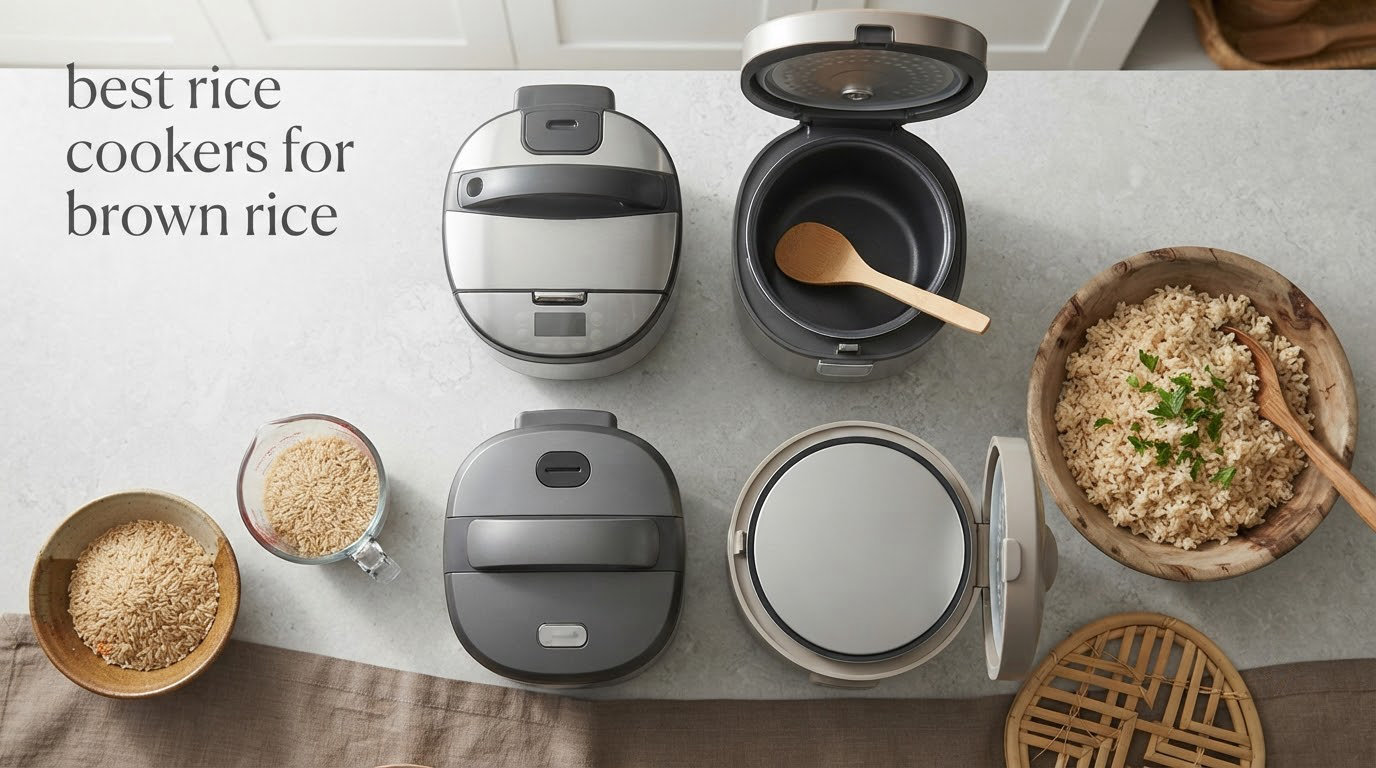
Yes, rice cookers handle brown rice well, but only if the machine senses what is happening in the pot. A basic one-button cooker runs a fixed timer and then switches to warm, which is why brown rice so often comes out crunchy in the middle or scorched on the bottom. Sensor-driven cookers measure moisture and temperature and adjust the cycle as the grain cooks, and that single difference separates the good picks from the disappointing ones.
The AROMA ARC-914SBD is the best rice cooker for brown rice overall. Its Sensor Logic Technology reads the internal temperature of the pot and re-times the cycle, and it pairs that with a dedicated brown rice preset, a 15-hour delay timer and a sensor-driven keep warm mode. If you want the texture control that induction heating provides, the Zojirushi NP-HCC10XH is the premium route, and it is the only machine in this roundup with separate cycles for brown rice, GABA brown rice and germinated brown rice.
Below is the roundup of all 10 picks, from a 3-cup unit for a single person to an 8-cup uncooked pot for a large household. I also included the water-to-rice ratio table, a troubleshooting block and a heating-technology comparison, because a brown rice problem is usually a ratio or measurement problem rather than a machine problem.
Table of Contents
Top 3 Rice Cookers for Brown Rice in October 2026

AROMA ARC-914SBD
- Sensor Logic auto-timing
- Dedicated brown rice preset
- 15-hour delay timer
- 4-cup uncooked


Instant Pot Zest 8 Cup
- Dedicated brown rice program
- Ceramic-coated pot
- 4-cup uncooked
- Light 2 kg body
The 10 Best Rice Cookers for Brown Rice at a Glance for October 2026
| Product | Specs | Action |
|---|---|---|
| AROMA ARC-914SBD |
|
Check Latest Price |
| Instant Pot Zest 8 Cup |
|
Check Latest Price |
 BLACK+DECKER RC516 BLACK+DECKER RC516 |
|
Check Latest Price |
| Cosori CRC-R501 |
|
Check Latest Price |
 CUCKOO CR-0675FG CUCKOO CR-0675FG |
|
Check Latest Price |
 COMFEE’ CRS2010BS COMFEE’ CRS2010BS |
|
Check Latest Price |
 Zojirushi NP-HCC10XH Zojirushi NP-HCC10XH |
|
Check Latest Price |
 Toshiba TRCS02 Mini Toshiba TRCS02 Mini |
|
Check Latest Price |
 CUCKOO CR-0632F CUCKOO CR-0632F |
|
Check Latest Price |
 AROMA ARC-363NG AROMA ARC-363NG |
|
Check Latest Price |
1. AROMA ARC-914SBD – the best rice cooker for brown rice overall
AROMA Digital Rice Cooker, 4-Cup (Uncooked) / 8-Cup (Cooked), Steamer, Grain Cooker, Multicooker, 2 Qt, Stainless Steel Exterior, ARC-914SBD
Sensor Logic timing
4-cup uncooked / 8-cup cooked
Dedicated brown rice preset
Pros
- Sensor Logic adjusts internal temperature for consistent texture
- Dedicated brown rice program alongside white
- steam and flash rice
- Steam tray cooks meat and vegetables while rice cooks below
- Automatic keep warm mode holds rice for hours
- Nonstick inner pot wipes clean
Cons
- Water fill lines inside the pot are hard to see
- Included measuring cup is three quarters of a true cup
- Lid assembly needs disassembly to clean
- Short power cord limits placement
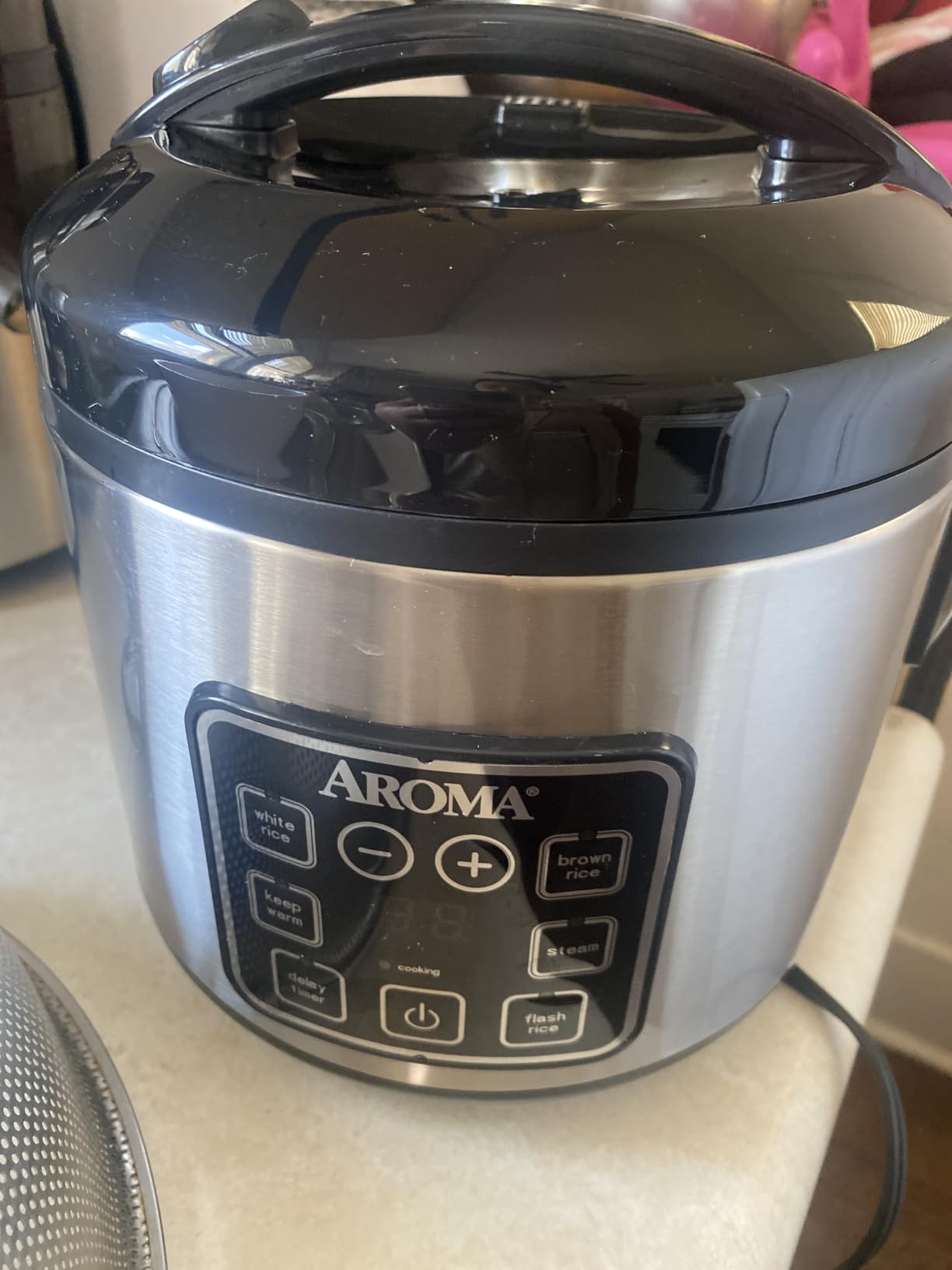
The ARC-914SBD is the machine I keep reaching for when I want brown rice without a learning curve. Sensor Logic Technology samples the internal temperature of the pot and adjusts the cycle rather than trusting a fixed timer, and with more than 65k reviews behind it, the pattern owners describe is repeatable batches rather than occasional luck.
Brown rice has its own preset next to white rice, steam and flash rice. That matters because repurposing a white-rice cycle is where most budget machines fail, since the brown preset here runs longer and holds the pot at a lower temperature through the absorption stage.
It also has the widest scheduling in its class with a 15-hour delay timer, and a steam tray that lets you cook protein and vegetables over the rice in the same cycle. For a weeknight cook who wants one pot and one button, that combination is genuinely useful.
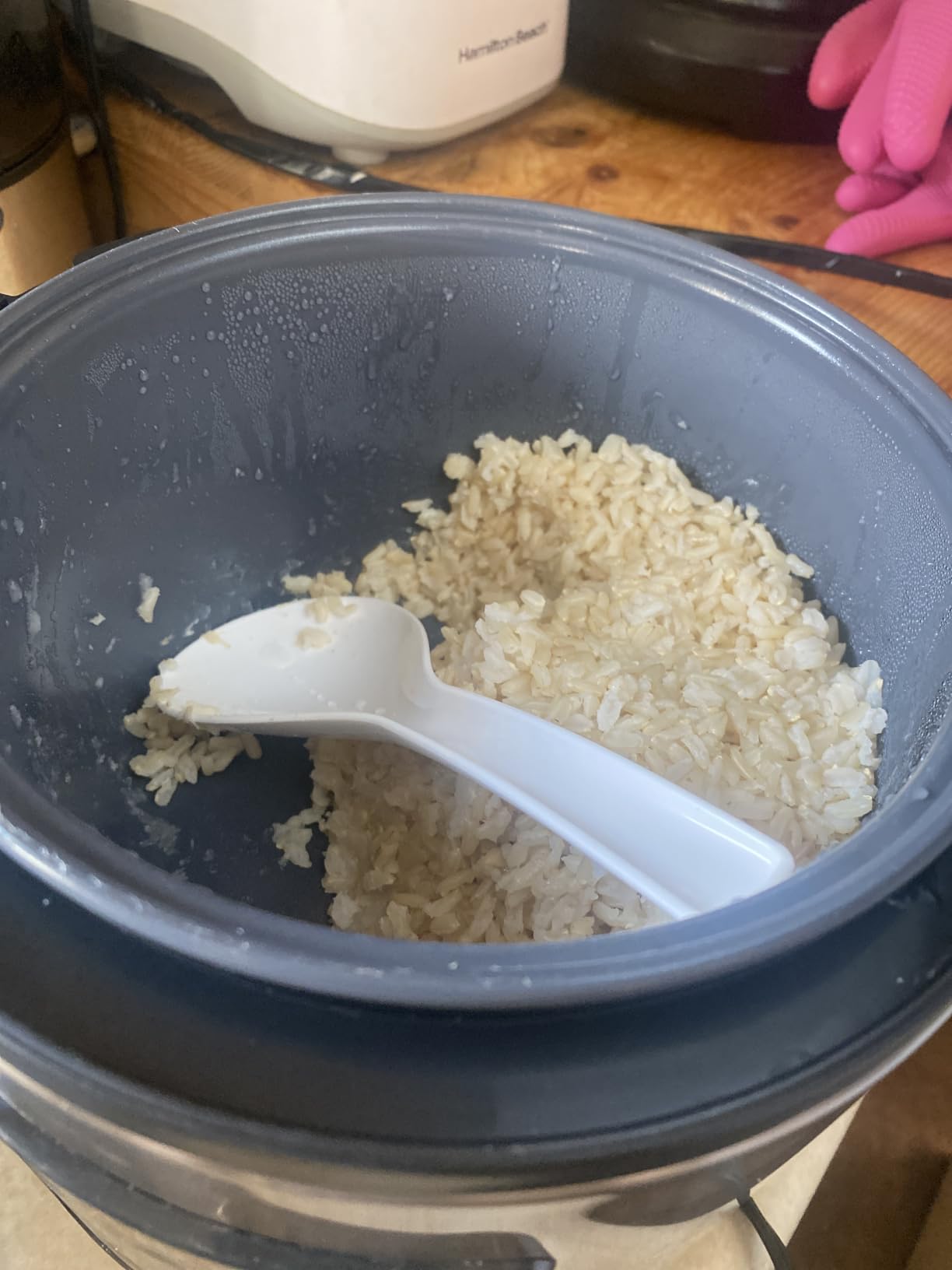
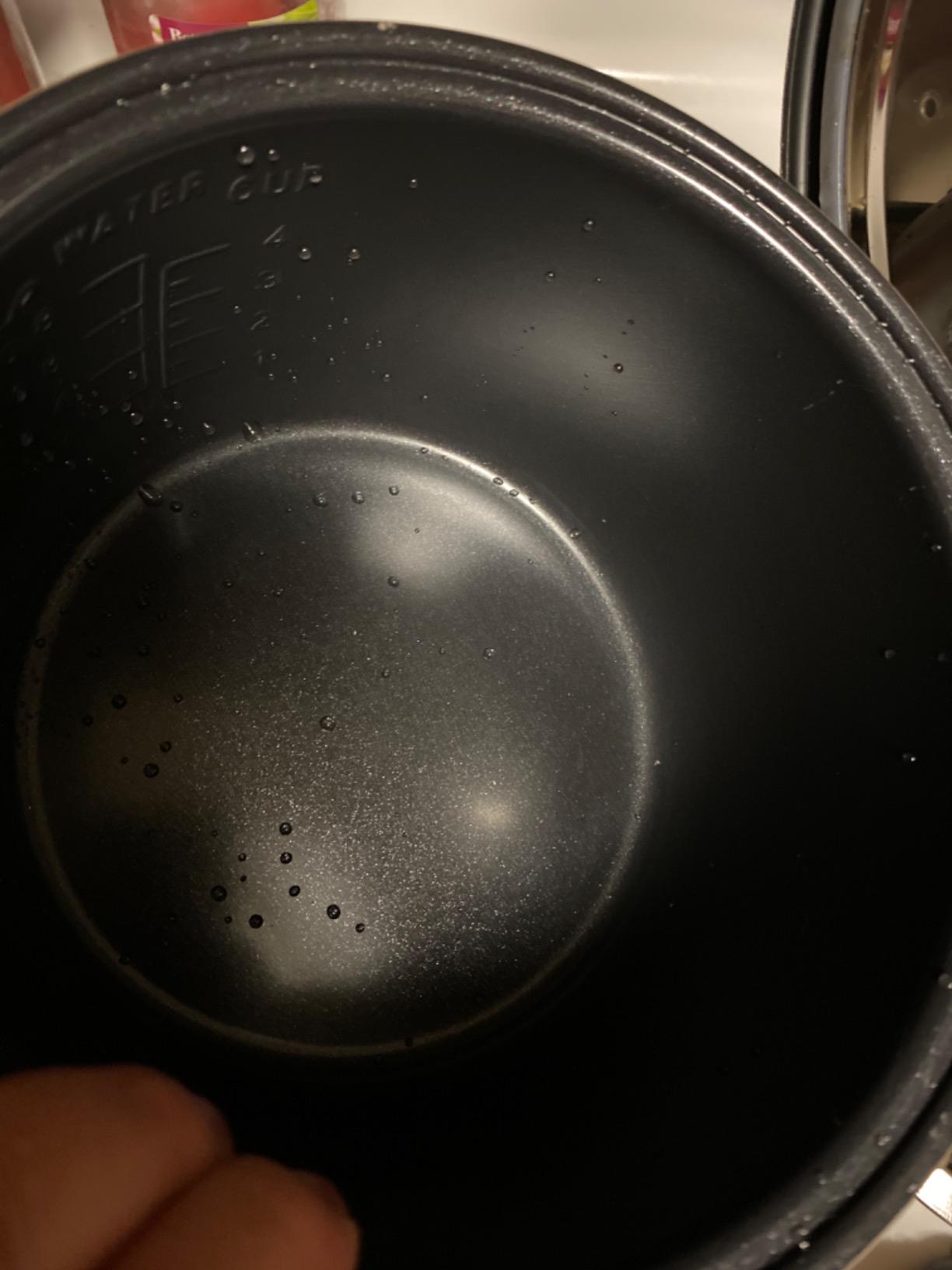
Two practical notes before you commit. The water fill lines moulded inside the pot are faint, especially in dim light, so pour against the printed instructions rather than eyeballing the markings. And the supplied measuring cup is three quarters of a true cup, which throws off ratios if you substitute your own.
The brown rice preset also runs a tight water ratio, and several owners report adding extra water by feel after the first batch. Treat the first cook as a calibration run rather than a verdict on the machine.
At 350 watts this is not a fast cooker. Long-grain brown rice will take substantially longer here than in a 1000-watt fuzzy logic unit, and there is no countdown from the start of the cycle, so plan the timing rather than expecting a display to tell you.
Who the AROMA ARC-914SBD suits
It suits households of one to four that eat brown rice most days and want set-and-forget reliability more than speed. The 4-cup uncooked capacity yields about 8 cups cooked, which covers a typical family’s daily pot with a little room for a second small batch.
It is also a good first rice cooker. The controls are labelled in plain language, the pot is nonstick and easy to wash, and the steam tray adds a second use case for the same appliance rather than a second appliance.
Who should skip the AROMA ARC-914SBD
Skip it if brown rice texture is the whole point of your purchase. There is no induction element and no pressure function here, so the ceiling on grain-by-grain separation is lower than it is on a Zojirushi induction unit.
Skip it if you cook for six or more people at once. At 4 cups uncooked, a large gathering means running two cycles back to back, and the pot is also the part most likely to need replacing eventually.
2. Instant Pot Zest 8 Cup – the best value rice cooker for brown rice
Instant Pot Zest 8 Cup One Touch Rice Cooker, From the Makers of Instant Pot, Steamer, Cooks Rice, Grains, Quinoa and Oatmeal, 8-cup cooked/4-cup uncooked, No Pressure Cooking Functionality
4-cup uncooked / 8-cup cooked
Ceramic-coated nonstick pot
Four one-touch programs
Pros
- Dedicated brown rice setting among four programs
- Consistently tender rice on the first attempt
- Ceramic-coated pot wipes clean in seconds
- Lid condensation drains into a small basin
- Light 2 kg body suits small kitchens
- Doubles as a warmer for hours
Cons
- No countdown timer from the start of the cycle
- Steamer tray is plastic rather than metal
- Measuring cup is not a true 8-ounce cup
- 4-cup uncooked capacity is small for families
There is no pressure cooking function in the Zest, despite the Instant Pot badge, and that is exactly why it works so predictably for brown rice. It is a rice cooker and nothing else, so there is no wrong setting to pick and no release protocol to learn.
Owners consistently describe the results as foolproof, and the brown rice program is the most-used of the four one-touch programs alongside rice, oatmeal and grains. Mixing in quinoa or buckwheat is a common extension of the same program.
Cleanup is the quiet strength here. The ceramic-coated pot wipes clean in seconds, and condensation from the lid drains into a small basin rather than dripping back into the rice, which is a small design decision that prevents a soggy crust on every batch.
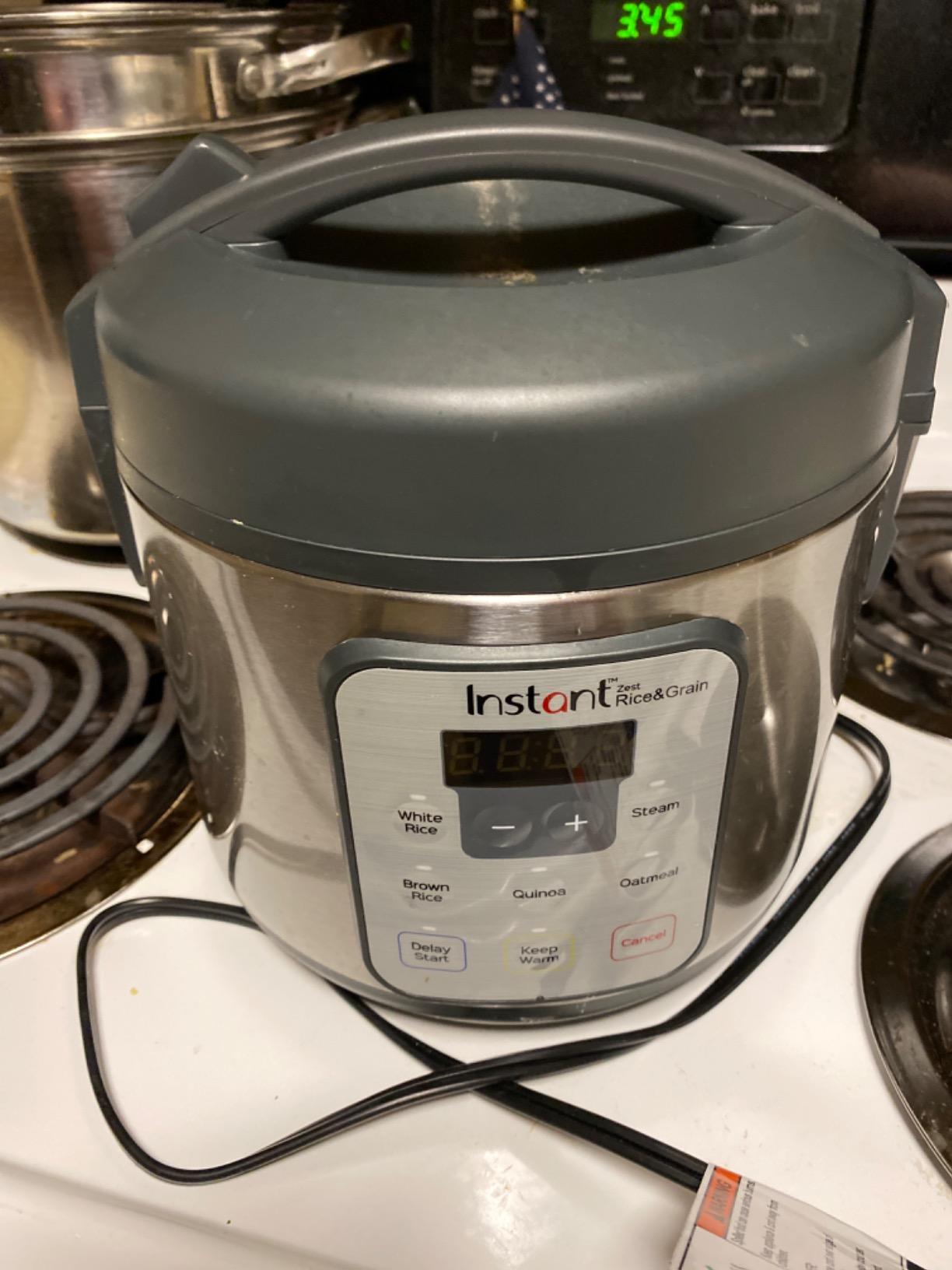
The recurring complaint is the display. There is no countdown at the start of the cycle, so the timer only appears near the end, and owners generally recommend timing a batch manually and planning backwards from when you want to eat.
Two smaller gripes: the included steamer tray is plastic rather than metal, and the measuring cup is not a true 8-ounce cup, so ratios only work if you use the one supplied. Both are fixable, neither is dangerous.
At 2 kg and 8 cups cooked, the footprint suits a small kitchen or a dorm where counter space is the constraint. This is the pick to buy if your previous rice cooker was a larger unit you stopped using because it was awkward to store.
Who the Instant Pot Zest suits
It suits first-time buyers and anyone who wants brown rice that works without adjusting ratios. The instruction set is short, the programs are labelled clearly, and the pot surface is forgiving.
It also suits people who cook for one or two. A 4-cup uncooked batch is generous for two people eating brown rice several times a week, and the unit doubles as a warmer for buffets without needing a second appliance on the counter.
Who should skip the Instant Pot Zest
Skip it if you batch cook. Four cups uncooked is not enough for meal prep across a week, and running the cycle repeatedly for small amounts wastes the delay timer this unit is otherwise good at.
Skip it if you need quick results. Without pressure cooking, brown rice here runs on the longer standard schedule, and nothing in the program list shortens it.
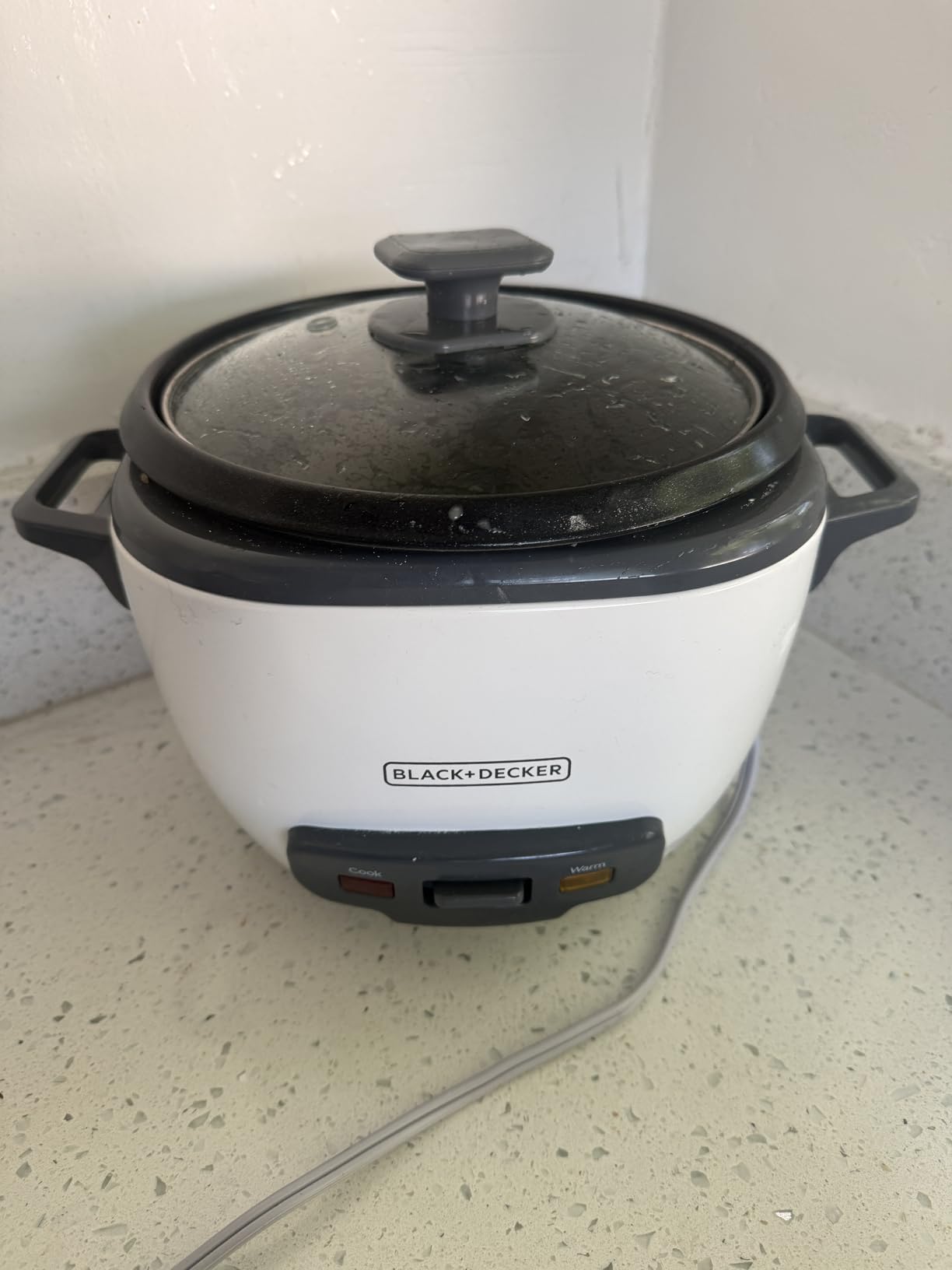
3. BLACK+DECKER RC516 – the best rice cooker for large brown rice batches
BLACK+DECKER 16-Cup Rice Cooker, RC516, 8-Cup Uncooked Rice, Steaming Basket, Removable Non-Stick Bowl, One Touch
8-cup uncooked / 16-cup cooked
Removable nonstick bowl
Steaming basket
Pros
- Largest uncooked capacity in the roundup
- Removable dishwasher-safe nonstick bowl
- Steaming basket for vegetables
- fish or dumplings
- Simple one-touch operation with automatic keep warm
- Tempered glass lid with a hanger
Cons
- Instructions are confusing enough that some owners found a video
- Cook times run long with reports near an hour
- Water can overflow onto the counter
- Build quality is lighter and thinner than older models
At 8 cups uncooked and 16 cooked, the RC516 is the only machine here that can handle a full week of meal prep or a large family in a single cycle. If you are the person cooking for five or six people, capacity is the first filter and this one wins it.
Operation is genuinely simple. Cooking stops when the moisture is absorbed, the ready indicator lights, and the unit switches to warming on its own. The removable bowl is dishwasher safe, which matters more than it sounds when you are cooking daily.
The tempered glass lid has a hanger built into the handle, so it stays out of the way of the counter during serving instead of taking up space beside the pot.
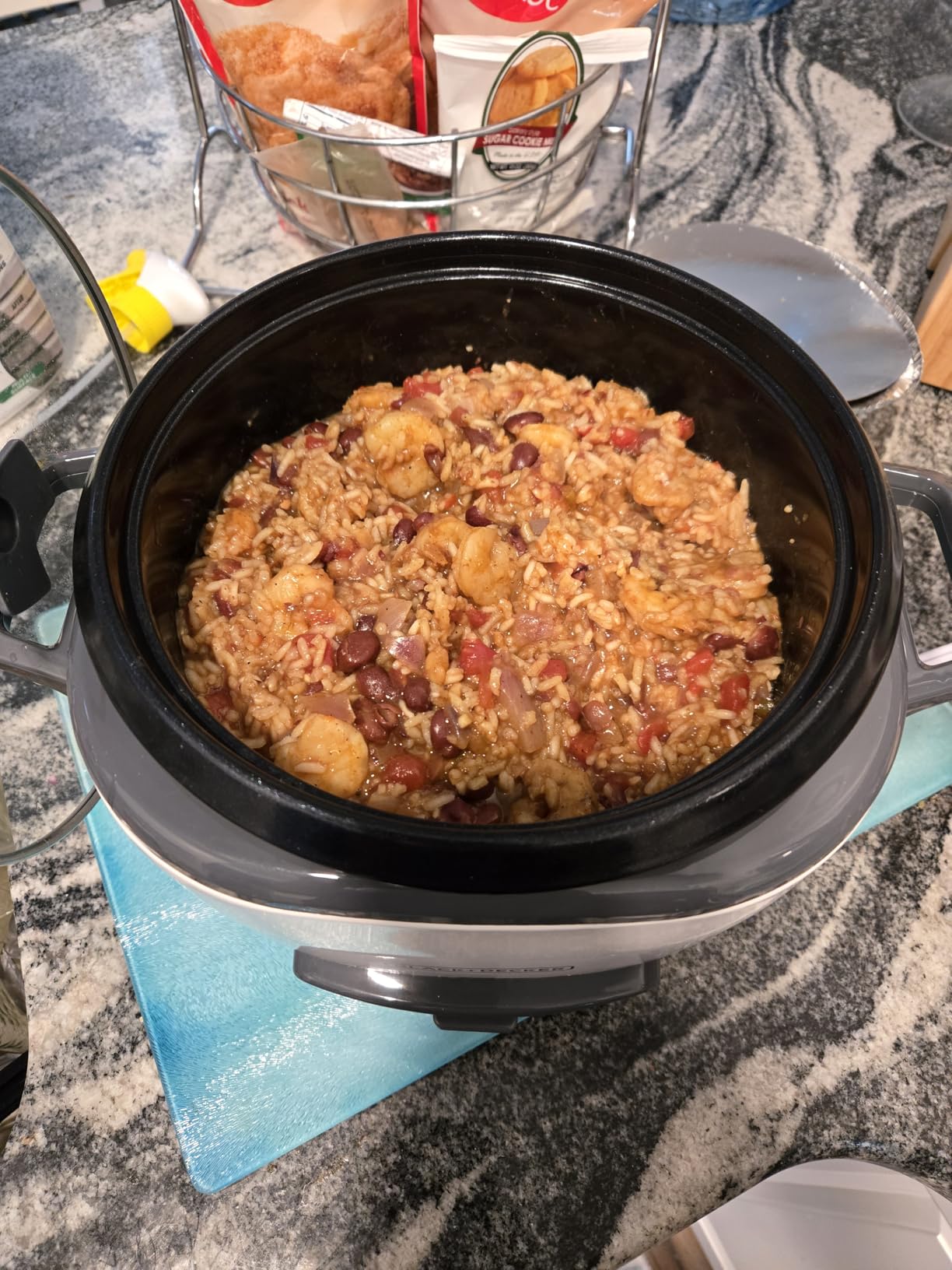
Sentiment on this one is sharply split, and the 4.2 average reflects that. Owners who came from older 1990s models note that the bowl and body are noticeably lighter and thinner built, and that the confusion in the instructions sent some of them looking for a walkthrough video before starting.
There are also reports of water overflowing onto the counter during a full 8-cup load. If you fill to the maximum line, leave headroom and keep an eye on it the first few times.
Cook times run long, with some owners reporting close to an hour for a full batch. For brown rice on a schedule before work, that is the difference between planning ahead and not cooking it at all.
Who the BLACK+DECKER RC516 suits
It suits large households, meal preppers and anyone cooking once or twice a week in volume. One 8-cup uncooked cycle covers a family of six or fills a week of lunch containers for two.
It also suits buyers who want zero menu learning. There is one button and one outcome, and the dishwasher-safe bowl means the cleanup after a 16-cup batch is not a chore.
Who should skip the BLACK+DECKER RC516
Skip it if texture matters more than volume. The 4.2 average reflects a real split in results, and a fixed-cycle machine is more exposed to ratio mistakes than a sensor-driven one.
Skip it for a small household. An 8-cup uncooked pot in a one or two-person kitchen is a large object to own for a small need, and the long cook times are harder to justify for small batches.
4. Cosori CRC-R501 – the highest rated fuzzy logic rice cooker for brown rice
Cosori Rice Cooker 10 Cup, Fuzzy Logic, Ceramic Coating Inner Pot,18-in-1
Advanced fuzzy logic
10-cup / 5-quart capacity
1000 watts
18-in-1 menu
Pros
- Fuzzy logic adjusts a 7-step cooking process
- 18-in-1 menu covers white and brown rice types
- 24-hour keep warm plus 24-hour delay timer
- 1000W quick rice function
- Ceramic pot and steel basket both dishwasher safe
- Airtight lid design
Cons
- Bulky 4.2 kg body with a wide footprint
- Brown rice is one option inside a large menu rather than a headline feature
- 5-quart capacity is oversized for one or two people
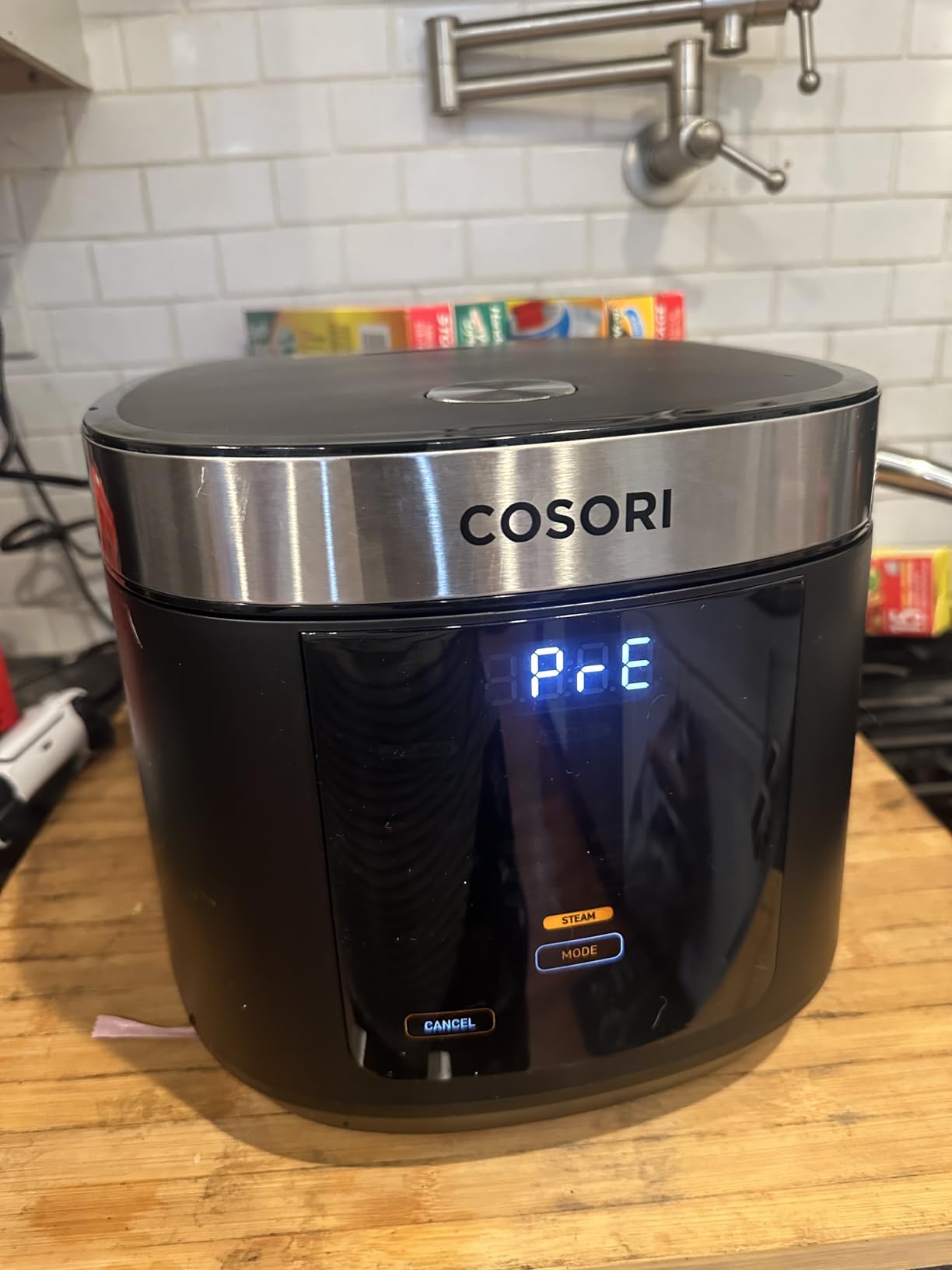
The Cosori has the highest rating in this roundup at 4.8, with 91 percent of reviews at five stars, and the reason is consistency rather than any single feature. Advanced fuzzy logic drives a seven-step cooking process that adjusts across the cycle, and the dominant theme in the reviews is batch after batch of evenly cooked rice with no manual correction.
The 18-in-1 menu is the widest in the list. It covers white and brown rice types, texture options, three grains, three oat settings, steamed vegetables, slow-cooked soups and sauteed flavoured rice, all from one panel.
Scheduling is strong too, with 24-hour keep warm and a 24-hour delay timer, and the 1000-watt quick rice function cooks white rice faster without owners reporting a texture penalty. A two-year warranty backs it.
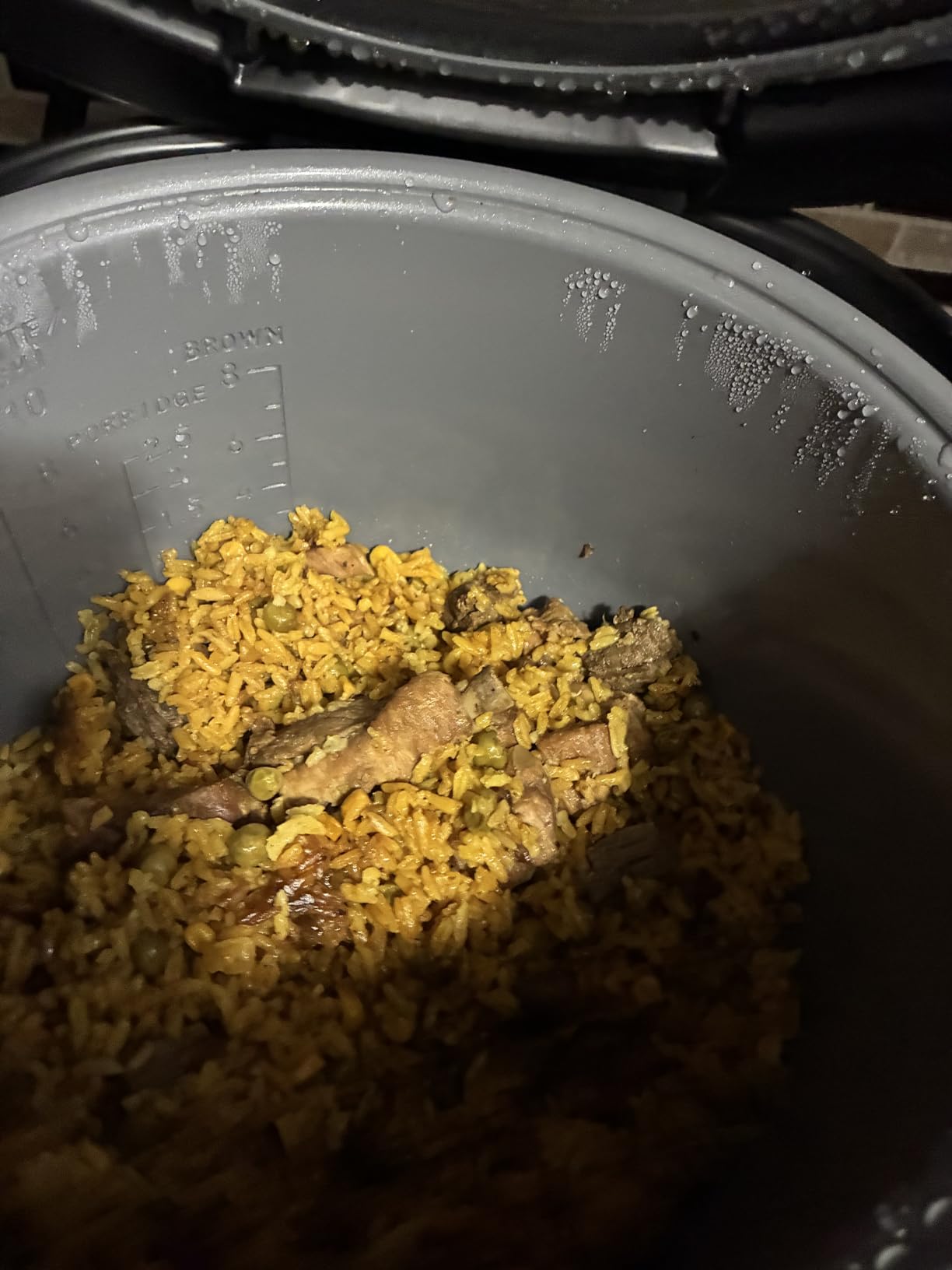
The practical trade is size. At 4.2 kg with a 12.3 inch depth, this is the bulkiest machine here, and a 5-quart pot is generous for one or two people cooking daily.
Brown rice is available and well reviewed, but it sits inside a broad menu rather than being the headline cycle it is on the Zojirushi. If GABA brown rice is a specific goal, this is not the unit built for it.
Buyers also praise that the ceramic-coated pot and stainless steel basket are both dishwasher safe, which removes the usual hand-wash step at the end of a long cycle.
Who the Cosori CRC-R501 suits
It suits households of three to five that want one appliance to cover rice, grains, oats, steaming and soup. The breadth of the menu is what owners actually use it for, not just the rice functions.
It suits anyone who has fought with ratios before. Fuzzy logic reads the process and adjusts, so a slightly off water measurement is far less likely to produce a crunchy batch than on a fixed-cycle machine.
Who should skip the Cosori CRC-R501
Skip it for a one or two-person kitchen where counter space is tight. The footprint is the largest in the roundup and the capacity is more than the household needs.
Skip it if you cook brown rice every single day and want a dedicated cycle for it. There is no GABA or germinated mode, and the texture options are built around white rice profiles.
5. CUCKOO CR-0675FG – the best rice cooker for multicooking brown rice
CUCKOO Micom Fuzzy Logic Rice Cooker, 12-Cup Cooked, Gray, CR-0675FG
Fuzzy logic timing
6-cup uncooked / 12-cup cooked
10 cooking modes
Pros
- Fuzzy logic adjusts cooking time and temperature
- Keep warm holds without burning the bottom
- Handles white rice
- brown rice
- oats
- baby food and grains
- Multicook modes cover daal and stew
- Self-clean setting and detachable inner lid
- Replacement inner pots sold separately
Cons
- Bulky body that overhangs under a cabinet
- Very spring-loaded lid that shoots up fast
- Cook times run around 37 minutes for 3 cups on the quick setting
- Many top-panel buttons at first
The CUCKOO CR-0675FG is the pick for anyone who wants the rice function to be one part of a larger cooking appliance. Ten modes cover glutinous white rice, brown rice, oats, baby food, grains and multicook dishes, and owners put the daal and stew modes to regular use.
On rice specifically, fuzzy logic adjusts cooking time and temperature so the grain does not catch on the base. r/Cooking users describe CUCKOO micom models as sitting between the premium Japanese units and basic one-button cookers, which is a fair description of where this sits on capability.
The keep warm function is called out repeatedly as genuinely keeping rice warm without burning the bottom, and the fuzzy logic tolerates small variations in water amount better than a fixed-cycle machine does.
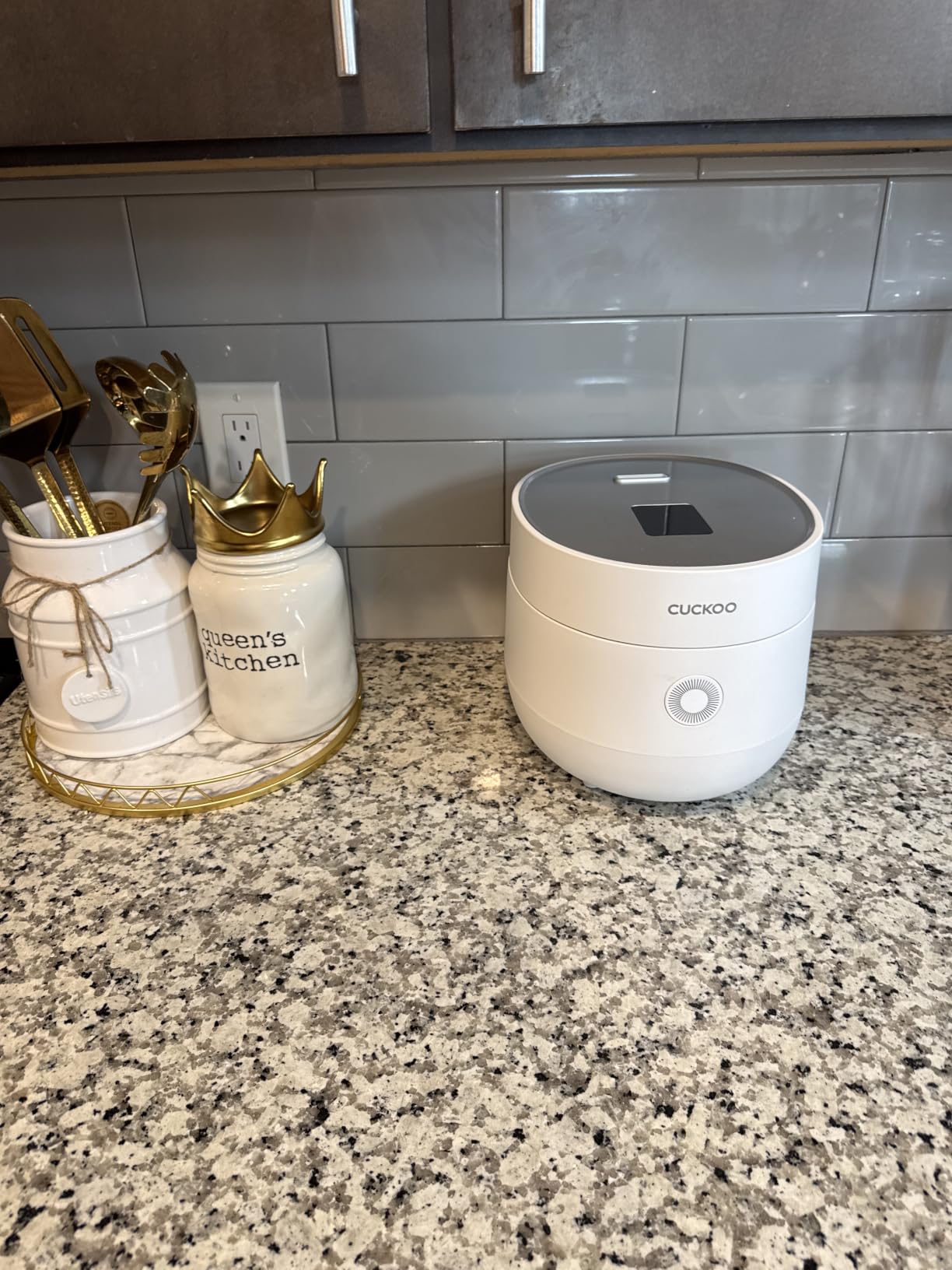
The physical size is the main drawback. At 12.7 inches deep the body is large relative to the amount of rice most households cook, and owners mention it overhanging under a cabinet.
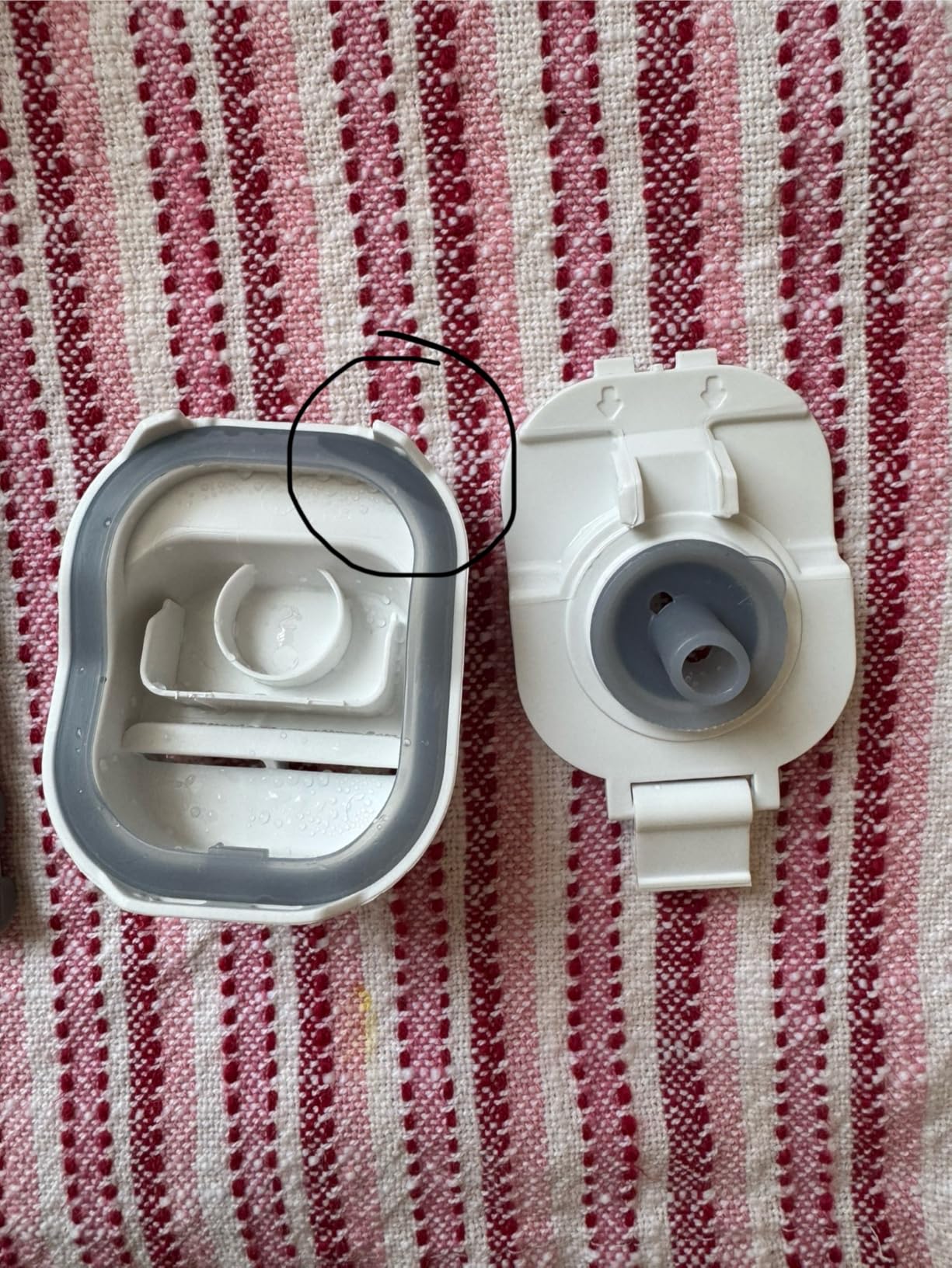
The lid is aggressively spring-loaded and shoots up fast, which is enough to ding an overhead cabinet if you open it in a hurry. It is a real consideration in a small kitchen with a low cabinet above the counter.
Quick cook still runs around 37 minutes for 3 cups of dry rice, so the faster setting saves time without being fast. Condensation also needs drying out after each use to avoid stagnant water inside the body.
Who the CUCKOO CR-0675FG suits
It suits cooks who want lentils, stews and grains alongside rice. Ten modes and a self-clean setting make it the most versatile machine in this roundup for the money.
It also suits anyone who has had a bad experience with a fuzzy logic machine and gone back to a simple one. The inner pot hand-washes clean quickly, the inner lid detaches, and replacement pots are sold separately, which extends the life of the unit.
Who should skip the CUCKOO CR-0675FG
Skip it if you cook for one or two people. The body is large for a 4-cup uncooked batch, and the many top-panel buttons take getting used to before they stop feeling overwhelming.
Skip it if you want the shortest possible brown rice cycle. Nothing in this machine compresses the long absorption stage, so plan around a longer cook.
6. COMFEE’ CRS2010BS – the best budget rice cooker for brown rice in small kitchens
COMFEE’ Rice Cooker with 6 Functions, 4-Cups Uncooked Rice
Six one-touch programs
4-cup uncooked / 8-cup cooked
450 watts
BPA-free materials
Pros
- Dedicated brown rice program among six presets
- Stainless steel exterior wipes clean
- Inner pot and accessories are dishwasher safe
- 12-hour keep warm plus 12-hour delay timer
- Compact footprint for small kitchens
- Overheat protection and BPA-free materials
Cons
- Four-cup uncooked capacity is small for families
- No sensor-driven timing
- so ratios need attention
- 450 watts is modest for a large brown rice batch
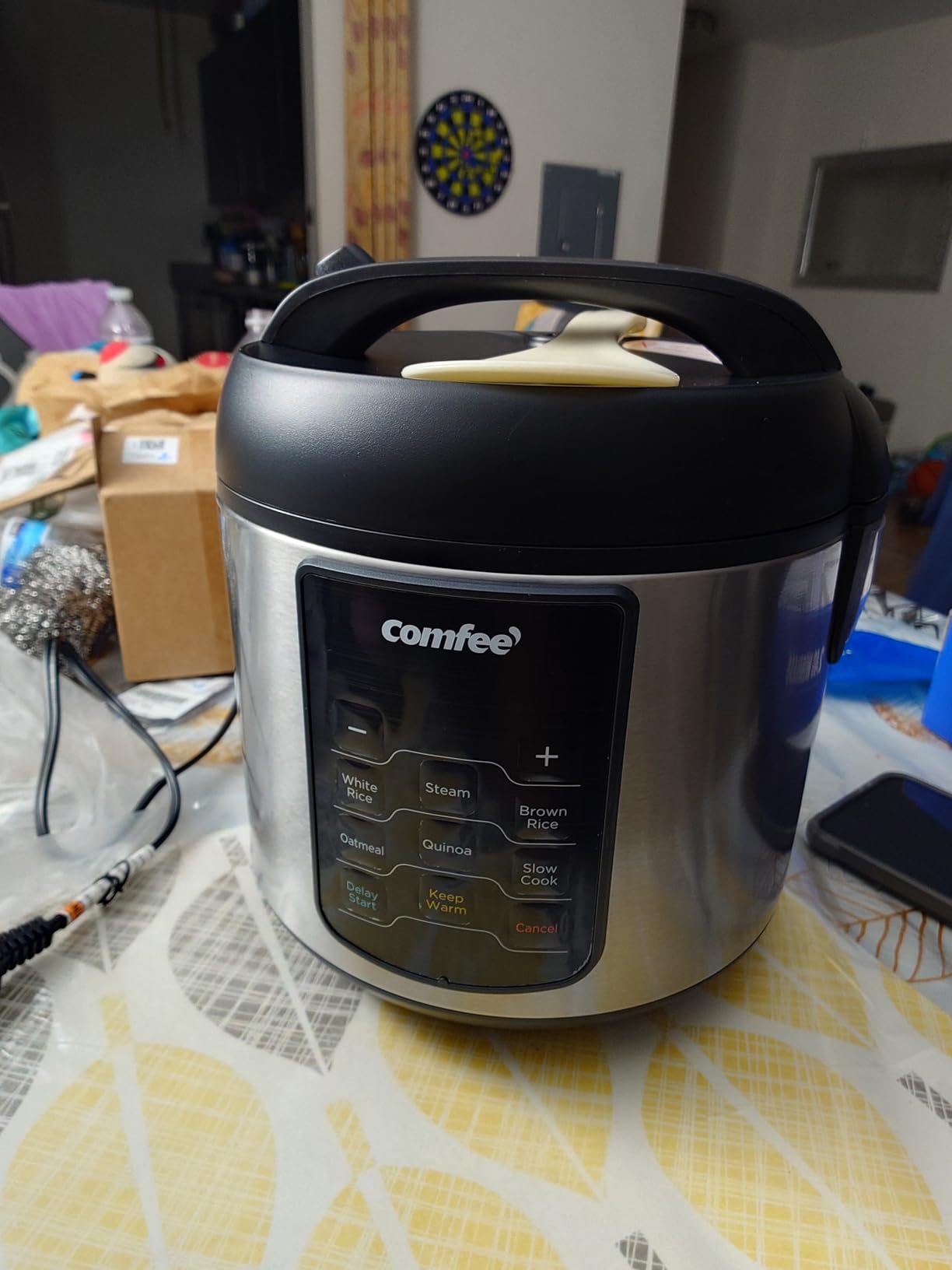
The COMFEE’ covers the basics that matter for brown rice at a modest price point. There is a dedicated brown rice program among six one-touch presets, and the combination of 12-hour keep warm and a 12-hour delay timer is unusual at this level.
With a 4.5 average and 77 percent five-star ratings, the owner base is broadly positive, and the recurring mentions are the brown rice program, easy dishwasher cleanup and the scheduling features making daily use simple.
Safety features are specified rather than implied, with built-in overheating protection, BPA-free food grade materials, a cool-touch handle and a UL certification.
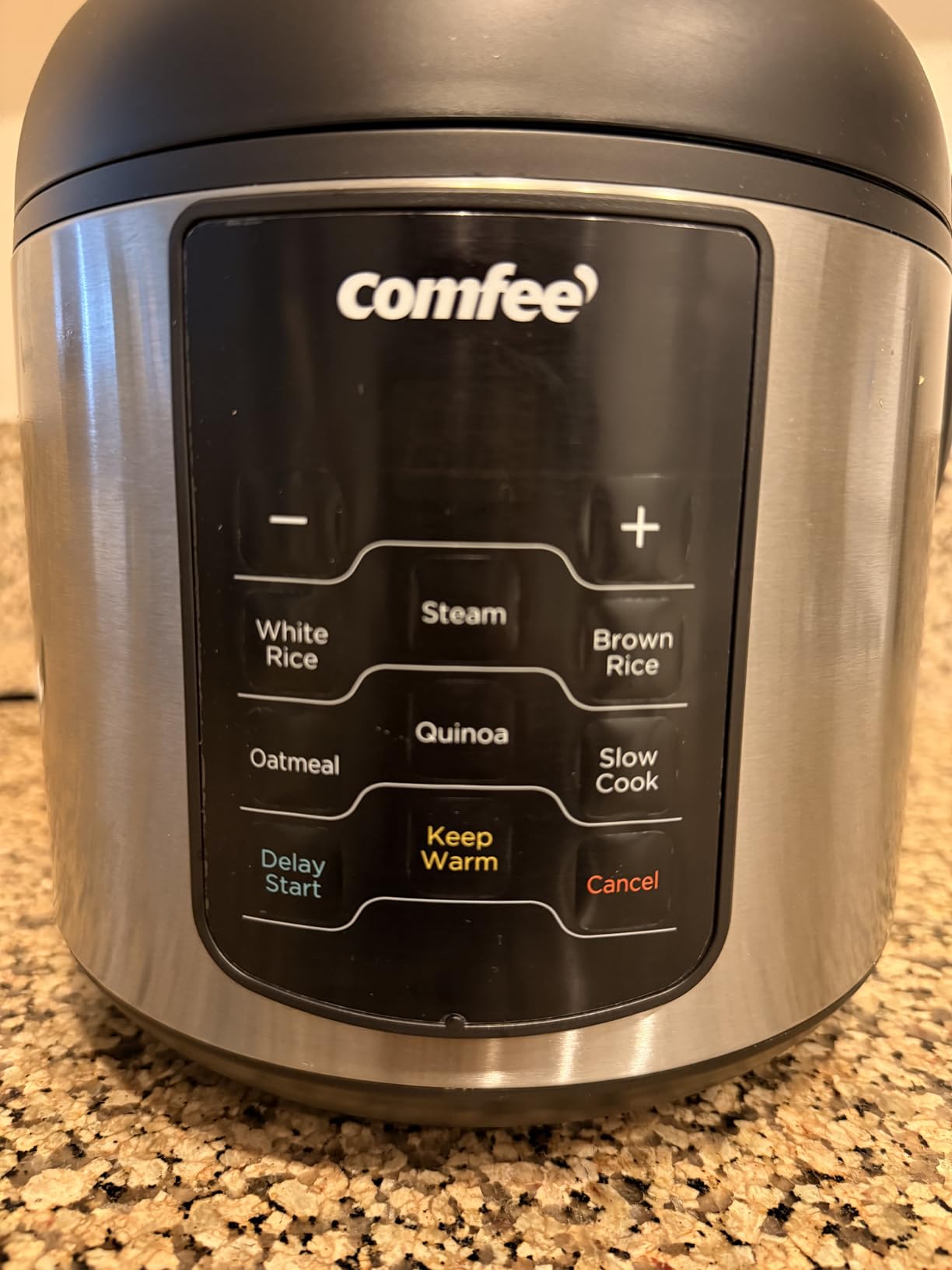
There is no sensor-driven timing in this unit, so your water measurement matters more here than on a fuzzy logic machine. If the ratio is off, nothing in the machine corrects for it.
Four cups uncooked is a small ceiling. That is comfortable for a household of two and tight for a family of four doing more than one meal a day.
At 450 watts the brown rice cycle is not quick, and while the multicooker modes cover steam, slow cook, quinoa and oatmeal, there is no pressure function to compress the cook time.
Who the COMFEE’ CRS2010BS suits
It suits couples and one or two-person households in compact kitchens. The stainless steel body is smaller than most 4-cup units and wipes clean without a dishwasher cycle.
It suits buyers who want scheduling at the entry level. A 12-hour delay timer and 12-hour keep warm make a morning start or an evening batch realistic without a more expensive machine.
Who should skip the COMFEE’ CRS2010BS
Skip it if texture is the deciding factor. Without moisture sensing, brown rice outcomes depend much more heavily on getting the ratio right each time.
Skip it for a family of four or more who eat rice twice a day. The 4-cup uncooked limit means frequent cycles, and the modest wattage makes each one slow.
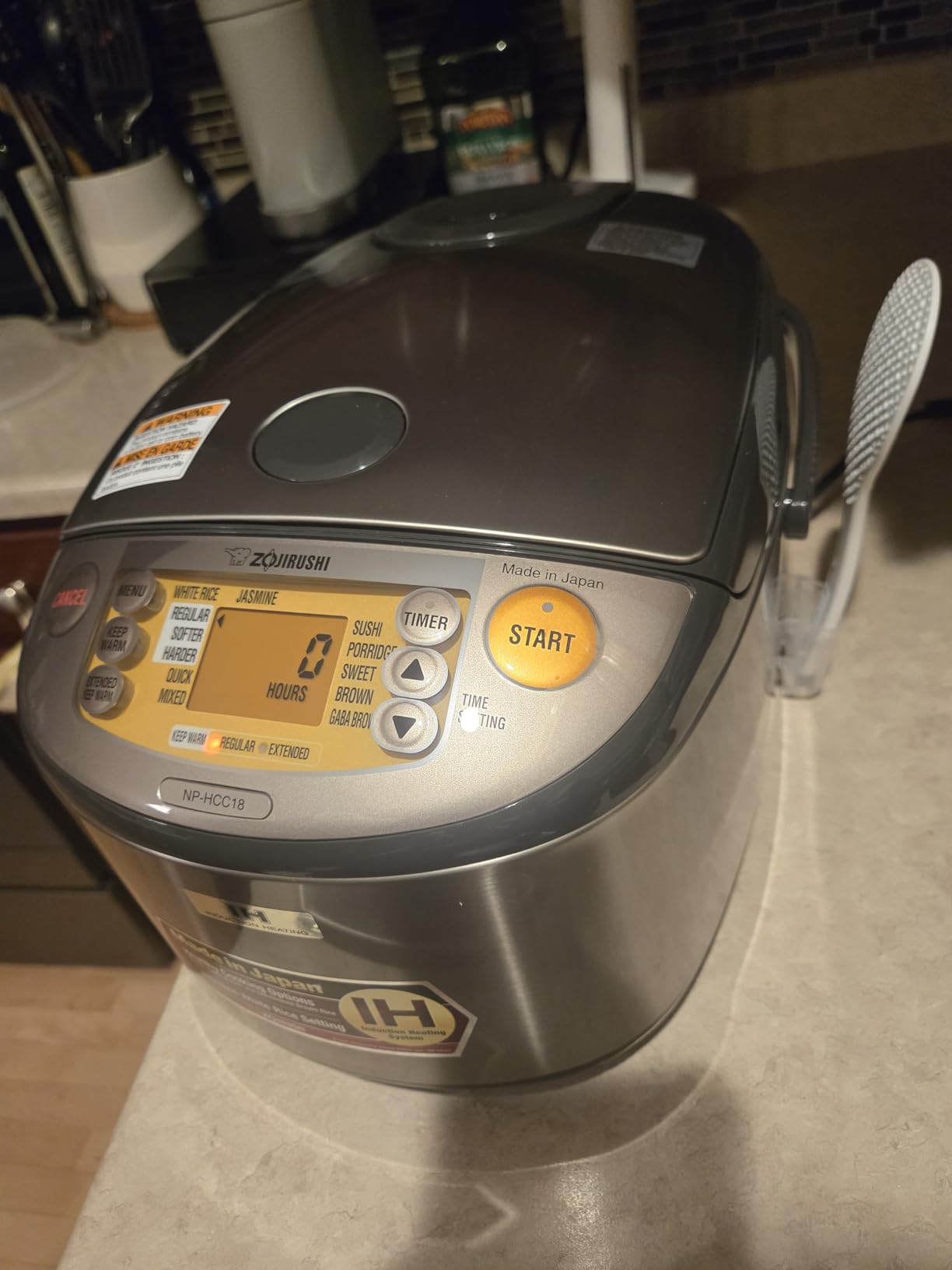
7. Zojirushi NP-HCC10XH – the best premium induction rice cooker for GABA brown rice
Zojirushi NP-HCC10XH Induction Heating System Rice Cooker and Warmer, 5.5-Cup, Stainless Dark Gray
Induction heating at 1,230 watts
5.5-cup uncooked / 1.0 liter
GABA brown rice cycles
Pros
- Induction heating surrounds the pot for even temperature control
- Separate brown rice
- GABA and germinated brown rice programs
- Extended keep warm holds rice without drying it out
- Large 1230-watt element cooks substantial batches quickly
- Two delay timer settings
- Includes measuring cup
- spatula and holder
Cons
- 5.5-cup capacity suits small to medium households
- Rice must be measured with the supplied cup
- Heavy unit with a wide 14-inch footprint
- Minor sparks at the plug are a known characteristic
Brown rice is the reason induction heating exists as a category, and this is the clearest example. The element surrounds the pot instead of heating a plate beneath it, which removes the hot spot that scorches the bottom of long brown rice cycles and distributes heat across the whole surface of the inner pot.
It is also the only unit here with three separate healthy-grain programs: brown rice, GABA brown rice and germinated brown rice. The GABA cycle holds the grain at a lower temperature for longer, which softens the bran layer and raises the GABA content, and owners single those settings out as the reason they bought it.
At 87 percent five-star ratings and 4.7 overall, the praise centres on distinctively separate grains and on the extended keep warm holding rice at serving temperature without drying it out over a long stretch. That is a specific answer to a specific complaint, and it is why this unit ranks where it does.
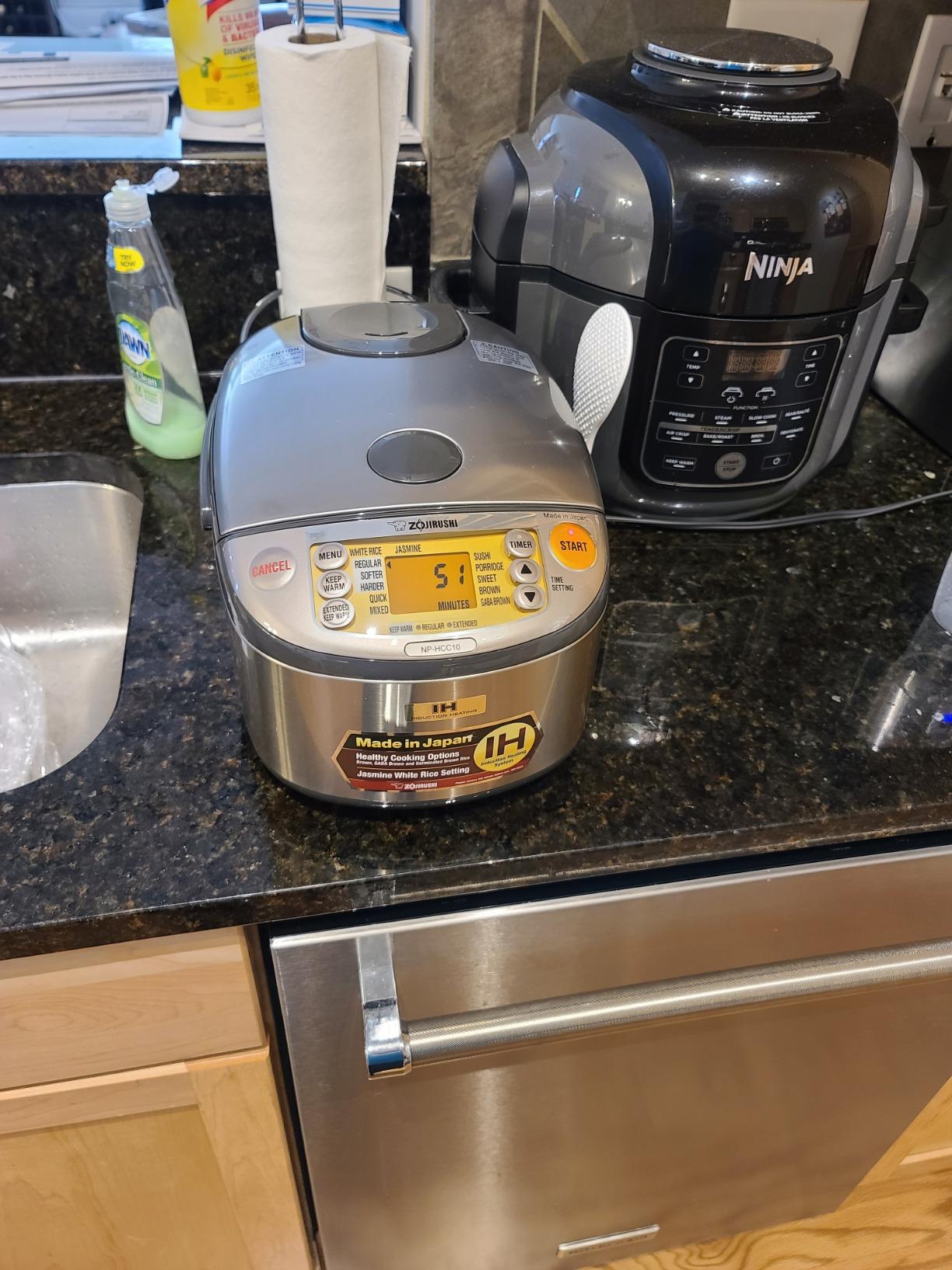
Capacity is the honest limitation. At 5.5 cups uncooked and 1.0 liter, this is a small to medium household machine rather than a large family one.
Rice must be measured in the cup that ships with the unit, which is the recurring practical note. The supplied cup is smaller than a standard US measuring cup, so substituting your own will throw off the ratio in a way that is easy to mistake for a faulty machine.
It is also physically substantial: 9 pounds and a 14-inch depth for a 5.5-cup cooker. Plan the counter space before the shelf life, not after.
Who the Zojirushi NP-HCC10XH suits
It suits brown rice as a daily staple rather than an occasional side. If you eat it most days, the induction element and the dedicated healthy-grain cycles are worth the step up from a heated-plate machine.
It also suits anyone who cares about the GABA and germinated cycles specifically, or who wants keep warm to hold rice for hours without the drying and hardening that owners report from cheaper units.
The 1230-watt element is also the most powerful in the roundup, which matters for cooking a substantial brown rice batch in one pass.
Who should skip the Zojirushi NP-HCC10XH
Skip it if you cook for a large family. Five and a half cups uncooked is not a big batch, and you would be running multiple cycles in a machine with a wide footprint.
Skip it if you want cook-and-forget simplicity without any ratio discipline. Induction gives better texture, but it still expects the supplied measuring cup to be used, and precision comes with that responsibility.
8. Toshiba TRCS02 – the best small rice cooker for brown rice for one to three people
Toshiba Mini Rice Cooker, 3 Cups Uncooked, for 1-3 People, Steamer and Warmer, Fuzzy Logic, One-Touch Cooking, 24-Hour Delay Timer, Auto Keep Warm, White
Fuzzy logic moisture sensing
3-cup uncooked
Eight cooking functions
Pros
- Fuzzy logic senses moisture and adjusts time and temperature
- Eight functions including brown rice and mixed grain
- Handles brown
- jasmine
- sushi
- basmati and wild rice plus quinoa
- 24-hour delay timer with keep warm and reheat
- Large LED display with one-touch controls
- Removable steam valve and vent cap
Cons
- 3-cup uncooked capacity limited to roughly 1-3 people
- Inner pot is not dishwasher safe and must be hand-washed
- Compact body means small batches per cycle
For a one or two-person household, a 10-cup machine is a large object to own for a small need. The Toshiba TRCS02 is the compact answer here, with 3 cups uncooked and a 4.5 rating from more than 3600 reviews.
It runs fuzzy logic that senses the moisture content of the rice and adjusts temperature and cooking time, which is the feature that separates it from other machines at this size. Owners point to that sensor as the reason the results need less guesswork.
The menu runs to eight functions, including white rice, quick cook, brown rice, mixed grain, slow cook, porridge, cake and egg. The porridge and cake modes are mentioned more than you would expect for a rice cooker at this size, and a detachable power cord plus a thermal fuse cover the safety basics.
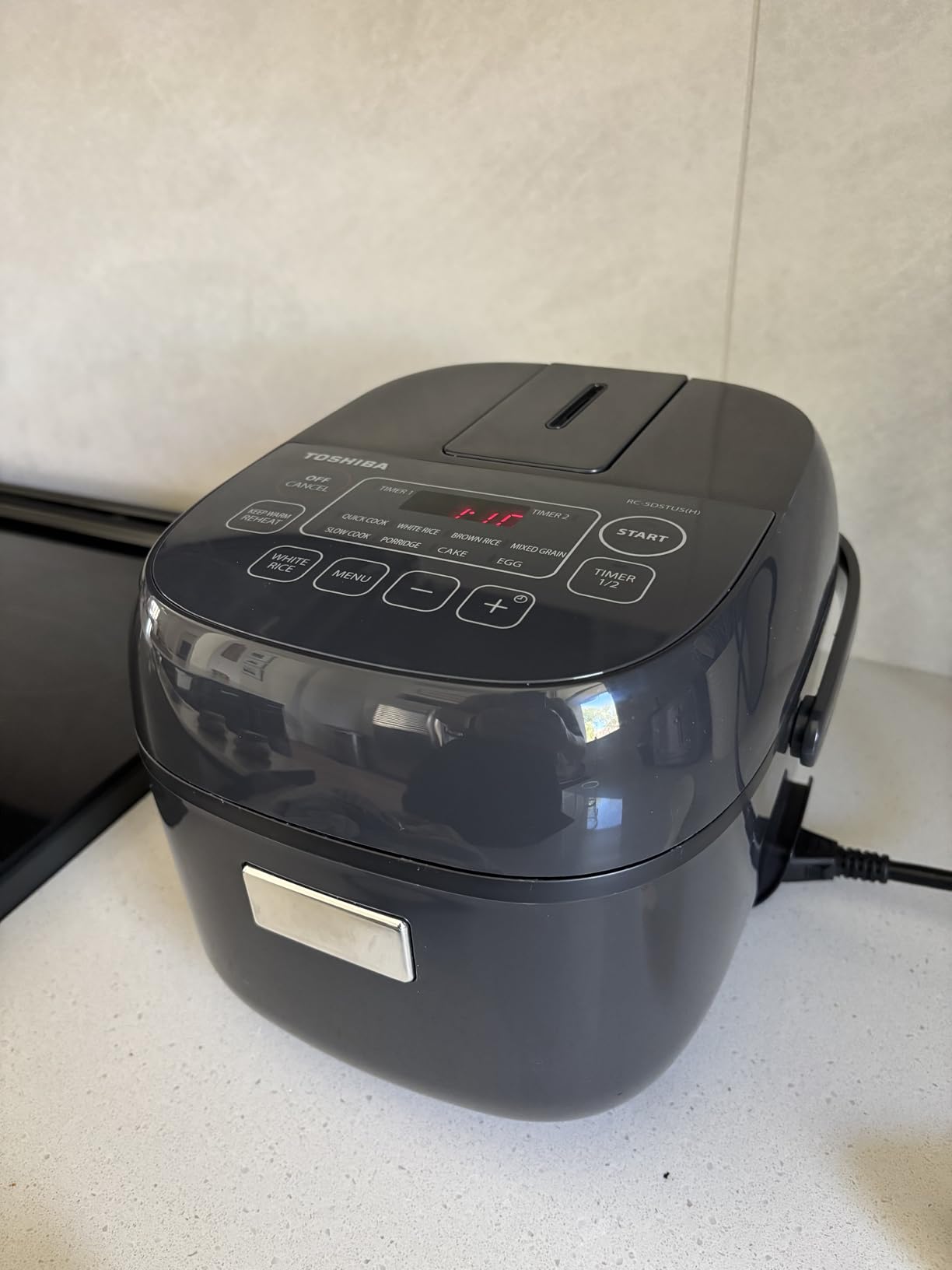
Three cups uncooked is the hard limit, and that only works for roughly one to three people. Anyone cooking for a family of four will run it several times a day, which is the real cost of a compact machine.
The inner pot is not dishwasher safe and has to be hand-washed with mild soap and a soft cloth. On a small machine that is the routine cleanup task, so expect it to become habit immediately.
Cook times are on the standard schedule, and at 460 watts there is no pressure function to shorten the brown rice cycle. The 24-hour delay timer is the more useful feature for a small household than speed is.
Who the Toshiba TRCS02 suits
It suits individuals, couples and small families, and it suits dorm rooms and small apartments where a full-size machine will not fit. Fuzzy logic at this size is the differentiator.
It also suits anyone who wants more than rice from a small footprint. Quinoa, oatmeal, mixed grains and porridge all appear on the menu alongside the rice functions.
Who should skip the Toshiba TRCS02
Skip it if you batch cook or feed more than three people. Three cups uncooked is a small batch, and the compact body limits how much you can do per cycle.
Skip it if you refuse to hand-wash. The pot and lid both need washing by hand, which is a real consideration for anyone who runs a dishwasher-only kitchen routine.
9. CUCKOO CR-0632F – the best rice cooker for GABA and multigrain brown rice menus
CUCKOO Micom Fuzzy Logic Rice Cooker, 12-Cup Cooked, Silver, CR-0632F
Fuzzy logic
6-cup uncooked / 12-cup cooked
GABA rice and multigrain menus
Pros
- GABA rice and multigrain brown rice menus
- Fuzzy Logic with LCD display and digital controls
- Made in Korea with a durable nonstick inner pot
- Detachable inner lid and drainage tray simplify cleaning
- 13-hour preset timer
- Includes measuring cup and spatula
Cons
- Fewer cooking modes than the larger CUCKOO CR-0675FG
- Aluminum body is less insulating than stainless steel
- 12-cup cooked capacity is modest for very large households
The CR-0632F is the mid-sized route into CUCKOO and the only machine here with a dedicated GABA rice menu alongside a separate multigrain and brown rice menu. That pairing is unusual below the premium tier, and it is why this model earns its place on a brown rice list.
Owners tie their positive sentiment most directly to those two menus and to the cleaning design. The inner lid detaches and there is an excess water drainage tray, so the post-cook cleanup is a rinse rather than a scrub.
At 81 percent five-star ratings and a 4.6 average, the core cooking performance satisfies owners, and the quick rice cycle is noted as useful when white rice is what you actually need that day. Made in Korea, with a 580-watt element and a 13-hour preset timer.
This has fewer cooking modes than the larger CR-0675FG, so if multicooking is the goal the bigger CUCKOO covers more ground. Nine multifunctional options is still a broad menu, just not the broadest one here.
The body is aluminum rather than stainless steel, which is less insulating and means the exterior runs warmer during a long cycle. The practical effect is a pot that stays warm to the touch on the sides.
Twelve cups cooked is modest for very large households, though it handles small gatherings and parties comfortably at 6 cups uncooked.
Who the CUCKOO CR-0632F suits
It suits households of two to four that want a named GABA rice cycle without moving to the induction tier. Short-grain brown rice is the case where a named menu and fuzzy logic combine most usefully.
It also suits buyers who clean up immediately after cooking. The detachable inner lid and drainage tray are the difference between a two-minute rinse and a proper wash.
Who should skip the CUCKOO CR-0632F
Skip it if you want the widest menu. The larger CUCKOO model adds multicook modes for stews and grains that this one does not include.
Skip it if you plan to leave the machine on a warm counter for hours. The aluminum body is less insulating, and a stainless body is the better choice for that.
10. AROMA ARC-363NG – the best PFAS-free pot rice cooker for individuals
AROMA® Rice Cooker, 3-Cup (Uncooked) / 6-Cup (Cooked), Small Rice Cooker, Oatmeal Cooker, Soup Maker, Auto Keep Warm, 1.5 Qt, White, ARC-363NG
3-cup uncooked / 6-cup cooked
CoreCoat PFAS-free ceramic coating
One-touch operation
Pros
- CoreCoat ceramic coating made without PFAS
- One-touch add rice add water press button
- Inner pot and lid both remove for cleaning
- Compact 1.5-quart size for individuals and couples
- Automatic keep warm when rice is ready
- Also handles oatmeal
- soups and stews
Cons
- No dedicated brown rice setting so water and time need manual adjustment
- Rice can crisp on the bottom after a couple of hours on warm
- Build feels flimsy compared with heavier brands
- Coating can scratch with metal utensils
If your priority is the coating on the pot rather than the electronics, this is the pick. The CoreCoat ceramic coating is naturally nonstick and made without PFAS, which is a specific answer to buyers who do not want a conventional nonstick surface in a pot they use daily.
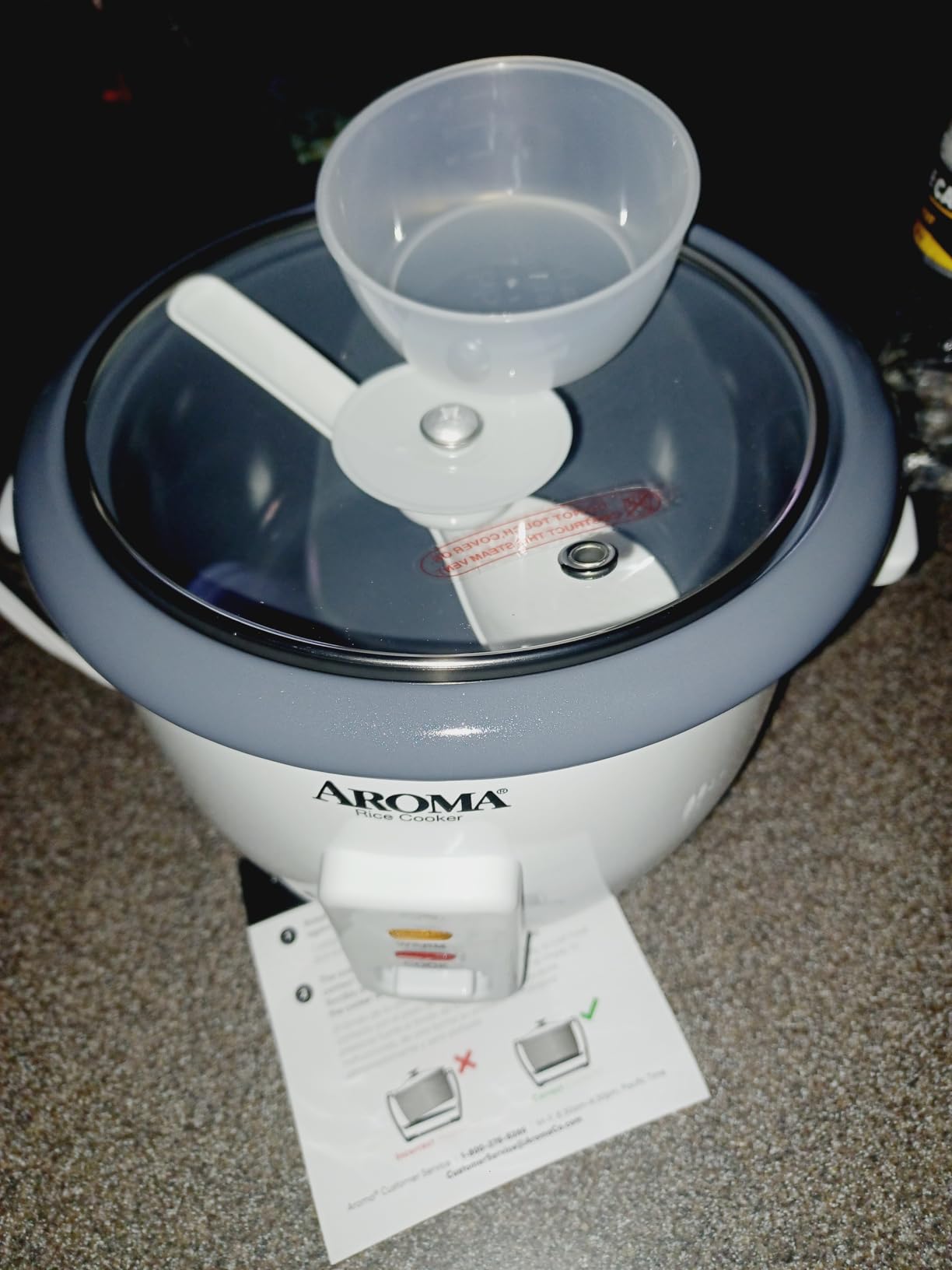
Operation could not be simpler: add rice and water, press the button, and the unit switches itself to keep warm when the rice is ready. The inner pot and lid both lift out for cleaning, and the 1.5-quart size stores easily in a small kitchen.
With more than 27000 reviews and a 4.5 average, it is widely regarded as a dependable first cooker for one or two people, and the same pot handles oatmeal, soups and other one-pot meals.
There is no dedicated brown rice setting, which is the central compromise here. Brown rice needs manual water and time adjustment, so you are managing the cycle rather than pressing a preset and walking away.
Rice can also crisp on the bottom if it sits on keep warm for more than a couple of hours, which is a real limitation for anyone who wants rice held through a long evening. Keep warm here is a short buffer, not an all-day holding function.
Several owners describe the build as flimsy and light next to heavier brands, and the coating can scratch if metal utensils are used. Treat the pot as the consumable part of this machine.
Who the AROMA ARC-363NG suits
It suits individuals, couples and anyone who wants a PFAS-free pot in a small footprint. The 3-cup uncooked capacity is right-sized for a daily batch for two.
It also suits buyers who want one pot for more than rice. Oatmeal, soups and stews all work in the same vessel, and the removable pot and lid make the cleanup quick.
Who should skip the AROMA ARC-363NG
Skip it if brown rice is a frequent, texture-sensitive part of your week. No dedicated setting, no sensor-driven timing and a keep warm that crisps the base make it a compromise on the one thing this roundup is about.
Skip it if you want a machine you can leave rice in for hours. The extended keep warm behaviour on the Zojirushi is the opposite of what this unit does.
Brown Rice Water-to-Rice Ratio by Grain and Cooker
Most crunchy brown rice is a measurement problem, not a machine problem. Brown rice absorbs more water than white rice because the intact bran layer resists penetration, and it keeps drinking during the resting stage after the heat stops.
Use the measuring cup that came with the machine, not a standard cup. Japanese-made cookers come with a smaller micom cup, and US-standard cups are a different volume entirely, which is the single most common reason a ratio that works in one machine fails in another.
As a starting point for long-grain brown rice, use roughly 3 cups of water per 2 cups of uncooked rice in a standard fuzzy logic or sensor cooker. Short-grain brown rice drinks more, so go closer to 3.5 cups of water per 2 cups of rice, and expect to reduce that after your first batch if the grains turn out wet.
Rinse until the water runs clear, add a small amount more water than the recipe if you live at altitude or have hard water, and let the rice rest for 10 to 15 minutes after the cooker switches to warm. The resting stage is where the remaining water finishes penetrating the bran, and skipping it is a frequent cause of a firm, dry finish.
Why Is My Brown Rice Crunchy, Burnt or Mushy
If brown rice comes out crunchy, four things are usually responsible. You under-measured the water, the measuring cup was not the one supplied with the machine, you did not rinse the grain, or you lifted the lid during the cook and let steam escape.
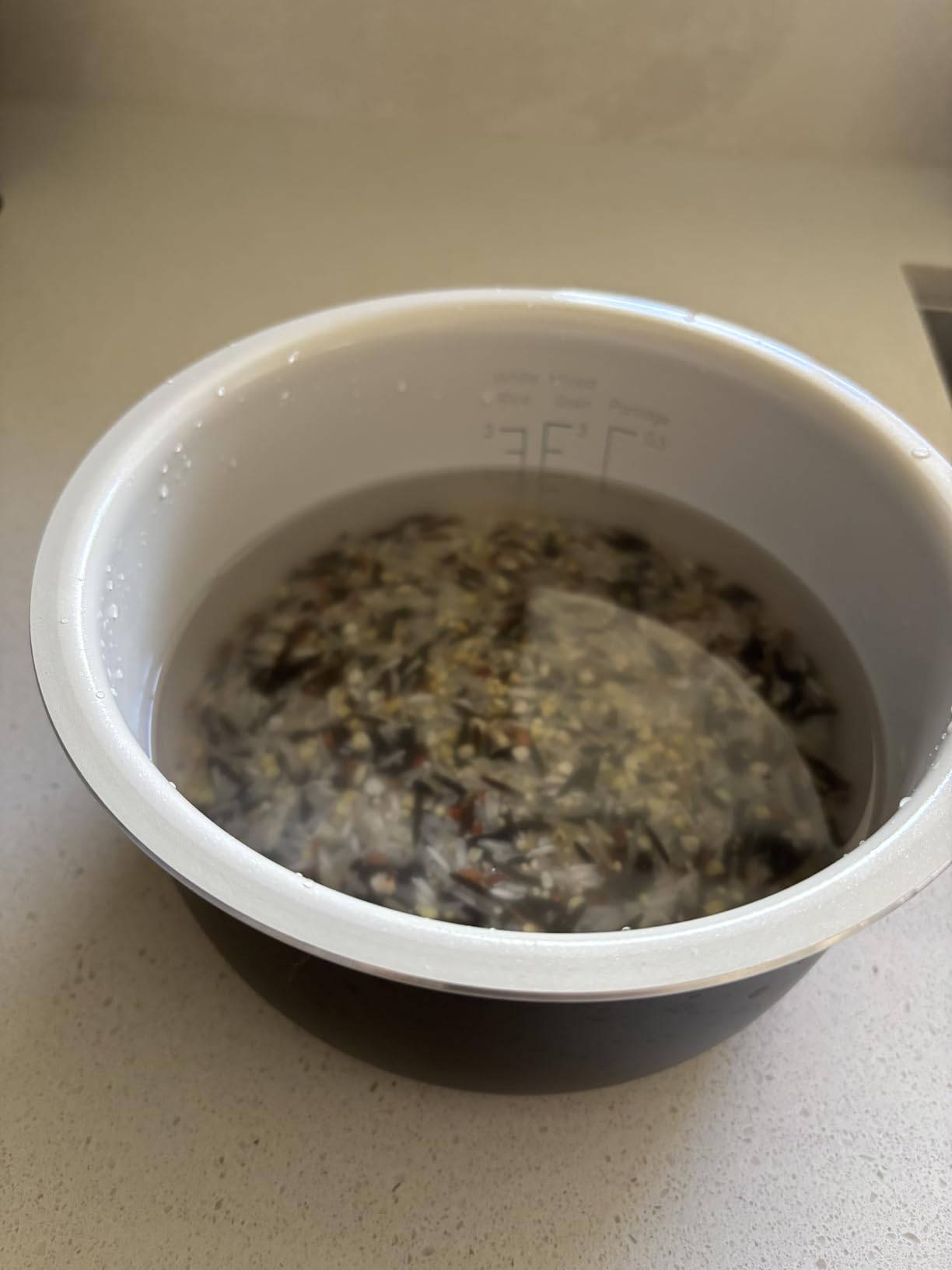
For a crunchy centre with tender edges, the fix is almost always more water rather than a longer cycle. Add 2 to 3 tablespoons of water per cup of rice and run the brown cycle again. Soaking the grain for 20 minutes before cooking also helps, because the bran starts absorbing early.
If the bottom of the pot is scorched while the top is underdone, the heat is too concentrated under the base. That is the argument for induction heating, and the workaround on a heated-plate machine is to avoid filling the pot to its maximum line.
If brown rice turns out mushy or overly wet, you have gone the other way. Use less water, let the rice sit undisturbed on warm for several minutes before opening the lid, and remember that brown rice continues absorbing during that time, so opening early makes a wet batch worse.
For a slow cook, that is by design rather than a fault. A standard fuzzy logic or sensor cycle runs substantially longer for brown rice than for white, because the grain needs time at temperature for water to move through the bran. Pressure cooking is the one approach that compresses it, and that is the trade-off behind the CUCKOO-versus-Zojirushi debate.
Induction vs Pressure vs Fuzzy Logic for Brown Rice
The two highest-authority signals in this category disagree, and both are right for different cooks. Users on r/Cooking repeatedly call CUCKOO pressure models the best choice for short-grain brown rice, pointing at a roughly 30-minute brown cook against a shorter white cycle. Editorial roundups point at the Zojirushi induction unit and its dedicated GABA brown rice setting.
There is no contradiction once you separate texture from speed. Induction heating drives the pot directly, which removes the hot plate and gives the steadiest, most even heat for texture. Pressure cooking raises the boiling point so water penetrates the bran faster, which is the fastest route to a tender grain.
Fuzzy logic sits in the middle and is the practical default for most households. Sensors adjust time and temperature for the grain rather than running a fixed timer, which is enough to fix most crunchy and burnt outcomes without a premium element.
Choose induction if texture is the priority and you can measure rice precisely. Choose pressure if a 30-minute brown rice cycle changes whether you cook it at all. Choose fuzzy logic if you want reliable results across several grain types without managing the machine.
GABA Brown Rice: What the Setting Actually Does
Germinated brown rice, often called GABA brown rice after the gamma-aminobutyric acid it raises, is soaked and germinated so the enzyme that breaks down the hull is partly activated before cooking. That soaked grain is softer and wetter, which is exactly why it does not cook well on a standard white rice cycle.
The dedicated setting exists because the cycle is different, not because the rice is a different species. It runs longer and at a gentler temperature, so the grain hydrates evenly instead of cooking hard at the outside while the centre stays dry.
Two machines in this roundup have a named GABA cycle. The Zojirushi NP-HCC10XH has separate brown rice, GABA brown rice and germinated brown rice programs alongside its induction element, and the CUCKOO CR-0632F pairs a GABA rice menu with a separate multigrain and brown rice menu.
The rest of the list can still produce good brown rice, but they do it through a general brown preset and fuzzy logic rather than a cycle tuned for germinated grain. If GABA is the reason you are shopping, start with those two.
Buying Guide: Choosing a Rice Cooker for Brown Rice
Start with capacity in uncooked cups, not cooked cups. One cup uncooked yields roughly two cups cooked, and brown rice expands more than white, so a household of two wants at least a 3-cup uncooked machine and a household of four or five wants 6 cups or more. Buying up from that point mostly buys a heavier pot and a larger footprint.
Next, look for a dedicated brown rice setting. A machine that only has a white rice cycle will run brown rice on a fixed timer, and that is the origin of both the crunchy and the burnt complaints.
Then check whether the timing is sensor-driven. Fuzzy logic, micom control and sensor logic all describe the same idea: the machine measures conditions in the pot and adjusts rather than trusting a clock. This single feature correlates more closely with good brown rice than any other.
For the inner pot, nonstick coated pots are the easiest to clean and the most common. A ceramic coating made without PFAS is the option to choose if you cook daily and want to avoid a conventional nonstick surface, and stainless steel is the option to choose if you want a pot you can use with metal utensils. Thick pots heat more evenly, which is why induction units pair with heavier inner pots.
Keep warm deserves its own check. A basic keep warm holds rice at a safe serving temperature for hours, but many of the lower-cost machines also dry the surface or crisp the bottom over a long hold. An extended keep warm function, as on the Zojirushi, is the feature that answers the most common complaint about rice cookers in this category.
Scheduling matters if you eat rice at set times. Delay timers range from about 12 hours on entry-level units to 24 hours on mid and premium models, and they only help if you are confident in the ratio for the first batch.
Finally, consider wattage as a proxy for cook time. Higher-wattage machines bring a larger pot of water to temperature faster, which shortens the brown rice cycle. A 1000-watt fuzzy logic unit cooks faster than a 350-watt sensor machine, and pressure cooking shortens it further.
Budget machines can cook acceptable brown rice if the measurement is right, and forum consensus repeatedly favours the cheaper of two options when the difference is marginal. The step up to induction or pressure is worth it when brown rice is a daily staple and texture is the reason you care.
Frequently Asked Questions
Do rice cookers work well for brown rice?
They do, as long as the machine senses what is happening in the pot. Sensor-driven cookers such as the AROMA ARC-914SBD, the Cosori CRC-R501 or the Toshiba TRCS02 measure moisture and temperature and adjust the cycle, which is why they avoid the crunchy and burnt results that fixed-timer machines produce. A basic one-button cooker runs a set timer and then switches to warm, and brown rice usually needs a longer, gentler absorption stage than that timer allows.
What is the correct ratio of water to brown rice in a rice cooker?
Start with about 3 cups of water per 2 cups of uncooked long-grain brown rice in a sensor or fuzzy logic cooker, and closer to 3.5 cups for short-grain brown rice. Always measure rice and water with the cup supplied with the machine, because Japanese cookers ship with a smaller micom cup than a standard US measuring cup. Rinse until the water runs clear, add extra water at altitude or in hard water areas, and let the rice rest 10 to 15 minutes on warm before opening the lid.
Why is my brown rice crunchy in the rice cooker?
The usual causes are too little water, the wrong measuring cup, skipping the rinse, or lifting the lid mid-cycle so steam escapes. The fix is almost always more water rather than a longer cycle: add 2 to 3 tablespoons of water per cup of rice and run the brown cycle again. Soaking the grain for 20 minutes before cooking also helps, because the bran starts absorbing earlier.
Does brown rice need longer in a rice cooker?
Yes. Brown rice keeps its bran and germ, so it needs a longer absorption stage and steadier heat than white rice to turn tender rather than hard. Standard fuzzy logic and sensor cookers run a much longer brown cycle than the white cycle on the same machine. Pressure cooking is the one approach that compresses it, with a brown cycle around 30 minutes on a pressure model.
Why does my rice cooker take so long to cook brown rice?
The long cycle is a design feature, not a fault. The bran layer takes time to hydrate at cooking temperature, and rushing it leaves the grain firm in the centre. If the length of the cycle is a genuine problem in your week, the options are a higher-wattage fuzzy logic machine or a pressure-capable model, which raises the boiling point so water moves through the bran faster.
What size rice cooker do I need for brown rice?
Judge capacity in uncooked cups. One cup uncooked yields roughly two cups cooked, and brown rice expands more than white rice does, so 3 uncooked cups suits one to three people, 4 to 5 suits three or four, and 6 or more suits a family of five or a meal-prepper. Buying larger than your household needs mostly adds counter space and weight rather than capability.
What is the best rice cooker for GABA brown rice?
Two machines in this roundup have a named GABA cycle. The Zojirushi NP-HCC10XH has separate brown rice, GABA brown rice and germinated brown rice programs driven by induction heating, and the CUCKOO CR-0632F pairs a GABA rice menu with a separate multigrain and brown rice menu. The rest of the list cook good brown rice through a general brown preset rather than a cycle tuned for germinated grain.
Are expensive rice cookers worth it for brown rice?
Only if you cook brown rice often. The step up to induction or pressure heating buys even heat, better texture and a shorter cycle, and it matters most when brown rice is a daily staple. If you eat it once a week or less, a sensor-driven machine such as the AROMA ARC-914SBD produces good results for far less, and getting the water ratio right matters more than the price of the machine.
The Verdict: Which Rice Cooker for Brown Rice Wins
The AROMA ARC-914SBD is the best rice cooker for brown rice overall. Sensor Logic timing, a dedicated brown rice preset, a 15-hour delay timer and the deepest review base in the roundup make it the pick most households should buy, and it is the machine I would put in a first kitchen without hesitation.
Move up to the Zojirushi NP-HCC10XH if brown rice is a daily staple and texture is the reason you care, or to a CUCKOO micom model if a named GABA cycle or multicooking matters. The Cosori CRC-R501 is the highest rated fuzzy logic option here, the BLACK+DECKER RC516 is the only one that handles a large batch in one cycle, and the Toshiba TRCS02 or AROMA ARC-363NG cover small households properly.
Whatever you choose, calibrate the water ratio on the first cook. A machine can only do as much as the measurement you give it, and the ten picks above all reward precision differently.