
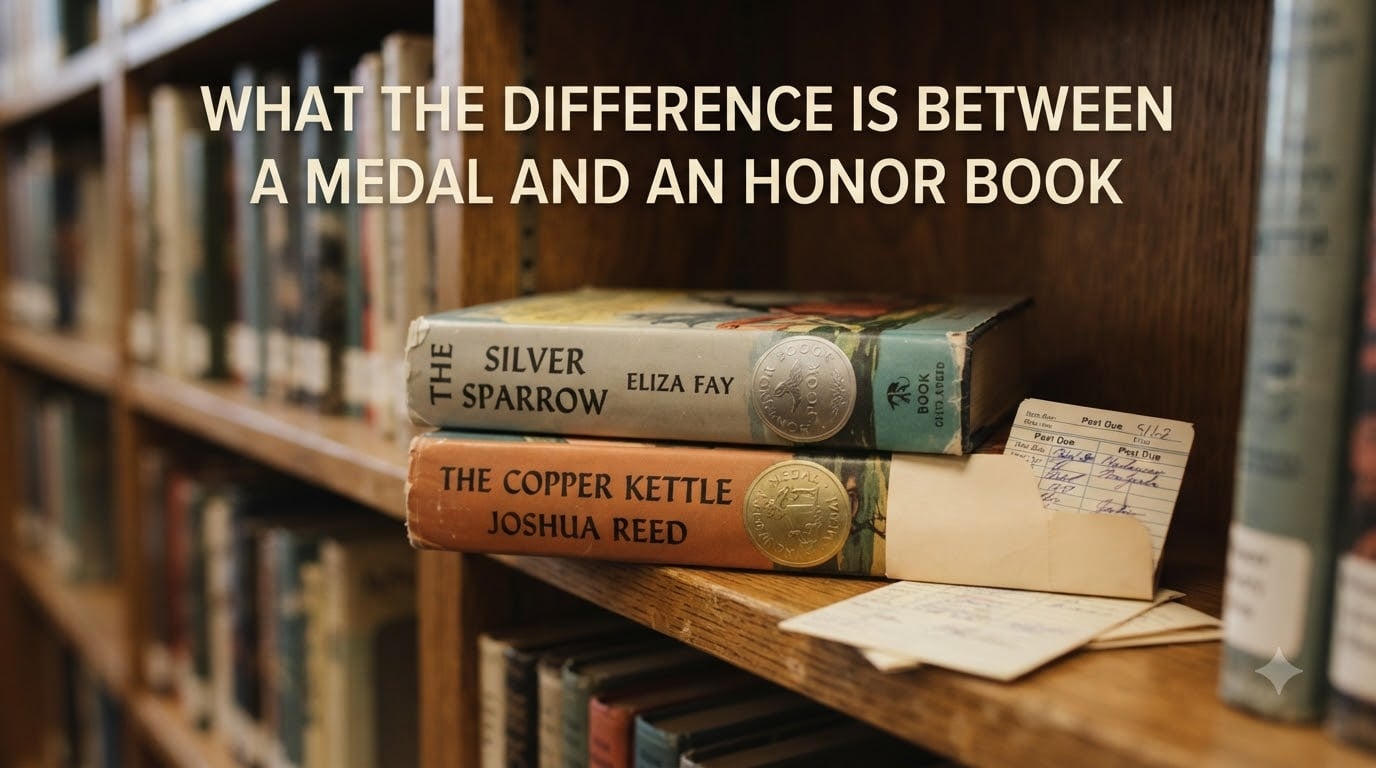
If you have ever picked up a children’s book and noticed a shiny gold or silver seal on the cover, you have seen the difference between a Medal and an Honor book in action. Both seals come from the same award program, both are stamped on the dust jacket by the publisher, and both signal literary quality. Only one, though, marks the single most distinguished book of the year. Here is the short version: a Medal book is the annual winner, while an Honor book is a runner-up the committee also wants to celebrate. I have spent years reading through award lists with my own kids, and that single distinction is the one that trips up most parents and teachers.
Table of Contents
What Is the Newbery Medal?
The Newbery Medal is the most prestigious award in American children’s literature. It is given every year by the Association for Library Service to Children (ALSC), a division of the American Library Association (ALA), to the author of the single most distinguished contribution to American literature for children published in the previous year.
The award was first given in 1922, making it the oldest children’s book award in the world. It is named after John Newbery, an 18th-century English bookseller who is often credited as the first publisher to produce books specifically for children.
The Medal itself is a bronze medal awarded to one author per year. A silver seal is then added to the book’s cover so readers can spot a Medal winner at a glance on library and bookstore shelves. Winning the Newbery is widely seen as the highest honor an American children’s book author can receive.
What Are Newbery Honor Books?
Newbery Honor books are the runners-up. Each year, the same ALSC selection committee that picks the Medal winner also chooses a small number of other books they want to recognize. Those books receive a Newbery Honor designation rather than the Medal itself.
Honor books earn a silver seal on the cover (the same color as the Medal seal in modern designs), plus an official Honor Book sticker. They are listed right next to the Medal winner on every official ALA announcement, and they are treated as award-winning books in libraries and classrooms across the country.
In a typical year, the committee names anywhere from zero to eight Honor books, depending on the strength of the field. There is no fixed number. The committee simply recognizes as many additional distinguished books as it believes deserve the honor.
Key Differences Between Medal and Honor Books
The two designations come from the same award and the same committee. The differences are smaller than most readers assume, but they are real. Here is the side-by-side breakdown I walk friends through when they ask.
Medal book: One per year. Author receives a physical bronze medal. Silver seal on the cover. Considered the single most distinguished contribution to American children’s literature that year.
Honor book: Zero to eight per year. Author receives a Newbery Honor seal and certificate, but no Medal. Recognized as a distinguished contribution, not the most distinguished one.
In practice, both Medal and Honor books are added to school reading lists, both fly off library shelves, and both authors are celebrated at the annual ALA conference. The Medal simply carries a bit more prestige because it is the single top selection.
You will sometimes hear Honor books described as “lesser” winners. That framing is not accurate. An Honor book beat out roughly 2,500 to 3,000 other eligible titles to be named one of the year’s most distinguished books for children. It only lost to one.
The History Behind the Honor Book Terminology
The terminology has not always been “Honor book.” When the Newbery was first awarded in 1922, the additional books recognized by the committee were simply called runners-up. That label stuck for nearly 50 years.
In 1971, the ALSC renamed the runners-up “Newbery Honor Books.” The change was a deliberate effort to signal that these books were award-winning in their own right, not just consolation prizes. The committee wanted parents, librarians, and booksellers to understand that an Honor book was something to celebrate, not to dismiss as second place.
The renaming mattered. Before 1971, many libraries and parents skipped runners-up titles, assuming they were inferior to the Medal winner. After the change, Honor books gained their own recognition and grew into a meaningful tier of the award.
How the Selection Committee Chooses Winners and Honor Books
Every year, a committee of around 15 to 20 ALSC members reads through the previous year’s eligible children’s books. Each member reads hundreds of titles and submits an initial ballot of their top choices. The committee then narrows the list, discusses the strongest contenders, and votes through multiple rounds until a Medal winner emerges by majority vote.
After the Medal vote, the committee decides how many additional books, if any, deserve Honor recognition. There is no quota. In some years, the committee names only a Medal winner and no Honor books at all. In other years, they name four, five, or even eight Honor books when the field is unusually strong.
To be eligible, a book must be an original work of fiction, nonfiction, or poetry published in the United States during the preceding year. The author must be a U.S. citizen or resident. Reprints, compilations, and textbooks are not eligible. The committee looks for distinguished writing, clear theme, accurate information, and a book that makes a significant contribution to children’s literature.
Caldecott Medal vs Newbery Medal: A Quick Comparison
Parents often confuse the Newbery with the Caldecott, because both come from the ALA and both use similar seals. The difference is simple. The Newbery Medal honors the author of the most distinguished children’s book of the year. The Caldecott Medal honors the artist of the most distinguished American picture book for children.
If a book has mostly text and is read aloud by older children, it is in the Newbery pool. If a book is built around illustrations that tell the story, it is in the Caldecott pool. Some picture books win both, but most years the two awards recognize entirely different titles.
Why the Medal vs Honor Distinction Matters for Readers
For most parents, teachers, and librarians, the practical takeaway is that both Medal and Honor books are worth reading. I have watched my own kids connect deeply with Honor books they picked up at the library, sometimes more than with the Medal winner from the same year.
Here is how I use the distinction in real life. When I build a summer reading list for my kids, I start with the most recent Medal winner, then add every Honor book from the same year. That gives my children several high-quality choices rather than just one. Many teachers do the same when building classroom libraries, because the Honor list expands the pool of award-winning titles without diluting quality.
If you are choosing books for a sensitive reader, the Honor list can actually be more useful than the Medal winner alone. Some Medal winners tackle mature themes that may not fit every child. The Honor list gives you multiple options, so you can pick the book that matches your reader’s age and sensibility.
Librarians, school media specialists, and bookstore staff treat Medal and Honor books the same when ordering. Both get prime shelf placement, both go into award-winners displays, and both are highlighted in seasonal reading guides. From a sales and visibility standpoint, Honor books see a meaningful boost, just not quite as large as the Medal winner.
One last practical point. When you see a Newbery seal on a book, look carefully. The Medal winner gets one style of seal, and Honor books get another. Once you know the difference, you can tell at a glance which is which on the shelf.
FAQs
What is the difference between a Newbery Medal and a Newbery Honor book?
The Newbery Medal is awarded to one book each year as the most distinguished contribution to American children’s literature. Newbery Honor books are additional distinguished books recognized by the same committee in the same year, but they do not receive the Medal itself. Both are considered award-winning titles.
Is a Newbery Honor book the same as a Newbery Award winner?
A Newbery Honor book is not the same as the Newbery Award winner. The award winner receives the Medal, while Honor books receive a separate seal and recognition. Both are selected by the same ALSC committee and both are honored at the annual ALA conference.
What does it mean to be a Newbery Honor book?
A Newbery Honor book means the ALSC selection committee chose it as one of the most distinguished children’s books of the year, but did not name it the single most distinguished. The book receives an Honor seal and is listed alongside the Medal winner on every official ALA announcement.
How many Honor books are named each year?
There is no fixed number. The committee names anywhere from zero to eight Honor books per year, depending on the strength of the field. Some years have no Honor books at all. Other years have several, when the committee believes multiple books deserve recognition.
Why were runners-up renamed to Honor books?
In 1971, the ALSC renamed the Newbery runners-up to Newbery Honor Books. The change was meant to signal that these books were award-winning in their own right, not just consolation prizes. Before the change, many readers and librarians dismissed runners-up as inferior to the Medal winner.
Final Thoughts on the Medal and Honor Book Difference
The difference between a Medal and an Honor book comes down to one word: most. The Medal winner is the single most distinguished book of the year. The Honor books are the additional distinguished books that deserve recognition. Both are award winners. Both belong on your reading list. The Medal gets the extra shine of being the top pick, but the Honor books are every bit as worthy of your time.
Next time you visit the library with a young reader, look for both seals. Together they offer a rich, curated collection of the best American children’s literature has to offer.