
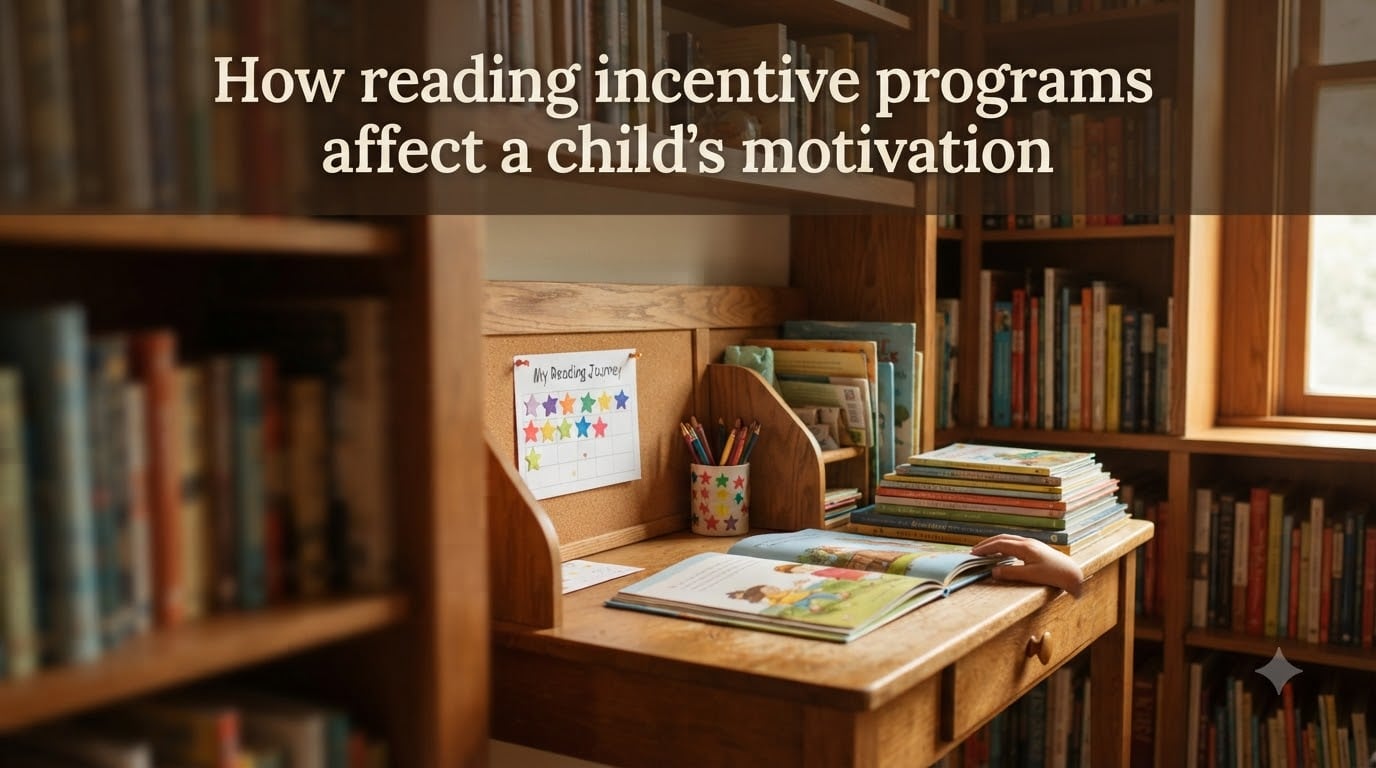
I have watched my own children light up at the promise of a pizza party and watched other children sigh at the sight of another sticker chart. Reading incentive programs work in ways that surprise most parents, and the research behind them is more complicated than a simple rewards-are-bad or rewards-are-great message.
This guide explains how reading incentive programs affect a child’s motivation using peer-reviewed research and practical classroom observations. You will learn what the science says, when rewards help, when they backfire, and how to transition children toward reading for genuine enjoyment. By the end, you will have a clear framework for using incentives wisely without crushing the love of reading.
Table of Contents
What Are Reading Incentive Programs?
Reading incentive programs are structured systems that offer external rewards for completing reading tasks. They appear in schools, public libraries, homeschool co-ops, and family homes across the country. The most recognizable examples include Pizza Hut Book It, Accelerated Reader, and the summer reading clubs run by local libraries.
These programs typically track reading through logs, quizzes, or time-based goals. Children earn points, prizes, certificates, or special privileges when they hit milestones. Some reward minutes read, others reward books finished, and still others reward comprehension test scores.
Three main categories dominate the landscape. Token reward programs offer small prizes like bookmarks, pencils, or gift cards. Recognition programs focus on certificates, honor rolls, and public celebration. Activity-based programs grant experiences such as extra recess, field trips, or pizza parties. Each operates on different psychological principles and produces different motivational outcomes.
How Reading Incentive Programs Affect a Child’s Motivation
Reading incentive programs affect a child’s motivation in three measurable ways. Short-term reading volume increases, comprehension sometimes improves, but long-term intrinsic motivation often declines. The effect depends on the type of reward, the child’s age, and how the program is framed.
A 2010 study published in the journal Literacy Research and Instruction tracked elementary students over a full school year. Students in high-reward incentive programs read more books during the program period but showed lower voluntary reading when rewards were removed. Researchers called this the overjustification effect, where an activity that was already somewhat interesting becomes less interesting once external rewards take over.
The nuance matters. When the reward itself supports reading, like a new book or a trip to the bookstore, motivation often stays high. When the reward is unrelated to reading, like candy or screen time, motivation drops more sharply. This single distinction explains why some parents and teachers swear by incentives while others watch their students lose interest.
The Research on Extrinsic Rewards and Intrinsic Motivation
Behavioral psychology research from the 1970s onward reveals a consistent pattern. External rewards can boost performance while the reward is present, but they tend to erode the underlying interest that fueled the activity in the first place. This finding emerged from dozens of studies on puzzles, games, and creative tasks, and reading behaves similarly.
Researchers identified three mechanisms at work. First, rewards shift attention away from the activity itself and toward the prize. Second, children begin to attribute their reading to the reward rather than to their own choice. Third, the reward sets a price on the activity, making the unrewarded version feel like a loss.
A landmark review by McQuillan examined reading incentive programs across multiple school districts. The conclusion was sobering. Students in heavy reward programs scored higher on standardized reading tests during the program but reported lower enjoyment of reading and chose to read less during free time. The programs produced better short-term numbers and worse long-term readers.
However, the research is not uniformly negative. Studies on struggling readers and reluctant readers show that incentives can open a doorway into reading that did not exist before. A child who never picks up a book may, with the right incentive, discover an author they love. Once that discovery happens, intrinsic motivation can take over.
Types of Reading Incentive Programs Compared
Different incentive structures produce different motivational effects. Below is a side-by-side comparison of the most common program types parents and teachers encounter.
| Program Type | Typical Reward | Best For | Motivational Risk |
|---|---|---|---|
| Pizza Hut Book It | Free pizza personal pan | Whole-class participation | Moderate (food reward) |
| Accelerated Reader | Points and recognition | Comprehension tracking | Higher (quiz-based pressure) |
| Library Summer Reading | Prizes, certificates, coupons | Preventing summer slide | Low to moderate |
| Time-Based Programs | Minutes read logged | Building reading stamina | Low (focus on habit) |
| Book-Reward Programs | Free book or bookstore trip | Developing personal libraries | Lowest (reading-aligned reward) |
Book-reward programs consistently perform best in motivation research because the prize reinforces the activity itself. Time-based programs come second because they focus on building a habit rather than chasing a prize. Quiz-based programs like Accelerated Reader produce the most mixed results because they add assessment pressure that can feel punishing to struggling readers.
Signs That Incentives May Be Counterproductive
Watch for these warning signs that your reading incentive program is doing more harm than good.
Your child only reads when a reward is on the table and stops the moment prizes end.
Your child picks short or easy books to maximize quantity rather than engaging with harder material.
Reading has become a negotiation rather than a pleasure, with daily arguments about goals.
Your child memorizes quiz answers or shortcuts the comprehension process to earn points faster.
Free-time reading drops to near zero even though your child meets all program goals.
Your child expresses anxiety or frustration about reading rather than excitement.
Your child chooses screen time, sports, or other activities with relief when reading time ends.
If you recognize three or more of these signs, the incentive program needs adjustment. A small reframe toward book rewards, time-based goals, or autonomy-supporting choices can shift the balance.
Age-Specific Considerations for Reading Motivation
Children respond to reading incentive programs differently at each developmental stage. Understanding these differences helps you choose the right approach for your child’s age.
Early Elementary (Ages 5-7)
Young children are still building foundational reading skills. Token rewards and sticker charts work well here because the goal is repetition and confidence-building. Short, daily reading with immediate praise produces strong results. Avoid quiz-based programs at this stage because comprehension pressure can damage early enthusiasm.
Upper Elementary (Ages 8-11)
Children in this range begin forming their reading identity. Time-based programs and book-reward programs outperform token systems because they respect growing autonomy. Allow children to choose what they read rather than assigning titles. Reading logs work when the focus stays on minutes or pages rather than scores.
Middle School (Ages 12-14)
Adolescent readers are highly sensitive to perceived judgment. Public reward charts and competitive ranking systems can backfire badly at this age. Bookstore gift cards, book subscription boxes, and choice-based programs perform best because they treat teens as independent readers rather than performers.
Neurodivergent readers, including children with ADHD, dyslexia, and autism, often benefit from incentives that reduce friction rather than increase output. Audiobooks, graphic novels, and choice-based programs tend to outperform traditional reward structures for these learners.
Practical Tips for Using Reading Incentives Effectively
Most parents and teachers do not need to abandon incentives entirely. They need to use them more deliberately. Below is a practical framework for getting the motivational benefits of incentives while protecting long-term reading love.
Choose book-related rewards whenever possible. A new novel, a bookstore trip, or a library wishlist card reinforces the activity itself.
Reward effort and time, not just output. A child who struggles through a difficult chapter deserves the same recognition as a child who breezes through easy ones.
Set time-based goals rather than page or book counts. Twenty minutes of daily reading builds a habit. Fifty pages feels arbitrary.
Let your child choose the reading material. Autonomy is one of the strongest predictors of intrinsic motivation in every age group.
Use rewards as celebration, not payment. Frame them as recognition of effort rather than earned income per book.
Phase out rewards gradually. Start the year with incentives, then reduce them as the habit solidifies.
Pair incentives with discussion. Talk about what your child is reading, what surprised them, and what they would recommend.
One strategy I have seen work well in real families is the starter reward approach. Parents offer a small, meaningful incentive for the first few weeks of a new reading routine. Once the child is reading regularly without prompting, the reward fades and the habit takes its place. This pattern uses the incentive as a bridge rather than a destination.
Forum discussions from parenting and teacher communities reinforce this approach. Parents on Reddit and the Well-Trained Mind forums consistently report that dollar-per-book systems work initially but create dependency. Time-based incentives feel less pressured than page-count goals. And teachers find that book tastings and genre exploration outperform point systems for building genuine interest.
Building Intrinsic Motivation to Read
The goal of every reading incentive program should be to make itself unnecessary. Children who become lifelong readers read because they enjoy stories, information, and ideas, not because someone promised them a prize.
Three strategies build intrinsic motivation more effectively than any reward system. First, give children wide choice over what they read. Second, connect reading to social activities like book clubs, family read-alouds, and book-swapping events. Third, model reading yourself so children see adults they love doing the activity.
Choice, connection, and modeling beat prizes in nearly every study on long-term reading habits. A reward gets a child to open a book. These three elements keep the book open long after the rewards are gone.
FAQs
Do reading incentives work?
Yes and no. Research shows reading incentives reliably boost short-term reading volume, but they often reduce intrinsic motivation once rewards are removed. Book-related rewards and time-based goals produce the best results.
What is the role of motivation in learning classroom incentives?
Motivation determines whether students engage with reading for its own sake or only for external payoffs. Classroom incentives work best when they support autonomy, competence, and connection rather than compliance.
How do we promote reading intrinsic motivation?
Build intrinsic reading motivation by giving children wide choice over books, connecting reading to social experiences like family read-alouds and book clubs, and modeling reading yourself. Avoid tying rewards to specific output numbers.
Does reading fluency help in achieving motivation?
Yes. Reading fluency removes the mechanical barriers that make reading feel like work. Children who read fluently experience stories instead of decoding words, which strengthens enjoyment and long-term motivation.
Should parents pay kids to read?
Paying kids per book can produce short-term reading gains but risks creating a transactional view of reading. Many educators recommend book rewards, bookstore trips, or time-based recognition instead of direct cash payment.
Conclusion
Reading incentive programs affect a child’s motivation in ways that depend on what the program rewards, how it is framed, and how long it lasts. Used carelessly, incentives can turn readers into reward hunters. Used carefully, they can open a doorway into reading that did not exist before.
The clearest finding from decades of research is that book-related rewards and time-based goals protect intrinsic motivation better than cash, food, or quiz-based systems. Pair incentives with choice, connection, and adult modeling, and you have a recipe for building readers rather than just filling out reading logs.
Start by auditing your current program against the warning signs above. If your child shows three or more red flags, adjust the rewards, the goals, or the duration. Then phase incentives out as the habit takes hold. The ultimate measure of success is not how many books your child finished during the program. It is whether your child still picks up a book when no one is watching.