
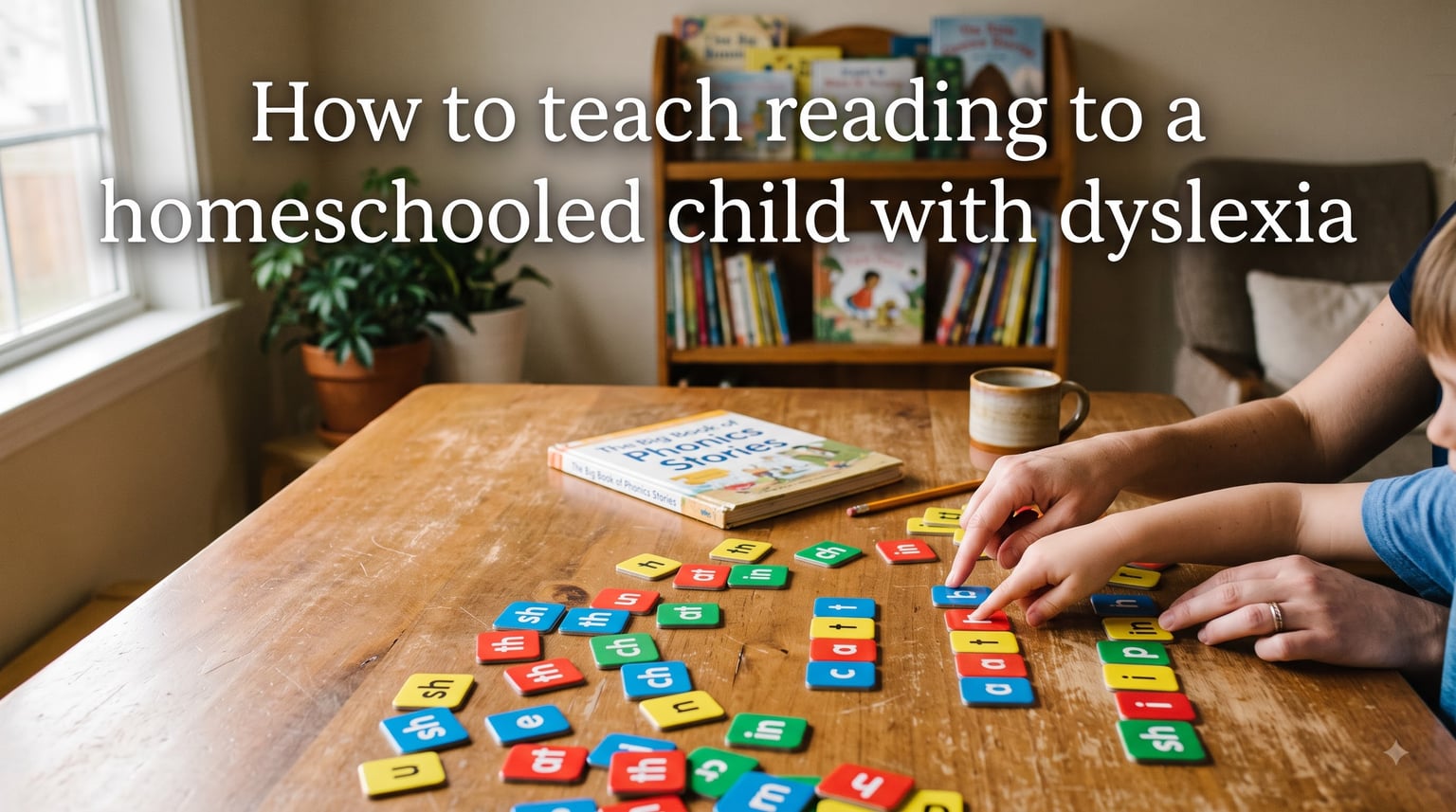
Teaching reading to a homeschooled child with dyslexia can feel overwhelming at first, especially if you’ve already tried programs that didn’t click. I know that sinking feeling of buying a curriculum, opening it up, and wondering whether your child will ever read fluently.
The good news is this: with the right approach, dyslexic children absolutely can learn to read. I’ve seen it happen with my own students, and the research backs it up. In this guide, I’ll walk you through exactly how to teach reading to a homeschooled dyslexic child, from understanding dyslexia itself to building a daily routine that works.
You’ll learn the multi-sensory structured literacy methods that actually move the needle, how to choose between popular curricula, and how to keep both your child and yourself from burning out. Everything here is built around evidence-based practice, not guesswork.
Table of Contents
What Is Dyslexia and How Does It Affect Reading
Dyslexia is a neurologically based learning difference that affects how the brain processes written language. Children with dyslexia usually have average or above-average intelligence, but they struggle to connect letters with the sounds they represent.
The core issue is phonological processing. Your child may hear sounds fine, but linking those sounds to written symbols (graphemes) feels like trying to crack a secret code. That’s why traditional sight-word-heavy instruction often leaves dyslexic kids behind.
Dyslexia also affects working memory, processing speed, and sometimes spelling. The word “bottle” might look like “btolle” to your child because letter order gets jumbled. This is not a vision problem and not laziness. It’s how the brain is wired.
Common signs include difficulty rhyming, slow letter naming, frequent letter reversals past age 7, and avoiding reading aloud. If several of these sound like your child, a formal evaluation can confirm dyslexia and unlock access to specialized instruction.
Why Standard Reading Instruction Often Fails Dyslexic Learners
Most classrooms teach reading through a balanced literacy or whole-language approach. These methods assume kids can pick up letter-sound relationships by exposure.
For dyslexic children, this assumption doesn’t hold. They need explicit, systematic phonics instruction that teaches every sound-symbol relationship directly, not implicitly. Without that, gaps compound quickly.
Why Homeschooling Works for Dyslexic Children
Homeschooling gives dyslexic kids something classrooms rarely can: one-on-one instruction tailored to their exact level. No waiting for the class to catch up. No embarrassment when they stumble on a word.
You can spend an extra two weeks on short vowels without falling behind a curriculum schedule. You can re-teach the same concept seven different ways until one finally clicks. That flexibility is the single biggest advantage you have.
Homeschooling also lets you control the environment. A dyslexic child in a quiet room with a patient parent beats 30 kids and a stressed teacher almost every time.
You can fold reading practice into daily life. Menu reading at restaurants, recipe cards in the kitchen, road signs on a drive. These low-pressure moments add up. Several studies on homeschooled dyslexic learners show outcomes equal to or better than school-based remediation when parents use evidence-based methods.
The Confidence Factor
Many dyslexic children develop reading anxiety after years of school struggle. They associate books with failure. Homeschooling lets you rebuild that association from scratch.
Start with material far below grade level, where success is guaranteed. Celebrate every win, no matter how small. Within weeks, the dread begins to fade.
Essential Teaching Methods: Multi-Sensory Structured Literacy
Multi-sensory structured literacy is the gold standard for teaching dyslexic children to read. Every major dyslexia organization, including the International Dyslexia Association, recommends it.
The method engages three learning channels simultaneously: visual (seeing the letter), auditory (saying the sound), and kinesthetic (tracing or writing). When all three fire at once, the brain forms stronger neural pathways than any single channel alone.
What Multi-Sensory Instruction Looks Like in Practice
Say you’re teaching the letter “b” and its /b/ sound. A multi-sensory lesson would include:
- Visual: Showing a picture of a bat and the letter “b” side by side.
- Auditory: Saying “b-b-bat” out loud three times.
- Kinesthetic: Having the child trace the letter in sand, on carpet, or in the air while saying the sound.
Repeat this with each new phoneme until it’s automatic. The same approach works for syllables, prefixes, suffixes, and full words.
Structured Literacy and the Orton-Gillingham Approach
Structured literacy is the broader umbrella. It requires instruction that is systematic (follows a logical order), explicit (nothing is left for the child to infer), and cumulative (each lesson builds on the last).
The Orton-Gillingham approach is the original structured literacy method, developed in the 1930s. Nearly all modern dyslexia programs, including Barton, All About Reading, and Logic of English, are rooted in Orton-Gillingham principles.
If a curriculum claims to teach dyslexic readers but isn’t systematic and explicit, keep looking. Your child needs the rules of English taught directly, not absorbed through guessing.
Recommended Curriculum Options for Dyslexic Homeschoolers
Choosing a curriculum is one of the biggest decisions you’ll make. The right program makes teaching easier. The wrong one wastes months.
All About Reading
All About Reading is one of the most popular choices among homeschool parents of dyslexic kids. It’s an Orton-Gillingham-based program with scripted lessons, so you don’t need a teaching background to use it well.
Lessons include hands-on letter tiles, decodable readers, and built-in review. The pace is gentle and the materials are colorful. Many parents in online communities say it’s the first program that finally worked for their child.
Logic of English
Logic of English teaches not just phonics but the logic behind English spelling rules. Why does “one” end with “e”? Why is “said” spelled that way? The curriculum explains these patterns clearly.
It’s a strong choice for kids who ask “why” constantly or who get frustrated by exceptions. The Foundations program works for early readers; Essentials handles older struggling readers.
Barton Reading and Spelling System
Barton was designed specifically for struggling readers and dyslexic learners. It’s widely used by tutors and homeschool parents who want a rigorous, research-based program.
The lessons are longer and the pace is more demanding than All About Reading. If your child is older or severely behind, Barton often makes faster progress.
How to Choose Between Programs
Start by considering your child’s age, attention span, and severity of reading difficulty. Younger children often thrive with All About Reading’s lighter pace. Older students who are years behind may need Barton’s intensity.
Most curricula offer sample lessons online. Try before you buy. Your child’s engagement with the first three lessons predicts long-term success better than any review.
Building a Daily Reading Practice Routine
Consistency matters more than duration. A dyslexic child who reads 20 minutes daily will outpace a child doing two-hour sessions twice a week. The brain needs repeated exposure to form automatic decoding skills.
A Sample 30-Minute Daily Lesson
Here’s a structure that has worked for hundreds of dyslexic homeschoolers I’ve worked with. Adjust as needed, but keep the core components.
- Warm-up review (5 minutes): Review previously learned phonemes, syllables, or words. Use flashcards or a quick game.
- New concept introduction (10 minutes): Introduce one new phoneme, rule, or word family using multi-sensory techniques.
- Guided practice (10 minutes): Read decodable text together. Take turns. Correct errors gently and immediately.
- Independent or read-aloud time (5 minutes): Either silent reading of an easy book or read-aloud of a favorite picture book.
Aim for four to five lessons per week. Take weekends off if needed. Burnout helps no one.
Adding Audiobooks and Audio Support
Audiobooks let your child access stories above their reading level without struggling through every word. Services like Learning Ally and Audible offer vast libraries.
Pair audiobooks with physical books so your child can follow along visually. This builds vocabulary, comprehension, and a love of stories. None of it replaces decoding practice, but it keeps joy in the reading journey.
Getting Started: Assessment and Planning
Before you teach, you need to know where your child stands. A baseline assessment prevents wasted time on material that’s too easy or impossibly hard.
Formal Evaluations
A formal dyslexia evaluation by a psychologist or educational diagnostician costs anywhere from free (through your public school district on request) to several thousand dollars privately. The report identifies specific weaknesses: phonological processing, rapid naming, working memory.
If your child is school-age and you’ve pulled them out to homeschool, you may still qualify for evaluations through your district. Ask about a Child Find referral or response-to-intervention evaluation.
Informal Reading Assessment at Home
No budget for a formal evaluation? You can still get a clear picture. Pick a graded reader and have your child read aloud. Note the highest level where they read with at least 90 percent accuracy and decent comprehension.
That level is your starting point. Go back two levels for instruction and use the assessment level for independent practice.
Setting Goals and Building a Plan
Write down one main reading goal for the next three months. Examples: “Master all short vowel sounds” or “Decode three-syllable words independently.”
Smaller goals work best. Mastery of letter sounds beats “read at grade level” as a working target. Track weekly and adjust as you go.
Dealing With Frustration and Building Confidence
Emotional safety matters as much as curriculum choice. A dyslexic child who hates reading lessons will fight you every day, no matter how good the program.
Watch for signs of frustration: clenched jaw, avoidance, tears, sudden headaches. When you see them, stop the lesson. Pushing through rarely helps and often backfires.
Practical Strategies That Work
Break lessons into smaller chunks. Two 15-minute sessions beat one 30-minute meltdown. Offer frequent breaks. Use timers to show when the lesson will end.
Let your child choose the read-aloud book, even if it’s below their level. Read together, taking turns page by page. Keep a “success jar” where you drop a marble for each mastered word or skill. When it fills, celebrate.
Taking Care of the Parent
You will have bad days. Days when nothing sticks and your child cries and you wonder why you started this journey. That’s normal. It’s not a sign that you’re failing.
Find at least one other homeschool parent of a dyslexic child to talk to regularly. Online communities, local co-ops, or a mentor can carry you through the hard stretches. You cannot pour from an empty cup, so protect your own rest.
Tracking Progress and Adjusting Methods
What gets measured gets improved. Keep a simple reading log: date, lesson number, new concepts, mastery notes. Review it monthly.
If your child isn’t progressing after two months on a curriculum, something is off. It could be the program, the pace, or an undiagnosed issue like auditory processing.
When to Adjust Your Approach
Plateaus are normal. Persistent lack of progress over six weeks is a signal to change something. Options include switching curriculum, slowing the pace, adding tutoring hours, or consulting a dyslexia specialist.
Don’t be afraid to abandon a program that’s not working. The money is already spent, but the time is not.
Support Resources for Parents
You don’t have to teach reading alone. Resources abound for parents of dyslexic homeschoolers.
Online communities like the Homeschooling with Dyslexia Facebook group and the r/dyslexia subreddit on Reddit offer daily advice from parents in your shoes. The Homeschooling with Dyslexia website has parent courses and mentoring programs. The International Dyslexia Association publishes fact sheets covering everything from testing to curriculum choices.
For books, “The Gift of Dyslexia” by Ronald Davis and “Overcoming Dyslexia” by Sally Shaywitz are excellent parent primers. They explain the science without overwhelming you.
If budget allows, a one-time consultation with a dyslexia specialist can set your entire homeschool up for success. Even a single hour of expert input often pays for itself in saved curriculum mistakes.
Frequently Asked Questions
What is the best reading curriculum for homeschoolers with dyslexia?
All About Reading and Barton are the most popular evidence-based options. All About Reading works well for younger or less severe cases due to its gentle pace. Barton is more rigorous and often produces faster progress for older or severely struggling readers. Logic of English is another strong choice for kids who benefit from understanding spelling rules.
Is homeschooling good for kids with dyslexia?
Yes. Homeschooling allows one-on-one instruction, individualized pacing, and a low-anxiety environment, all of which are critical for dyslexic learners. Research and parent reports consistently show that homeschooled dyslexic children using structured literacy methods make strong reading gains, often outpacing their school-based peers.
What is the best way to teach reading to a child with dyslexia?
The best method is multi-sensory structured literacy rooted in Orton-Gillingham principles. Teach one phoneme at a time using visual, auditory, and kinesthetic channels simultaneously. Practice daily in short sessions. Use decodable readers and review constantly. Avoid sight-word memorization as a primary strategy.
Will my dyslexic child ever learn to read?
Yes. With appropriate instruction, nearly all dyslexic children learn to read, though the timeline varies. Some children reach grade level by middle school. Others remain slower readers but become fully literate adults. The key is starting early, using evidence-based methods, and never giving up. Persistence is the single biggest predictor of long-term success.
Final Thoughts on Teaching Your Homeschooled Dyslexic Child
Teaching reading to a homeschooled child with dyslexia is a marathon, not a sprint. The multi-sensory structured literacy approach works. Daily practice works. Patience, paired with the right curriculum, works.
You don’t need to be a trained teacher to do this well. You need the right tools, consistent daily effort, and a willingness to adjust when something isn’t clicking. Your child is lucky to have a parent who cares enough to research how to teach reading to a homeschooled dyslexic child. That dedication will pay off in ways that matter for the rest of their life.
Take it one lesson at a time. Celebrate small wins. Find your community. And remember: with the right approach in 2026, your child can absolutely learn to read.