
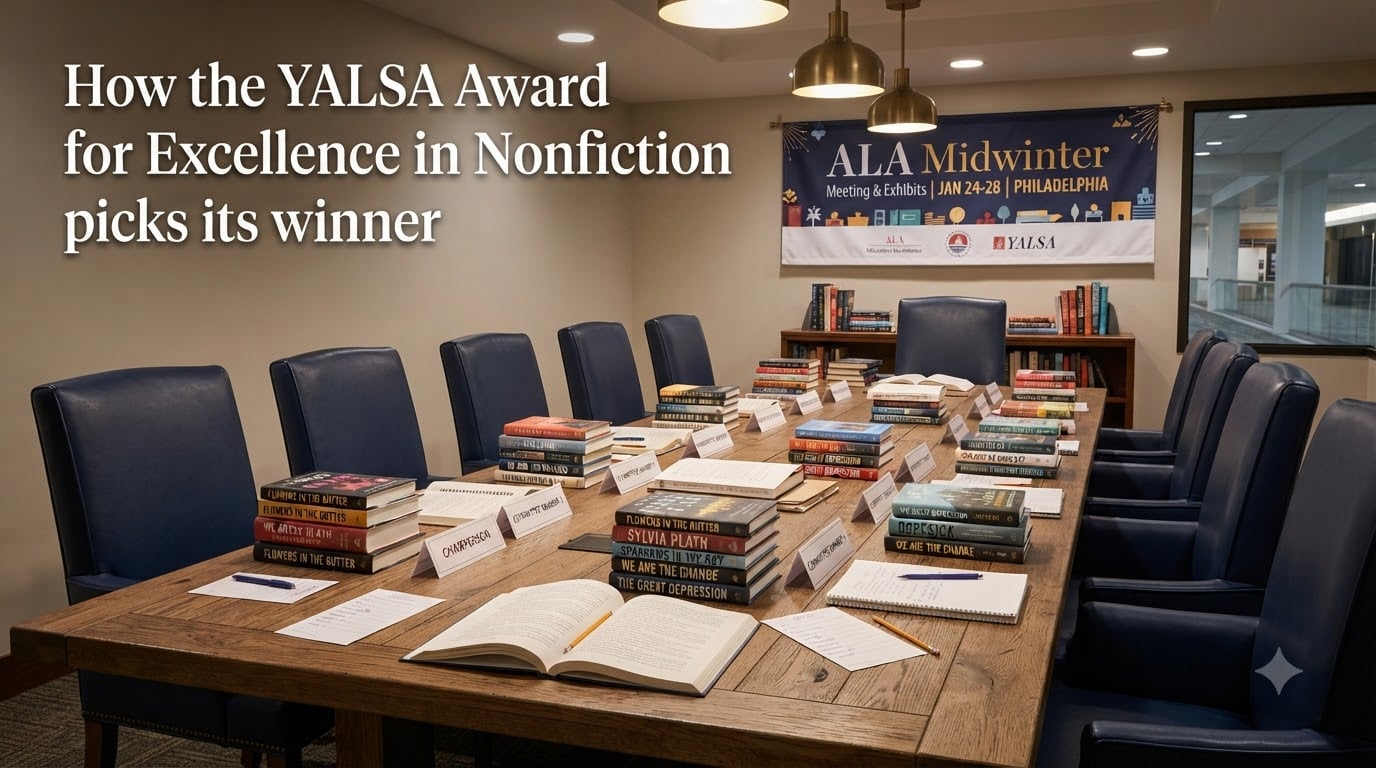
The YALSA Award for Excellence in Nonfiction honors the single best nonfiction book published for young adults each year, and the selection process is more deliberate than most readers realize. I dug into the official YALSA policies, the ALA archives, and the past winners lists to walk you through exactly how the YALSA Award for Excellence in Nonfiction picks its winner from the first committee meeting in February to the final announcement in January.
Whether you are a librarian building a collection, a parent looking for trustworthy nonfiction for a teen, or a publisher considering a submission, this guide breaks the full process into clear steps. You will see how the ten-member committee forms, how titles become eligible, how the shortlist is built, and how the point-based voting system actually decides the winner.
Table of Contents
What Is the YALSA Award for Excellence in Nonfiction?
The YALSA Award for Excellence in Nonfiction is an annual literary honor presented by the Young Adult Library Services Association, a division of the American Library Association, that recognizes the best nonfiction book published for young adults ages 12-18. It was established in 2010 to fill a gap in the YA awards landscape, which had long been dominated by fiction-focused honors.
The award exists to celebrate quality writing, solid research, and thoughtful presentation of nonfiction subjects for teen readers. It also gives libraries, schools, and readers a trusted shortlist to lean on when selecting nonfiction for YA collections. Each year, the winner is announced at the ALA Midwinter Meeting, one of the largest library conferences in the United States.
Award Purpose and Mission
The award’s stated mission is to honor the best nonfiction published for young adults in a given award year and to promote wider readership of the genre. In practice, this means the committee weighs both literary quality and how accessible the content is for teen readers, not just subject matter expertise.
By singling out one title and a small group of honor titles, the award gives bookstores, school librarians, and curriculum coordinators a curated signal. I have seen this curation matter when our team compares award shortlists against community reading lists, and the YALSA nonfiction list is consistently one of the most reliable filters for YA nonfiction quality.
Who Sits on the Selection Committee?
Ten voting members and a non-voting chair form the committee each year, and they are appointed by the YALSA President-Elect to serve staggered terms. The Chair is appointed separately and acts as the facilitator, not as a voter, which keeps the process moving without giving one role outsized influence over the outcome.
Members are typically working librarians, school media specialists, or young adult literature specialists with strong familiarity with the YA publishing landscape. Each member commits to reading the entire eligible field and to attending all committee meetings held during the selection process. This commitment is the backbone of the award’s credibility, because the committee cannot rank titles it has not read.
The Role of the Committee Chair
The Chair sets the meeting calendar, runs the discussions, and ensures the policies are followed but does not vote on the final ballot. The Chair also acts as the committee’s public spokesperson for the final announcement and serves as the liaison between the committee and YALSA leadership.
Because the Chair does not vote, a single appointment cannot tip the result. This separation between facilitation and voting is one of the more thoughtful design choices in the process, and it is something the official YALSA policies emphasize.
What Books Are Eligible for the Award?
A book qualifies if it is a nonfiction title first published in the United States between November 1 and October 31 of the award year and intended for young adult readers ages 12-18. Reprints, new editions, and titles originally published before November 1 of the award year are not eligible, even if they are released in a new edition during the window.
Eligible titles must be nonfiction, which includes memoir, autobiography, narrative nonfiction, essays, and informational titles that serve a young adult audience. The committee evaluates books on writing quality, research quality, readability, presentation, and the overall treatment of the subject. Aesthetic design and visual layout matter too, especially for heavily illustrated works.
Who Can Nominate a Book
Publishers, authors, librarians, and the general public can submit titles for consideration. Publishers send copies directly to the committee through a process administered by YALSA, and committee members often pull additional titles from their own professional reading and from field suggestions submitted by other librarians and educators.
Field suggestions are an underappreciated part of the process. YALSA members who are not on the committee can still flag titles they think deserve a look, and these suggestions are reviewed by the committee alongside publisher submissions. This is one of the key pathways for a strong title to make the shortlist without major publisher backing.
The Selection Timeline From February to January
Committee members begin their term in February, read and discuss eligible titles throughout the year, narrow the field to a shortlist in November, announce finalists the first week of December, and reveal the winner at the ALA Midwinter Meeting in January. The full cycle runs roughly eleven months from swearing in to the public announcement.
Phase 1: February to April (Onboarding and Reading)
The new committee is seated in February, and the Chair holds an initial organizational meeting. By March, members begin receiving publisher submissions and pulling titles from their own research. Throughout the spring, members read widely and submit informal nominations to the group.
Phase 2: May to August (Deep Reading and Discussions)
Summer is when the heaviest reading happens. Members split the eligible field, host monthly conference calls or virtual meetings, and start sharing short reviews of standout titles. The committee works through long lists of nominations during this period to identify which books deserve deeper discussion.
Phase 3: September to November (Shortlist Building)
In the fall, the committee narrows the long list to a small shortlist of final contenders. Multiple rounds of discussion and informal ballots take place, and only the titles with broad support move forward. By late November, the committee has typically settled on the finalists that will appear on the December shortlist.
Phase 4: December (Finalist Announcement)
The first week of December, YALSA publishes the official shortlist of finalists. The shortlist usually includes the eventual winner and up to four honor titles. Finalists are embargoed until the announcement, so even the shortlisted authors do not know the final outcome until January.
Phase 5: January (Winner Announcement)
The winner is announced in January at the ALA Midwinter Meeting, typically during a dedicated press conference streamed for library staff worldwide. The winning title and the honor titles are all revealed together, and YALSA publishes a press kit, reading guides, and discussion materials immediately after.
How the Point-Based Voting System Works?
Each committee member privately ranks three finalists using a 5-3-1 point system, and the winner needs at least five first-place votes and five more points than the second-place finisher. This combination of a majority threshold and a point margin is what makes the final result both decisive and hard to game.
Here is how the points add up on a typical final ballot:
First-choice title: 5 points
Second-choice title: 3 points
Third-choice title: 1 point
Each of the ten voting members submits a ballot, so the maximum number of first-place votes a single title can receive is ten. The dual requirement of five first-place votes plus a five-point lead over the runner-up forces the committee to converge on a single clear favorite rather than splitting the award between two strong contenders.
What Happens If No Title Meets the Threshold?
If no title clears both thresholds on the first ballot, the committee holds additional rounds of discussion and revotes. Final ballots are repeated until a winner emerges, which is rare but not unheard of in years with a particularly strong shortlist. The committee does not announce a winner unless one of the titles has genuinely earned majority support with the required margin.
All final ballots are conducted by secret oral ballot, tallied by the Chair, and the results are kept confidential until the public announcement. This is one of the reasons the YALSA Award results are trusted by the library community: the process is designed to resist lobbying, groupthink, and outside pressure.
Confidentiality and Conflict of Interest Rules
Committee members must keep all discussions secret until the official announcement and recuse themselves from any title where they have a personal or professional stake. Anyone who has worked on a finalist title, has a close personal relationship with one of the authors, or has a financial interest in the publisher must step out of the room during discussions and voting on that title.
Confidentiality rules extend beyond the verdict. Members cannot share which titles they personally championed, how individual ballots were cast, or which titles came close in the final vote. This is a firm policy, and violation of confidentiality can result in removal from the committee and a ban from future YALSA service.
These rules are not just procedural. They are what keeps the integrity of the award intact year after year, and they explain why the shortlist often surprises people. Committee members are explicitly told not to coordinate their votes outside of meetings, and the Chair is responsible for enforcing that boundary.
Recent Winners and Honor Titles
Each year’s winner is accompanied by a curated list of honor titles that recognize other standout nonfiction books for teens. The honor list is usually three to five titles long and is published alongside the winner during the ALA Midwinter Meeting press conference.
Looking at recent winners, the committee has leaned toward titles that combine rigorous reporting with narrative drive, including works on youth activism, science, history, and memoir. The mix of subjects shows the committee’s commitment to honoring nonfiction across the full range of teen interests, not just the topics that dominate bestseller lists.
Why the Honor List Matters?
The honor list is often more useful than the single winner for anyone building a YA nonfiction collection. While only one book can take the top prize, the honor titles are the next-best filter the committee can offer, and they usually include the strongest runner-ups from the year.
Many libraries I have spoken with treat the entire shortlist as a reading list for the year, not just the winner. Our team has done the same when comparing the YALSA list against other YA nonfiction awards, and the honor titles consistently surface books that hold up for years after the award cycle ends.
How the YALSA Award Compares to Other YA Book Awards?
The YALSA Award for Excellence in Nonfiction fills a specific niche as one of the only major U.S. awards dedicated solely to nonfiction for teens, sitting alongside the Printz Award for fiction and the Alex Awards for adult books with teen appeal. Each of these awards uses a different committee structure and process, but the YALSA nonfiction award is the most direct match for someone specifically looking for nonfiction written for young adults.
The Printz Award focuses on literary excellence in YA fiction, the Alex Awards recognize the top ten adult books with teen appeal, and the YALSA nonfiction award sits in the nonfiction gap in between. Newbery and Caldecott awards cover a broader age range, while the YALSA award is targeted squarely at ages 12-18.
The practical takeaway for librarians and educators is that the YALSA nonfiction award is the single most reliable U.S. filter for quality YA nonfiction. If a teen reader is asking for a nonfiction book and you want a vetted recommendation, the YALSA shortlist is the best place to start before branching out to other awards and reviews.
FAQs
What is the YALSA Award for Excellence in Nonfiction?
It is an annual literary award given by the Young Adult Library Services Association to the best nonfiction book published for young adults ages 12-18.
How many people are on the YALSA Nonfiction Award committee?
Ten voting members and a non-voting chair make up the committee, appointed by the YALSA President-Elect to serve staggered terms.
When is the YALSA nonfiction winner announced?
The winner is announced in January at the ALA Midwinter Meeting, with the official shortlist released the first week of December.
How does the voting work for the YALSA nonfiction award?
Each committee member ranks three finalists using a 5-3-1 point system, and the winner must receive at least five first-place votes and five more points than the second-place finisher.
Who can nominate a book for the YALSA nonfiction award?
Publishers, authors, librarians, and the public can submit titles for committee review, and YALSA members can also submit field suggestions for books they want the committee to consider.
Final Thoughts on How the YALSA Award for Excellence in Nonfiction Picks Its Winner
The YALSA Award for Excellence in Nonfiction picks its winner through a deliberate, year-long process that combines deep committee reading, staged shortlist building, and a strict point-based voting system. The result is a single winner and a shortlist of honor titles that librarians, educators, and teen readers can trust.
For 2026, the shortlist is one of the clearest signals in YA nonfiction, and the process behind it is worth understanding whether you are submitting a book, building a library collection, or just looking for your next great read. Start with the December shortlist, watch the January announcement, and then keep the honor titles on your reading list well beyond the award cycle.