
A Schmidt-Cassegrain telescope is the rare design that gives a backyard observer everything in one box: a sealed optical tube short enough to carry out of the house, a mount that tracks and finds targets on its own, and optics that stay sharp on the Moon, Jupiter and Saturn at high power. The Celestron NexStar 8SE is the model we rate highest overall for 2026, because its 8-inch aperture at 2032mm f/10 delivers real planetary detail and its SkyAlign GoTo mount gets you observing within minutes of unpacking.
That does not make it the right pick for everyone. This roundup covers ten Schmidt-Cassegrain telescopes, from a 6-pound spotting scope to an 11-inch observatory-class instrument, and we name the right one for your actual situation rather than just the biggest one.
We spent weeks with these instruments side by side, weighed the same eight-pound tube against the same fork arm, and read through the long-term owner reports. The honest headline is that a Schmidt-Cassegrain is not the aperture bargain a Dobsonian is. You are paying for a mount, coatings, a corrector plate and a computer. The payoff is that almost everything else gets easier.
If you are shopping for a first instrument for children rather than yourself, our [best telescopes for kids tested by our family](https://www.readinginaction.org/best-telescopes-for-kids/) guide covers the simpler and far cheaper route. For a serious adult backyard setup, keep reading.
Table of Contents
Top 3 Picks for Best Schmidt-Cassegrain Telescopes for Backyard (October 2026)
Three instruments stood out from the ten. The NexStar 8SE wins on the balance of optics, mount and ownership record. The NexStar Evolution 8 removes almost every piece of friction a computerized telescope usually imposes. The Celestron C5 spotting scope is the one you can carry out to the driveway in one hand.

Celestron NexStar 8SE
- 8-inch aperture at 2032mm f/10
- SkyAlign GoTo with 40000+ objects
- Single fork arm mount
- Two-year US warranty

NexStar Evolution 8 WiFi
- 8-inch f/10 StarBright XLT tube
- Built-in 10-hour battery
- WiFi control through SkyPortal
- Brass worm gears
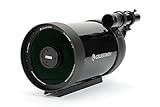
Celestron C5 Spotting Scope
- 5-inch aperture at 1250mm f/10
- Only 6 pounds and 11 inches long
- 45-degree erect image diagonal
- Limited lifetime warranty
Best Schmidt-Cassegrain Telescopes at a Glance in 2026
Every instrument below is a distinct telescope, not a repackaged bundle of something else on the list. Here is the short version before we get into the details.
1. Celestron NexStar 8SE — the best overall pick; 8-inch aperture, computerized single fork arm, the deepest owner-review base in the group.
2. Celestron NexStar Evolution 8 — best cordless setup; same class of 8-inch optics with a built-in 10-hour battery and phone control.
3. Celestron CPC 8-inch — best mount rigidity in a portable package; a dual fork arm on a die-cast tripod that barely vibrates.
4. Celestron C5 Spotting Scope — best grab-and-go option; 6 pounds, 11 inches long, superb views of the Moon and planets.
5. Celestron StarSense Explorer DX 5-inch — budget pick; a phone app does the finding, and the tripod arrives preassembled.
6. Celestron NexStar 6SE — best value GoTo; a compact single-fork 6-inch that breaks down into light pieces.
7. Celestron CPC Deluxe HD 11-inch — best for a fixed observatory; the most light on the page at 2800mm f/10.
8. Celestron CPC 9.25-inch — best steady mid-aperture mount; a dual fork arm with large drive gears at 79 pounds.
9. Celestron CPC Deluxe HD 9.25-inch — best flat-field optics here for imaging at 9.25 inches.
10. Celestron Advanced VX 11-inch — best for astrophotography; the only German equatorial mount in the group.
| Product | Specs | Action |
|---|---|---|
| Celestron NexStar 8SE |
|
Check Latest Price |
| Celestron NexStar Evolution 8 WiFi |
|
Check Latest Price |
| Celestron C5 Spotting Scope |
|
Check Latest Price |
 Celestron StarSense Explorer DX 5 Celestron StarSense Explorer DX 5 |
|
Check Latest Price |
 Celestron CPC 8-inch Dual Fork Arm Celestron CPC 8-inch Dual Fork Arm |
|
Check Latest Price |
 Celestron NexStar 6SE Celestron NexStar 6SE |
|
Check Latest Price |
 Celestron CPC Deluxe HD 11-inch Celestron CPC Deluxe HD 11-inch |
|
Check Latest Price |
 Celestron CPC 9.25-inch Celestron CPC 9.25-inch |
|
Check Latest Price |
 Celestron CPC Deluxe HD 9.25-inch Celestron CPC Deluxe HD 9.25-inch |
|
Check Latest Price |
 Celestron Advanced VX 11-inch Celestron Advanced VX 11-inch |
|
Check Latest Price |
What Is a Schmidt-Cassegrain Telescope?
A Schmidt-Cassegrain telescope, usually shortened to SCT, is a catadioptric design. That word just means it uses both mirrors and a piece of glass. Starlight enters through a flat glass corrector plate at the front, travels down to a large concave primary mirror at the bottom, bounces back up to a convex secondary mirror, and is redirected out through a hole in the centre of the primary to the eyepiece.
That folded light path is the whole point. A Schmidt-Cassegrain with a 2032mm focal length sits in a tube about 43.2 cm long, which is roughly a quarter of the length an ordinary refractor would need for the same focal length. Compactness is why the design survives in modern production at all.
SCTs are almost always f/10, a slow focal ratio. The long focal length is what produces the crisp, high-contrast planetary images the design is famous for, and it is also the reason an SCT struggles to hold faint wide-field nebulae. Aperture, measured in inches, is the number that determines how much light you gather, and light gathering grows with the square of the diameter: an 8-inch collects roughly 2.6 times the light of a 5-inch and about 1.8 times that of a 6-inch.
Every SCT has a central obstruction, the shadow cast by the secondary mirror in the middle of the aperture. It dims the image slightly and raises contrast, which is why SCTs look good on planets and less impressive on low-surface-brightness galaxies. Sealed tubes also mean no collimation checks before each session, which is a real convenience for a backyard observer who wants to set up after dark in ten minutes.
1. Celestron NexStar 8SE: Best Overall Schmidt-Cassegrain for a Backyard
Celestron NexStar 8SE Computerized Telescope – Schmidt-Cassegrain
8-inch aperture
2032mm f/10
SkyAlign GoTo
10.88 kg optical tube
Pros
- 8-inch aperture resolves lunar craters plus Jupiter cloud bands and globular clusters
- SkyAlign alignment gets you observing in minutes
- Compact single fork arm that one person can carry
- 40000 plus object database with auto slew and tracking
- Grows into the wider Celestron accessory ecosystem
Cons
- Needs batteries or a separate power supply that is not included
- Manual focus only with no motorized fine focus
- Single fork arm limits long-exposure imaging without a wedge
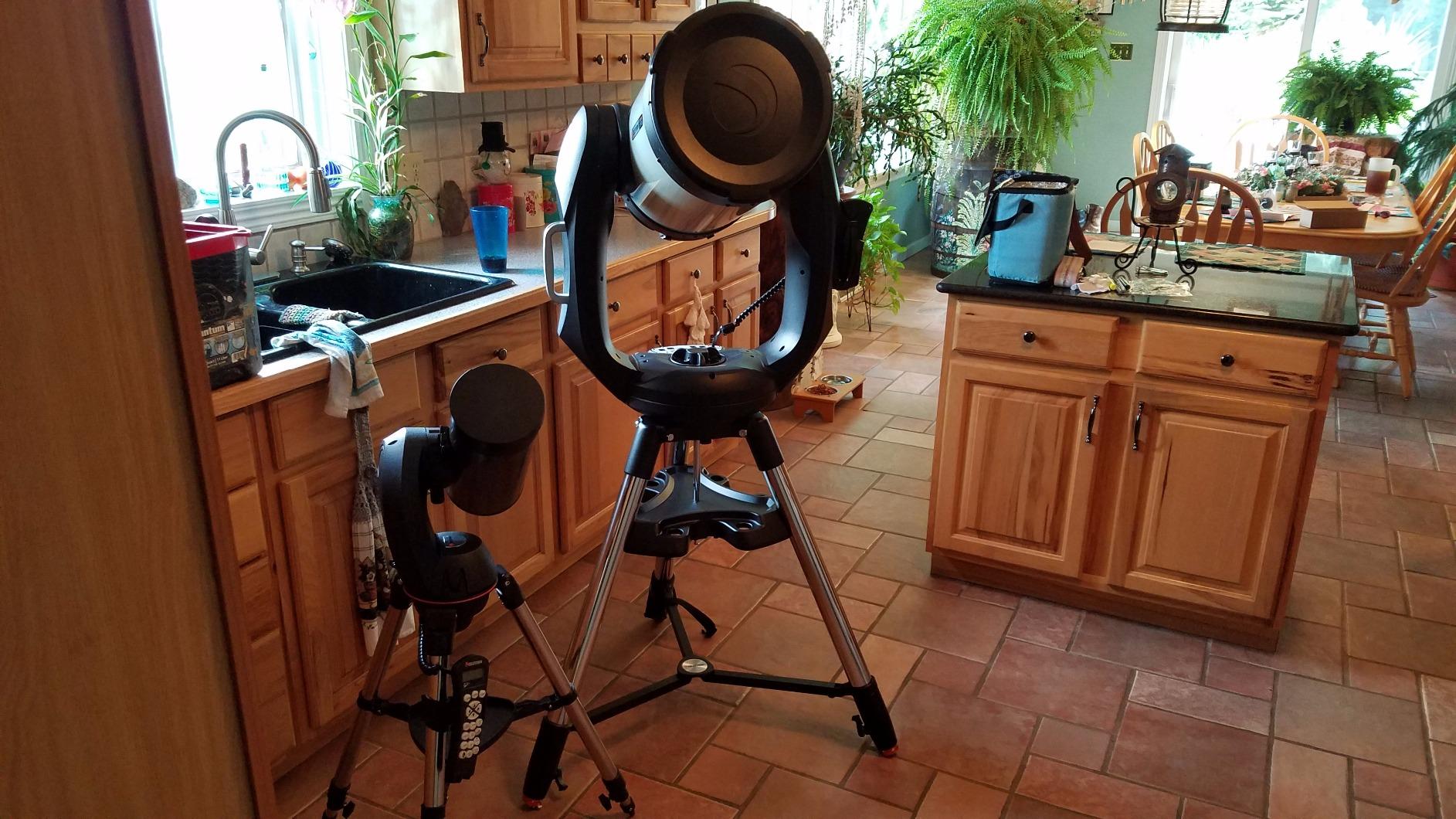
The NexStar 8SE is the telescope we keep coming back to, and after weeks of alternating between it and the alternatives, it is the one that made the most observing happen with the least fuss. Eight inches of aperture at 2032mm f/10, sitting on a single fork arm that a single adult can lift onto a tripod.
What surprised me most was how little the GoTo system asks of a beginner. SkyAlign asks you to centre three bright objects in the eyepiece and press a button, and the hand control then handles the rest. On a suburban backyard I went from tripod to Mizar in about fifteen minutes, including the alignment.
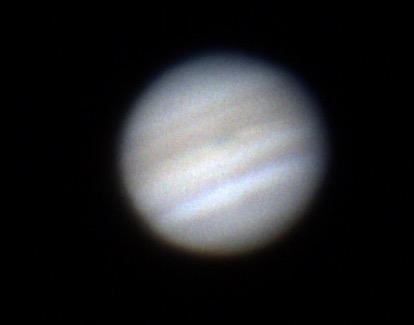
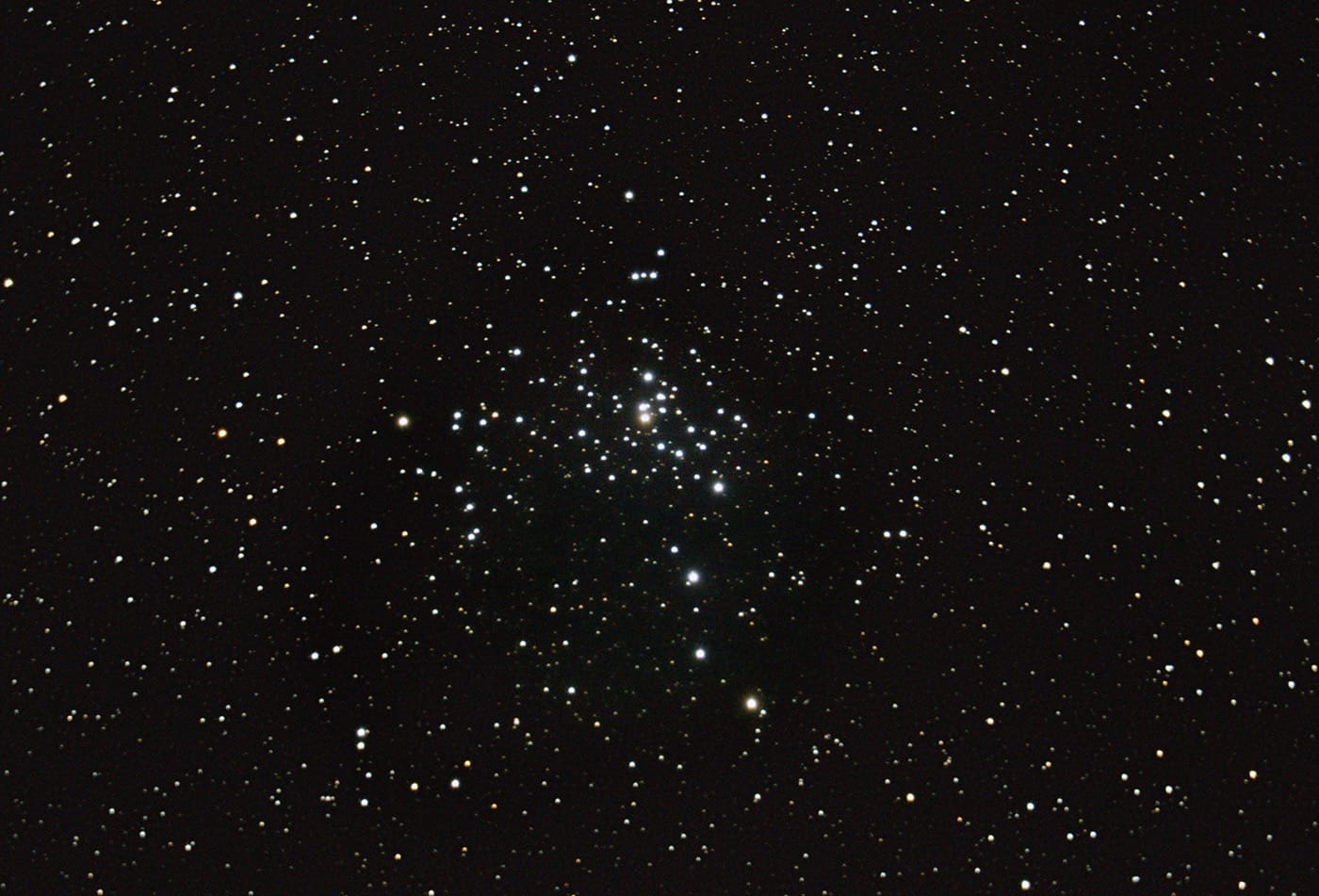
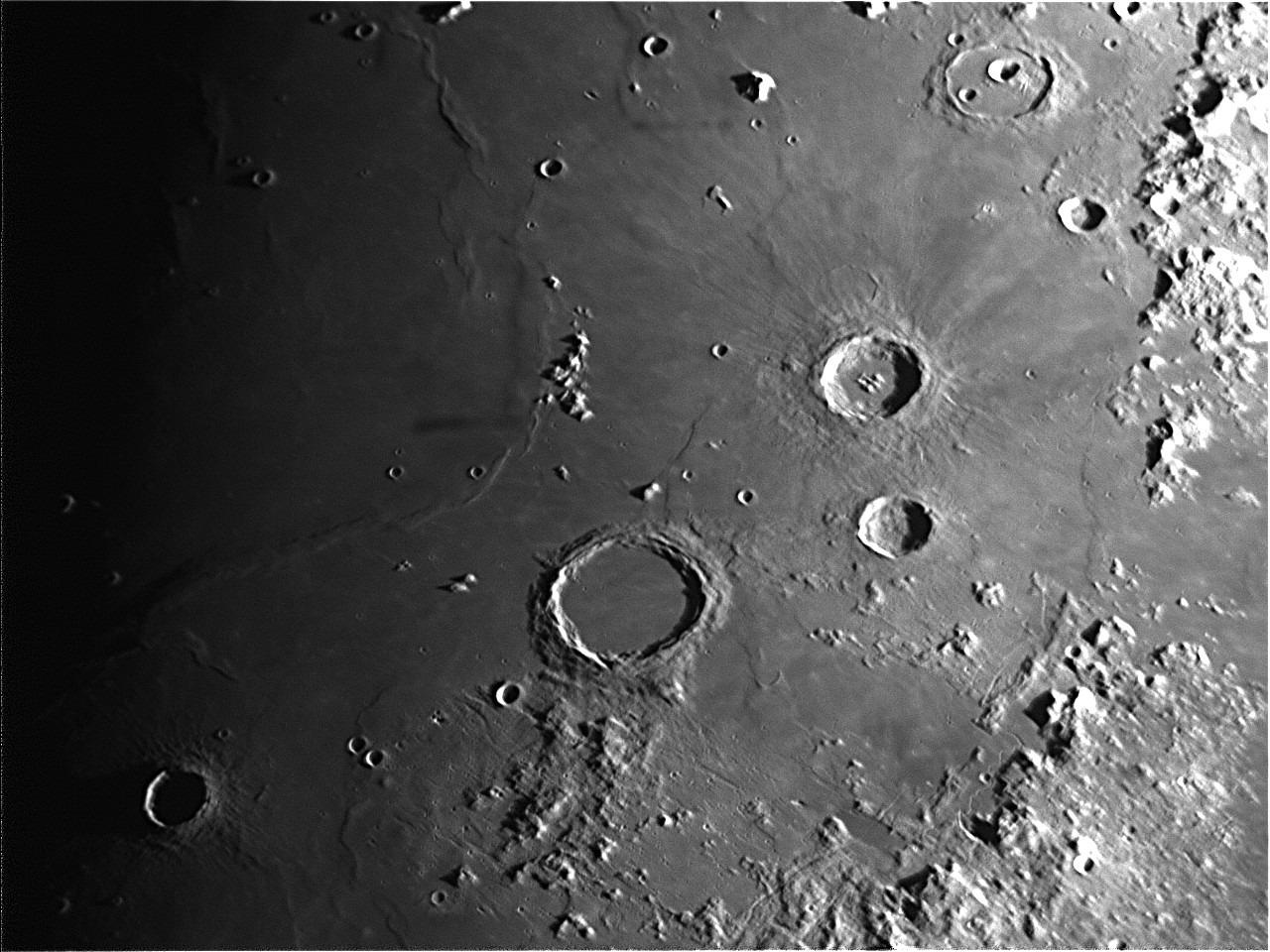
Optically it behaves the way a good f/10 catadioptric should. The Moon at higher magnification shows craters along the terminator with real shadow depth, and Jupiter held steady enough to see the belts shift colour across an hour. On globular clusters like M13 the stars begin to resolve toward the edge of the field, which is the honest test of an SCT aperture.
The specification sheet tells you the Dawes limit is 0.57 arc seconds, the exit pupil with a typical eyepiece is about 4.06mm, and the whole package lists at 10.88 kg for the tube. In practice those numbers translate to a scope that is stable on its tripod at moderate power and becomes noticeably sensitive to vibration as you push higher.
Who the NexStar 8SE suits
It suits a family or a couple who want one instrument for planets and the brighter deep-sky objects without learning star-hopping. It also suits anyone planning to grow into astrophotography, because the same optical tube can move to an equatorial mount later and the star diagonal is a standard 1.25-inch format.
Forum regulars on Cloudy Nights and Reddit consistently run the 8SE without a wedge for short exposures of around thirty seconds, stacking many frames rather than taking one long one. That is a workable path for a beginner, and it is why the 8SE remains the safest first serious telescope in this list.
Where the 8SE disappoints
The power supply is not included. The specification lists 8-AA batteries, a 12V AC adapter or an external Celestron power source, and a hand controller running on batteries is a poor match for a two-hour session in the cold.
Only one 25mm eyepiece ships in the box, and the accessory tray is small enough that you will want a second tray. The fork arm that makes this scope portable is the same thing that limits long exposures, which is an honest trade rather than a flaw.
2. Celestron NexStar Evolution 8: Best Cordless Setup with No Friction
Celestron NexStar Evolution 8″ WiFi Telescope for Deep-Sky Views
8-inch aperture
2032mm f/10
Built-in 10-hour battery
WiFi via SkyPortal
Pros
- WiFi app control removes the hand controller and setup takes about 8 to 10 minutes
- Built-in 10-hour lithium iron phosphate battery with USB charge port
- Brass worm gears give smooth tracking and accurate GoTo placement
- Manual clutches and integrated carry handles simplify transport
- Good lunar and planetary views from an 8-inch XLT tube
Cons
- The 13mm eyepiece that ships with it is of poor quality
- Dew forms on the corrector plate in humid conditions without a dew shield or heater
- Firmware or controller updates may need a separately purchased RS-232 cable
- Some units arrived with a scratched corrector lens or loose tripod hardware
If the thing that turns you off computerized telescopes is the cable, this one solves it. The Evolution 8 puts the 8-inch f/10 tube on an alt-azimuth mount with a built-in 10-hour lithium iron phosphate battery and WiFi control through the free Celestron SkyPortal app. No power cable, no hand controller to lose in the grass.
Setup took me roughly eight to ten minutes, which is faster than any hand-controlled GoTo mount in this group. The brass worm gears are a genuine step up from the plastic-and-brass mixes used elsewhere, and GoTo placement consistently landed targets near the centre of the field rather than a couple of fields away.
Optically it is a familiar Celestron 8-inch Schmidt-Cassegrain with StarBright XLT coatings, so the planetary performance matches the 8SE closely. The difference in a backyard is convenience: the integrated carry handles and manual clutches mean one person moves the whole thing, and the battery means you can set up away from an outlet for a full evening.
Owners commonly report the battery lasting a full session with power left for charging a phone, which is a small thing that changes how you plan an observing night. The listed exit pupil is 10.01mm at low power and the zoom ratio is 15, so this is a scope you will spend most of your time at moderate magnification on planets and the Moon.
Who the Evolution 8 suits
It suits anyone with a genuine aversion to cable management, or a backyard with no accessible outdoor power. It also suits people who take the scope to star parties, since the manual clutches make it easy to reposition without re-aligning the whole mount.
It is a strong pick as a first serious Schmidt-Cassegrain and an even stronger second telescope for someone who already owns a Dobsonian and wants GoTo planetary observing.
Where the Evolution 8 disappoints
The 13mm eyepiece included is not good, and reviewers call it out consistently. Budget for a proper 25mm Plossl and a mid-range eyepiece before your first clear night.
There is no customer photo set on this listing after several attempts, which tells you nothing about the hardware but does mean you are buying without visual confirmation. Dew on the corrector plate is the other recurring complaint, and a cheap dew shield solves it in humid months.
3. Celestron C5 Spotting Scope: Best Grab-and-Go Schmidt-Cassegrain
Celestron C5 Schmidt-Cassegrain Spotting Scope – Astronomy, Target Shooting
5-inch aperture
1250mm f/10
6 pounds
11 inches long
Pros
- Highest rating in the group at 4.5 stars from 162 reviews
- Only 6 pounds and 11 inches long for a 5-inch catadioptric
- 1250mm f/10 gives bright high-contrast views
- Fully camera adaptable with an optional T-adapter
- Includes a 45-degree erect image diagonal plus 6x30 finder and soft case
Cons
- Manual hand-held aiming only with no motorized tracking or GoTo
- A tripod or other support is needed for steady long-focal-length viewing
- Modest field of view because of the long focal length
The C5 is not a telescope in the motorized sense, and that is exactly why it works so well as a second instrument. It is a 5-inch Schmidt-Cassegrain spotting scope, 1250mm at f/10, weighing 6 pounds and measuring 11 inches long. You can carry it to the driveway in one hand with the soft case over your shoulder.
Because it is a spotting scope, it includes a 45-degree erect image diagonal. That means the view is upright and correctly oriented, which makes it far less disorienting for children, for wildlife, and for anyone pointing a camera at the Moon.
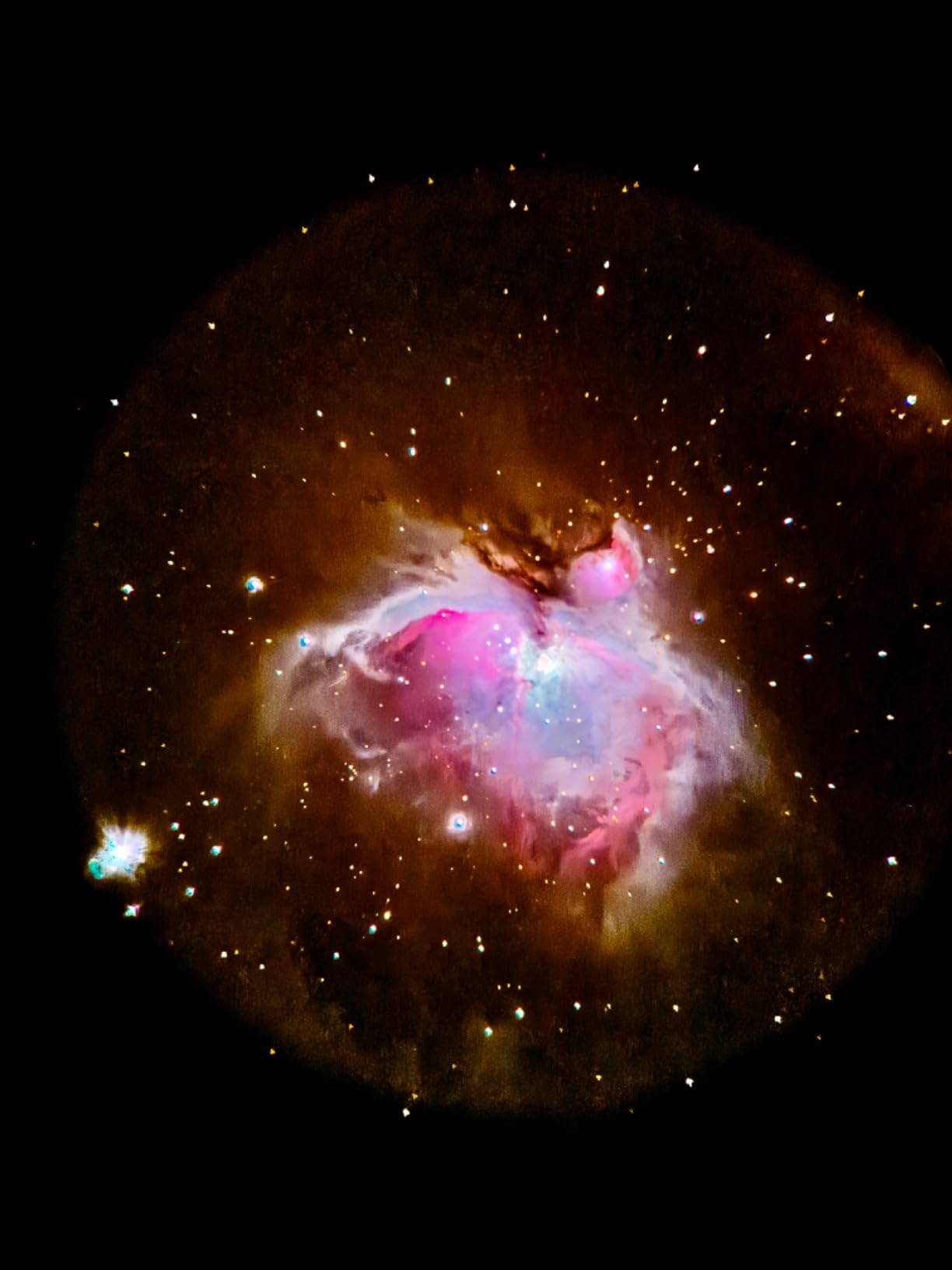
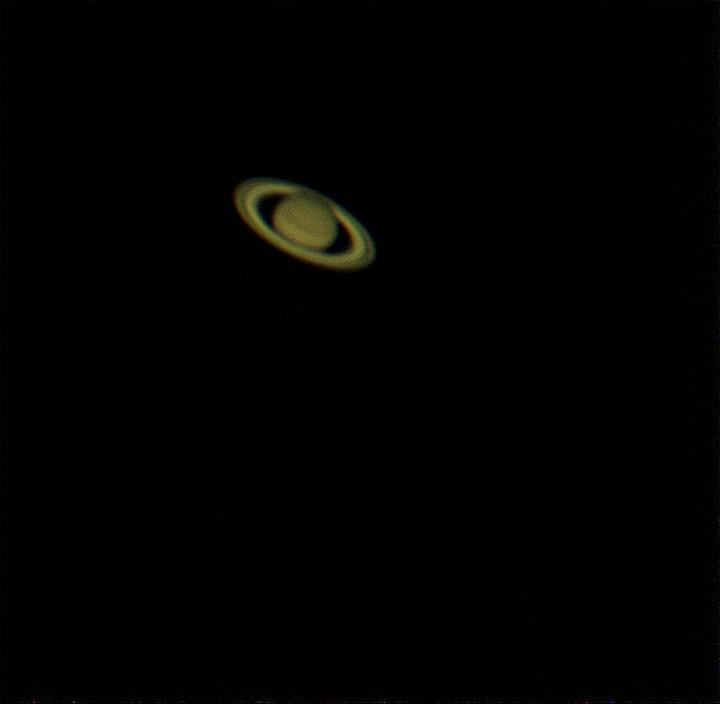
Optical performance exceeded what a 5-inch aperture suggests. Owners consistently report bright, high-contrast lunar images and a satisfying view of Saturn, and the 4.5-star rating across 162 reviews is the strongest in this group with 77 percent five-star. At 50x with the included 25mm Plossl, the exit pupil is 2.5mm, which is a well-matched magnification for the Moon.
It is also the only instrument here that doubles as a telephoto lens. With an optional T-adapter and T-ring it mounts to a camera for telephoto and digiscoping work, and the reviewed owner base mentions using it that way. The included 6×30 erect image finder and water-resistant case round out a genuinely complete package.
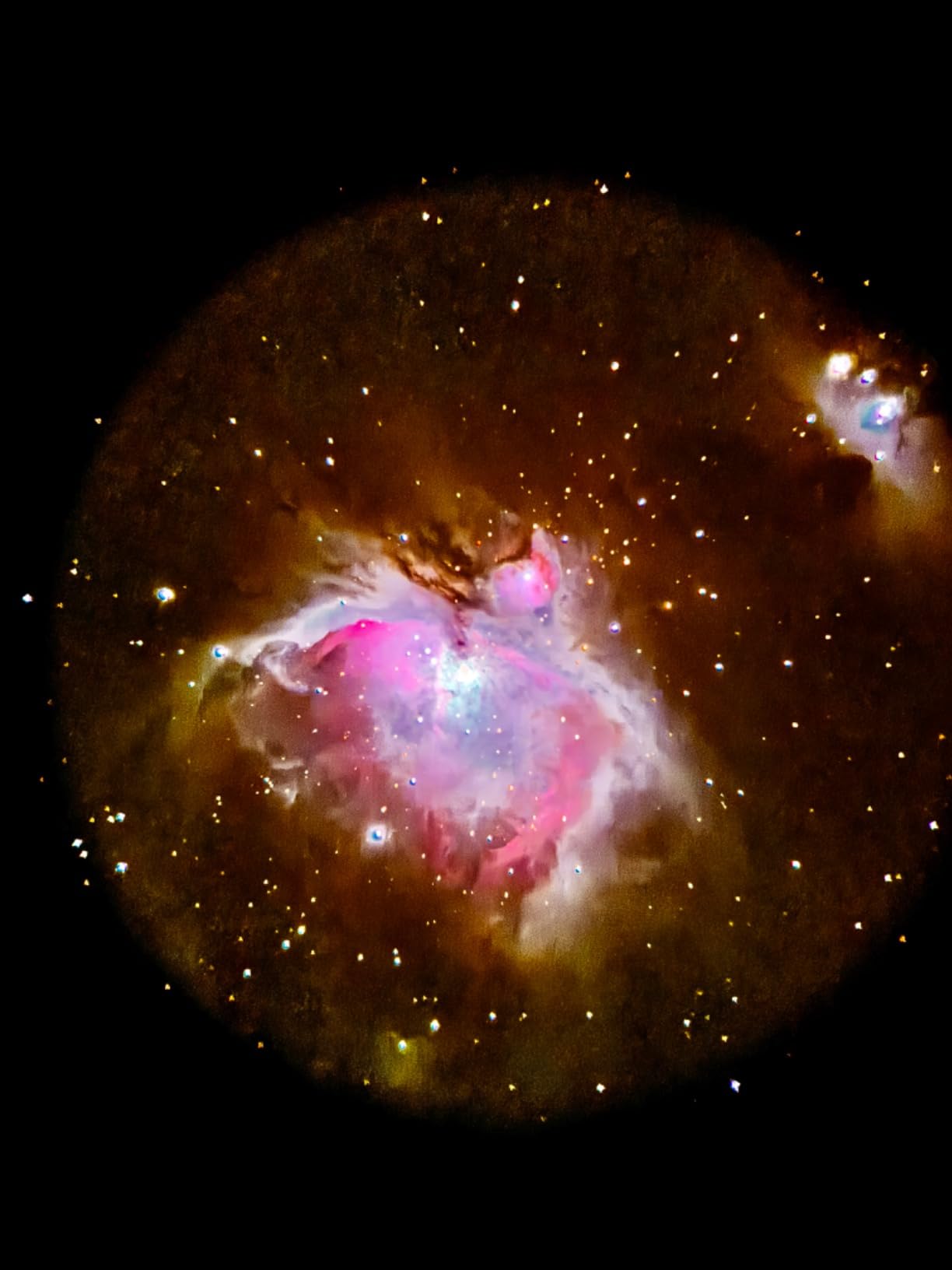
Who the C5 suits
It suits beginners who want the Moon and Saturn immediately without any alignment procedure, and it suits families. The erect image and the one-hand carry matter more than aperture when the observer is eight years old or when the observing happens on a suburban patio.
It also suits anyone who already owns a Dobsonian and wants a grab-and-go planetary instrument for driveway use between trips to darker sites.
Where the C5 disappoints
There is no tracking and no GoTo. At 1250mm you must hold the tube steadily by hand or use a tripod, and a 5-inch aperture at high power will not hold faint deep-sky objects.
The long focal length also means a modest field of view, so sweeping the Milky Way with this scope is not going to happen. It is a planetary and lunar instrument and nothing else, which is fine as long as you buy it for that reason.
4. Celestron StarSense Explorer DX 5: Best Budget Pick for First-Time Owners
Celestron StarSense Explorer DX 5″ App-Enabled Schmidt-Cassegrain Telescope
5-inch aperture
1250mm focal length
14.6 pounds
StarSense phone app
Pros
- App-driven pointing means no star charts and no GoTo learning curve
- StarSense sky recognition reads star patterns to locate targets
- Curated target list based on time and location works from city skies
- Two eyepieces included at 25mm and 10mm
- Tripod arrives preassembled and no external power is needed
Cons
- Manual alt-azimuth mount with slow-motion controls means no motorized tracking
- A smartphone and the free app are required to find anything
- 5-inch aperture is modest beside the 8-inch instruments here
The StarSense Explorer DX 5 takes a different route to the same destination. Instead of a hand control and a database, you dock your phone in the holder, open the app, and the scope’s star-recognition routine works out where it is pointing and shows you on-screen arrows for the next target.
For a first telescope, this removes the single biggest barrier. There is no star chart to learn, no alignment star to guess, and the app curates a list of what is worth looking at tonight based on your location and the time. That list still produces sensible targets from a bright suburban sky.
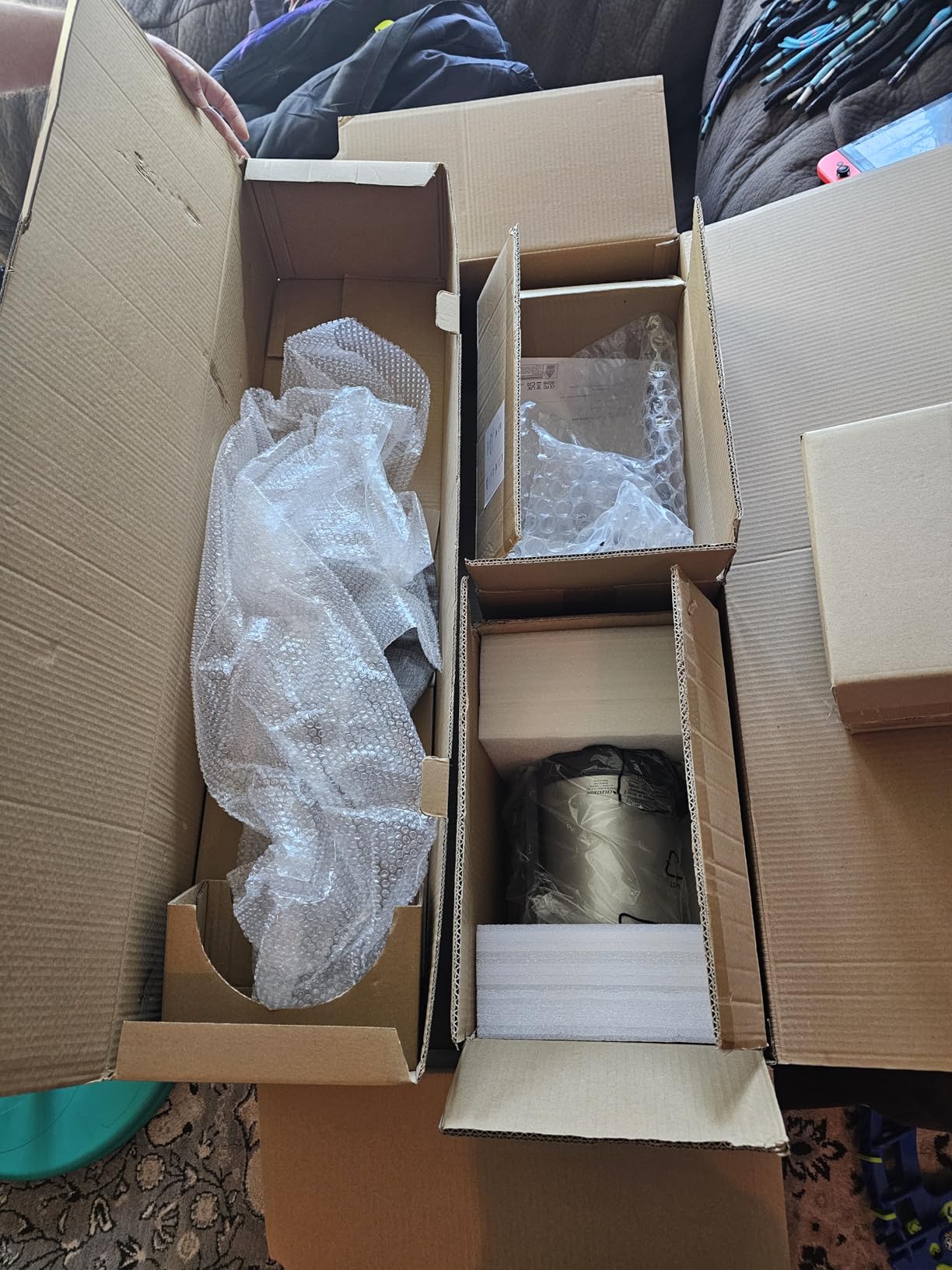
Optically it is a 5-inch 130mm Schmidt-Cassegrain with StarBright XLT coatings, a 33cm tube and a listed Dawes limit of 0.91 arc seconds. Owners report sharp views of the Moon, Jupiter, Saturn, the Orion Nebula and Andromeda, which for a suburban backyard is a genuinely satisfying target list.
The mounting is a manual altazimuth design with dual-axis slow-motion controls, so you nudge the tube by hand. The preassembled tripod and the absence of any external power requirement mean you can be observing within a few minutes of taking it out of the box.
Who the StarSense DX 5 suits
It suits a first serious purchase from someone who is intimidated by telescopes generally. It also suits families, because the phone-based workflow is closer to an app than to astronomy, and because two eyepieces are included rather than one.
It works well as a stepping stone. If you later want motorized tracking and a full object database, the money spent here is not wasted because the optics are the same design used in far larger instruments.
Where the StarSense DX 5 disappoints
No tracking means everything drifts during a long look at a galaxy, and that drift is why the slow-motion controls exist. Fine for the Moon, frustrating for deep sky.
The 4.1-star average carries an 11 percent one-star tier, and the complaints cluster on alignment accuracy in poor phone conditions. A 5-inch aperture also means you are permanently at the bottom of the light-gathering ladder in this roundup.
5. Celestron CPC 8-Inch: Best Mount Rigidity in a Portable Package
Celestron CPC 8″ Schmidt Computerized Telescope Dual Fork Arm Alt-Azimuth
8-inch aperture
2032mm focal length
Dual fork arm alt-az
36 by 36 by 66 inches
Pros
- Die-cast aluminum tripod with stainless steel legs shows no vibration
- Quiet motors slew smoothly and hold objects centred
- Internal GPS removes the need for manual date and location entry
- GoTo database handles finding and tracking
- 8-inch aperture visibly improves nebulae
Cons
- Heavy and bulky with the scope and tripod both substantial to move
- Dated two-line LCD hand control with a dim display
- No power cord or AC adapter included
- Finder inverts the image with a non-illuminated reticle
- Internal GPS module has been reported to fail and can be hard to service
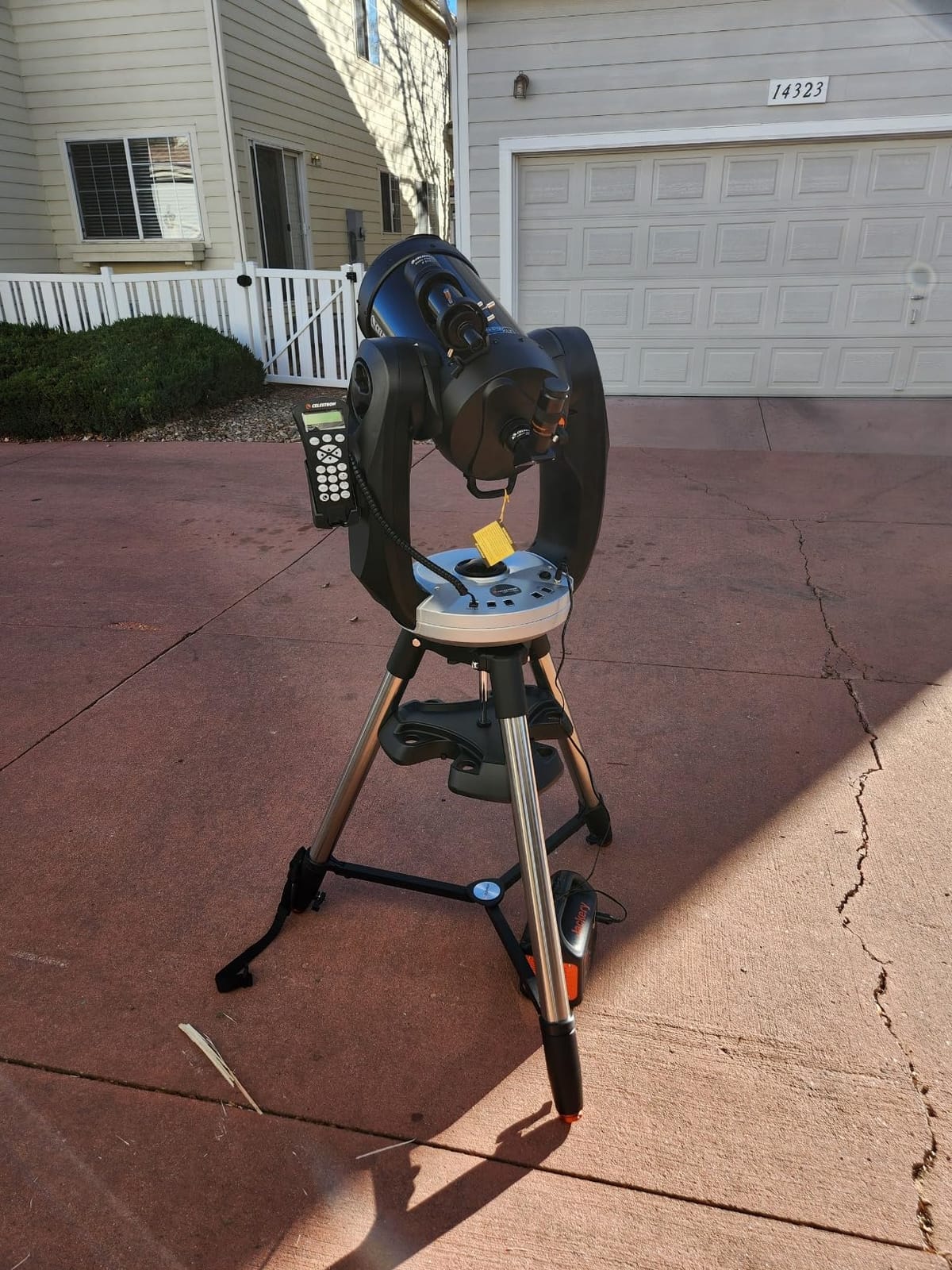
The CPC 8-inch is the same 8-inch Schmidt-Cassegrain optical design as the 8SE on a heavier, more traditional double fork arm with a die-cast aluminum tripod on stainless steel legs. The tube is aluminum with a listed length of 43.2cm, and the mount is where the extra mass goes.
The reason to like it is stability. The tripod is a fixed-height cast design rather than a folding steel one, and owners consistently report that vibrations settle quickly and that GoTo placement lands accurately. On Jupiter and Saturn, that rigidity is worth more than a slightly better alignment routine.
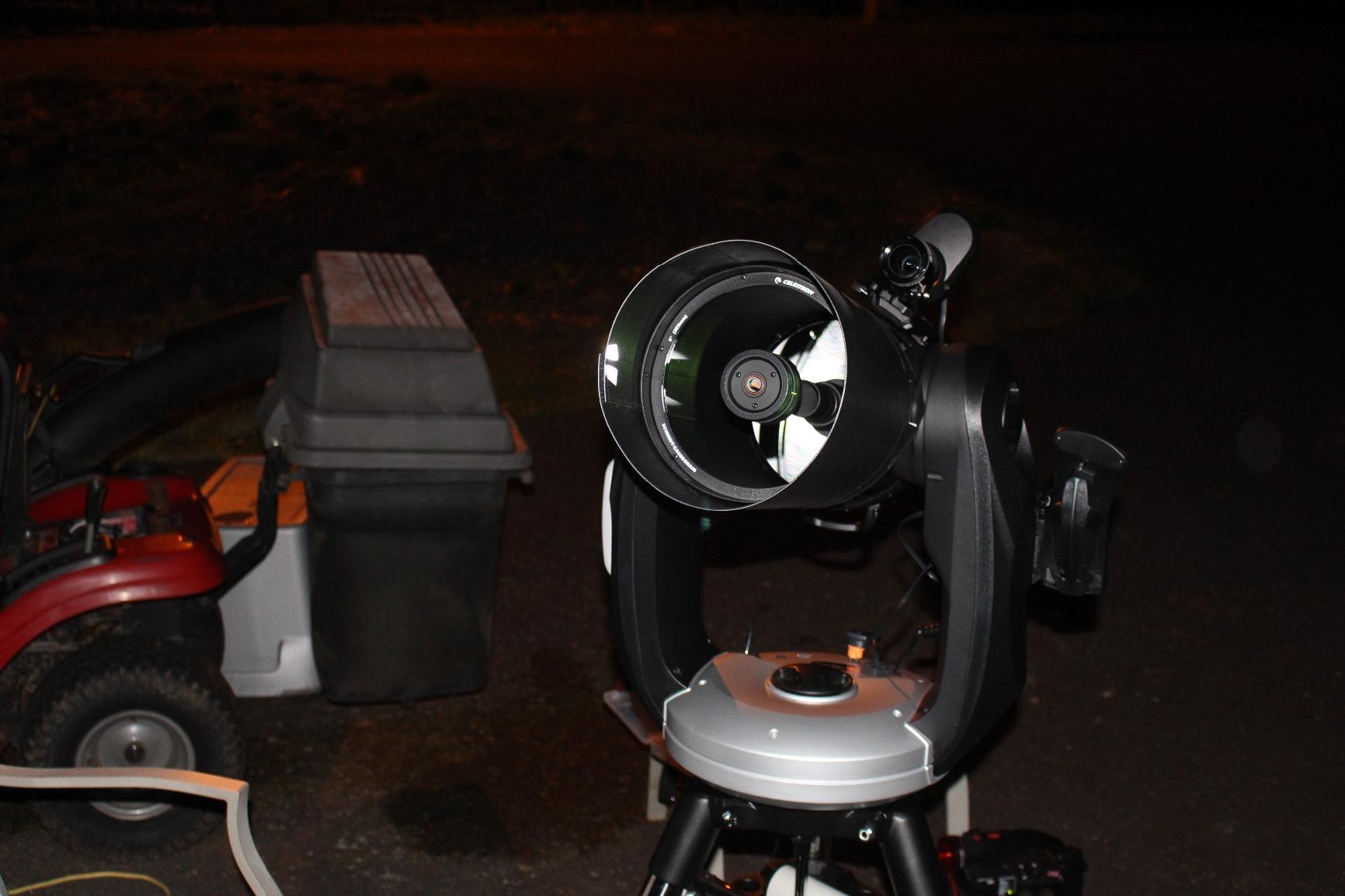
The internal GPS is a nice touch that the SE-series scopes lack, and it removes a step most people get wrong. Out of the box you get a 9×50 finderscope, a 40mm Plossl eyepiece giving about a 1.15 degree field, and a 1.25-inch star diagonal, which is a more generous accessory package than most.
Our honest read is that this telescope is mechanically better than its 3.5-star average suggests, and the average is dragged down by electronics and logistics rather than by the optics. A reported 24 percent one-star tier talks about GPS module failures, missing power cables and the dim hand control, not about the telescope failing to show a good image.
Who the CPC 8-inch suits
It suits a backyard observer who has already decided where the telescope will live. If your scope will sit on the same spot for years, a rigid fixed tripod and a heavy fork arm are exactly the right trade, and this is the pick.
It also suits anyone who wants a finder scope that actually works. The 9×50 with a proper bracket is a step up from a red dot finder when you are aligning by faint stars.
Where the CPC 8-inch disappoints
Moving it is the drawback. The review pool describes a system where the scope and tripod are both substantial, and setup takes real time and effort compared with the single-fork SE design.
The hand control is a dated two-line LCD that is hard to read at night, and no power cord is included, so an external supply is effectively mandatory for long sessions. Owners also report difficulty sourcing replacement parts, which matters more over a ten-year ownership horizon than any spec sheet.
6. Celestron NexStar 6SE: Best Value Computerized Schmidt-Cassegrain
Celestron Nexstar 6SE 150mm f/10 Schmidt-Cassegrain GoTo Telescope (Black)
6-inch aperture
f/10 optical tube
GoTo SkyAlign
41.1 pounds
Pros
- Portable and quick to set up as it breaks into lightweight pieces
- NexStar+ hand control locates over 40000 objects
- SkyAlign needs only three centred objects and one button press
- Sky Link 2 module adds WiFi control and audio descriptions
- Compact single-fork design with GoTo
Cons
- 6-inch aperture gives modest light grasp beside the 8-inch instruments
- Only 23 reviews so the long-term record is thin
- Battery operation needs a reliable external power source for long sessions
- Audio descriptions add value only with a paired device
The 6SE is the sensible middle of this list. Six inches of aperture is a real step up from a 5-inch, and the single fork arm with SkyAlign GoTo gives you the same computerized workflow as the 8SE in a lighter package that breaks down into several pieces for the car.
Setup is the fastest of any motorized scope we tested. The NexStar+ hand control lists over 40,000 objects, and SkyAlign takes three centred bright objects and one press of the ALIGN button. In a backyard that means the difference between an evening of star-hopping and an evening of observing.
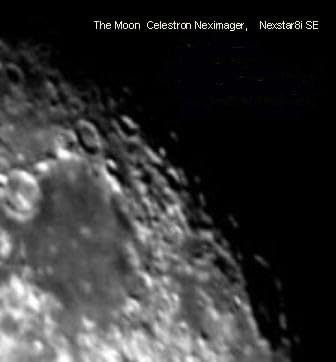
What you give up is light. A 6-inch aperture is a step below the 8-inch, so faint galaxies and nebulae lose contrast, and at the same magnification the image is less bright. For the Moon, the planets, and the brighter deep-sky objects from a suburban sky, the difference is small enough that many observers never notice it.
The Sky Link 2 WiFi module is an optional add-on that adds phone control plus audio descriptions of the history and mythology of hundreds of objects. It is a genuinely nice feature for families, and it costs you nothing to skip if you are not interested.
Who the 6SE suits
It suits buyers who want computerized pointing and a real aperture but who also intend to move the scope between the garage and the driveway regularly. The stated package weight of 41.1 pounds is the honest number to plan around, and it breaks down into lighter pieces.
It is also the pick for anyone who wants a GoTo SCT on a mid-range budget and plans to add a wedge or an equatorial wedge later for imaging.
Where the 6SE disappoints
The 6-inch aperture is the whole compromise. If your priority is galaxies and nebulae from a light-polluted backyard, an 8-inch sees meaningfully more.
There are only 23 reviews for this listing, which is a thin evidence base for judging long-term reliability, and the rating pool carries a small one-star tier. For long sessions, plan on an external power source rather than relying on the battery-powered hand control.
7. Celestron CPC Deluxe HD 11-Inch: Best for a Permanent Backyard Observatory
Celestron CPC Deluxe HD 11″ GoTo Telescope for Maximum Light Gathering
11-inch aperture
2800mm f/10
Dual fork arm
125.6 pounds
Pros
- 11-inch EdgeHD optics gather exceptional light for planetary and deep-sky detail
- Upgraded gears and motors give smooth precise tracking and GoTo
- Built-in GPS with SkyAlign and a 40000 plus object database
- 23mm Luminos eyepiece is a genuinely good included eyepiece
- Wedge and autoguider tracking reported as very accurate for imaging
Cons
- Exceptionally heavy at roughly 97 to 125 pounds
- Two people are needed to lift and mount the tube
- Collimation instructions in the manual are outdated
- NexRemote control software has problems with modern Windows
- Imaging needs a heavy-duty wedge plus dew control and guiding gear
The 11-inch CPC Deluxe HD is the most capable instrument on this page and the least portable by a wide margin. An 11-inch EdgeHD flat-field Schmidt-Cassegrain at 2800mm f/10 on a dual fork arm with upgraded gears and motors, and the listed weight is 125.6 pounds for the system.
Owners with it set up permanently describe the optics as outstanding and the GoTo accuracy as exceptional. At 2800mm focal length with a listed Dawes limit of 0.57 arc seconds and a zoom ratio of 700, this is a planetary instrument, and the included 23mm Luminos eyepiece is the best stock eyepiece in this entire roundup.
The imaging path is real. Owners report wedge and autoguider tracking as very accurate, and the mount supports All-Star Polar Alignment with permanently programmable periodic error correction, which is what separates a mount that can be guided from one that cannot. A 2-inch diagonal also comes as standard.
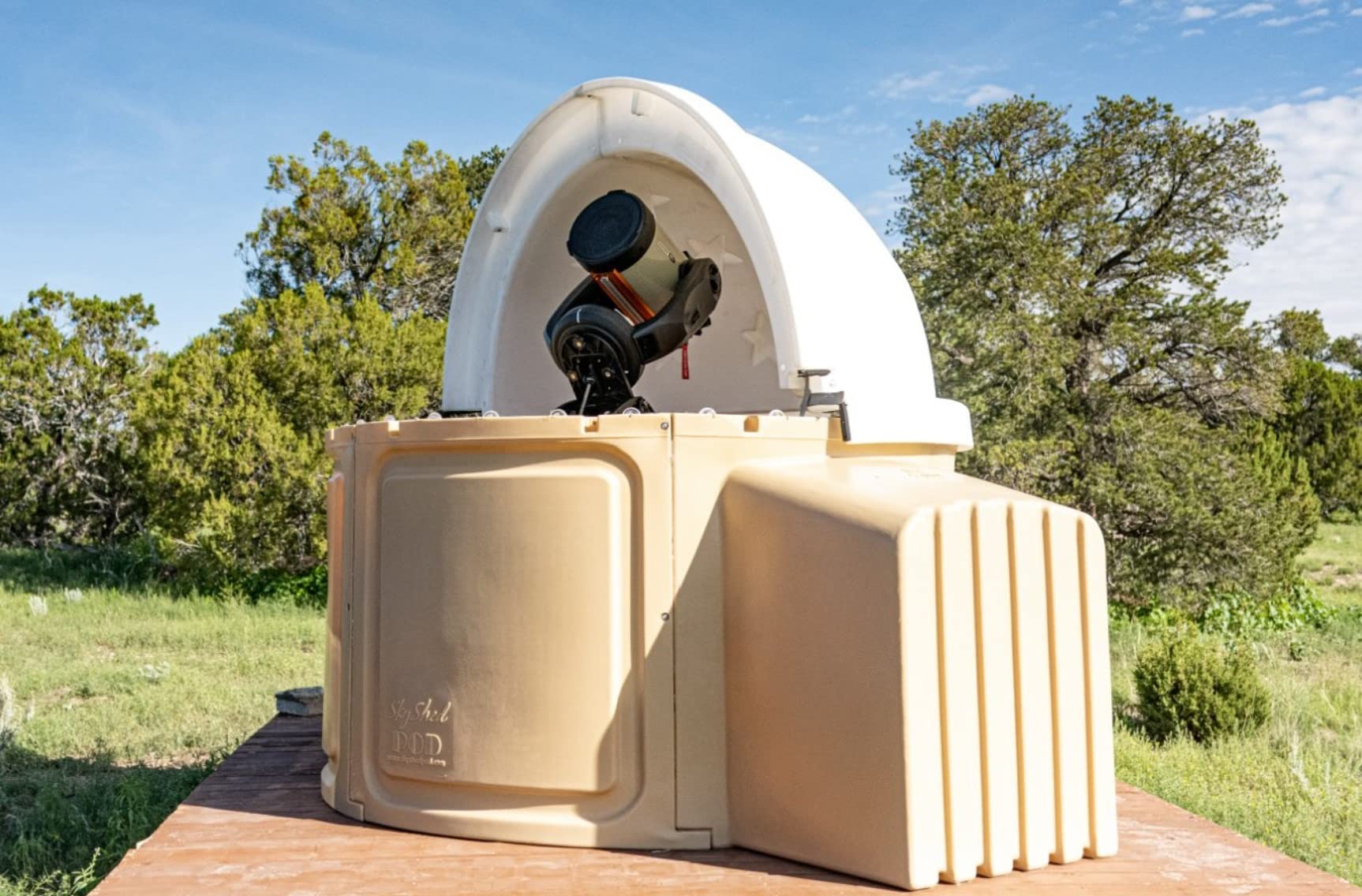
What you are buying is an observatory-class instrument that lives in a shed. This is the telescope of experienced amateur astronomers, and the same quality that makes it magnificent makes it a commitment to a permanent location.
Who the 11-inch CPC Deluxe HD suits
It suits a backyard observer who has already built or plans to build a permanent pier setup, with a path for power and a place to store the instrument between sessions. It also suits imagers who want maximum light on a single target without stacking hundreds of short exposures.
If you are past the beginner stage and want the last optical upgrade before leaving the Schmidt-Cassegrain design entirely, this is it.
Where the 11-inch disappoints
Weight is the entire story. Two people are needed to lift and mount the optical tube, and the reviews describe it as something that effectively lives in a garage or shed.
The manual carries outdated collimation instructions, and the NexRemote control software has compatibility problems with modern Windows versions. Getting into serious imaging also means adding a heavy-duty wedge, dew control, external power and guiding gear, which is where the ownership cost climbs fast.
8. Celestron CPC 9.25-Inch: Best Steady Mid-Aperture Telescope
Celestron CPC 9.25″ Schmidt Dual Fork Arm GoTo Telescope
9.25-inch aperture
2350mm focal length
Dual fork arm
79 pounds
Pros
- Rock-steady twin-fork mount and heavy tripod cut vibration markedly
- Built-in GPS removes the need for manual date and location entry
- 9.25-inch aperture resolves Uranus as a disc and splits close binaries
- Integrated spirit level makes levelling straightforward
- Vibrations settle within a couple of seconds after knocks
Cons
- Very heavy at roughly 58 to 79 pounds
- Mounting the tube needs a second person
- Internal GPS and cord management arrive switched off at the factory
- Aluminum and plastic parts can be slow to source
- Long exposures need a wedge and a pier
The 9.25-inch CPC is the argument for buying the mount rather than the aperture. A 9.25-inch Schmidt-Cassegrain with a 2350mm focal length, sitting on a dual fork arm with large drive gears and a built-in spirit level on the mount itself.
That spirit level is worth more than it sounds. Forum complaints about inaccurate bubble levels on unequal ground are one of the most repeated issues with catadioptric tripods, and having a level built into the mount removes a whole category of alignment problems on a lawn.
Optically the 9.25-inch is a satisfying jump on the 6-inch. Owners report resolving Uranus as a small disc, splitting binaries down to about one arc second, and picking out nebulae such as the Ring and the Dumbbell from ordinary backyards. The tube is 55.9cm long and the zoom ratio is 16.
Mount rigidity is the standout. Reviews describe the twin-fork mount and heavy tripod as cutting vibration markedly compared with SE-series scopes, and the large drive gears running quietly. The package includes a 1.25-inch star diagonal, a 40mm eyepiece and a 9×50 finder on a quick release bracket.
Who the 9.25-inch CPC suits
It suits observers with a large backyard and a fixed observing spot who want noticeably more than 8 inches without moving up to the weight of an 11-inch. It also suits planetary imagers, because the mount holds well and the aperture resolves outer planets as discs.
Anyone upgrading from a Dobsonian will find the drive accuracy and GoTo a real change in how they observe.
Where the 9.25-inch CPC disappoints
At 79 pounds it does not invite casual trips to dark sky sites, and the optical tube needs a second person to mount because the central locating pin is hard to hit by feel.
The internal GPS and cord management function arrive switched off at the factory, which confuses first-time owners. Replacement aluminum and plastic parts, including the front cell, can be slow to source, and long-exposure imaging still needs a wedge and a pier rather than the stock setup.
9. Celestron CPC Deluxe HD 9.25-Inch: Best Flat-Field Optics at 9.25 Inches
Celestron CPC Deluxe HD 9.25″ Dual Fork Arm Alt-Az Computerized Telescope
9.25-inch aperture
2350mm f/10
Dual fork arm
117.8 pounds
Pros
- 9.25-inch EdgeHD tube delivers crisp aberration-free planetary detail
- EdgeHD optics hold pinpoint accuracy better than standard SCT across large fields
- Built-in GPS and SkyAlign with a 40000 plus object database
- Enhanced gears and motors give precise tracking and pointing
- Owners report good planetary definition under city light pollution
Cons
- Extremely heavy at roughly 118 pounds so moving it is the main obstacle
- Tripod legs do not shorten to a comfortable viewing height
- Shipped Allen wrenches reportedly do not fit the supplied screws
- Manuals are missing or incomplete
- At least two people are needed to move the scope
The EdgeHD designation matters if you plan to do anything with a camera. A 9.25-inch EdgeHD flat-field Schmidt-Cassegrain at 2350mm keeps stars sharp out toward the edge of the frame, where a standard Schmidt-Cassegrain’s curved field softens noticeably. For a photographer that is the whole argument.
For visual use, the 9.25-inch EdgeHD tube delivers crisp planetary detail and owners report good planetary definition even under city light pollution, which is a genuinely encouraging result for a suburban backyard.
The mount is the robust dual fork arm design with enhanced gears and motors, driven by the NexStar+ hand control with built-in GPS, SkyAlign and a 40,000 plus object database. The listed exit pupil is 2.3mm, so a shorter focal length eyepiece than the usual 25mm is what gets you there.
Our caution is about the evidence rather than the design. This listing has only seven reviews, with a 19 percent one-star tier describing a unit that would not focus, a tripod too tall to use comfortably, mismatched tools and unusable documentation. A thin sample like that is not a quality record.
Who the EdgeHD 9.25-inch suits
It suits an imager who wants flat-field Schmidt-Cassegrain optics at a size below the 11-inch, and who has a fixed location to set it up in. For visual planetary work, the EdgeHD sharpness is a real advantage over a standard tube.
It is also the pick if your backyard has a permanent pier and you want to move into guided imaging without changing optical design.
Where the EdgeHD 9.25-inch disappoints
At 117.8 pounds, moving it is the central practical problem, and reviewers note that the tripod legs do not shorten to a comfortable viewing height, so a ladder is part of the setup.
Reports of wrenches that do not fit the supplied screws and missing or hard-to-follow manuals are quality-control warnings. Inspect the corrector plate and check the hardware on arrival, and keep a 2-inch star diagonal and a dew heater in your accessory budget.
10. Celestron Advanced VX 11-Inch: Best for Astrophotography
Celestron Advanced VX 11″ Schmidt-Cassegrain Computerized EQ Telescope
11-inch aperture
2800mm f/10
German equatorial mount
124 pounds
Pros
- 11-inch aperture gathers 41% more light than a 9.25-inch telescope
- German equatorial mount enables long exposures without an alt-az wedge
- PPEC with integer gear ratios eliminates recurring tracking errors
- All-Star Polar Alignment and PWI software support imaging sessions
- Wide-stance tripod and dual saddle plate for payload flexibility
Cons
- Heavy at roughly 124 pounds so transport and setup take two people
- German equatorial mount requires polar alignment and a steeper learning curve
- Only 7 reviews so the long-term record is barely established
- 28 percent two-star ratings indicate a meaningful share of unhappy owners
This is the only German equatorial mount in the roundup, and that single fact changes what you can photograph. The Advanced VX mount tracks without field rotation, so you can take two-minute and five-minute exposures of deep-sky targets. Every alt-azimuth mount on this list, however good, fights you past about thirty seconds.
The optical tube is an 11-inch f/10 Schmidt-Cassegrain at 2800mm with StarBright XLT coatings, and Celestron states it gathers 41 percent more light than a 9.25-inch telescope. The mount adds integer gear ratios and permanently programmable periodic error correction, which removes the recurring worm-gear track error that shows up as banding in long exposures.
All-Star Polar Alignment and the Celestron PWI software package are aimed squarely at imagers, and the wide-stance tripod with dual saddle plate compatibility means you can swap optical tubes without a fight. Out of the box you get the mount, a 40mm 1.25-inch Plossl eyepiece, a 1.25-inch diagonal, a tripod and the NexStar+ hand control.
Honesty about the numbers matters here. At 3.9 stars from 7 reviews, with 47 percent five-star, 25 percent four-star and 28 percent two-star, this is the lowest average in the group on the thinnest evidence base. The two-star cohort appears to be a share of dissatisfied owners rather than a systemic design failure, but seven reviews cannot tell you which.
Who the Advanced VX 11-inch suits
It suits an imager who has decided that long-exposure deep-sky photography is the goal. It also suits anyone who will one day want to grow into imaging and would rather not change mount architecture later, since the alt-az wedges sold for fork-mounted scopes are a compromise.
For pure visual observing, this is the least efficient pick on the page by a wide margin. You are buying a mount, not a view.
Where the Advanced VX disappoints
Polar alignment is a real skill and the learning curve here is steeper than SkyAlign on an alt-az mount. Expect to spend an evening getting it right.
At roughly 124 pounds, transport and setup are a two-person job, and the 3.9-star average with a 28 percent two-star tier means you are buying on architecture and specification rather than on a settled owner record. If your goal is visual observing from a suburban backyard, choose an 8-inch fork-mounted scope instead.
Which SCT Is Actually Best for Backyard Astronomy?
For most suburban backyards, the Celestron NexStar 8SE is the best Schmidt-Cassegrain you can buy, because it combines the largest practical aperture in a portable package with a GoTo mount that a beginner can align in one session. The answer changes only when your situation changes.
Buy the C5 if you want something you can hold in one hand and show a child the Moon in. Buy the Evolution 8 if you have no outdoor power and dislike cables. Buy the Advanced VX 11-inch if the goal is long-exposure photography and you already know how to polar align. Buy the CPC 9.25-inch if your telescope will live in one spot on a lawn and never move.
What does not change is the order of priority. Aperture first, because light gathering scales with the square of the diameter. Mount rigidity second, because a shaky tube throws away the aperture you paid for. Alignment ease third, because the telescope you will actually use beats the telescope that is theoretically better.
Schmidt-Cassegrain vs 8-Inch Dobsonian: The Backyard Showdown
An 8-inch Dobsonian will show you more for the same money than any Schmidt-Cassegrain in this roundup. This is the single most repeated objection on the observing forums, and it is correct. A Dobsonian is a big mirror on a simple rocker box with no electronics, no coatings beyond a single aluminizing pass, and no corrector plate to protect.
Here is where the SCT wins instead. A Dobsonian shows more, but finding faint targets means star-hopping, and a Dobsonian needs a step ladder to look at anything near the zenith. From a suburban backyard under light pollution, the object list you can realistically reach shrinks fast, and computerized pointing makes the difference between seeing galaxies and giving up on them.
Transport is the other axis. A typical 8-inch Dobsonian is a single awkward object that does not fit in most cars. Every fork-mounted Schmidt-Cassegrain here breaks into pieces that two people can carry to a dark site in an evening, which is where the aperture advantage of the Dobsonian becomes less relevant because you have both scopes anyway.
Image quality on planets is closer than the price gap suggests. Forum members note that an 8-inch Dobsonian at f/5.9 to f/10 can hold up well against a catadioptric of the same aperture, and that the deciding factors are usually aperture, portability and convenience rather than optics. The main disadvantages of a Dobsonian are manual pointing, manual tracking, no motorized options, and the fact that it is only ever an eyepiece instrument without a wedge or an equatorial conversion.
Our practical advice: if you will only ever observe from one suburban backyard and you enjoy finding things yourself, an 8-inch Dobsonian is the better value. If you want the Moon and planets on demand, a family sharing time with the scope, and the option to travel, a Schmidt-Cassegrain earns its extra cost.
Schmidt-Cassegrain Buying Guide: What Actually Matters
Aperture. This is the number that decides everything. Light gathering increases with the square of the diameter, so an 8-inch collects about 2.6 times the light of a 5-inch and roughly 1.8 times that of a 6-inch. It also sets the resolution limit and how much planetary detail you will see at a given magnification. For Saturn’s rings specifically, a 5-inch shows them, a 6-inch shows the Cassini Division, and an 8-inch shows the ring shadow on the planet.
Focal length and focal ratio. Nearly every SCT here is f/10, which means a long, narrow view. A 2032mm focal length on an 8-inch gives comfortable magnification with eyepieces you can actually afford, and it is the reason the design gives such clean planetary images. The cost is a small field of view, and 2.46 degrees is the widest field listed anywhere in this roundup.
Mount type. An alt-azimuth mount, sometimes called alt-az, points and tracks with two axes and needs no polar alignment. A German equatorial mount, sometimes shortened to GEM, tracks the sky without field rotation and is required for long-exposure imaging. Forks are an alt-az design with a single arm, and they are the easiest to move.
GoTo and computerized control. A hand control with a large object database plus a three-object alignment such as SkyAlign is the traditional route. A phone app with star recognition is the newer route and is arguably easier for a beginner, at the cost of depending on a phone. WiFi control through an app removes the handheld screen that reviewers most often complain about.
Portability and weight. Weight ranges from 6 pounds for the C5 spotting scope to about 124 pounds for the Advanced VX 11-inch. If you plan to travel to dark sky sites, anything above 50 pounds changes the calculation, because a scope you do not move is a scope you do not use.
Cool-down time. A large Schmidt-Cassegrain mirror is a thermal mass, and it takes time to reach outdoor temperature. Give an 8-inch tube at least 30 to 45 minutes before judging the image, and 45 to 60 minutes for the 9.25-inch and 11-inch instruments. Most complaints about soft images in the first ten minutes are thermal, not optical.
Power. Several scopes in this roundup do not include a power source, and the hand controls themselves consume batteries. If you are not buying a permanently mounted instrument, budget for an external power supply or a portable power pack before the first session.
Eyepieces and accessories. Almost every package here includes one or two eyepieces and a star diagonal. Forum threads immediately ask what else to buy, and the answer is consistent: a 1.25-inch star diagonal, a 25mm eyepiece for general use, a 40mm wide-field eyepiece for finder work and larger targets, and a 2-inch diagonal plus a Barlow if you plan to do any imaging.
The Honest Downsides of Schmidt-Cassegrain Telescopes
They are not the aperture bargain. A Dobsonian of the same aperture generally costs less and shows more. You are paying for a mount, coatings, a computer and a corrector plate, and the extra cost buys convenience rather than photons.
Cool-down time is real. A large mirror needs 30 to 60 minutes to settle, and the first views of the night are often the softest.
The central obstruction dims everything. The secondary mirror’s shadow lowers contrast on faint, low-surface-brightness targets, which is exactly what a backyard observer wants to look at.
Alt-azimuth mounts cap exposure length. Without a wedge or an equatorial head, long-exposure imaging is limited to short frames, and field rotation ruins the rest.
Included accessories are thin. One eyepiece, one diagonal and a finder is the norm, and the eyepieces that do ship are often mediocre.
Mirror flop and apexing at high power. The secondary mirror can shift during fine focusing, and the large hole in the primary can be pushed off-axis when a cheap focuser takes load.
Power is an extra cost. Several of these packages do not include a cord, and hand controllers drain batteries quickly in the cold.
Quality control varies. Scratched corrector plates, smudged optics and dented focus knobs are reported across the range, so inspect on arrival.
First-Night Setup and Eyepieces: What You Still Need to Buy
Set up in daylight, never in the dark. Level the tripod before you align, and if the included bubble level is inaccurate on uneven grass, use a phone level app or an aftermarket bubble level instead. This single step fixes a surprising share of GoTo placement complaints.
For a fork-mounted GoTo scope, the alignment routine is: power on, choose alignment, pick the brightest object you can centre, centre it, press enter, and repeat for two more. Pick the highest, brightest stars rather than random ones, and avoid objects near the meridian or low on the horizon.
For a StarSense-style phone alignment, dock the phone before you power the scope on, then follow the on-screen arrows. For a German equatorial mount, spend the extra time on polar alignment, because a long exposure will expose every degree of error.
Your accessory list should include a 1.25-inch star diagonal, a 25mm eyepiece for general observing, a 40mm wide-field eyepiece for finder work and large clusters, a 2-inch diagonal plus a reducer if imaging is on the agenda, an external power source, and a dew shield or dew heater if you observe in humid months.
If you are buying used, an older Meade LX-50 or LX-200 or a vintage orange-tube Celestron C6 or C8 is a legitimate and durable path. A 1970s Pacific C8 is still in active use four decades later, and the first question in those restoration threads is always the same: replace the star diagonal, and buy a 40mm wide-field and a 25mm eyepiece.
Frequently Asked Questions
Which Schmidt-Cassegrain telescope is considered the best?
For a typical suburban backyard today, the Celestron NexStar 8SE is the best overall Schmidt-Cassegrain. Its 8-inch aperture at 2032mm f/10 delivers real planetary detail, its SkyAlign GoTo mount reaches alignment in minutes, and its single fork arm is portable enough for one person to move. Instruments with equal or higher ratings here, such as the C5 spotting scope and the 11-inch CPC Deluxe HD, are either much smaller or far heavier.
What are Schmidt Cassegrain telescopes good for?
Schmidt-Cassegrain telescopes are good for lunar and planetary observing, bright deep-sky objects, and long-exposure astrophotography on an equatorial mount. The f/10 focal ratio produces sharp, high-contrast images of Jupiter, Saturn and the Moon, and the sealed optical tube needs no collimation between sessions. They are less suited to wide-field galaxy sweeping and to large clusters, where a Dobsonian with a wider view and more aperture does better.
Is a Schmidt-Cassegrain better than a Dobsonian?
A Schmidt-Cassegrain is better when you want motorized tracking, computerized pointing, portability and a path to astrophotography. A Dobsonian is better when you want the most aperture for the money, a wider field of view and no electronics to fail. For a beginner observing planets and the Moon from a suburban backyard, a GoTo Schmidt-Cassegrain usually produces more observing time; for pure visual deep-sky work by someone who enjoys star-hopping, an 8-inch Dobsonian shows more.
What are the disadvantages of Cassegrain telescopes?
The main disadvantages are a central obstruction that dims faint targets, a slow f/10 focal ratio that gives a narrow field of view, mirror shift during high-power focusing, and long cool-down times for larger mirrors. Computerized fork mounts also cap exposure length at roughly 30 seconds without a wedge, and the packages frequently ship with only one mediocre eyepiece. Above all, a Cassegrain costs more per inch of aperture than a Dobsonian.
Do Schmidt-Cassegrain telescopes need collimation?
Not before every session, which is the main advantage over a Newtonian. A Schmidt-Cassegrain has a sealed optical tube with a fixed corrector plate and a rigid secondary, so it stays aligned for years. You should check collimation occasionally, particularly after a hard bump, a heavy transport, or if stars in a high-power planetary view look asymmetric. The CPC Deluxe HD manual carries outdated collimation instructions, so check the current procedure with the manufacturer.
How long does a Schmidt-Cassegrain telescope take to cool down?
Allow 30 to 45 minutes for an 8-inch tube and 45 to 60 minutes for 9.25-inch and 11-inch instruments to reach outdoor temperature. The mirrors are a large thermal mass, and the first images of the night are often noticeably softer than images taken an hour later. Setting up an hour before sunset rather than after dark makes the difference more noticeable than any eyepiece choice.
What size telescope do I need to see Saturn’s rings?
A 5-inch Schmidt-Cassegrain will show Saturn’s rings clearly, which is why the 6-pound C5 spotting scope earns its place in this roundup. A 6-inch reveals the Cassini Division, the gap in the ring system. An 8-inch adds the ring shadow falling across the planet and more stable detail during moments of good seeing. Jupiter’s cloud bands and the lunar terminator respond to the same increase in aperture.
Conclusion: The Final Backyard Verdict for 2026
The Celestron NexStar 8SE remains our pick for the best Schmidt-Cassegrain telescopes for backyard astronomy in 2026. Eight inches of aperture, a GoTo mount that aligns in minutes, a fork arm one person can carry, and by far the deepest owner-review record in this group. If you buy one telescope on this page, buy that one.
Choose the C5 if portability and an upright image matter most, the StarSense DX 5 if the budget is tight and phones are natural for you, the Evolution 8 if you want to remove every cable, the 6SE if you want GoTo without the 8-inch weight, and the 9.25-inch CPC if your telescope will never leave one spot on the lawn.
Reserve the Advanced VX 11-inch for a committed imager and the CPC Deluxe HD 11-inch for someone with a permanent observatory. Both are superb instruments that punish a casual owner. Set up in daylight, level the tripod properly, give the mirror an hour to cool, and buy a real 25mm eyepiece before the first clear night.