
A refractor telescope is the most honest optical design you can point at a planet. There is no mirror to collimate, no central obstruction dulling the contrast, and nothing to defog in the middle of a session. If you want to see Saturn’s rings sharpen, Jupiter’s belts hold steady and the lunar terminator throw shadows across a crater wall, that unobstructed light path is worth real money.
So which is the best refractor telescope for planets? It depends on how honest you are about your budget and your nights. A 70mm achromatic on a simple alt-azimuth mount shows you the Moon, Jupiter’s four moons and Titan moving against the stars. It will not show you the Cassini Division. A 90mm scope doubles the light and the resolving power, and it is the point where most observers stop needing anything bigger. Anything past that buys sharper images on the calmest nights of the year, not new targets.
We spent weeks comparing ten refractors across every price tier a first telescope can occupy, from a 70mm starter kit to the only extra-low-dispersion optic in the group. What follows is ranked on the things that actually decide a planetary view: aperture, focal ratio, glass type, and whether the mount underneath can hold still at 150x.
Quick answer: the Celestron AstroMaster 70AZ is the best refractor telescope for planets for most people, because its 900mm focal length gives it the slowest focal ratio in our group and the sharpest, steadiest views without any glass upgrade. If you can spend more, the MEEZAA 90mm is the bigger aperture step that actually matters, and the SVBONY SV503 80mm ED is the only scope here with proper low-dispersion glass.
A word on what you are buying into. Never point any telescope at the Sun without a certified solar filter fitted over the front aperture. A refractor’s front lens is the only place a filter belongs, and a filter that is not rated for the job will do permanent eye damage.
Table of Contents
Top 3 Best Refractor Telescopes for Planets (October 2026)
Celestron AstroMaster 70AZ
- 70mm achromat at f/12.9
- 900mm focal length
- Red dot finder plus two eyepieces

SVBONY SV503 80mm ED
- 80mm S-FPL51 ED glass
- f/7 with 0.8x flattener
- Dual-speed 2 inch focuser

Celestron StarSense DX 102AZ
- 102mm aperture
- 650mm focal length
- Phone-guided sky recognition
All 10 Refractor Telescopes for Planets Compared in 2026
| Product | Specs | Action |
|---|---|---|
| Celestron AstroMaster 70AZ |
|
Check Latest Price |
| Celestron StarSense DX 102AZ |
|
Check Latest Price |
| SVBONY SV503 80mm ED |
|
Check Latest Price |
 Gskyer 70mm Travel Refractor Gskyer 70mm Travel Refractor |
|
Check Latest Price |
 Koolpte 80mm AZ Refractor Koolpte 80mm AZ Refractor |
|
Check Latest Price |
 UncleHu 80mm Travel Refractor UncleHu 80mm Travel Refractor |
|
Check Latest Price |
 Celticbird 80mm AZ Refractor Celticbird 80mm AZ Refractor |
|
Check Latest Price |
 MEEZAA 90mm Refractor MEEZAA 90mm Refractor |
|
Check Latest Price |
 HETEKAN 90mm Refractor HETEKAN 90mm Refractor |
|
Check Latest Price |
 Hawkko 90mm Refractor Hawkko 90mm Refractor |
|
Check Latest Price |
1. Celestron AstroMaster 70AZ – the best refractor telescope for planets for most people
Celestron AstroMaster 70AZ Refractor Telescope for Moon & Planet Viewing
70mm achromatic objective
900mm focal length (f/12.9)
20mm and 10mm eyepieces
StarPointer red dot finder
10.8 lbs complete
Pros
- Slow f/12.9 focal ratio controls false colour on bright planets
- Simple manual alt-azimuth mount with a usable panhandle
- Crate is genuinely tool-free and fast to assemble
- Red dot finder and two eyepieces included
- Works on the Moon
- planets and daytime landmarks
Cons
- Manual focus takes practice to find sharp focus at high power
- 70mm aperture limits detail on tight double stars
- Stock eyepieces are basic next to a single X-Cel upgrade
The number that should decide this purchase is 900mm of focal length on a 70mm objective. That is f/12.9, and it is by a wide margin the longest focal ratio of anything we tested. Long focal ratios are the cheapest anti-chromatic-aberration treatment in astronomy: the objective’s colour fringing scales with how steeply the light converges, so a slow scope behaves almost like a two-element apochromat would.
In practice that means Venus shows as a clean white disc rather than a purple-rimmed blob, and the Moon’s edge stays neutral instead of glowing blue on one side and orange on the other. It also means the extra path length makes the whole image calmer under magnification, because any tremor in the tube shows up as a smaller angular wobble.
What you get is a complete, preassembled package: optical tube, alt-azimuth mount with a slow-motion panhandle, adjustable tripod, a StarPointer red-dot finder, an erect-image star diagonal, and both a 20mm and a 10mm eyepiece. Out of the box that 10mm gives you 90x, which is a genuinely useful magnification for Jupiter’s belts and Titan’s track across the sky.
The honest weakness is the mount. It is a friction-based alt-azimuth design with no tracking, so Jupiter drifts out of a 10mm field in a couple of minutes and you recentre by hand. That is normal for the class and manageable once you learn it, but it is the reason an experienced observer would never buy this as an optical tube.
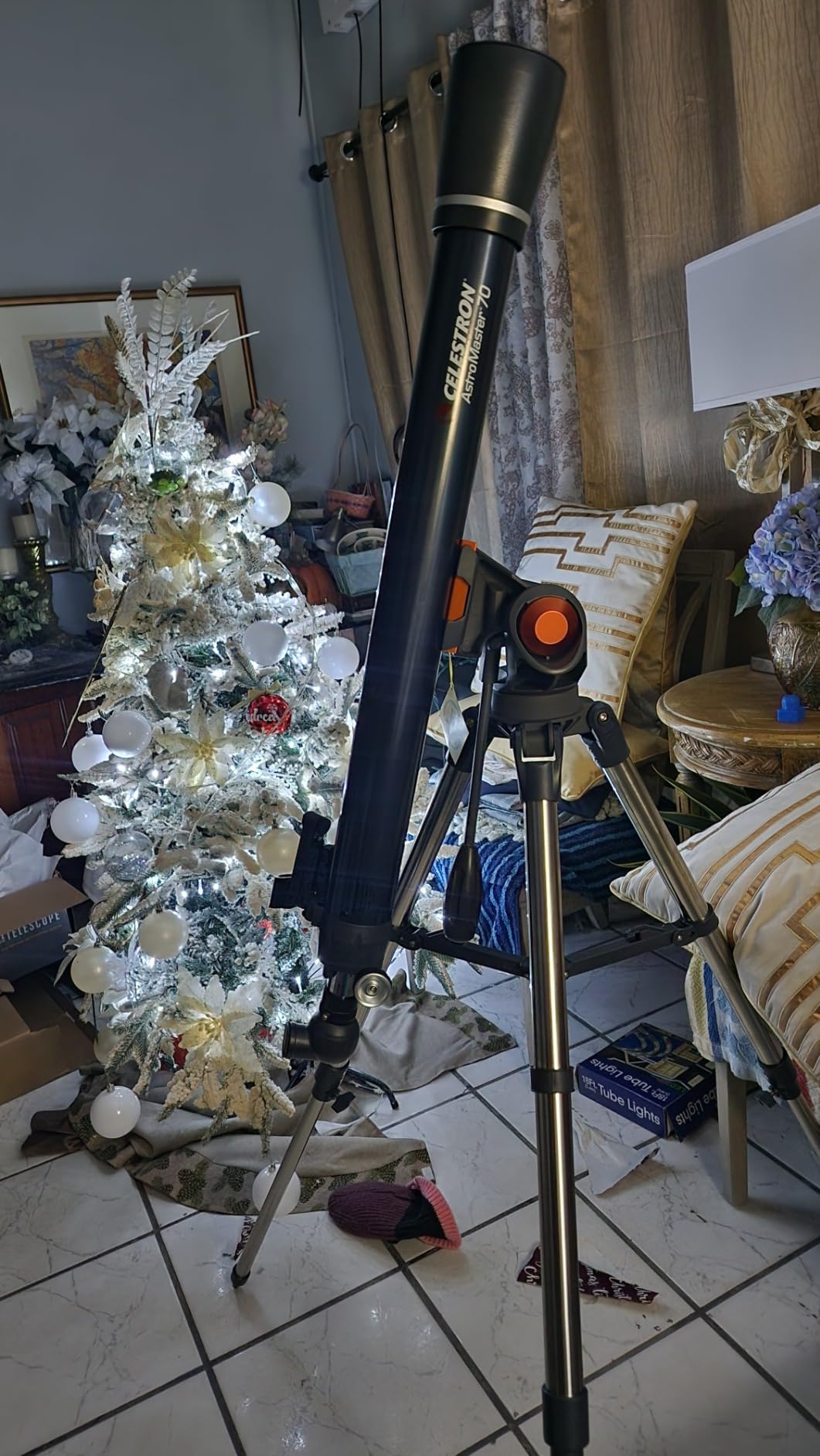
What you can realistically see with a 70mm refractor
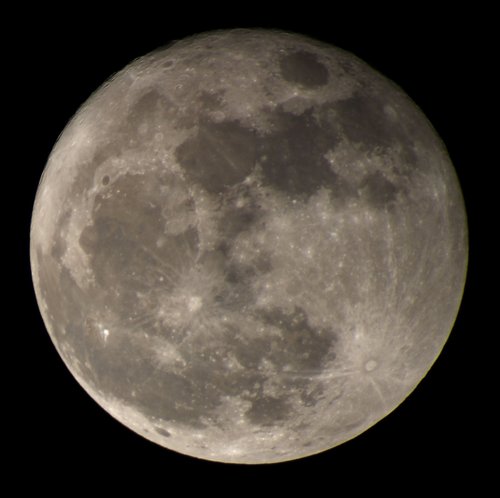
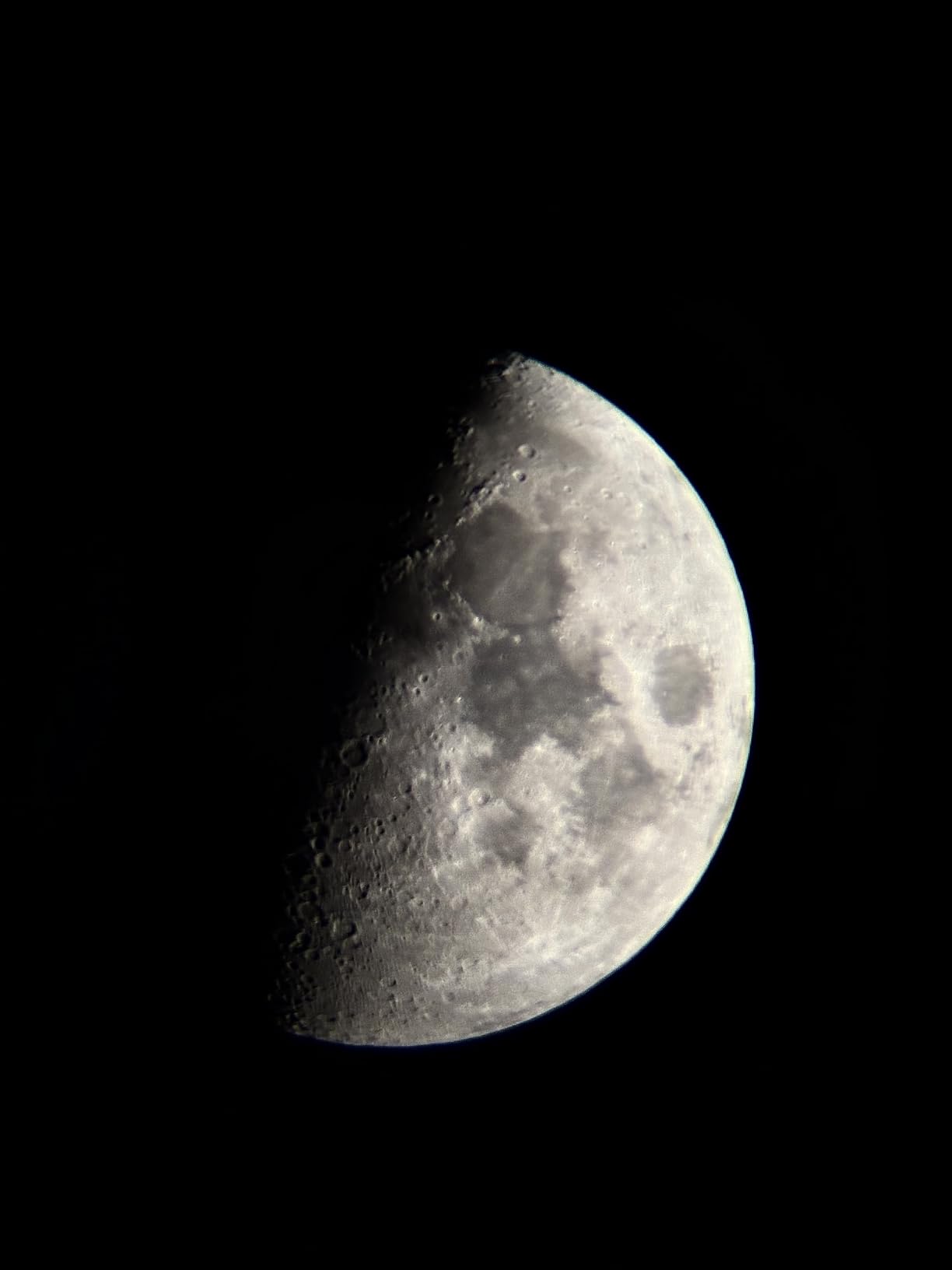
At 45x with the 20mm eyepiece you get the whole disc of the Moon with the maria visible as grey patches. At 90x the terminator shows individual crater rims and mountain shadows, and Jupiter’s four Galilean moons shift position noticeably over an evening. Titan and Rhea show on Saturn, and the rings resolve as an oval surrounding the planet.
Venus shows phases as a twilight object, and Mars is a small orange dot that grows a hint of detail within a few days of opposition. The useful magnification ceiling on a 70mm is roughly 140x, so a 7mm or 6mm eyepiece is the last sensible step. Push a 4mm to 225x and you are simply magnifying atmospheric turbulence.
Where this scope falls short
Colour fringing never fully disappears on an achromatic doublet, and on a target as bright as Venus or the Moon’s limb it is visible even at f/12.9. The included 20mm and 10mm Plossl eyepieces are fine for a first look but become the limiting factor before the glass does.
The 1.66 arc-second Dawes limit is theoretical, and the sky will rarely let you use it. If your real interest is Mars’s polar caps or the Cassini Division on a regular basis, you need more aperture, and no amount of magnification will substitute for it.
2. Celestron StarSense Explorer DX 102AZ – best for people who have never looked through a telescope
Celestron StarSense Explorer DX 102AZ App-Enabled Refractor Telescope
102mm fully XLT-coated objective
650mm focal length (f/6.4)
25mm and 10mm eyepieces
StarSense app-guided pointing
14.2 lbs complete
Pros
- 102mm aperture is a real step up from entry-level 70mm and 80mm tubes
- Phone app reliably locates targets so nobody gets lost
- Refractor needs no collimation and no maintenance
- Tripod collapses for storage
- Handles suburban light-polluted skies well
Cons
- Friction slow-motion controls have no usable middle setting
- Settle time after touching the focuser runs to several seconds
- Focuser can feel gritty on fine focus
- Stock eyepieces are basic and X-Cel upgrades make a difference
- App can struggle to align under heavy light pollution
A 102mm objective on a 650mm focal length is f/6.4, which is fast for a planetary refractor and will show more false colour than the 70mm above. The trade is deliberate: you gain 102mm of aperture and an app that points the telescope for you, and you accept a faster beam and a plastic mount.
That app is the reason to consider this scope at all. You dock your phone, it analyses the star pattern overhead with the patented StarSense recognition, and on-screen arrows walk you onto Saturn instead of leaving you sweeping the sky for forty minutes. For a first-time observer, that removes the single biggest reason people give up on astronomy.
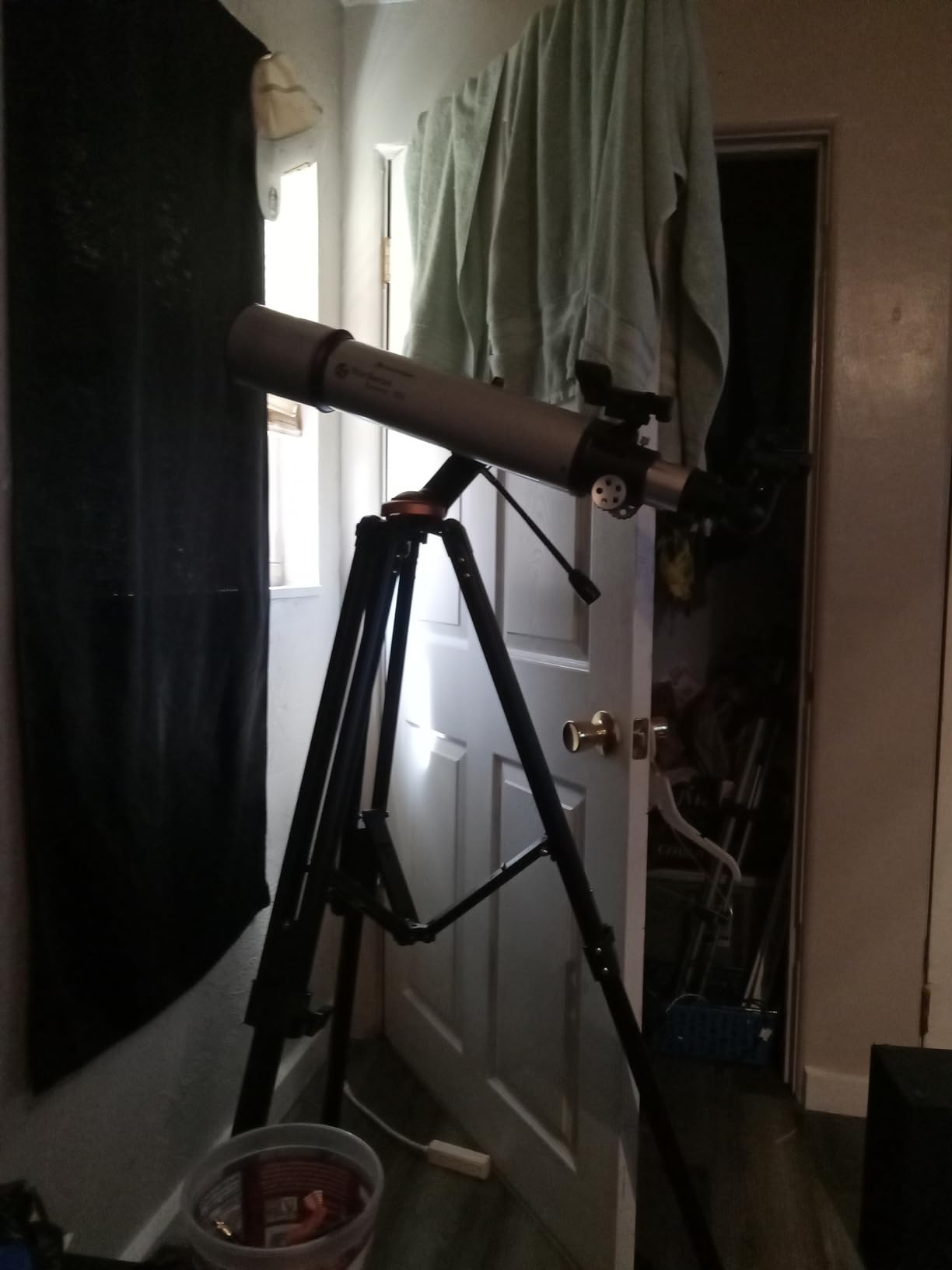
Optically it is a fully XLT-coated achromatic doublet. That means the Moon at 65x with the 25mm eyepiece is noticeably brighter and more detailed than what the cheaper 80mm bundles give you, and Jupiter’s belts separate into distinct zones. Reviewers consistently single out the crisp lunar and Saturn views from suburban backyards as the standout.
It is also worth noting this scope is not limited to planets. A 102mm refractor with a 25mm eyepiece gives a 1.05-degree field, which sweeps up dozens of bright deep-sky objects and the larger Messier clusters. It is a genuine all-rounder where the 70mm scopes are planetary tools with a side hobby.
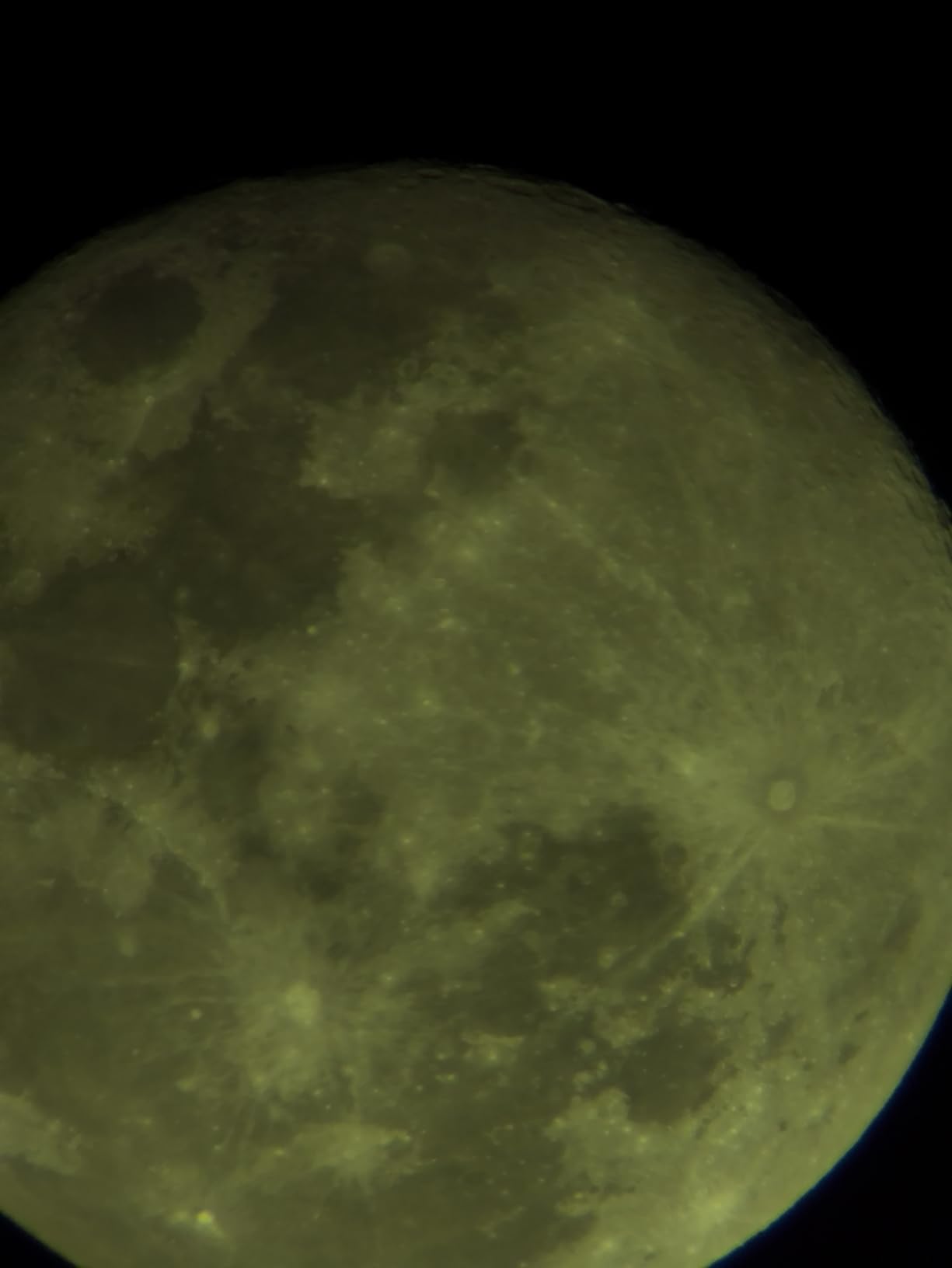
What the phone guidance actually changes
Pointing a new observer at a moving planet manually means learning coordinate basics before you see anything rewarding. Here the alignment process is roughly two minutes and the app also serves a curated list of tonight’s best targets, which quietly teaches you what is visible in your sky at that hour.
Its limit is light pollution. Star pattern recognition degrades under heavy suburban glow, and in a truly bright sky the app can fail to acquire alignment, at which point you are back to sweeping. It works best under medium skies and darker.
Where this scope falls short
At 14.2 lbs this is the heaviest complete package in the group, and the single-fork alt-azimuth mount is the weak link. Fine focus is genuinely frustrating: reviewers report a gritty focuser and several seconds of settling after every adjustment, which is painful when you are trying to hold a planetary disc steady.
Two eyepieces means a coarse magnification ladder. The 25mm gives 26x and the 10mm gives 65x, which is a big jump for planetary work, and a 2.5x Barlow or a 9mm eyepiece is close to essential to fill it.
3. SVBONY SV503 80mm ED – the only scope here with real low-dispersion glass
SVBONY SV503 Upgraded ED Refractor Telescope, 80mm F7 with Field Flattener
80mm S-FPL51 ED doublet
560mm focal length (f/7)
SV193 0.8x reducer and flattener
2 inch dual-speed focuser
2.5 kg tube only
Pros
- S-FPL51 extra-low-dispersion glass nearly removes false colour on bright targets
- Dual-speed 2 inch focuser with 1:10 micro-adjustment for precise focusing
- Highest rating in this group at 4.6 across 186 reviews
- Lightweight 2.5 kg CNC tube keeps mount demands modest
- CNC metalwork and white finish feel a tier above the price
Cons
- Optical tube only
- so a mount and tripod are a separate purchase
- No finder scope is included at all
- Bundled reducer and flattener are weighted toward imaging rather than visual work
This is the only true optic in the group. The objective is an ED doublet built around S-FPL51 extra-low-dispersion glass, which means the two wavelengths a standard achromat fails to bring to a common focus are handled properly. Stars come to a point with no colour halo, and Jupiter’s belts show an even white tone rather than a purple cast.
At 560mm it runs f/7, a sensible planetary focal ratio that sits in the sweet spot between fast wide-field tubes and painfully long ones. The included SV193 0.8x reducer and field flattener gives edge-to-edge sharpness, which reviewers consistently praise, and it also shortens exposure times if you ever put a camera on it.
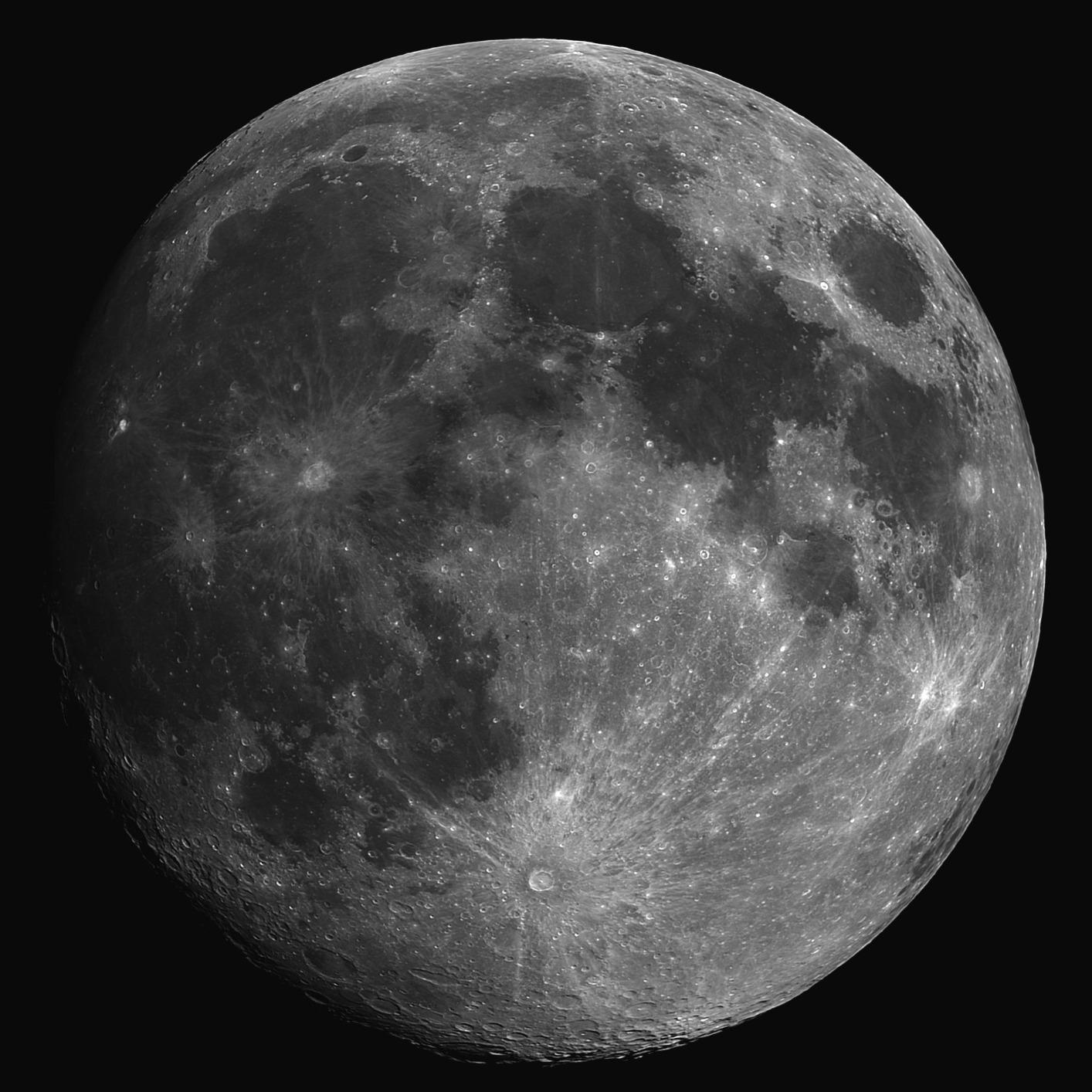
The focuser is the part that will keep you. It is a 2 inch dual-speed Crayford design with 1:10 micro-adjustment, and at planetary magnification of 140x or higher that fine control is what separates a sharp disc from a soft one. Entry-level focusers on the complete packages cannot do this.
What you give up for that glass is everything around it. This is an optical tube assembly, not a telescope. There is no mount, no tripod, no finder and no eyepieces in the box. You need a mount rated for a 2.5 kg tube plus a star diagonal, a finder and at least two eyepieces before the scope does anything at all.
Whether the ED upgrade is worth it for planets
For planetary work specifically, chromatic aberration matters more than for almost any other target because the objects are bright and their edges are high contrast. On Venus and the Moon’s limb, that false colour is the first thing a new observer notices and the first thing they think is a fault.
The SV503 removes it almost completely. If you are buying for planets and can attach this to a steady mount, that is a visible and immediate improvement over every achromat in this list. Buyers also report the flat field holds stars sharp across a wide camera frame, which is why this tube keeps appearing in imaging setups.
Where this scope falls short
Reviewers are blunt that the bundled field flattener and reducer kit is aimed at astrophotography, not visual planetary work. For looking at planets you would typically run the tube without the 0.8x reducer, which also brings the native magnification back up to a more useful level.
The 186-review rating base is the smallest in this group, so treat the 4.6 score as promising rather than proven across thousands of owners. And with no finder included, first-time observers should add that to the shopping list along with a mount that does not wobble.
4. Gskyer 70mm Travel Refractor – the most validated starter scope here
Gskyer Telescope, 70mm Aperture 400mm AZ Mount Astronomical Refracting Telescope for Kids Beginners – Travel Telescope with Carry Bag, Phone Adapter and Wireless Remote.
70mm fully coated objective
400mm focal length (f/5.7)
Two eyepieces plus a 3x Barlow
5x24 finder scope
Travel bag included
Pros
- Over 22000 ratings makes this the most thoroughly proven scope in the group
- Carry bag swallows the whole scope and tripod for travel
- Smartphone adapter and wireless remote are both included
- Tool-free assembly and a fully coated 70mm objective
- Bright clean views of the Moon and naked-eye doubles
Cons
- f/5.7 focal ratio is fast
- which suits wide fields rather than planets
- 400mm focal length caps useful magnification low
- Stock eyepieces and finder are basic components
Twenty-two thousand ratings is a genuine signal, and it is not the kind of number you see anywhere else in this roundup. When a product has that many owners, the failure modes are well known and the accessory quality is what it is, with no surprises.
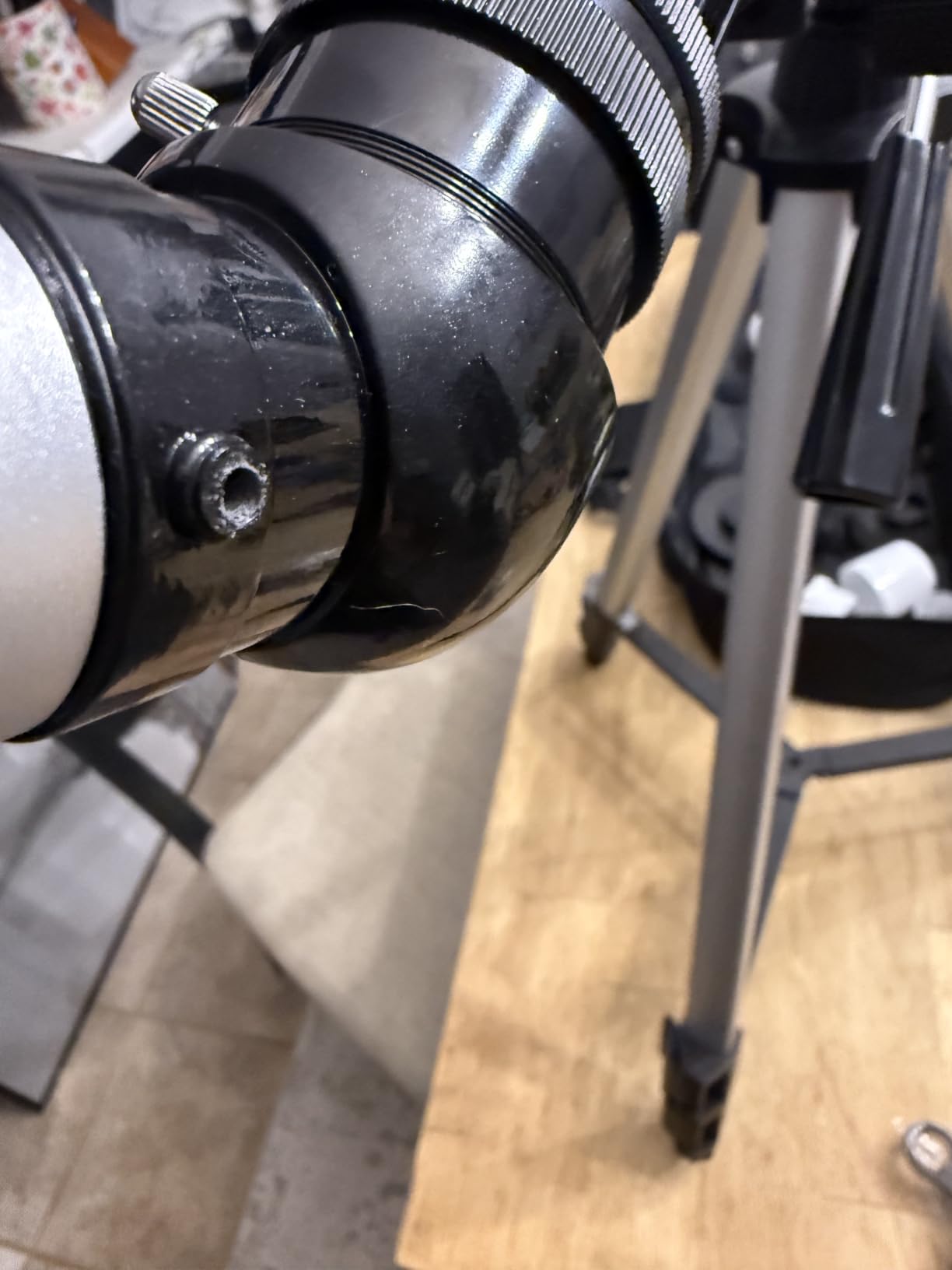
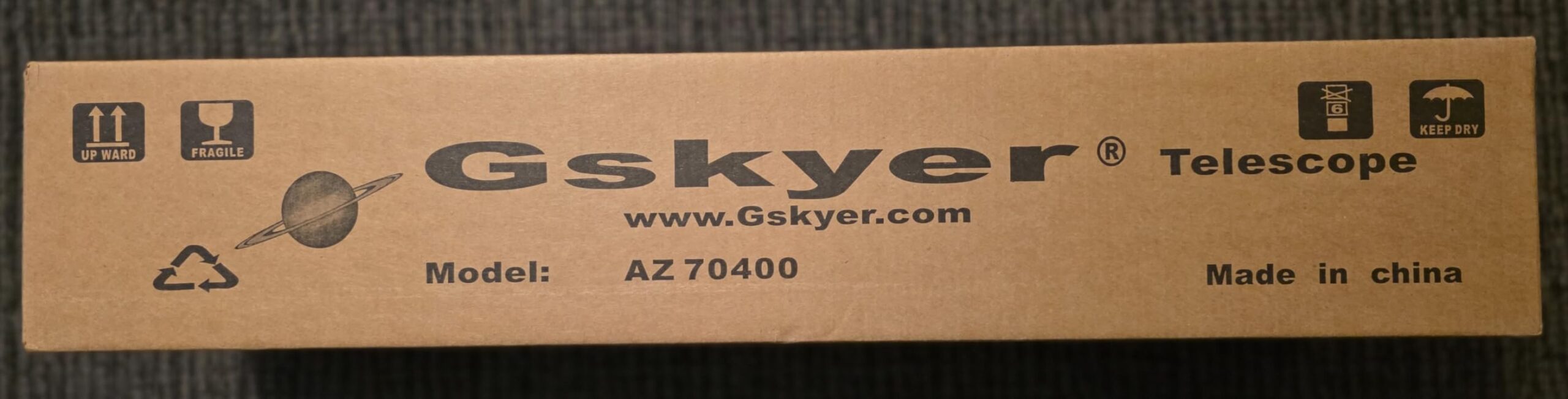
Everything you need is in the box: fully coated 70mm objective on a 400mm focal length, two eyepieces, a 3x Barlow, a 5×24 finder scope with crosshairs, an adjustable aluminium tripod, a smartphone adapter, a wireless shutter remote and a carry bag that takes the whole assembled scope.
As a grab-and-go travel scope this is hard to argue with. The bag means it lives in a cupboard rather than a garage, which is the single best predictor of whether a telescope ever gets used. It is also a good first telescope for children, and our guide to the best telescopes for kids covers the setup side of that decision in more detail.
For planets specifically, though, this is the weakest optical design in our group and we would not pretend otherwise. At 400mm with a 70mm objective the focal ratio is f/5.7, which is wide open and produces visible colour fringing around bright targets. The 3x Barlow pushes the headline magnification up without adding resolution.
When a short wide-field refractor makes sense
A fast short tube is not a bad telescope, it is a telescope for a different job. At f/5.7 with a low-power eyepiece you get a wide, bright field that sweeps up large clusters, the Pleiades, the Andromeda galaxy and the Orion nebula. That is a satisfying first night in a way that Saturn at 100x is not.
It is also the right choice if the scope lives in a car and gets used in the field. Fold it up, carry it to a dark site, set it up in two minutes. No other complete package in this group is as easy to actually take somewhere.
Where this scope falls short
Planetary detail is where the short focal length bites. You will see Jupiter as a disc with its four moons and Saturn as a ringed point, but the belts, the Great Red Spot and the Cassini Division need longer focal length and a bigger aperture than 400mm and 70mm can deliver.
The 3x Barlow multiplies magnification but not resolution, which is exactly the trap the forums warn about repeatedly. More magnification on a fast achromatic short tube mostly magnifies false colour and atmospheric turbulence.
5. Koolpte 80mm AZ Refractor – the best value 80mm in the group
Koolpte Telescope for Adults, 80mm/600mm AZ Refractor for Beginners
80mm fully multi-coated objective
600mm focal length (f/6.7)
25mm and 10mm eyepieces plus 3x Barlow
5x24 finder scope
Phone adapter and remote
Pros
- 80mm at 600mm gives clear views of the Moon
- Jupiter's moons and Saturn's rings
- Lowest cost per unit of capability among the 80mm packages
- 24x to 180x magnification range covers planetary work well
- Tool-free setup that beginners finish in minutes
- Carrying bag and light tripod make dark-site trips straightforward
Cons
- Finder sits on a fixed plastic bracket and is often badly aligned
- Plastic Barlow produces visible colour splits on Jupiter
- Tripod adjustment is stiff and some units report a shakier base
- Setup instructions are confusing around the diagonal
- Several parts are cheap plastic with hard-latching buckles
At 80mm on 600mm, this is the f/6.7 package that gets the most telescope for the least money. The 10mm eyepiece gives 60x, which is enough to see Jupiter’s belts as bands, and the 25mm gives a comfortable 24x wide view that frames the Moon nicely.
It is also the scope in this roundup where reviewers most consistently separate the optics from the accessories. The main objective is fine for the price. The finder bracket, the Barlow and the tripod legs are the parts that generate complaints, and every one of those is fixable.
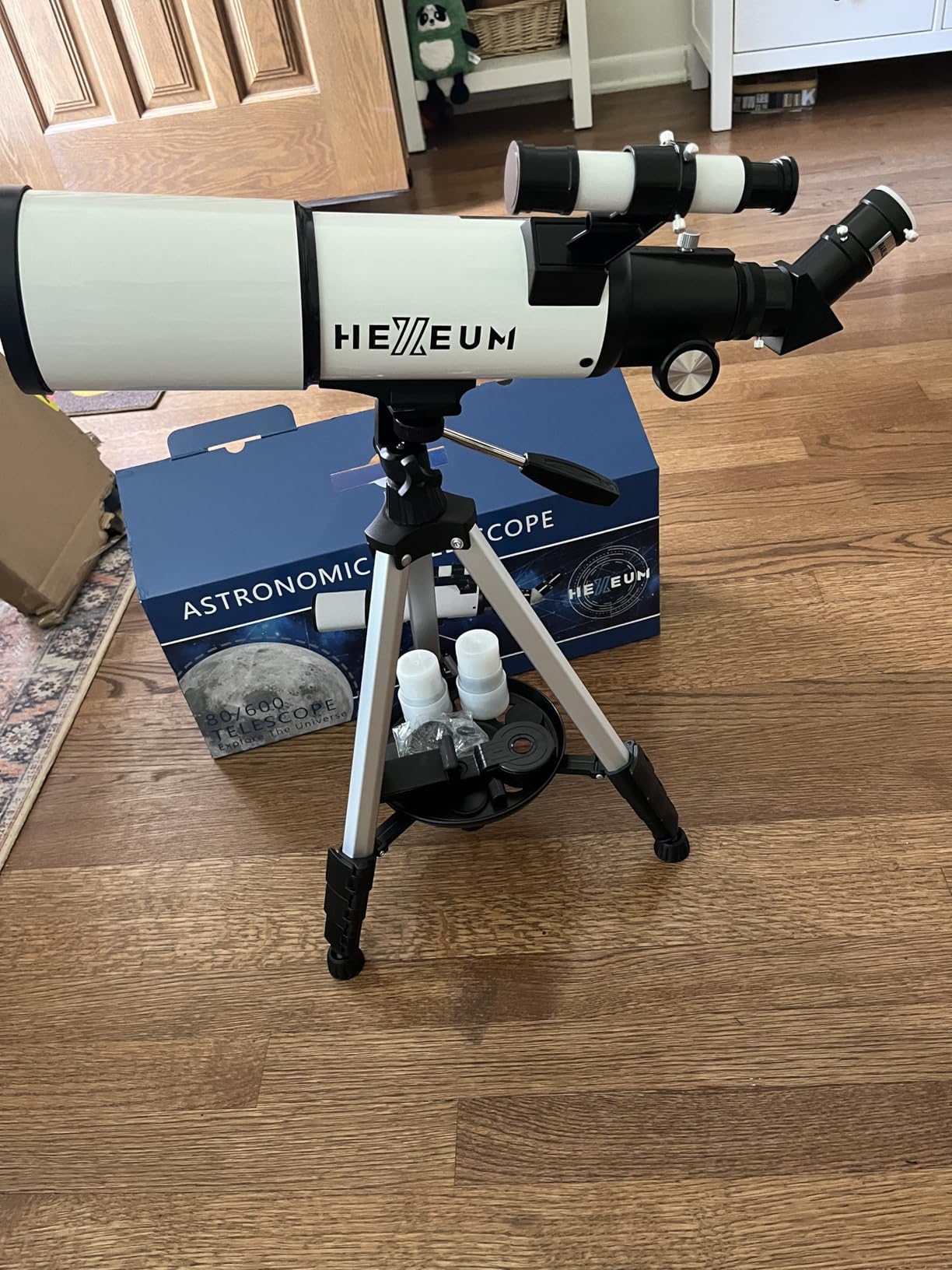
The concrete problems are worth stating plainly. The finder scope uses a non-adjustable plastic mount and frequently arrives misaligned with the main tube, which you correct by loosening and retightening it a few times. The 3x Barlow is low-quality plastic and adds visible colour splits when used on Jupiter, so skip it for planetary work and use the eyepieces on their own.
Several owners also report that the tripod is stiff to adjust and can feel shaky, and that the printed instructions do not explain the diagonal assembly clearly. None of that is fatal. It means you spend ten minutes on setup, which is a small price for a package that works.
How much magnification to actually use
The stated 24x to 180x range is honest about its endpoints, with the 180x figure coming from the 10mm eyepiece plus the 3x Barlow. For a 80mm aperture the useful ceiling is around 160x, so the raw eyepieces alone take you close to the limit without the plastic Barlow in the path.
A sensible planetary session here is 60x for finding, roughly 120x with a 5mm eyepiece for Jupiter’s belts, and then stopping. Above that you are watching the atmosphere rather than the planet.
Where this scope falls short
The 5.8 pound figure is not the issue, but the f/6.7 beam is. Achromatic doublets at f/6.7 show more colour fringing around Venus and the Moon’s edge than a slower scope, and you cannot adjust the collimation because there is none to adjust, so that is simply the design’s limit.
If you have any interest in galaxies, this is not the scope. A short wide-field refractor favours nearby clusters, not faint smudges. For that, the usual advice from experienced observers is a larger reflector on a Dobsonian mount, which puts the money into aperture instead.
6. UncleHu 80mm Travel Refractor – the best choice for daytime and Moon viewing
UncleHu 80mm Aperture, 600mm Refractor Travel Telescope for Adults and Kids
80mm fully multi-coated objective
600mm focal length
23mm, 10mm and 4mm eyepieces
3x Barlow lens
22 to 49 inch tripod range
Pros
- Fully multi-coated 80mm lens gives bright crisp lunar detail
- Three eyepieces plus a Barlow cover a very wide magnification range
- Tripod has generous 22 to 49 inch height adjustment
- Tool-free assembly with simple paper instructions
- 45 degree zenith mirror gives an upright terrestrial image
Cons
- Pan handle does not translate cleanly into scope movement
- The 23mm eyepiece delivers underwhelming magnification
- Phone adapter produces poor quality photos in practice
- Some reviews describe double images from mirror alignment drift
- Finder has no inverted lens option and relies on video tutorials
This one earns its place through the tripod. A 22 to 49 inch height range covers everything from a child standing in the garden to an adult sitting in a chair, and reviewers single out the aluminium legs as sturdier than the plastic hardware on cheaper kits. That stability matters more at 100x than any glass upgrade would.
The 45 degree zenith mirror gives an upright image, which makes this a genuinely useful terrestrial scope as well as an astronomical one. Point it at the Moon and you get an upright, correctly oriented view, which is friendlier for family observing than an inverted Newtonian-style image.
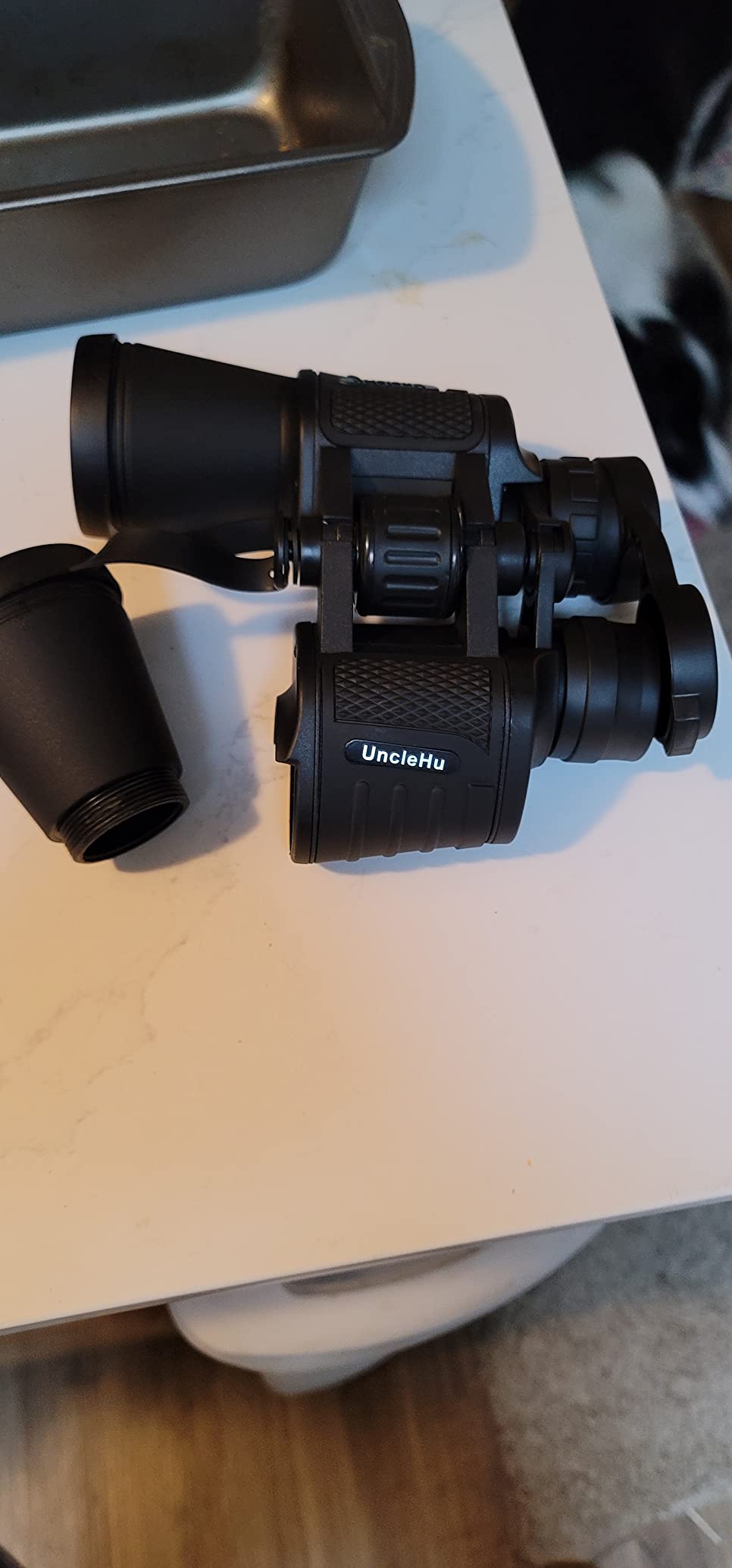
Magnification is where it gets soft. The three eyepieces plus the 3x Barlow are advertised across a 26x to 450x range, and 450x on an 80mm objective is not a real magnification, it is a number. The useful ceiling here is about 160x.
For planets, work between 60x and 120x. The 10mm eyepiece gives 60x, which is where Jupiter’s belts and Saturn’s rings separate, and the 4mm pushes to 150x where the image starts to boil. Reviewers who are honest about it note that the 23mm eyepiece is weak for what it costs and the phone adapter produces disappointing images.
Best used for Moon and landscape viewing
The multi-coated 80mm objective produces bright lunar images with good surface contrast, and the upright image from the zenith mirror means it doubles as a spotting scope for distant landscapes. That is a real use that many families end up enjoying more than faint deep-sky objects.
The lunar terminator at around 100x shows individual crater walls and the shadows inside them, and the wide 60-degree field of view of the low-power eyepiece fits the whole Moon comfortably. For a first night out, that is about as satisfying as astronomy gets.
Where this scope falls short
The pan handle is the most common complaint. Motion in the handle does not translate cleanly into movement of the scope, so fine adjustments at high power are awkward, and a few reviewers report double images appearing over time as the internal mirrors drift out of alignment.
The finder scope also lacks an inverted lens option, which matters for terrestrial use because without it the view is inverted left to right. The instructions lean on video tutorials rather than printed detail, so budget an extra ten minutes for first assembly.
7. Celticbird 80mm AZ Refractor – the most complete kit for a family first scope
Celticbird Telescope for Adults High Powered, 80mm Aperture 600mm AZ Mount Refractor Telescope for Kids Beginners – Portable Telescopes for Adults Astronomy with Backpack, Phone Adapter, Moon Filter
80mm multi-coated objective
600mm focal length (f/6.7)
20mm and 9mm eyepieces
Moon filter at 13 percent transmission
5.8 lbs with backpack
Pros
- Backpack carries the full scope and every accessory in one bag
- Tool-free assembly with a printed manual and setup video
- Adjustable aluminium tripod from 17.7 to 52 inches
- Multi-coated optics give brighter images than bare glass
- Designed for children roughly eight to twelve years old
Cons
- Only two eyepieces giving 30x and 66x
- the lowest range in the group
- Moon filter passes just 13 percent of light and darkens the view
- Achromatic objective shows colour fringing on bright planets
- No slow-motion controls so tracking is manual repositioning
The pitch here is the backpack. Everything, including the tripod, eyepieces, finder and phone adapter, packs into a single bag, so the scope can live in a cupboard and come out when the sky is clear. For a household with children, that solves the storage problem that stops most first telescopes from being used twice.
Optically it is a straightforward 80mm achromatic doublet on a 600mm focal length, which is f/6.7 and gives 30x with the 20mm eyepiece and 66x with the 9mm. Those two magnifications are enough for Saturn’s rings to appear as an oval and Jupiter’s four moons to be individually resolved.
The included moon filter is the accessory most worth knowing about. It transmits 13 percent of the incoming light, and its purpose is to darken a full Moon so the bright surface detail stands out against the background. That helps on a full Moon and hurts on anything else, so keep it off for Jupiter and Saturn.
The tripod adjusts from 17.7 to 52 inches, which covers a child and an adult with the same hardware, and assembly is tool-free with a manual and a setup video included. Reviewers note the scope is aimed at children around eight to twelve, and the simple eyepiece pair supports that.
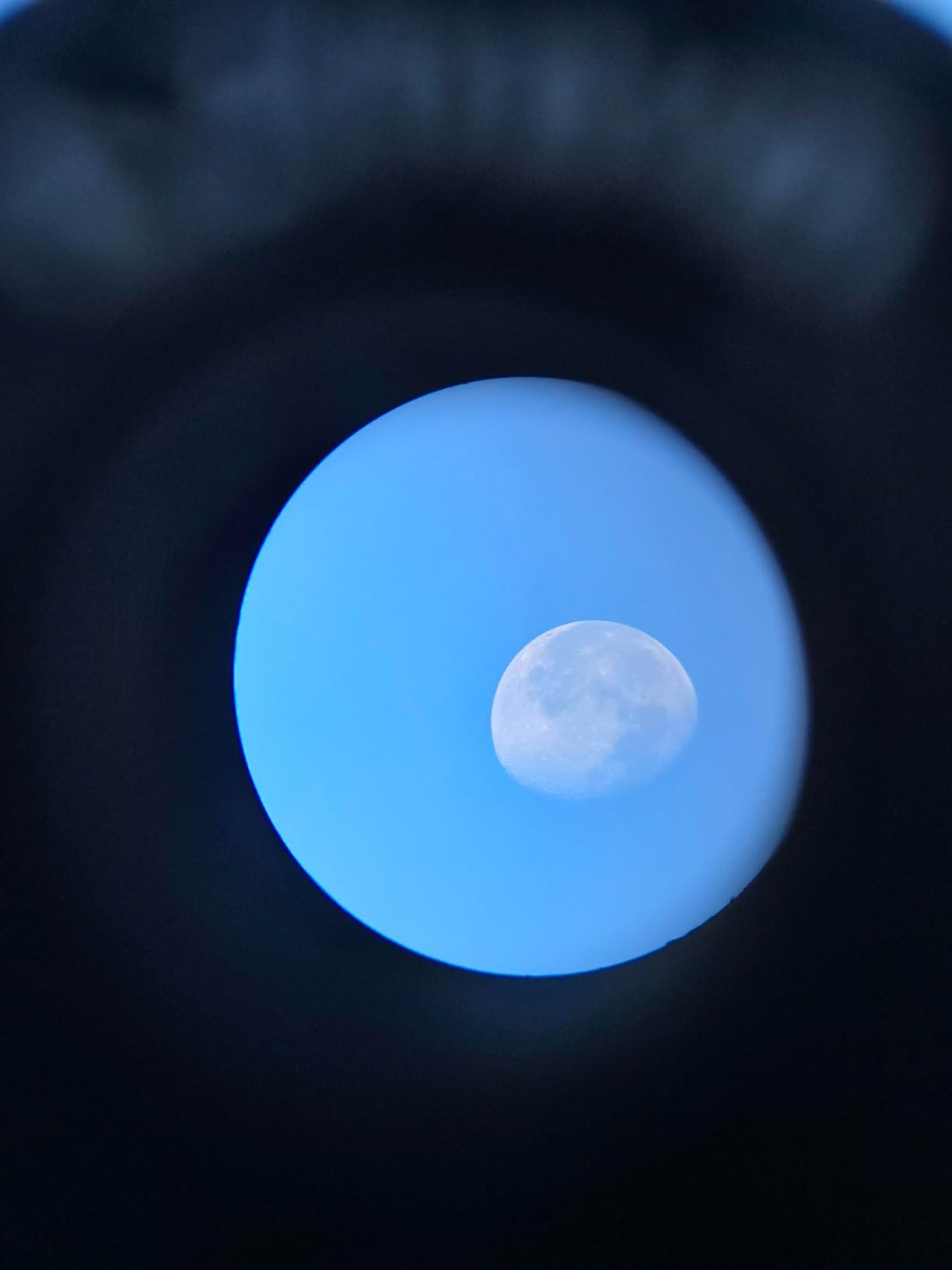
Setting realistic magnification expectations
Two eyepieces means no intermediate step, which is a real limitation. There is nothing between 30x and 66x without a Barlow, and at 66x you are already close to the useful ceiling for a 70 to 80mm achromatic in average seeing.
The right way to use this scope is at 66x on the Moon and Saturn, and at 30x for finding. Planets like Venus and Jupiter will look small at 30x and lack detail, and adding the included accessories will not fix that because magnification does not create resolution.
Where this scope falls short
There are no slow-motion controls on the tripod, so tracking a planet is entirely manual repositioning. At 66x that is manageable, but anyone aiming for double-digit minutes of Jupiter observation will find it tiring.
The achromatic objective also means colour fringing is present on bright planets, and with only 66x of magnification you cannot use a short-wavelength filter to mask it. This is a scope for the Moon and the easy planets, and it is honest about that.
8. MEEZAA 90mm Refractor – the best aperture step you can make for the money
MEEZAA Telescope for Adults High Powered, 90mm Aperture 800mm Refractor
90mm fully multi-coated objective
800mm focal length (f/8.9)
10mm and 25mm eyepieces plus 3x Barlow
Stainless steel tripod
Carry bag included
Pros
- 90mm is the widest aperture available in a complete package in this group
- 800mm f/8.9 focal length keeps chromatic aberration under control
- Stainless steel tripod is sturdy yet light enough to carry easily
- Assembly takes about twenty minutes with a clear manual
- Phone adapter and carry bag make it a genuinely complete kit
Cons
- Finder is inverted and not perfectly aligned with the tube
- Adding a phone on the adapter knocks the finder further out of alignment
- Touching the focus knob shakes the scope enough to spoil fine focus
- Advertised magnification images are not achievable with supplied eyepieces
- Deep-sky performance is adequate rather than impressive
This is the scope we keep coming back to as the sensible midpoint. At 90mm it collects roughly twice the light of a 70mm and gives about 20 percent more angular resolution, which in practice is the difference between Jupiter showing as a featureless disc and showing at least two or three belts.
The 800mm focal length makes it f/8.9, and that matters more than the brand. A slow achromatic beam behaves much better on bright targets than a fast one, so this scope shows Venus and the Moon’s limb with far less colour fringing than the 600mm 80mm packages, even though both use the same basic doublet design.
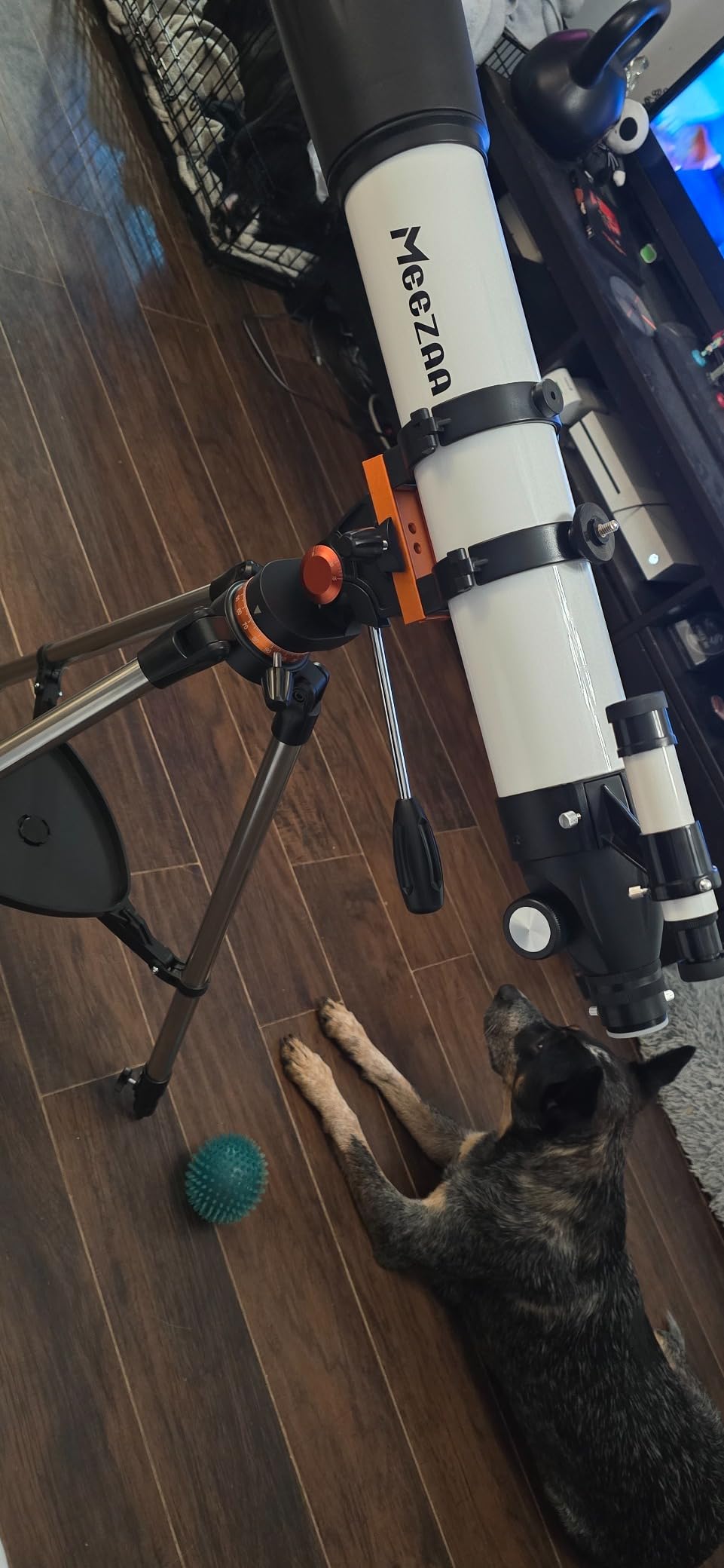
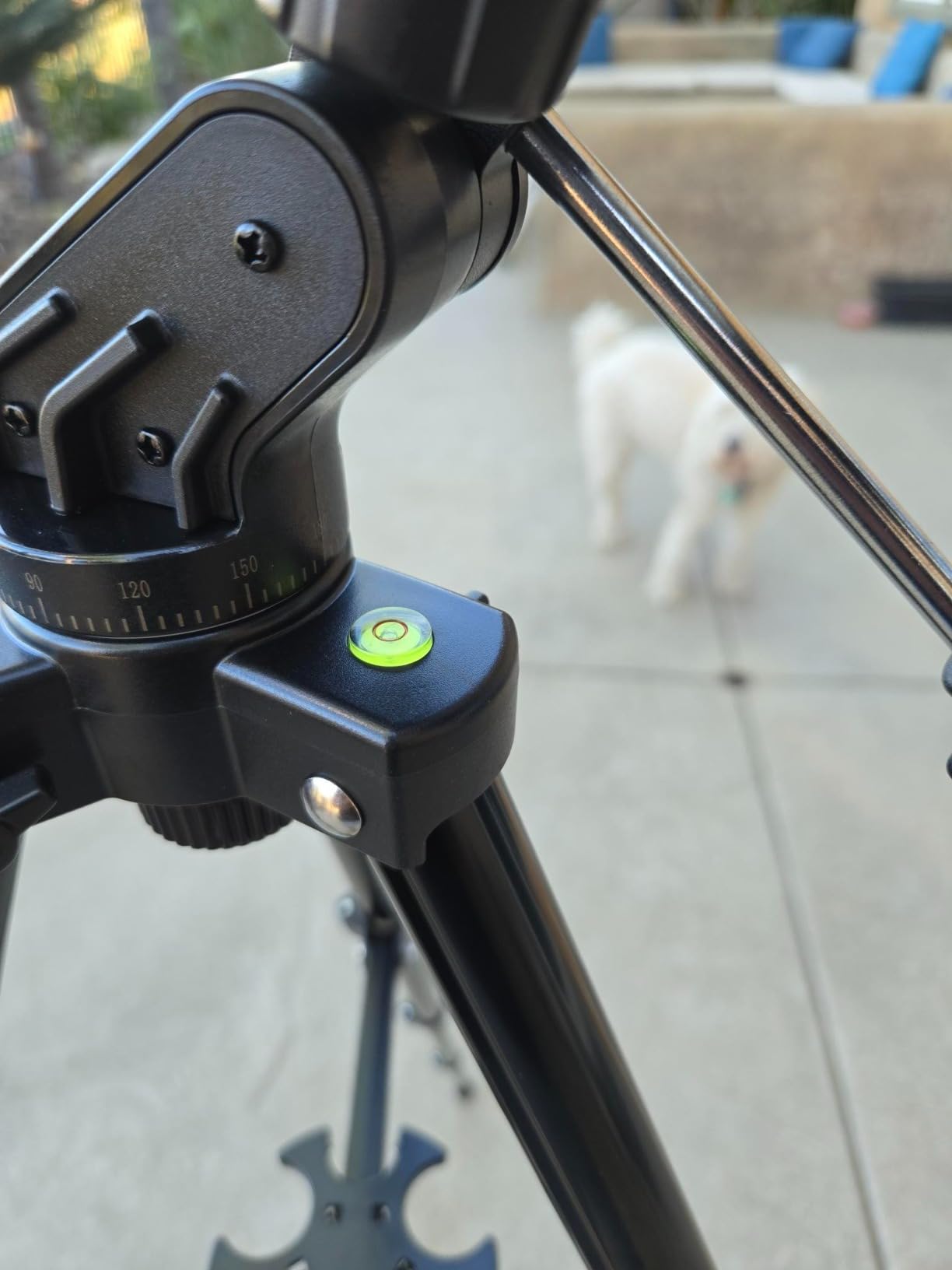
The stainless steel tripod is the best in this group at this tier. Reviewers describe it as sturdy but light enough for a child to carry upstairs, and stability under a 90mm tube at 100x is the difference between a usable view and a shimmering one. Nothing here is as heavy as the two other 90mm packages below.
The included stainless steel legs adjust from 28 to 46 inches, and the accessory tray, zenith mirror, straight-through finder and carry bag complete a package that needs nothing added before first light. Assembly averages about twenty minutes with the printed manual.
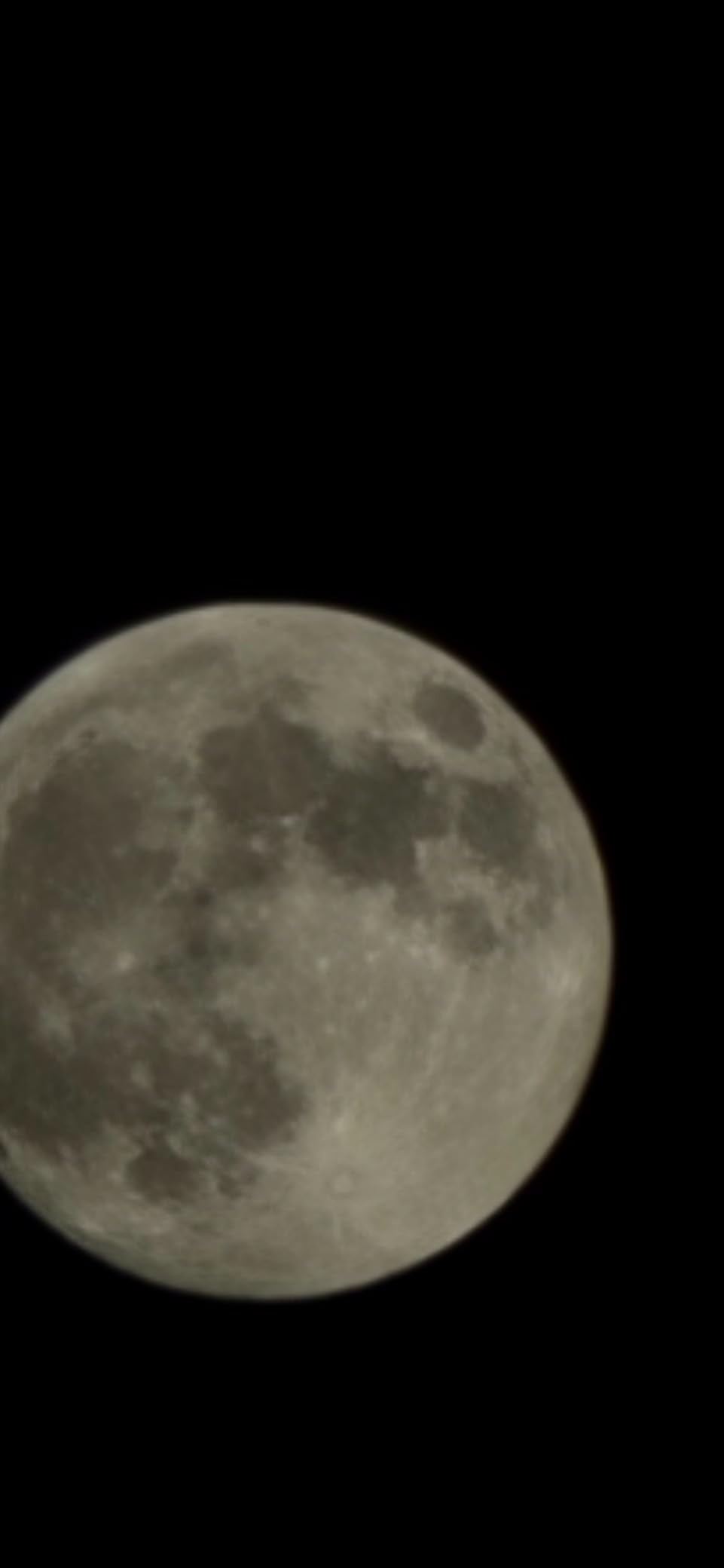
Why 90mm is the practical minimum for planets
Forum consensus across observing communities converges on roughly 100mm as the threshold where planetary observing stops being a novelty. Experienced members on StargazersLounge and IceInSpace repeatedly recommend a 100mm refractor over an 80mm or 90mm, and CloudyNights advice is to buy the largest aperture you can carry comfortably.
At 90mm you are at the low end of that threshold. The Galilean moons are clean discs, Jupiter shows belt structure and the Great Red Spot, Saturn’s rings show a gap beginning to hint at the Cassini Division, and Mars shows a recognisable disc rather than a dot near opposition. Going to 100mm sharpens all of it without changing what is visible.
Where this scope falls short
The finder is the weak point. It is inverted relative to the main tube and not perfectly aligned from the box, and adding a phone to the adapter adds enough weight to knock it further out. Expect to realign it a few times, and treat the phone adapter as an afterthought rather than a feature.
Touching the focus knob shakes the scope enough to spoil a planetary disc, which is the same complaint that appears on every complete package here. And reviewers rightly point out that the advertised magnification imagery of the Moon cannot be reproduced with the supplied eyepieces, so judge it on the aperture and the focal length instead.
9. HETEKAN 90mm Refractor – the best high-power eyepiece set in the group
HETEKAN Telescope for Adults High Powered, 90mm Aperture 900mm Refractor
90mm fully coated objective
900mm focal length
25mm, 10mm and 6mm eyepieces
3x Barlow lens
Stainless steel tripod, 5.6 kg
Pros
- 90mm aperture on a 900mm focal length gives strong planetary light and resolution
- Three eyepieces plus a Barlow give the deepest magnification ladder here
- Stainless steel tripod with 360 degree rotation and 29 to 46 inch height
- Complete kit with finder
- phone adapter
- stargazing phone mount and carry bag
- Two-year manufacturer warranty and clear setup guide
Cons
- Achromatic doublet shows colour fringing at the 6mm eyepiece on bright planets
- Claimed 450x magnification far exceeds what a 90mm aperture can resolve
- Bulky 90cm tube and 5.6 kg package are among the least portable here
- Lowest rating tier in this roundup at 4.2 with 9 percent three-star reviews
Three eyepieces is the difference here. Most of the 80mm packages ship with two, which leaves a gap in the magnification ladder. This one includes 25mm, 10mm and 6mm, so you can work from 36x up through 90x to 150x without buying anything, and the 6mm lands right in the useful range for a 90mm aperture.
The 900mm focal length gives an unspecified but long focal ratio that keeps the achromatic colour fringing more manageable than a fast 600mm tube. Add the 3x Barlow and the package claims 36x to 450x, which is a marketing number rather than a real one, but the eyepieces themselves are a well-chosen set.
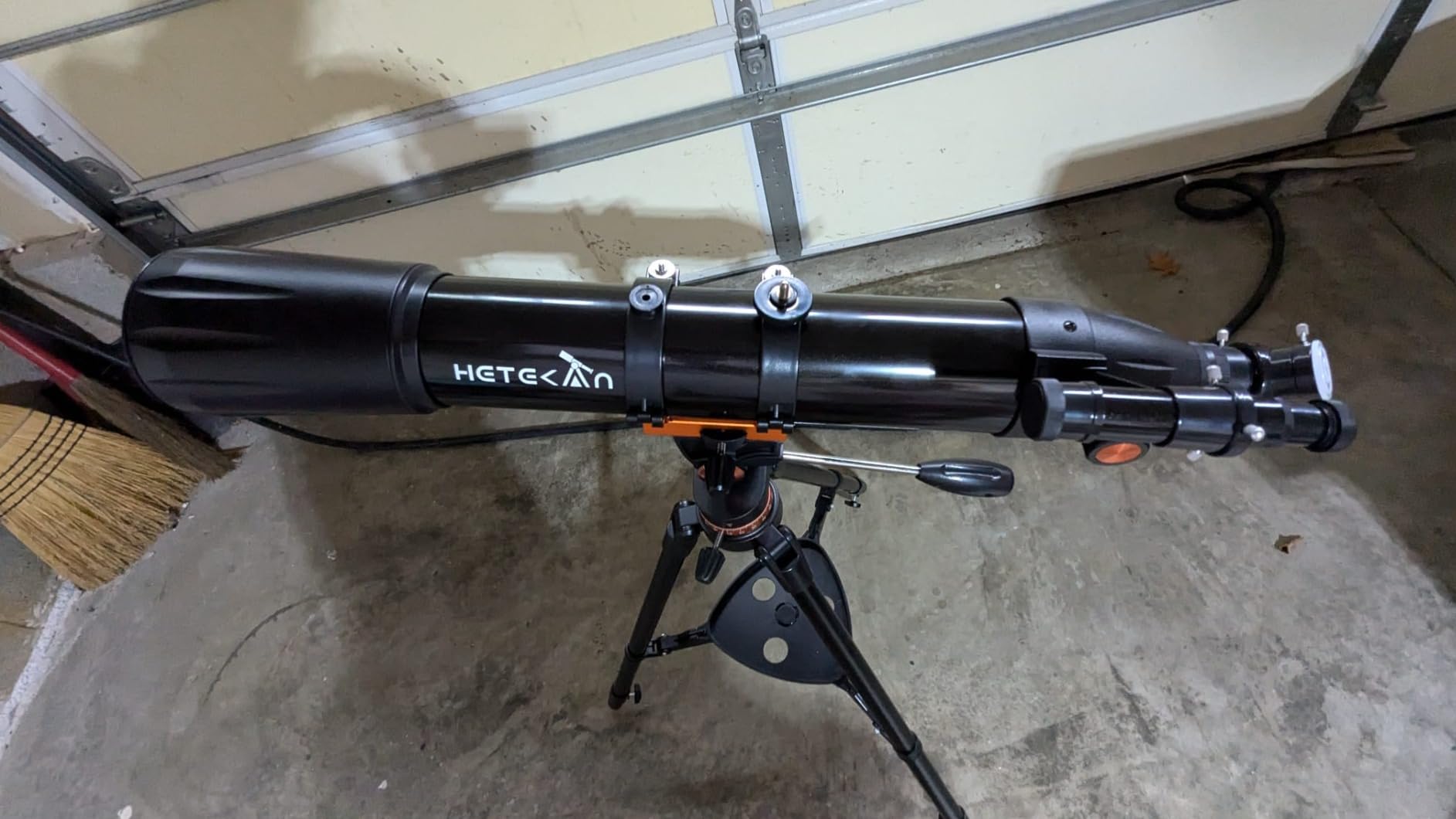
The stainless steel tripod rotates 360 degrees horizontally and 180 degrees vertically with a 29 to 46 inch height range, which is a usable range for both a seated and a standing observer. The kit is genuinely complete: finder scope, phone adapter, dedicated stargazing phone mount, accessory tray, zenith mirror and carry bag.
Where it loses ground is weight and size. At 5.6 kg with a 90cm optical tube, this is one of the bulkiest options here, and observers who eventually get serious about planets usually complain that a scope they cannot move to dark skies is a scope that stops being used.
Using the three-eyepiece ladder properly
Start at 36x with the 25mm to locate the target, step to 90x with the 10mm to see structure, and use the 6mm only on a steady night when the planets are high. Skipping the 6mm entirely on a night of poor seeing is the single most effective thing a beginner can learn.
Leave the 3x Barlow in the drawer for now. On an achromatic doublet a Barlow amplifies both the resolution and the colour error from the objective, and at 4mm you are well past the point where the atmosphere will let you use what is left.
Where this scope falls short
The 4.2 rating is the lowest in this group, with 9 percent of reviews giving three stars, and the reasons are consistent. Buyers report colour fringing on bright planets through the 6mm eyepiece, which is the doublet design working exactly as theory predicts.
Portability is the other structural limitation. A 90cm tube on a stainless steel tripod is a two-person carry for most people, and if you plan to drive to darker skies regularly, a 70mm or 80mm package will serve you better over the years.
10. Hawkko 90mm Refractor – the slowest focal ratio among the 90mm packages
Hawkko 90mm Aperture 900mm Telescope for Adults High Powered – Professional Multi-Coated Refractor Telescope for Astronomy Beginners (36X-270X) with AZ Mount, Phone Adapter and Carry Bag
90mm aperture on 900mm focal length (f/10)
Full multi-layer coating
25mm and 10mm eyepieces plus 3x Barlow
Stainless steel AZ mount
5 kg complete
Pros
- f/10 focal ratio is the slowest in this roundup and holds chromatic aberration down
- Full multi-layer coating lifts transmittance noticeably on faint targets
- Published Dawes limit of 1.29 arc seconds
- Stainless steel alt-azimuth mount with smooth 360 degree rotation
- Complete kit including finder
- zenith mirror
- accessory tray and carry bag
Cons
- Only two eyepieces giving a narrower range than most rivals
- Achromatic doublet still shows colour fringing on bright planets and the Moon's edge
- Bulky 90cm tube and 5 kg total weight limit portability
- Lowest rating tier here at 4.2 with 8 percent one-star reviews
A 90mm objective on a 900mm focal length is f/10, which makes this the slowest design in the group. Slow focal ratios are the cheapest way to suppress the colour error in a doublet, so for planetary work this behaves more like a premium scope than its rating suggests.
It is also the only package here publishing a Dawes limit, at 1.29 arc seconds. That is a theoretical figure and the atmosphere will almost never let you reach it, but it tells you the optics are specified with planetary resolving power rather than wide-field astronomy in mind.
The full multi-layer coating is a real step above the single-layer coating on some cheaper tubes, and reviewers notice the brightness difference on the Moon and on fainter targets. The stainless steel alt-azimuth mount rotates through 360 degrees with 28 to 46 inch height adjustment, and the whole kit assembles in about fifteen minutes.
The bundle covers everything: finder scope, zenith mirror, accessory tray, carry bag, phone adapter with star finder mount, and 25mm and 10mm eyepieces. For an 80mm-wide shopping list at 90mm aperture, nothing else here is as comprehensively equipped for the money.
Why f/10 suits planetary work
Chromatic aberration scales with the angle at which light is bent, so a slow beam is inherently gentler on colour error than a fast one. At f/10 this scope sits at the opposite end of the range from the short wide-field tubes in this roundup, and it shows on Venus, on the Moon’s bright limb and on Jupiter’s white zones.
Longer focal lengths are also kinder at high magnification, because the same angular shake in the tube produces a smaller wobble in the image. At 200x on an f/10 tube you are chasing a smaller piece of sky than at 200x on an f/5.7 one.
Where this scope falls short
Two eyepieces is a narrow range for a 900mm focal length, giving 36x and 90x before the Barlow. That leaves a real gap between low-power viewing and the 150x where this scope would be most useful, and filling it means buying a third eyepiece.
At 5 kg with a 90cm tube it is among the least portable options we tested, and 8 percent one-star reviews point to assembly and accessory issues that a careful buyer should expect to spend time on. The achromatic doublet still frings on bright targets despite the slow focal ratio.
How to Choose a Refractor Telescope for Planets
Aperture is the deciding number, not magnification
Aperture is the diameter of the front objective lens, and it governs two things simultaneously: how much light you collect, and how much detail you can resolve. Light-gathering power scales with the square of the diameter, so 90mm collects roughly 1.65 times what 70mm does. Resolution scales with diameter directly.
This is why every experienced observer on CloudyNights, StargazersLounge and r/telescopes tells beginners the same thing: buy the largest aperture you can afford and still carry comfortably. Every extra 10mm shows a little more. The step from 70mm to 80mm is noticeable, from 80mm to 90mm is clearer, and from 90mm to 100mm is the one most observers call the real threshold.
Why slow focal ratios win on planets
Focal ratio is the focal length divided by the aperture, written as f/12.9 or f/8 or f/5.7. It controls how tightly the light converges, and tighter convergence in a simple doublet produces more colour error. Slow scopes therefore look better on bright targets.
The planetary sweet spot is roughly f/7 to f/10. That is exactly why the fastest scopes here, like the 400mm f/5.7 Gskyer, are wide-field tools that merely tolerate planets, while the slowest, the f/12.9 Celestron AstroMaster, treat them as their main job. Fast short-tube achromats get recommended constantly as general-purpose first scopes and disappoint almost everyone who buys them for planetary work.
Achromat, ED doublet, fluorite doublet or triplet APO
An achromatic doublet uses one crown and one flint element. It is cheap, robust and never needs collimation, and on slow focal ratios it looks good. Almost every complete package in this roundup is one.
An ED doublet substitutes extra-low-dispersion glass such as S-FPL51 for the flint element. It brings three wavelengths to focus instead of two, which removes most of the colour fringing for a modest step up in cost. The SVBONY SV503 in this roundup is the example.
A fluorite or synthetic fluorite doublet behaves similarly to an ED doublet with excellent colour correction and very little chromatic shift as temperature changes, which matters for high-power sessions. True natural fluorite is fragile and expensive; synthetic fluorite is the practical version.
An apochromatic triplet uses three elements to bring three wavelengths to a common focus. The image quality on planets is superb with almost no fringing anywhere, and it is the standard serious planetary optic. None of the scopes in this roundup reach that level, which is the honest ceiling on what a complete package under this budget delivers.
Useful magnification and a worked eyepiece example
Useful magnification is roughly twice the aperture in millimetres. A 70mm scope is useful to about 140x, an 80mm to about 160x, and a 90mm to about 180x. Beyond that you are magnifying atmospheric turbulence rather than the planet.
Worked example on the Celestron AstroMaster 70AZ: at 900mm focal length, a 20mm eyepiece gives 45x and a 10mm gives 90x. Dropping to a 7mm gives about 128x, which is the highest power most observers use on a night of average seeing. A 4mm gives 225x, well past the ceiling, and the image will boil. A 3x Barlow on top of the 10mm would be worse still, because it multiplies magnification without adding any resolution.
Mount stability is where budget scopes get wasted
Forum consensus is repeated and blunt: a great optical tube on a cheap mount is wasted money. At 150x any vibration in the tripod or any wobble in the alt-azimuth head is visible as a shimmering disc, and no amount of glass fixes it. This is why a mediocre 80mm on a solid mount outperforms a fine 90mm on a flimsy one.
What to look for: rigid metal legs rather than thin plastic, a slow-motion control you can actually engage at one setting, and a focuser that is smooth enough to fine-focus without shaking the tube. Entry-level focusers with heavy friction are the most common complaint across every complete package in this roundup, and they are the first thing worth replacing.
The honest disadvantages of a refractor for planets
A refractor is not the right tool for every observing goal. The disadvantages worth knowing before you buy are chromatic aberration on cheap doublets, a cool-down period of 20 to 30 minutes before the tube reaches thermal equilibrium and stops shimmering, dew forming on the front lens during long sessions, tube length that makes storage awkward, and a narrower field of view than a reflector.
If your real goal is faint galaxies rather than planets, a Dobsonian reflector puts far more light per unit of money into the mirror, and that is the honest advice from every forum veteran we read. A refractor earns its premium specifically on high-contrast targets: the Moon, the planets and bright double stars.
For eyepieces, a 25mm for finding, a 9mm for general planetary work and a 6mm for the best nights gives you the ladder that matters. Colour filters sharpen planetary contrast: an 80A medium-blue filter improves Mars, a 21 filter brings out the Cassini Division on Saturn, and a 38A adds a greenish tone that helps Jupiter’s belts and the lunar terminator. And always check the seeing forecast before you set up, because a cool, windy night ruins more planetary sessions than any optical flaw.
If you are shopping for a younger observer rather than yourself, our guide to the best telescopes for kids covers the setup and durability questions that matter most for a first instrument.
Frequently Asked Questions
Which telescope is best to see all planets?
No single telescope shows all eight well. A 90mm to 100mm refractor resolves the Moon, Jupiter, Saturn, Venus and Mars well, and shows Uranus and Neptune as small blue-green discs that need a chart and patience. Pluto is not realistically visible in any scope at this level. If seeing every planet matters most, a GoTo mount or a phone-guided scope such as the Celestron StarSense Explorer DX 102AZ saves a lot of searching.
Can you see galaxies with a refractor telescope?
Yes, but they are faint. A refractor’s high contrast works against you on galaxies because they are low surface brightness targets. A 100mm refractor shows the brighter Messier objects, the Andromeda galaxy and large clusters well on dark nights. For faint galaxies generally, a larger reflector gives far more light for the same money.
What is a good telescope to see Saturn’s rings?
Any 70mm refractor shows Saturn’s rings as an oval surrounding the planet. You need roughly 100mm of aperture before the Cassini Division appears as a dark gap, and 120mm or more to see it reliably on average nights. Magnification of 100x to 200x is the working range for the rings.
What telescope should I buy to see galaxies?
A Dobsonian reflector. For galaxy observing, light-gathering power matters far more than contrast, and a 6 inch Dobsonian on a simple mount collects several times the light of a 70mm refractor while costing less. Refractors suit the Moon, planets and double stars; reflectors suit faint deep-sky objects such as galaxies.
Which refractor telescope is best for viewing planets?
For most people the Celestron AstroMaster 70AZ is the best refractor telescope for planets, because its 900mm focal length makes it the slowest design in our group and it holds sharp, low-fringe views without any glass upgrade. If you can step up, the MEEZAA 90mm buys the meaningful increase in aperture, and the SVBONY SV503 80mm ED is the only scope here with real low-dispersion glass.
What size telescope to see Saturn’s rings?
A 70mm refractor shows the rings clearly as an oval. Around 100mm you begin to see the Cassini Division as a dark gap between the two main rings. A 25mm eyepiece on a 900mm focal length gives about 36x and is enough to confirm the rings; 100x to 200x shows them best.
What is a good aperture for a telescope to see planets?
For the Moon, 70mm is enough. For Jupiter’s belts and Saturn’s rings, 90mm to 100mm is the practical minimum most experienced observers recommend. For Uranus and Neptune you want 100mm or more plus a chart. Doubling from 70mm to 140mm roughly doubles the detail available, but no refractor at any aperture shows galaxies like a Dobsonian does.
What are the disadvantages of a refractor telescope?
The main drawbacks for planetary use are chromatic aberration on cheap achromatic doublets, a 20 to 30 minute cool-down period before the tube stops shimmering, dew forming on the front lens during long sessions, and tube length that makes storage awkward. Refractors also need no collimation, which is their main advantage in return.
Which Refractor Telescope Should You Buy?
Our overall pick is the Celestron AstroMaster 70AZ. Its 900mm focal length makes it the slowest design in this group, and that single specification delivers the sharpest, steadiest planetary views here without any glass upgrade, a mount you have to learn, or an eyepiece ladder you have to buy.
Skip it if galaxies are your real interest. No refractor in this roundup competes with a Dobsonian reflector on faint deep-sky targets, and a 70mm achromatic is the wrong shape of instrument for that goal. Skip it too if you want Saturn’s Cassini Division or Mars’s polar caps, because those need 100mm of aperture or more. For that step up, the MEEZAA 90mm is the best value in the group, and if you already own a solid mount, the SVBONY SV503 80mm ED is the only optic here that removes false colour properly.
Whichever you choose, give it 20 minutes to cool down, start at low power, and stop pushing magnification before the image starts to boil. That habit alone puts you ahead of most first-time observers in 2026.