
You need 70mm of aperture at absolute minimum to see Saturn’s rings as anything more than a bump on a bright dot. The practical sweet spot is 90mm to 130mm, where ring separation becomes obvious. Six to eight inches of aperture is where the Cassini Division and Titan appear, and a rigid mount matters more than any advertised magnification figure.
The frustration that drives most searches here is familiar. You already own a telescope, Jupiter and its moons look great, and Saturn is still a soft yellow smear. A Reddit user with an Orion SkyQuest XT8 Plus described exactly this: their 35mm, 25mm, 17mm, and 10mm eyepieces handle Jupiter without problem, yet Saturn stayed fuzzy. In most of those cases the telescope is not the problem. Eyepiece choice and atmospheric seeing are.
That said, if you are buying your first telescope, aperture is the one specification that decides how Saturn looks. Everything else in this guide is secondary to that number. Below are the three criteria that actually move the needle for this planet:
- Aperture: 70mm is the floor for a ring hint, 90mm to 130mm shows clear ring separation, and 150mm to 200mm starts resolving the Cassini Division and Titan.
- Focal length: Longer focal ratios (f/8 to f/10 and beyond) give a larger, brighter image of a small bright planet, which is exactly what Saturn is.
- Mount stability: At the 150x to 250x range where Saturn’s rings resolve, a shaky tripod or wobbly eyepiece holder destroys the image before the optics even get a say.
We compared eight telescopes against that framework, weighing real aperture, focal length, and how much magnification each one can hold steady. Two of them are bare optical tubes that need a mount you already own. If you are shopping for a child rather than yourself, our guide to the best telescopes for kids covers the setup and durability side. If you want the shortest path, take the Editor’s Choice and skip ahead.
Table of Contents
Top 3 Picks for Seeing Saturn in 2026

Celestron NexStar 8SE
- 203mm aperture resolves the Cassini Division
- 2032mm f/16 focal length holds 200x+
- Fully computerized GoTo mount with 40000+ object database
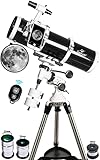
Gskyer 130EQ Reflector
- 130mm aperture with 650mm f/5 focal length
- German equatorial mount for smooth tracking
- Three eyepieces plus 3x Barlow included

Sky-Watcher Classic 200…
- 203mm aperture at 1200mm f/6
- No electronics and no alignment routine
- 25mm and 10mm eyepieces plus 9x50 finder
Best Telescopes for Viewing Saturn at a Glance (October 2026)
Every telescope below is judged on the same three questions: how much aperture does it have, can the mount hold magnification steady, and what Saturn actually looks like through it at around 150x. Use the buttons below for current listing details on each one.
| Product | Specs | Action |
|---|---|---|
| Celestron NexStar 8SE |
|
Check Latest Price |
| Sky-Watcher Classic 200 Dobsonian |
|
Check Latest Price |
 Celestron NexStar 127SLT Celestron NexStar 127SLT |
|
Check Latest Price |
 Celestron StarSense 8-inch Dobsonian Celestron StarSense 8-inch Dobsonian |
|
Check Latest Price |
 SVBONY SV503 80mm ED Refractor SVBONY SV503 80mm ED Refractor |
|
Check Latest Price |
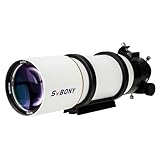 SVBONY SV48P 90mm Refractor SVBONY SV48P 90mm Refractor |
|
Check Latest Price |
 Sky-Watcher Heritage 150 Tabletop Dobsonian Sky-Watcher Heritage 150 Tabletop Dobsonian |
|
Check Latest Price |
| Gskyer 130EQ Reflector |
|
Check Latest Price |
What Aperture Do You Need to See Saturn’s Rings?
Aperture is the diameter of the main lens or mirror. It controls how much light you gather and, more importantly for Saturn, how much detail you can resolve. Saturn is small, so resolution matters far more than light. Here is the ladder that separates a vague dot from a planet you recognise instantly:
- 60mm to 70mm: Saturn is a yellow dot with a slight flattening. Some people see a hint of ring structure on a very steady night. Most see nothing convincing. This is the size where first-time buyers report identifying “a bunch of stars” even after locating the planet with software.
- 80mm to 90mm: The rings separate from the planet’s disc and read as a distinct shape. Titan is easy to spot as it swings around. This is the honest entry point for visual observing.
- 100mm to 130mm: Ring separation is obvious, ring tilt is easy to judge, and the Cassini Division starts appearing as a faint dark line during good seeing. Titan and Rhea both become reachable.
- 150mm (6 inch): The Cassini Division resolves consistently rather than occasionally. Titan, Rhea, and Enceladus are all within reach, and colour begins to show in the rings.
- 200mm (8 inch): This is where Saturn stops looking like an illustration and starts looking like Saturn. Enceladus sits inside the edge of the E ring, and subtle ring structure appears during steady air.
A practical ceiling for magnification is roughly two times the aperture in millimetres, which works out to about 50x per inch. A 4 inch scope tops out near 200x, an 8 inch scope near 400x. Past that you are not adding detail, just spreading the same light thinner and dimming the image.
1. Celestron NexStar 8SE – Editor’s Choice for Saturn
Celestron NexStar 8SE Computerized Telescope – Schmidt-Cassegrain
203mm aperture
2032mm f/16 Schmidt-Cassegrain
StarBright XLT coating
10.88 kg
Pros
- 203mm aperture resolves the Cassini Division and Titan
- 2032mm focal length holds 200x+ without fuss
- 40000+ object database removes star-chart hunting
- SkyAlign needs no star knowledge
- Large established review base of 1579 ratings
Cons
- Single fork arm tracks less precisely than an equatorial wedge
- Batteries or AC adapter required for powered use
- 24 lb weight is a two-person carry
This is the telescope we keep coming back to for one reason: 203mm of aperture in a tube you can carry out to the driveway in one trip. Saturn at 150x through this scope shows the Cassini Division as a real gap, not a suggestion. Titan is a clear point that moves noticeably over an hour, and on a steady night Enceladus is recoverable inside the faint outer ring.
The 2032mm focal length is the quiet advantage. Magnification comes from the eyepiece, so the included 25mm gives you 81x with a bright, wide image, and dropping to a 10mm pushes you to 203x without the scope straining. Because it is a catadioptric with a corrector plate, there is no collimation to do, and the closed tube does not suffer mirror dewing the way open reflectors can.
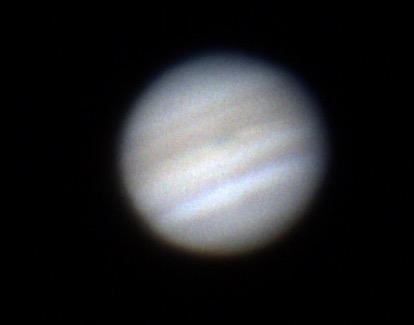
The GoTo mount is the reason this lands at the top for beginners. One user on r/telescopes with a Celestron SCT 8SE reported getting a genuinely good Saturn image only after many attempts, using an 18mm eyepiece. That is a fair description of the learning curve, and it is also why the 40,000-object database matters. Saturn is a moving target near the horizon early in the evening, and slewing straight to it removes a whole category of frustration.
What you give up is tracking precision for astrophotography. A single fork arm on an altazimuth mount will drift during long exposures, and at f/16 the field of view is very narrow. For visual Saturn work, neither matters. Those are imaging complaints being solved with an imaging accessory, not a defect in the scope.
Check the mount and power before you commit
The mount is where budget scopes cut corners, and this one does not. SkyAlign setup takes a few minutes if you can identify three bright objects, and the StarPointer red-dot finder makes centring Saturn straightforward.
Plan on power from 8 AA batteries, a 12V adapter, or a Celestron PowerTank, which is not included. Budget for that if you intend to observe away from mains power. The 24 lb weight is manageable for two people and awkward for one person climbing stairs.
Where this scope falls short
If your interest is wide-field deep-sky imaging, f/16 with a 0.75 degree field will disappoint you and cost you extra parts to fix. The 1579-rating review base is the largest in this group, which is a genuine strength for support and parts, but the 4.3 average reflects a premium product where expectations run high.
For visual Saturn specifically, there is no meaningful complaint about the optics. The aperture simply does what an 8 inch aperture does.
2. Sky-Watcher Classic 200 Dobsonian – Best Value
Sky-Watcher Classic 200 Dobsonian 8-inch Telescope – Solid-Tube – Simple, Traditional Design – Easy to Use, Perfect for Beginners, White (S11610)
203mm parabolic primary
1200mm f/6 solid tube
2 inch Crayford focuser
45 lb assembled
Pros
- 203mm aperture at f/6 for the price
- No batteries and no alignment routine
- 25mm and 10mm eyepieces plus 9x50 finder included
- Tension control handles make movement easy
- Solid tube holds collimation well
Cons
- 45 lb assembled weight is a two-person carry
- Manual base means targets drift during long sessions
- Newtonian mirror needs occasional collimation
Community consensus keeps landing in the same place on this: aperture per unit of money is very hard to match, and a beginner can be productive with one on the first night. The 19 percent one-star share in the reviews reflects transport weight and the collimation learning curve rather than bad optics, and that is worth knowing before you unbox it.
Saturn through this scope at 120x, using the included 10mm, shows ring separation clearly and often picks up the Cassini Division on a good night. The f/6 focal ratio produces a bright, wide planetary image, and the 1200mm focal length keeps magnification reasonable without needing exotic eyepieces. Adding a 2x Barlow puts a 10mm at 240x, which is the community recipe for a standout Saturn view.
Mechanically it is almost impossible to overcomplicate. The tension control handles let you move the tube without perfect balance, Teflon bearings give smooth azimuth motion, and there is no hand controller to learn. The 2 inch Crayford focuser holds heavier eyepieces without sag, which matters more than most buyers realise when they start using premium glass.
One r/telescopes user reported the best Saturn image they ever obtained came from an 8-inch Dobsonian using a premium 9mm eyepiece with a 2x Barlow. That is the exact combination this tube is built to support, and it is why this scope keeps appearing in value recommendations even though it is not the highest rated item here.

Check the transport situation first
At 45 lbs fully assembled, the base and tube are separate pieces and the base alone is 25 lbs. If you plan to move it between a house and a garage, that is two trips. If you plan to take it to a dark sky site, plan for a vehicle with room for the base.
The mitigating factor is that there is nothing to charge, align, or configure. You set it on the ground, point it, and look. For someone who just wants to see Saturn, that simplicity is worth more than any motor.
Where this scope falls short
Drift is the honest limitation. A manual altazimuth base means Saturn slowly walks out of a high-power field over 15 or 20 minutes, and you nudge it back. That is fine for planetary observing and annoying for imaging.
Collimation is the second limitation. Solid tubes hold alignment better than thin-sheet models, but a bump in the car will still require a few minutes with the collimation cap before the image is sharp.
3. Celestron NexStar 127SLT – Best for Portability
Celestron NexStar 127SLT Maksutov-Cassegrain Computerized GoTo Telescope
127mm Maksutov-Cassegrain
1500mm f/11.8
40,000+ object GoTo database
18.1 lb
Pros
- Long focal length gives a bright large image of Saturn
- 18.1 lb weight fits in most cars
- Computerized GoTo finds Saturn without star charts
- Compact closed tube needs no collimation
- SkyAlign setup takes minutes
Cons
- 127mm aperture limits faint deep-sky detail
- Included 9mm eyepiece exceeds the useful range on many nights
- Fork arm tracking suits visual work not long exposures
This is the pick if Saturn is a travel target. At 18.1 lbs the whole package fits in a car boot, and the closed Maksutov-Cassegrain tube survives being handled and transported without the mirror shifting. Forum consensus on portable scopes keeps pointing at compact long-focal-length designs like this one for exactly that reason: image scale survives the journey.
At 1500mm focal length the included 20mm gives 75x and the 9mm gives about 166x. That range is genuinely useful for Saturn because it sits right in the band where ring shape becomes obvious without pushing past what 127mm of aperture can resolve. The f/11.8 design keeps planetary contrast high, which is the spec that matters most here.
The Maksutov-Cassegrain design has real practical advantages for planetary work. No collimation is needed, the mirror is enclosed where it cannot fog up the way an open Newtonian secondary does, and the tube stays compact. Add a 2-inch diagonal at some point and the wide 1.7 degree field of view becomes useful for framing the ring system comfortably rather than constantly repositioning.
SkyAlign is the other half of the appeal. Centre three bright objects and the mount works out your position, then slews to Saturn directly. For someone who does not know where Saturn will be at 10pm on a given date, that is worth more than raw aperture.
Check whether you need dark skies more than you need Saturn
127mm is enough for rings and Titan. It is not enough for the Cassini Division on a consistent basis, and it will not reveal faint galaxies. If Saturn is your primary target and the Moon and Jupiter are secondary, this is the right scope.
Consider it a grab-and-go planetary instrument rather than a general observatory. The included Starry Night Special Edition download helps with planning, and free planetarium software on a phone covers the rest of the gap.
Where this scope falls short
The included 9mm eyepiece is the weak link in the box. At roughly 166x on a 5 inch aperture, it often pushes past what the scope can deliver on an average night, producing a dim image rather than a sharper one. Start with the 20mm and work up only when the air is steady.
With 1,200 ratings averaging 4.2, the feedback clusters around modest aperture rather than any defect in the optics. For long-exposure imaging you would want a different mount, and the GoTo pointing is the only real drawback for visual use.
4. Celestron StarSense 8-inch Dobsonian – Best for Beginners
Celestron StarSense Explorer 8″ Dobsonian Telescope with Smartphone App
203mm Newtonian
1200mm f/5.9
XLT reflective coatings
Dobsonian base with app
Pros
- StarSense app removes the hardest beginner barrier
- 203mm aperture gives excellent ring and moon detail
- Stable manual base with no batteries or alignment math
- Curated nightly target list for your location
Cons
- 43.4 lb weight is bulky for remote observing
- App navigation is less precise than encoder-based GoTo
- No motorized tracking for imaging
Most first-telescope disappointments come from failing to find the target, not from the optics being weak. This scope attacks that problem directly. You dock your phone, the app reads the star patterns overhead, and it tells you which direction to turn. When the bullseye turns green, the target is centred.
Optically it is a straightforward 203mm Newtonian at 1200mm f/5.9 with XLT reflective coatings and a 2-inch Crayford focuser. The included 25mm gives 48x, which frames Saturn and its moons comfortably. Add a 10mm and you are at 120x with visible ring separation, and a 2x Barlow takes you toward the Cassini Division range.
Unlike the other 8-inch Dobsonian here, this one carries a smartphone rather than batteries, which changes the failure modes. There is no charging, no motor, and no drift. The trade is that the app is a pointing aid rather than a GoTo mount with encoders, so faint objects near the limit of visibility need a finder and patience.
Reviews reflect this well. With 75 percent five-star ratings and a 1 percent one-star share across 190 ratings, satisfaction is broad and consistent. The recurring theme is speed from unboxing to a centred planetary image.
Check the setup table before dark
Plan where it will sit. A Dobsonian needs a table, a sturdy step, or the ground, and a tabletop surface at roughly standing waist height is close to ideal for Saturn, which sits fairly high for much of its observable season.
Set it up an hour before you plan to observe so the mirror reaches ambient temperature. A tube straight from a warm room will show a distorted image for a while, and beginners often blame the telescope for that.
Where this scope falls short
At 43.4 lbs it is bulky for car camping to a remote dark site, and it needs two hands to lift. If most of your observing happens at home, that is irrelevant. If you want to travel with it, look at a tabletop Dobsonian instead.
There is also no tracking, so long sessions at high power mean periodic nudging. The 190-rating review base is smaller than most here, which reflects how recently this configuration has been on sale rather than any quality issue.
5. SVBONY SV503 80mm ED Refractor – Best True-Colour Optics
SVBONY SV503 Upgraded ED Refractor Telescope, 80mm F7 with Field Flattener
80mm S-FPL51 ED glass
560mm f/7
2 inch dual-speed focuser
5.51 lb
Pros
- ED glass keeps chromatic aberration low on bright targets
- Dual-speed 2 inch focuser with 1:10 micro-adjustment
- Only 5.51 lb so it mounts on small travel scopes
- Lifetime warranty on the optical tube
Cons
- Optical tube only - mount tripod and diagonal sold separately
- 80mm aperture shows less ring detail than 6 inch and 8 inch scopes
- Fixed mount and no included accessories for first-time buyers
Saturn is the one planet where colour matters. Its rings are subtly different shades of cream and tan, and the planet itself has a warm banded look that cheap achromatic glass smears into a blue-purple halo. The SV503 uses S-FPL51 extra-low-dispersion glass, fully multi-coated, and that difference is visible on a bright target at high power.
At 560mm focal length the magnification maths is straightforward: 560 divided by eyepiece focal length gives power. A 10mm gives 56x, and adding a 2x Barlow takes you to 112x, which is the range where ring separation reads clearly on a decent night. The f/7 ratio is short enough that the tube sits quietly on a light mount.
Two things to know before you buy. First, this is an optical tube assembly. No mount, no tripod, no star diagonal, and no eyepieces are in the box. If you do not already own a mount, the total cost of this route is higher than it looks.
Second, the bundled SV193 0.8x reducer and field flattener is an imaging accessory. Its purpose is a wider, flatter field for full-frame cameras. For visual Saturn work, running the scope at its native 560mm is what you want.
Check whether you already own a mount
If you have a sturdy altazimuth or equatorial mount, this is a genuinely excellent pairing. At 5.51 lb it imposes almost nothing on the mount, so even a modest one stays steady at high power. The dual-speed focuser with 1:10 micro-adjustment is a genuine step up from the small single-speed focusers on budget scopes.
If you do not own a mount, add a solid altazimuth base to the real total before deciding. That is the hidden second purchase that catches a lot of first-time buyers.
Where this scope falls short
80mm is genuinely marginal for Saturn. Ring separation shows on a steady night, but you are working near the practical resolution limit and results will vary night to night. The 186 ratings at 4.6 reflect superb optics, not superb planetary reach at this aperture.
This is an aperture problem, not a quality problem. If Saturn’s rings are the specific goal, move up in aperture or set this aside as a wide-field, low-power instrument for the Moon and double stars.
6. SVBONY SV48P 90mm Refractor – Best Lightweight Optical Tube
SVBONY SV48P Telescope, 90mm Aperture F5.5 Refractor OTA
90mm achromatic aperture
500mm f/5.5
2 inch rotatable dual-speed focuser
3 kg
Pros
- 90mm aperture at a low price per millimetre
- Short 500mm focal length reduces mount shake
- 2 inch dual-speed focuser with 1:10 gear ratio
- Multi-coated achromatic glass limits edge distortion
- Metal interface focuser base improves optical axis alignment
Cons
- Optical tube only - mount tripod and diagonal sold separately
- Achromatic design shows more colour fringing than ED glass
- No finder scope included
The SV48P solves a specific problem: getting to 90mm of aperture without also buying a long, heavy tube that shakes. At 500mm focal length and 3 kg, it sits still on modest mounts and still gives Saturn enough magnification to show ring separation. That combination is rarer than it sounds.
Magnification comes out low for the same reason: 500mm divided by a 10mm eyepiece gives 50x, and a 2x Barlow makes 100x. That is the range where Saturn reads as a ringed planet rather than a dot. Pushing to 200x with a 5mm is possible on a very steady night but you will be wasting aperture rather than gaining detail.
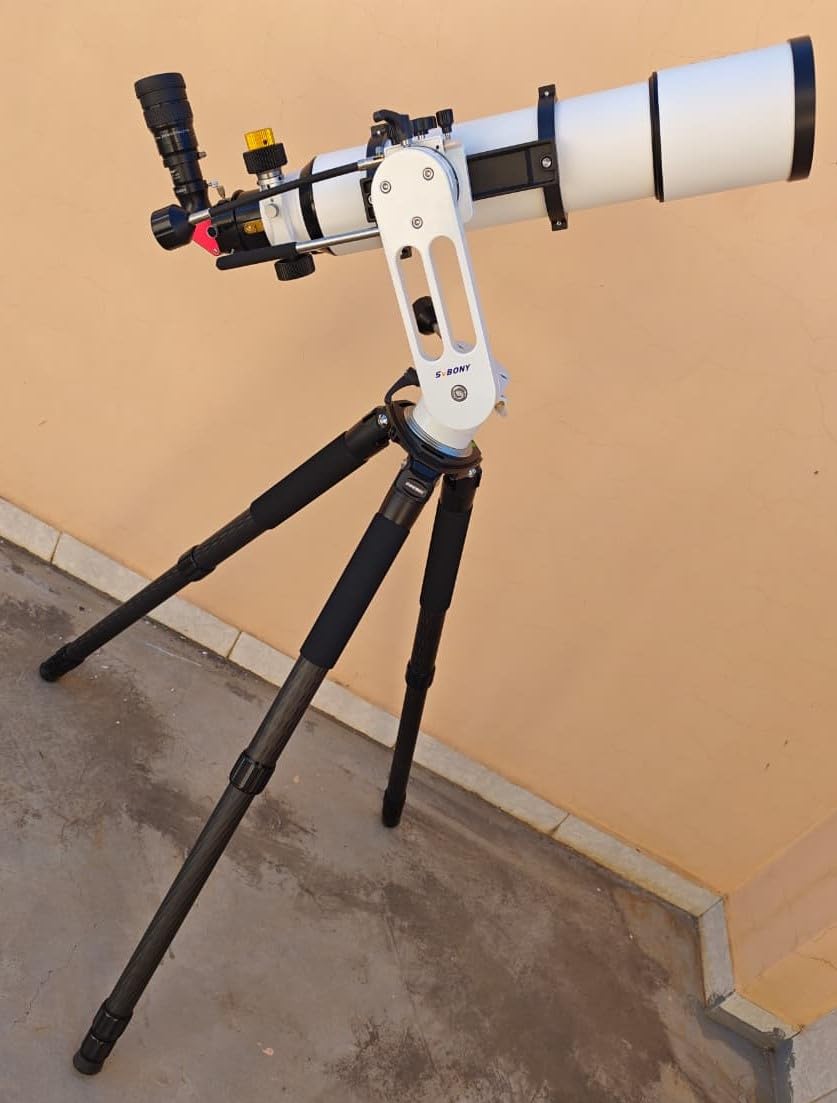
The focuser is the detail that separates this from a typical budget tube. A 2 inch rotatable dual-speed unit with a 1:10 gear ratio, mounted on a metal interface rather than plastic, holds heavy eyepieces without creep and lets you fine-focus without shaking the tube. On a small refractor that difference is obvious during planetary work.
At 90mm, Saturn shows ring separation and Titan reliably. The Cassini Division is beyond it. With 94 ratings averaging 4.5 and a 74 percent five-star share, buyers treat this as a capable starter tube for people who already have a mount.
Check the mount pairing carefully
Because it is an optical tube only, match it to a mount that can handle 3 kg without being overkill. A light altazimuth head is plenty. The short tube length means vibrations die down in a second or two, which is a real advantage over the longer tubes in this list.
Budget for a star diagonal, since none is included, and for eyepieces. Both are small additions compared with buying a whole new mount.
Where this scope falls short
It is achromatic, not ED. On a bright object at the top of its useful range you will see colour fringing around the edges, and Saturn is exactly the kind of bright target that shows it. That is an optical design consequence, not a build quality issue.
At 90mm it is still a modest aperture. If you know you want the Cassini Division, this is the wrong stopping point, and the 150mm and 203mm options elsewhere in this list serve that goal better.
7. Sky-Watcher Heritage 150 Tabletop Dobsonian – Best for Travel
Sky-Watcher Heritage 150 Tabletop Dobsonian Telescope – Perfect for Beginners, Easy Setup, Portable, and Fun (S11710)
150mm parabolic primary
750mm f/5
Collapsible tube
23 lb
Pros
- 150mm aperture delivers contrast-rich planetary views
- Tabletop format needs no tall tripod
- Collapsible tube stores easily and retains collimation
- Rubber-footed base cuts vibration at high power
- Fast f/5 ratio frames Saturn comfortably
Cons
- Tabletop format needs a stand for standing use
- 1.25 inch helical focuser is small by modern standards
- Visible colour fringing at high magnification
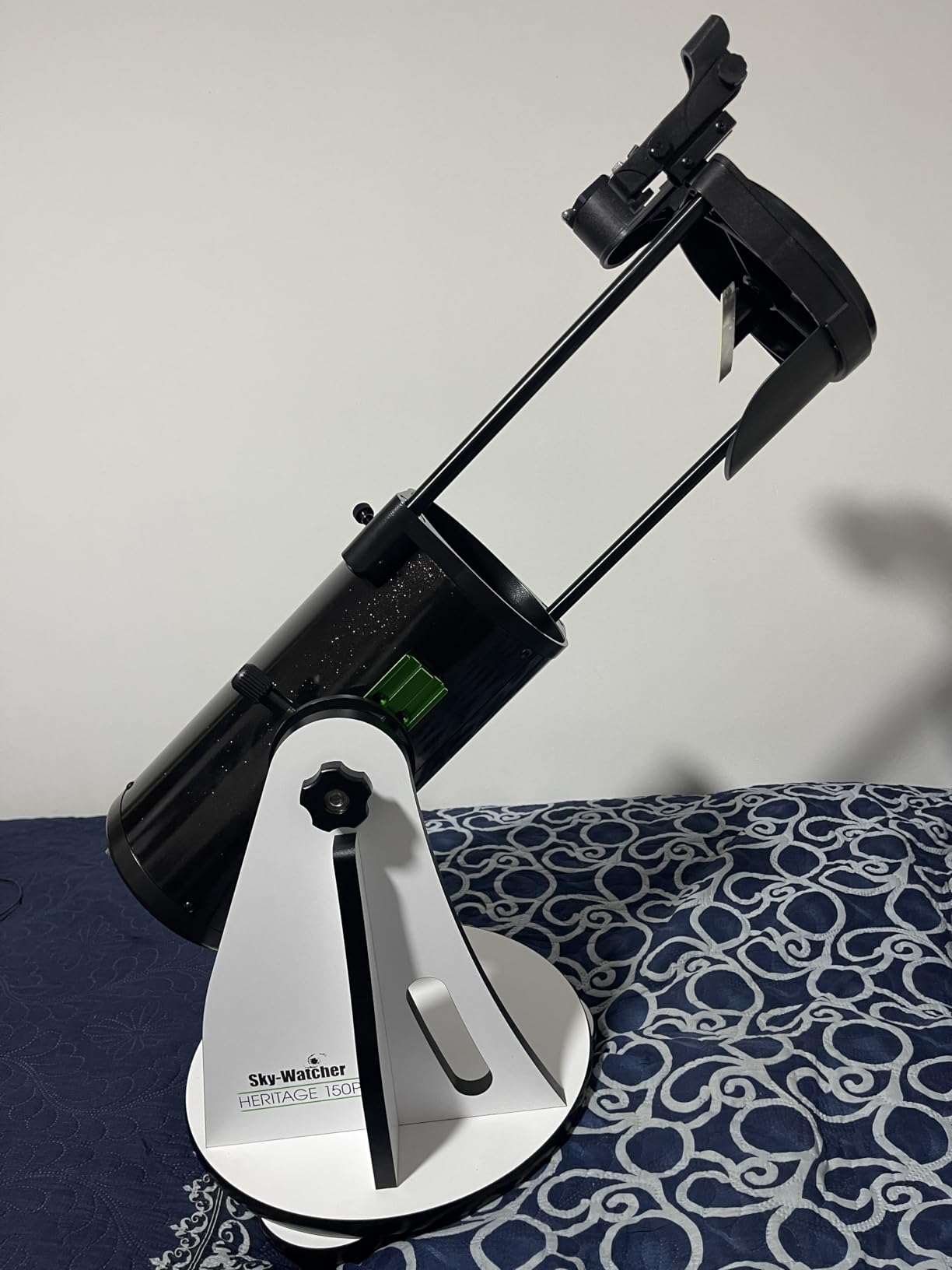
The Heritage 150 puts 150mm of aperture on a table you already own, which is the entire pitch. That is the aperture threshold where the Cassini Division starts resolving consistently, reached without a tall tripod, without a motor, and without a long optical tube. At 23 lb it is still a two-person carry, but it fits in a hatchback with the back seats down.
At 750mm focal length, the included 25mm gives 30x and a 10mm gives 75x, which frames Saturn and its moons well. Pushing to 150x needs a 5mm eyepiece, and that is where the f/5 ratio works in your favour because the planetary image stays bright.
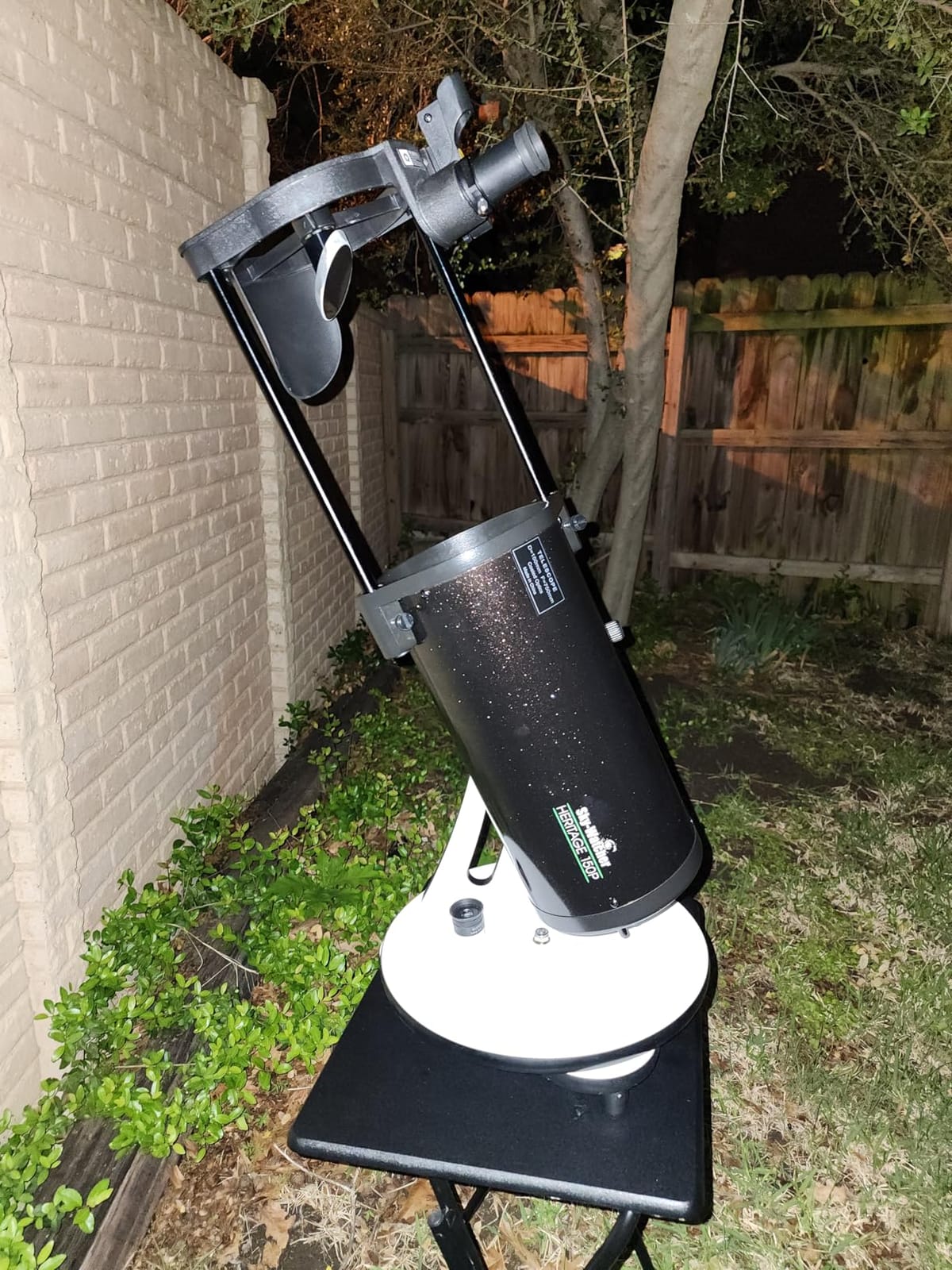
The collapsible tube is a genuinely clever feature. It shortens for storage and transport but holds collimation afterward, which addresses the standard objection to portable reflectors. The rubber feet on the base damp vibration, and because there is no eyepiece height to adjust, the whole system settles quickly after you move it.
With 104 ratings at 4.2 and a 72 percent five-star share, satisfaction among beginners is high. The 11 percent three-star share tracks neatly with what you would expect from a 150mm short-tube achromatic reflector pushed to high power, which is colour fringing on bright targets.
Check what you will set it on
This is a tabletop instrument. It needs a surface at roughly standing waist height, and outdoors that means a picnic table, a sturdy garden table, or a dedicated stand. Used at a normal desk or low table you will end up on your knees, which is a quick way to end an observing session early.
Plan your transport accordingly. The collapsible tube helps, but the base does not shrink, and you will want to keep it padded in a vehicle.
Where this scope falls short
The 1.25 inch helical focuser is the main practical limit. It holds lightweight eyepieces fine, but heavier glass can shift in it, and you cannot use 2 inch accessories without an adapter. On a planetary scope where premium eyepieces are common, that is an inconvenience worth factoring in.
Saturn at high magnification will show colour fringing, and the fast f/5 ratio does nothing to correct it. If crisp ring contrast matters more to you than portability, a longer-focal-ratio scope is the better trade.
8. Gskyer 130EQ – Best Complete Package
Gskyer 130EQ Professional Astronomical Reflector Telescope
130mm all-glass reflector
650mm f/5
German equatorial EQ-130 mount
30.1 lb
Pros
- 130mm aperture with high-transmission multi-coatings
- German equatorial mount gives real tracking ability
- Three eyepieces plus 3x Barlow and finder included
- Short 650mm f/5 tube is stable and shake-resistant
- 454 ratings at 4.4 show consistent performance
Cons
- German equatorial mount adds assembly and balancing steps
- 30.1 lb total weight is heavy for single-person setup
- Colour fringing on the achromatic mirror at higher powers
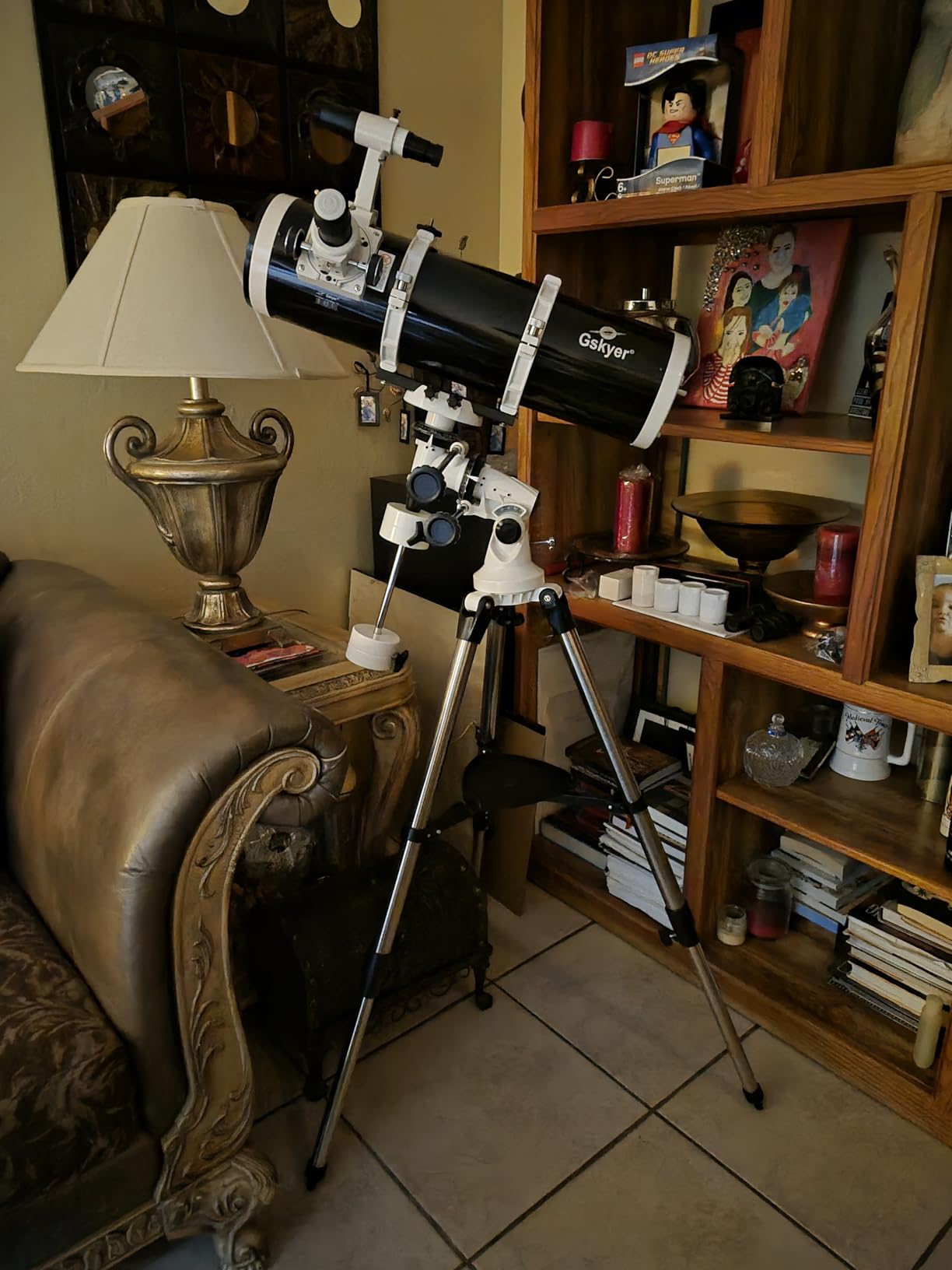
The Gskyer 130EQ is the rare package where the box contents genuinely change the outcome. Three eyepieces, a 3x Barlow, a reflex finder, an adjustable tripod, and a real German equatorial mount are all included. Most competitors in this list are optical tubes or bare kits, and buyers here consistently note that the bundle exceeds what they expected at this tier.
Saturn at 130mm with a 650mm focal length reaches around 100x with a short eyepiece or 150x when you use the included Barlow. That is enough for clear ring separation and an occasional glimpse of the Cassini Division. The f/5 ratio keeps the planetary image bright, and the short 24 inch tube settles fast after you move it, which is the main enemy of high-power observing.
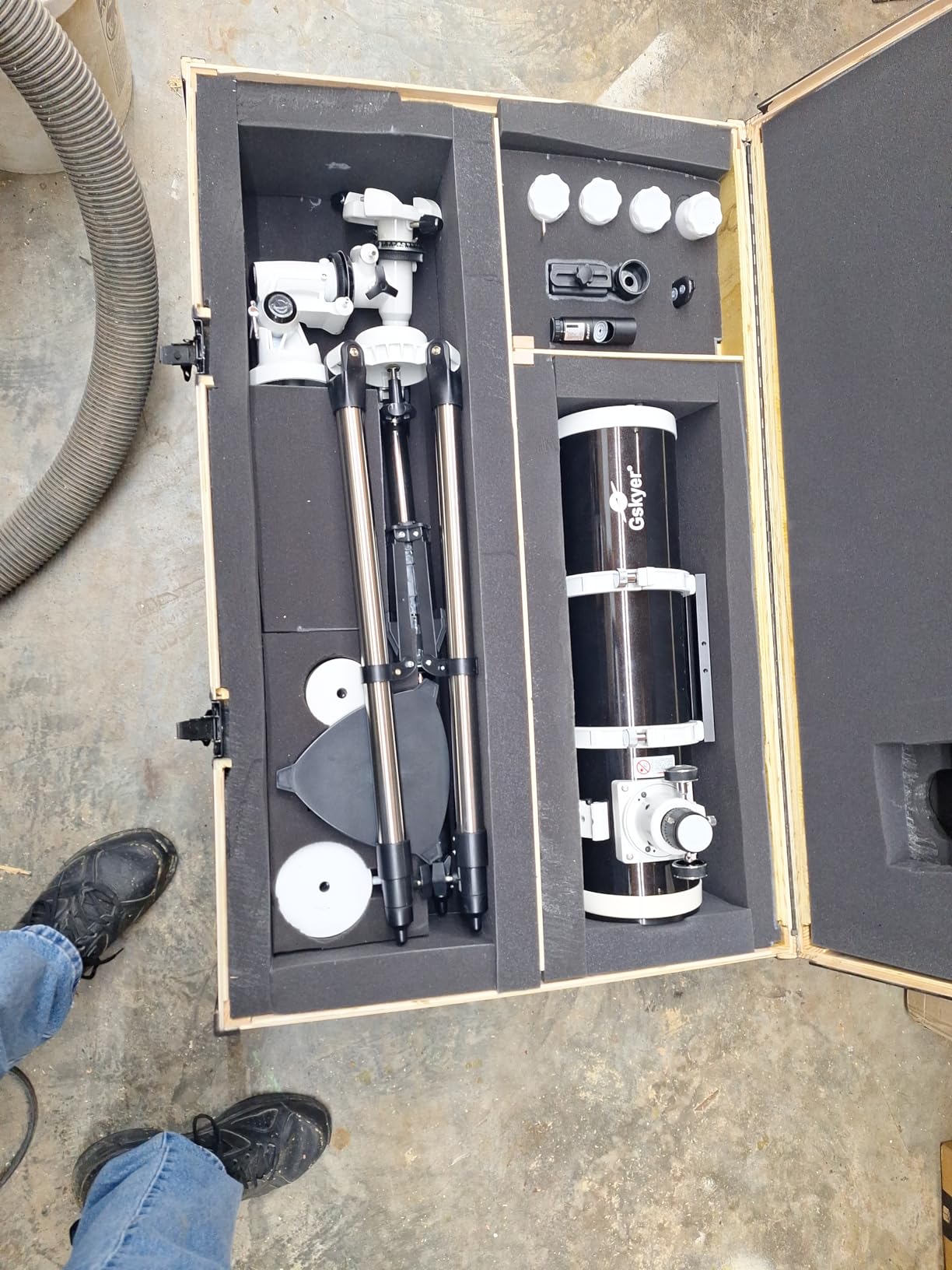
The German equatorial mount is the real differentiator. It tracks objects across the sky rather than letting them drift, and while a rigid altazimuth base would handle visual Saturn fine, an equatorial head means Saturn stays put while you change eyepieces or sketch what you see. There is also a Bluetooth remote for phone shutter control on quick phone shots through the tube.
With 454 ratings at 4.4 and 69 percent five star, satisfaction is broad. The common thread in the reviews is that the accessory bundle and the EQ mount feel like a genuine step up, offset by first time users finding polar alignment fiddly at first.
Check how you feel about polar alignment
A German equatorial head needs roughly north at the base and a level tripod. Set it up once in daylight and check the latitude scale, and it will hold alignment for many sessions afterwards. Get it wrong and Saturn will walk steadily out of the field.
If you would rather not do any alignment at all, a Dobsonian base avoids the process entirely at the cost of drift. Weigh that trade honestly against how much time you want to spend before the first look.
Where this scope falls short
At 30.1 lbs it is a heavy single package setup, and assembly plus balancing takes real effort the first time. There is no quick release tray to make moving it easier.
The mirror is achromatic rather than ED, so bright targets show colour fringing at the upper end of the useful range, and the headline 307x maximum magnification is a theoretical ceiling rather than something you will use on Saturn. Treat it as a spec sheet number, not a promise.
Choosing a Telescope for Saturn: Aperture, Focal Length, and Mount Stability
Aperture decides what you see. Every other specification is a refinement on top of it. A 203mm Schmidt-Cassegrain at f/16 and a 203mm Newtonian at f/6 show similar ring detail, and the Newtonian costs less. But a 90mm refractor at any focal length will never show you the Cassini Division, no matter how good the glass is.
Focal length sets image scale. Saturn spans roughly 18 arcseconds across, close to one hundredth the width of the full Moon. Longer focal length makes that small disc larger and brighter at the same eyepiece. This is why catadioptrics at f/10 and f/16 feel so good on planets compared to a short tube Dobsonian at f/5, even when the apertures are identical.
Mount stability decides whether you get to keep it. This is the most under rated factor in the whole buying decision. Saturn needs somewhere around 100x to 200x to look its best, and at that power any shake is immediately visible as the image boiling. A tripod that wobbles when you tap it will disappoint you more often than a modest aperture will.
On optical design, the four families here score differently for Saturn specifically:
- Refractors need no collimation and hold contrast well, which suits planetary work. Short focal ratios and cheap achromatic glass produce colour fringing on bright targets, so ED glass is worth paying for on this planet.
- Newtonians and Dobsonians give the most aperture for the money and have no collimated electronics to fuss with. The open tube can dew up, and the mirrors need occasional collimation.
- Maksutov-Cassegrains are compact, closed tube, low maintenance, and long focal length. They are the best balance for portable planetary observing.
- Schmidt-Cassegrains deliver large aperture in a short tube, need no collimation, and pair naturally with GoTo mounts. They are the strongest all round choice for Saturn at high aperture.
One warning about marketing. Claims like “675x magnification” on a 60mm department store scope are meaningless, because two times the aperture in millimetres is the real ceiling and that number is about 120x. Judge every listing by aperture in millimetres and by whether a mount is included. An optical tube sold without a mount is a hidden second purchase, and two of the telescopes in this list are exactly that.
Magnification and Eyepieces for Saturn
Magnification is simple arithmetic: telescope focal length divided by eyepiece focal length. A 1200mm telescope with a 10mm eyepiece gives 120x. There is no other variable, and any scope can reach any power as long as you own the glass.
What actually matters is picking the power that matches the aperture and the air. The practical ceiling is roughly two times the aperture in millimetres, or about 50x per inch of aperture. Here is the useful ladder for Saturn specifically:
- 40x to 60x: Finding Saturn and framing it with surrounding stars. Low power is easier to hold steady and is where you should start every session.
- 75x to 150x: Ring shape becomes obvious and you can judge the ring tilt. This is the range most observers use most of the time, and the range that looks best on an average night.
- 150x to 250x: Ring separation, subtle colour, and the Cassini Division on a steady night. Only worth it when the image is already sharp at lower power.
- 250x and above: Dimmer and more sensitive to every vibration. Worth trying when conditions are excellent, and rarely worth more than that.
On eyepieces, a practical starter set is a 25mm or 30mm for finding, a 10mm for ring shape, and a 6mm to 8mm for pushing detail. A 2x Barlow doubles the power of any of them without adding another eyepiece to buy. Star diagonals matter more than most buyers expect: a cheap diagonal with a narrow clear aperture can soften an otherwise good image, and a 2 inch diagonal keeps 2 inch eyepieces comfortable at high power.
Finally, watch the exit pupil. It is the aperture of the main lens divided by the magnification. Above roughly 7mm, you are wasting light; below about 0.5mm, you are asking the eyepiece to resolve more than the aperture can deliver. Most of the time the sweet spot for a 150mm scope on Saturn is somewhere between 100x and 200x, and that is a fact about the aperture, not a limitation of the design.
How to Actually See Saturn’s Rings: A Step-by-Step Routine
None of the eight telescopes above will show you anything on the night you unbox it if you rush the setup. This is the routine we use, and it takes about ten minutes longer than switching straight to a high power eyepiece.
- Set up an hour before dark if you can. A tube carried out from a warm room will not produce a sharp image for 30 to 60 minutes. This is the single most common reason a good telescope produces a disappointing first view.
- Find Saturn at low power first. Start around 40x to 60x with whatever eyepiece gives the widest, brightest image. A red dot finder or the lowest power eyepiece makes this fast. Trying to locate Saturn at 150x is a good way to lose an evening.
- Centre it, then let the image settle. Once Saturn is centred, stop touching the controls for a minute. Any residual wobble dies away, and the image usually sharpens noticeably on its own.
- Focus carefully. Use the fine focus knob and look for the point where the ring edges look hardest rather than biggest. On a Newtonian, a soft image at every power is usually collimation, not focus.
- Step up one eyepiece at a time. Go from your lowest power to the next and check the image before going further. Each step should show more detail, not a bigger blur.
- Back off when it gets worse. The moment the image turns dim and wavering, you have passed the useful magnification for that aperture and that night’s air. Drop back one step.
- Wait for a better night. If Saturn looks soft at every power, the atmosphere is the limit. Come back on a different night rather than assuming the telescope is at fault.
Time the session around the planet, not the telescope. Saturn takes a few minutes to drift noticeably at moderate power on a manual mount, so switch to a lower power eyepiece for a while and come back up rather than nudging continuously.
Why Does Saturn Still Look Blurry?
This is the most common question in telescope forums, and the answer is almost never the telescope. In most reported cases the scope resolves Jupiter’s cloud bands perfectly and leaves Saturn soft, which tells you the aperture is adequate and something else is wrong.
- Wrong eyepiece: Too little magnification, or a cheap eyepiece with poor optics. Move up in focal length and see if the image improves before blaming the scope.
- Too much magnification: Past roughly two times the aperture in millimetres, images get dimmer and softer. Backing off usually fixes it.
- Bad atmospheric seeing: Rising heat, jet stream turbulence, and a warm telescope tube all boil the image. Wait an hour after sunset and again after the tube cools.
- Observing through a window or over a hot roof: Glass distorts and rising heat shimmers. This one ruins more planetary sessions than any telescope fault.
- Tube not at ambient temperature: A telescope carried out from a warm room needs 30 to 60 minutes to settle before the image is sharp.
- Dew on the objective or secondary: A soft blur that appears later in the session usually means dew. A dew heater or a fan solves it.
- Collimation on a Newtonian: If the image looks soft at all powers including low, check collimation before anything else.
- Poor seeing rather than poor optics: If Saturn looks like it is boiling while Jupiter looks steady, the atmosphere is the limit and no equipment change will help that night.
One clarification worth making, because it confuses many beginners. Jupiter looks bigger than Saturn through the same telescope because Jupiter is physically a much larger disc in the sky, several times the apparent width of Saturn. Saturn is not being under resolved. Seeing a small sharp Saturn beats seeing a large blurry one every time, and a well tuned 4 inch scope at 150x will beat a shaky 6 inch at 300x every night of the year.
If You Already Own a Telescope
If your existing scope shows Jupiter and its moons, you probably do not need a new telescope. You probably need different eyepieces. This is the advice that forum communities give most often, and it is the advice most likely to save you money.
- Add a 10mm or 9mm eyepiece to the set you have. This is the single biggest jump in apparent Saturn size for almost every consumer telescope.
- Add a 2x Barlow once you are reliably sharp at 100x. It doubles power from the glass you already own.
- Use a star diagonal of decent quality before spending on more magnification. A better diagonal improves the whole observing experience.
- Wait for better air before concluding the telescope is at fault. Most “my scope is bad” posts resolve themselves on a different night.
Buy a larger aperture only if you have already exhausted eyepieces, waited for steady seeing, and still cannot resolve the Cassini Division. That is a real limit of physics, not a fixable setting.
When and Where to See Saturn
Saturn is observable for roughly eight to ten months a year, and it is a poor target in the first and last of those months because it sits low in the twilight sky. The best viewing is when Saturn is high in the sky during the darkest hours, which means mid evening in the months on either side of opposition.
Practical conditions to check before you plan a session:
- Altitude beats aperture at a certain point. A 200mm scope showing Saturn at 20 degrees altitude produces a worse image than a 130mm scope showing it at 60 degrees, because you are looking through far more atmosphere.
- Seeing conditions: Steady nights with transparent, cool air beat warm, turbulent nights regardless of telescope. Plan observing sessions for the nights after a cold front passes rather than the warm nights before it.
- Light pollution: Saturn is bright enough that a suburban backyard works fine. Darker skies help faint deep sky objects far more than they help this planet.
- Ring tilt changes over years. Saturn’s ring opening angle shifts slowly as both Saturn and Earth orbit, so the rings look wider in some years and narrower in others. Because our view of them is close to edge on for much of the current observing cycle, the rings often appear thinner than illustrations suggest. Track it over time if planetary observing becomes a habit.
None of this should stop you buying a telescope now. It is simply a reason to check a planetarium app for the date and time Saturn is well placed in your sky, so your first attempt happens on a good night rather than an unlucky one.
Frequently Asked Questions
What is the best telescope to watch Saturn?
The Celestron NexStar 8SE is the best overall telescope for Saturn, pairing 203mm of aperture with a computerized GoTo mount. Its 2032mm focal length holds high magnification steady, and 8 inches of aperture resolves the Cassini Division and Titan. Among manual options the Sky-Watcher Classic 200 Dobsonian delivers the same aperture with no electronics and no alignment routine.
What size telescope is needed to see Saturn’s rings?
70mm of aperture is the absolute floor, where the rings register as a slight bump on a dot. 80mm to 90mm shows clear ring separation and Titan. 130mm starts revealing the Cassini Division on good nights, and 150mm to 200mm resolves it consistently along with the brighter moons.
How much magnification do you need to see Saturn?
Start at 40x to 60x to find the planet, then use 75x to 150x for a clear ring shape. Push toward 200x only when the image is already sharp at lower power. The practical ceiling is roughly two times the aperture in millimetres, or about 50x per inch, so a 4 inch scope tops out near 200x and an 8 inch scope near 400x.
What kind of telescope do I need to see Saturn clearly?
A 90mm to 130mm refractor, Maksutov-Cassegrain, or reflector on a rigid mount is the practical answer. Longer focal ratios suit small bright planets, and mount stability matters more than any magnification claim on the box. Refractors hold contrast well, Dobs offer the most aperture per unit cost, and catadioptrics are the most compact.
What is the best telescope for a beginner to see the rings of Saturn?
A 90mm to 130mm reflector or Maksutov-Cassegrain with a stable mount is the beginner answer. A computerized GoTo model removes the hardest part of starting out, which is finding the target. Avoid anything whose headline specification is magnification rather than aperture, and avoid sub-70mm aperture kits.
Do you have to collimate a Schmidt Cassegrain telescope?
Not usually. A properly aligned factory Schmidt-Cassegrain needs no collimation in normal use, though a hard bump or rough transport can knock it out and it is worth checking the central obstruction shadow occasionally. Maksutov-Cassegrains and refractors never need collimation at all. Only Newtonian reflectors, including Dobsonians, require regular collimation.
The Best Telescopes for Viewing Saturn in 2026
Saturn rewards aperture more than any other planet, and the ladder is unforgiving. Below 70mm you will strain. Between 90mm and 130mm you get unmistakable rings and Titan. From 150mm to 200mm the Cassini Division resolves and the view stops looking like a diagram.
Our best telescopes for viewing Saturn in 2026 cover that whole range rather than pushing one tier. The Celestron NexStar 8SE takes the top spot for combining 203mm of aperture with a GoTo mount and a tube you can still carry alone. The Sky-Watcher Classic 200 Dobsonian matches that aperture with no electronics and no learning curve. The Celestron NexStar 127SLT is the one to take on a trip.
For the first Saturn session, set the telescope up an hour before dark, start at low power, work up one eyepiece at a time, and stop before the image gets worse rather than after. That single habit separates a good view from a disappointing one more often than any purchase decision.