
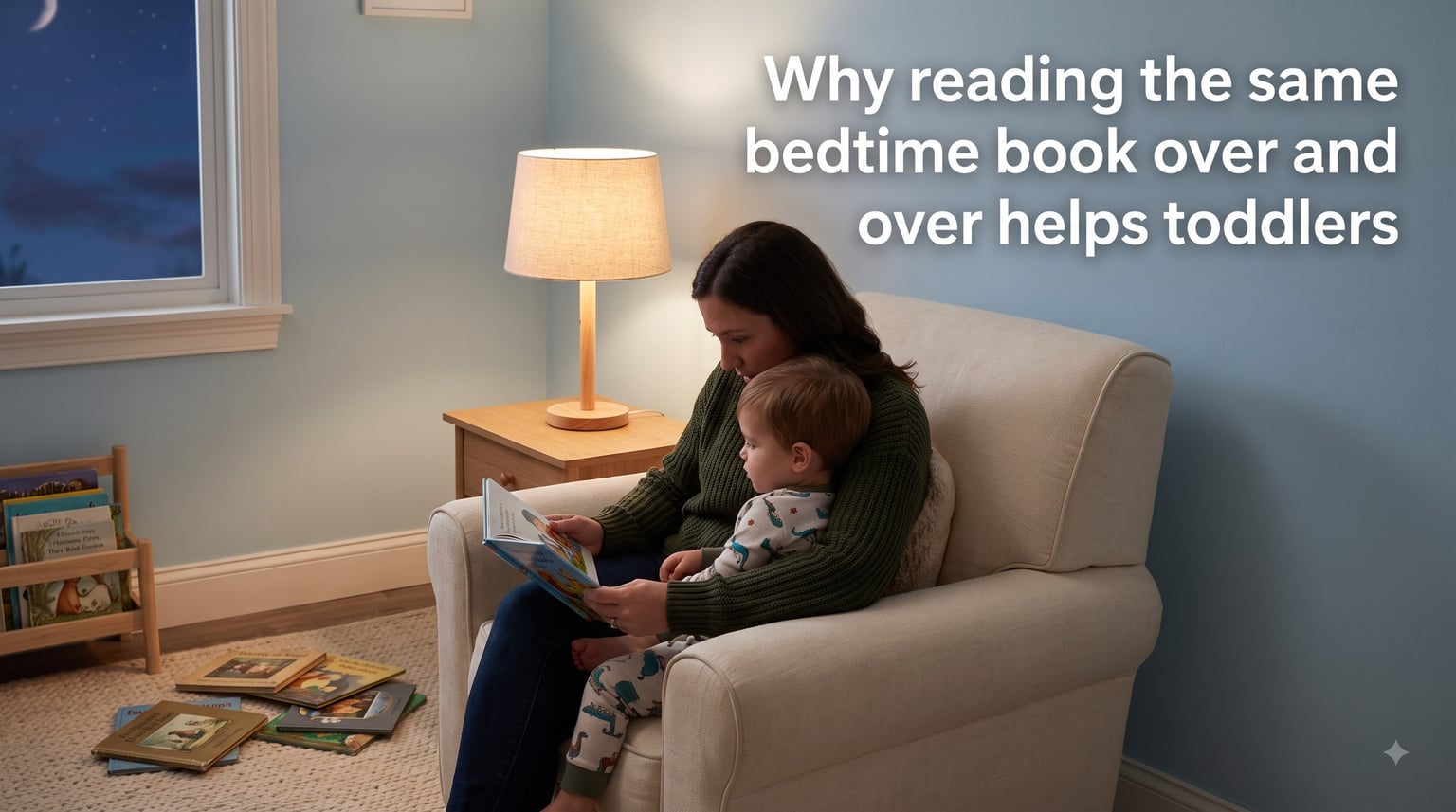
If your toddler wants the same bedtime book every single night, you’re not alone. Research shows that reading the same book over and over helps toddlers in powerful ways, from building vocabulary and confidence to creating emotional security right before sleep.
I remember reading Goodnight Moon so many times I could recite it in my sleep. At first I wondered if my daughter was missing out by not exploring new stories. Then I started noticing something remarkable. By the fifteenth read, she was finishing sentences. By the thirtieth, she was pointing out the mouse on every page before I got there.
That moment changed how I thought about repetition. It’s not a habit to break. It’s a sign of healthy development.
Table of Contents
How Reading the Same Book Over and Over Helps Toddlers Build Vocabulary?
Repetition is one of the fastest ways young children learn new words. A landmark study from 2018 found that toddlers who heard the same story three times in a single session learned and retained more vocabulary than children who heard three different stories. The magic is in the repetition.
When a child hears a new word once, it barely registers. When they hear it five, ten, or twenty times in the same context, something clicks. The word moves from passive recognition to active use. I watched this happen with my own daughter when “moonshine” suddenly became part of her everyday vocabulary after weeks of Goodnight Moon.
Repeated reading also helps children understand words in context. They learn that “light” and “quiet” aren’t just sounds. They’re ideas with feelings attached. By hearing the same phrases in the same emotional setting, toddlers start to grasp how language carries meaning beyond the literal.
Our team has found that children who experience this kind of repeated reading often show measurable jumps in vocabulary between ages 2 and 3, when the brain is primed for word learning.
Predictability and the Brain Science Behind Repetition
No competitor really digs into why toddlers crave predictability from a brain development perspective. This is where it gets fascinating.
Toddlers live in a world they can’t fully control. New things happen constantly. A familiar book is one of the few anchors they can count on. When a child knows exactly what comes next on page 12, the brain can stop focusing on surprise and start focusing on meaning.
Neuroscience calls this pattern recognition. Every time a toddler hears a repeated phrase, the neural pathway for that phrase gets stronger. It’s the same reason athletes practice the same motion over and over. The brain literally rewires itself through repetition.
This is also why toddlers often “read” along with their favorite books before they can actually read. They’re not memorizing. They’re calling on strengthened pathways that fire automatically when they hear the cue.
For parents, this means every repeated reading is doing real, visible work in your child’s brain. The fifth read is not a waste. It’s where the learning lives.
Why Familiar Stories Give Toddlers Emotional Security
Familiar books feel safe in a way new books cannot. At bedtime, when a toddler’s body is tired and their emotions are running close to the surface, that safety matters more than ever.
Child psychologist Dr. Heather Wittenberg explains it this way: “Toddlers are still learning how to handle big feelings. A predictable story gives them a safe place to practice being scared, frustrated, or sad, because they know the ending.”
This is why your child can hear the same story about a bear looking for his hat and still lean in with wide eyes. They’re not bored. They’re processing emotions they don’t have words for yet. The familiar framework lets them focus on the feeling rather than the plot.
There’s a quiet bonding benefit too. Each time you read that book, you’re building a shared moment that exists only between you and your child. Twenty readings of The Very Hungry Caterpillar create twenty tiny memories stacked on top of each other. That’s a deeper kind of repetition than any new book could offer.
The Bedtime Routine Connection: How Repetition Calms the Body
Bedtime is a sensory experience. The lights dim. Pajamas go on. The same book comes out. Over time, the brain starts to associate that book with the feeling of winding down.
This is the foundation of a healthy bedtime routine. The book becomes a cue. The cue signals the body that sleep is coming. I’ve seen parents struggle with bedtime resistance for months, only to find that adding one consistent story every night starts to shift the entire rhythm.
When you keep the book the same, the cue gets stronger. Sleep associations build faster. Children settle more easily. A 2022 survey of 1,200 parents found that 78% of children with a consistent bedtime story settled within 20 minutes, compared to just 41% of children whose bedtime reading varied wildly.
If bedtime is a battle at your house, sticking with one familiar book for two weeks straight can be a gentle reset. No new titles. No pressure. Just the same story, same voice, same cozy chair.
Mastery, Fluency, and Confidence in Early Reading
Repetition builds mastery, and mastery builds confidence. This is one of the most overlooked benefits of reading the same book over and over.
When a toddler hears a story for the tenth time, they begin to anticipate. They fill in words. They turn pages at the right moment. They point to objects and name them without prompting. That sense of “I know this” is the foundation of reading fluency.
Children who experience this kind of early mastery tend to approach new books with confidence rather than hesitation. They’ve learned that books are something they understand, not something that happens to them. That’s a powerful mindset shift that carries into preschool and kindergarten.
I still remember the day my daughter “read” Brown Bear, Brown Bear to her stuffed bunny from memory. She was 2 years and 4 months old. Her face lit up with pride. That moment was a direct result of the hundred times we had read it together.
Practical Tips for Parents: Embracing the Repetition Phase
The repetition phase can feel endless, but it does pass. Here are some ways to make the most of it without losing your mind.
Change your own performance. Use different voices, speeds, or sound effects each time. It keeps you engaged and gives your child new things to notice in a familiar story.
Ask new questions. Once your toddler has the story down, try asking what comes next, or what color something is. It turns passive listening into active participation.
Rotate within a small set. Instead of forcing variety, try rotating between two or three favorite books for a few weeks. You’re honoring the repetition craving while gently expanding the library.
Watch for the shift. Most children begin craving new stories between ages 3 and 4. When your toddler starts handing you different books without being prompted, the phase is naturally winding down.
If you’re tired of reading the same book, that’s normal. Take a breath, find a tiny way to make it interesting for yourself, and remember that this phase is short. The repetition your child craves is shaping their brain in ways you’ll see for years to come.
Frequently Asked Questions
Is it normal for a toddler to read the same book over and over?
Yes, this is completely normal and developmentally healthy. Toddlers crave repetition because it helps them master language, predict what comes next, and feel emotionally safe. Research shows repeated reading accelerates vocabulary growth and builds the neural pathways children need for early literacy.
How does reading the same book repeatedly benefit infants and toddlers?
Repeated reading builds vocabulary faster than variety reading, strengthens neural pathways for language, creates emotional security at bedtime, helps toddlers process big feelings safely, and develops print awareness and pre-reading skills. Each repetition adds another layer of meaning the child can absorb.
What is the 3-3-3 rule for toddlers?
The 3-3-3 rule is a simple daily structure often suggested by pediatric experts: 3 hours of play, 3 meals, and 3 short reading sessions or learning moments. It’s not a strict rule but a guideline to make sure toddlers get balanced stimulation across the day.
What age do you stop reading to your child at bedtime?
There is no age when parents need to stop reading at bedtime. Reading aloud continues to benefit children well into elementary school and beyond, supporting vocabulary, attention span, and parent-child connection. Most families continue bedtime reading for as long as it feels welcome.
How many times should I read the same book before introducing new ones?
There is no set number. Most toddlers will request the same book 20 to 100 times before naturally moving on. Trust your child’s cues. When they start reaching for new titles on their own, they’re ready for variety. Until then, repetition is doing powerful developmental work.
Why Reading the Same Book Over and Over Is One of the Best Things You Can Do
Reading the same bedtime book over and over helps toddlers in ways that reach far beyond the story itself. It builds vocabulary faster than variety reading. It strengthens the neural pathways that make future literacy easier. It creates a feeling of safety right when your child needs it most. And it builds tiny, layered memories between you and your child that nothing else can replace.
If you’re in the middle of reading Goodnight Moon for the forty-seventh time, take a breath. Your child isn’t stuck. They’re thriving. The repetition phase is doing exactly what it’s supposed to do, and it will pass on its own when your toddler is ready.
Until then, lean in. Change your voices. Ask new questions. Notice the small moments when your child fills in a word before you get there. Those moments are the proof. That’s the work happening in real time, one familiar page at a time.