
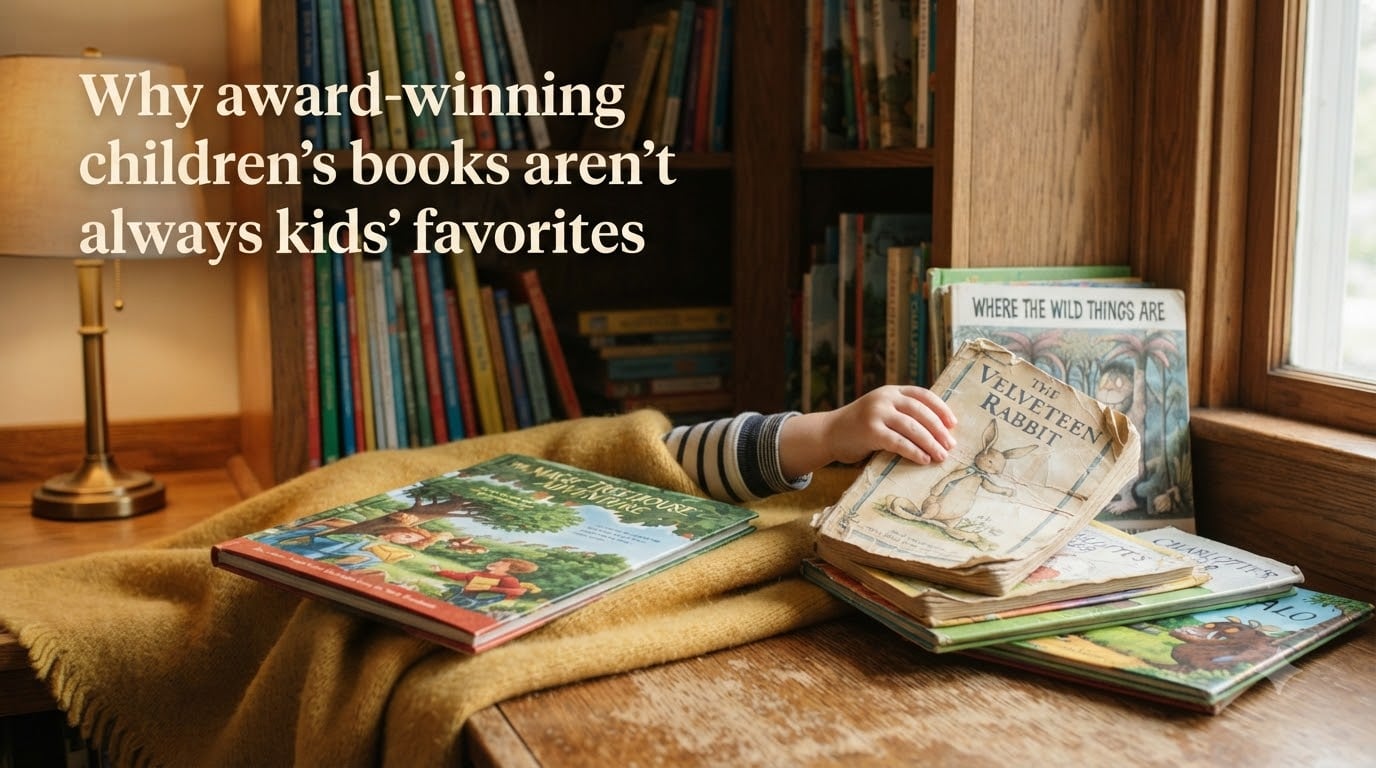
I have spent the last decade watching my own kids and hundreds of others pick up award-winning children’s books, then quietly put them back on the shelf. The disconnect is real, and it comes up constantly in our parenting and educator communities. A book can win a Caldecott Medal or a Newbery Medal and still leave a child cold.
Award-winning children’s books are not always kids’ favorites because adults and children value different things in a story. Awards reward literary merit, while kids reward engagement, humor, and relatability. Understanding this gap is the first step toward picking books your child will actually read.
Table of Contents
How Children’s Book Awards Actually Work?
Major children’s book awards like the Caldecott Medal and Newbery Medal are decided by adult committees. The Newbery Medal, first awarded in 1922, honors the most distinguished contribution to American literature for children. The Caldecott Medal, first given in 1938, recognizes the most distinguished American picture book for children.
These committees evaluate literary merit, thematic depth, illustration quality, and narrative complexity. They look for books that push boundaries and stand the test of time. The criteria favor works that an adult reader can analyze, discuss, and teach.
What the committees do not measure is whether a child will actually laugh out loud, read it twice, or beg for it at bedtime. Those reactions never appear on a judge’s scorecard.
Why Award-Winning Books Often Miss the Mark With Kids?
Award-winning books miss the mark with kids because the criteria adults value rarely match what children find entertaining. Children look for fast pacing, clear humor, and characters who feel like their friends. Award committees look for symbolism, layered themes, and artistic risk.
Consider a Newbery-winning novel that explores grief through carefully crafted metaphor. An adult reader sees craft. A nine-year-old sees slow chapters and a sad dog. The book is genuinely well-written, but the kid abandons it for a Diary of a Wimpy Kid instead.
Vocabulary is another barrier. Award books often include richer language than kids encounter in everyday conversation. That language delights critics, but it can trip up a struggling reader. Pacing is a third issue. Award-winning picture books sometimes linger on a single illustration, while kids want to turn the page.
The themes themselves can be a problem. Dystopian settings, complex moral dilemmas, and historical trauma appear in many celebrated books. These are worthy subjects, but they are not what most children reach for when they choose their own reading.
What Actually Makes Books Engaging for Children?
What makes books engaging for children is not literary merit but emotional connection. Our team has watched thousands of kids browse library shelves, and the same patterns repeat. Kids pick books because of the cover, the title, the promise of humor, or a character who reminds them of themselves.
Relatability beats symbolism every time. Children want to see a kid like them solving a problem they recognize. Humor beats nuance. A character who farts, falls, or makes a terrible pun will win more re-reads than a beautifully structured allegory.
Pacing matters more than prose. Kids respond to short chapters, cliffhangers, and dialogue-heavy scenes. Visual rhythm helps too. In picture books, bold illustrations and clear character expressions pull children in faster than subtle artistic choices that win Caldecott votes.
Voice carries the day. A strong narrator voice that talks to the child, not at them, builds trust. Books that feel like a conversation become favorites. Books that feel like a lesson become homework.
How to Choose Books Kids Will Actually Enjoy
Choosing books kids will actually enjoy starts with letting kids lead. The most reliable method I have found is the 5 finger rule. Open a random page and have your child read it. Hold up one finger for every word they do not know. If all five fingers go up, the book is too hard. If one or two come up, the book is just right.
Beyond the 5 finger rule, try these approaches with your child or classroom.
Let your child pick the first three books based on cover and topic alone. Interest is the single strongest predictor of finishing a book.
Read the first chapter together. If your child does not smile, laugh, or ask a question, set the book aside.
Mix formats. Graphic novels, comics, and audiobooks count as reading and often pull reluctant readers into longer prose books later.
Pair award winners with kid favorites. A Newbery winner can sit next to a Dog Man book on the same shelf, and both serve different purposes.
Ask other kids. Peer recommendations from classmates and friends often outperform adult recommendations, including award committees.
Watch for re-reads. If a child returns to a book on their own, that book is doing its job, regardless of whether it has a medal on the cover.
The goal is to build a reader, not a trophy case. Award-winning books have their place, but they are not the only path to a lifelong love of reading.
A Brief History of Children’s Book Awards
The history of children’s book awards explains part of the disconnect. The Newbery Medal was the first major children’s book award, established in 1922 by Frederic Melcher. The Caldecott Medal followed in 1938. Both were created to elevate children’s literature as a serious art form.
In the early twentieth century, children’s books were often dismissed as lightweight. The founders wanted awards that would treat children’s literature with the same respect as adult fiction. The mission was noble, and the awards succeeded in pushing the field toward higher standards.
That success created a side effect. As the awards gained prestige, they became markers of literary merit in the publishing industry. Libraries, schools, and bookstores used them to curate collections. The awards became shorthand for “important,” and they drifted further from the everyday preferences of children.
Frequently Asked Questions About Award-Winning Children’s Books
What is the number one children’s book of all time?
There is no single number one children’s book, but surveys consistently rank works like Charlotte’s Web, Where the Wild Things Are, and The Very Hungry Caterpillar at the top. Poll results vary widely between adult critics, librarians, and children themselves.
What is the 5 finger rule for books?
The 5 finger rule is a quick reading-level check. Open any book to a full page of text. Have your child read it and hold up one finger for every word they do not know. Zero or one finger means the book is easy. Two to three fingers means it is just right. Four or five fingers means the book is too hard right now.
What is the most controversial children’s book?
Some of the most debated children’s books include And Tango Makes Three, which features a same-sex penguin family, and the Dr. Seuss titles withdrawn for racist imagery. Award-winning books themselves, from the Newbery and Caldecott lists, have also sparked controversy over themes, language, and cultural representation.
What do the most successful children’s books have in common?
The most successful children’s books share a strong narrator voice, a relatable main character, fast pacing, and emotional honesty. Humor helps, illustrations matter in picture books, and stories that respect a child’s intelligence without talking down tend to outlast trends and award cycles.
Bridging the Gap Between Awards and Real Reading Joy
Award-winning children’s books are not always kids’ favorites because the people choosing the awards and the people reading the books value different things. Adult committees reward literary merit, thematic depth, and artistic risk. Children reward humor, relatability, and stories that respect their time and attention.
Understanding why award-winning children’s books aren’t always kids’ favorites gives parents and educators a more useful tool than any medal. The goal is not to chase awards or reject them. The goal is to build a reader who chooses books with confidence, finishes them with pleasure, and comes back for more.
Mix award winners with kid favorites. Trust the re-read. Watch for the smile. That is how real reading joy happens, with or without a medal on the cover.