
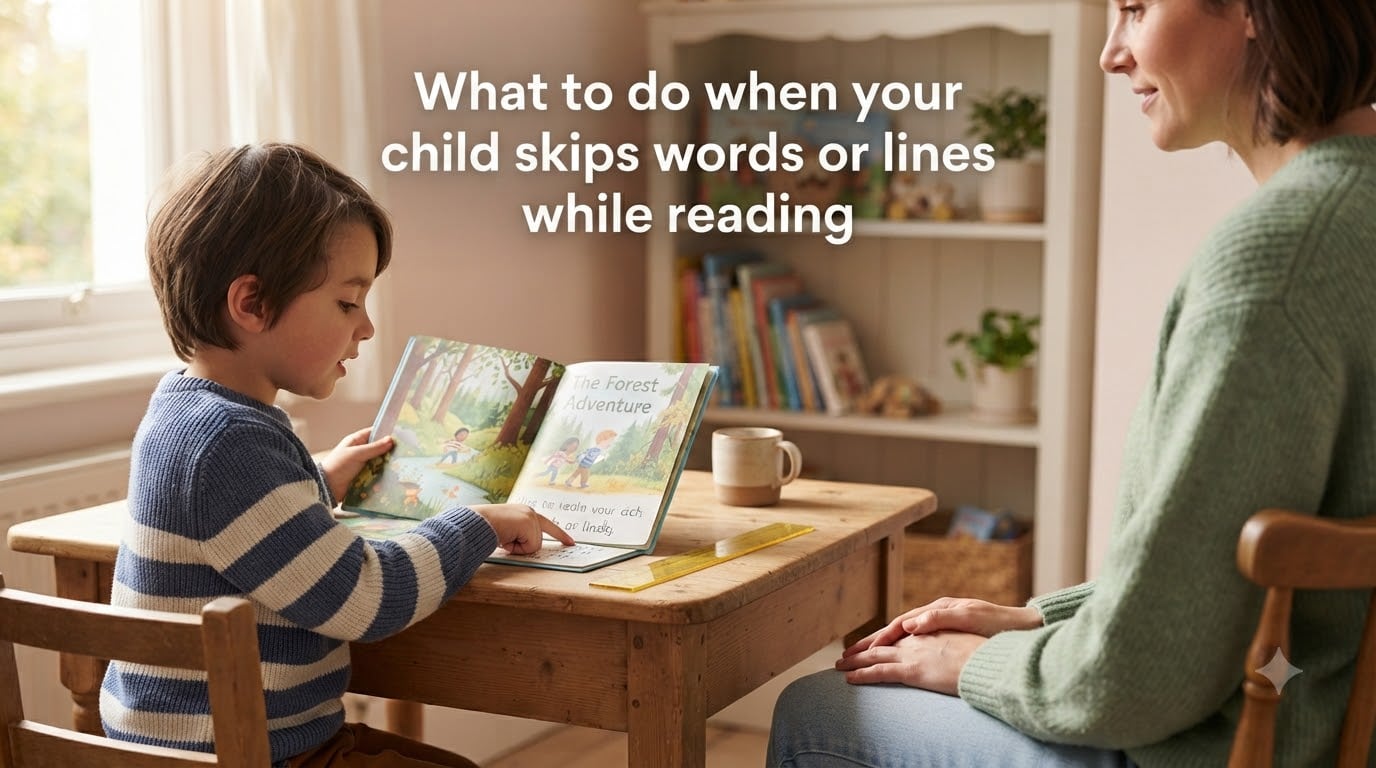
You sit down to listen to your child read aloud, and within a few sentences you notice it. They skip a word here, jump to the next line there, and suddenly the sentence they just read makes no sense at all.
If your child skips words or lines while reading, you are far from alone. It is one of the most common concerns parents bring to teachers and reading specialists, and in most cases it is a completely normal part of learning to read fluently.
But knowing whether it’s just a phase or something that needs attention can feel confusing. In this guide, I’ll walk you through what word and line skipping looks like, what causes it, practical strategies you can try at home tonight, and the warning signs that suggest it’s time to call in a professional.
Table of Contents
What Word and Line Skipping Actually Looks Like
Word skipping and line skipping are two related but distinct behaviors. Understanding the difference helps you respond in the right way.
Word skipping happens when a child reads past individual words without saying them. This often affects small function words like “the,” “a,” “of,” “and,” or “is” because those words carry less meaning and a child’s brain can predict the sentence without them.
Line skipping is when a child’s eyes jump ahead or down to the wrong line mid-sentence. Instead of continuing across the page, they might drop two lines below or bounce back up to the previous line. The result is a jumbled reading that doesn’t match the text on the page.
Skipping Small Words vs Critical Words
There’s an important difference between skipping filler words and skipping words that change meaning. A child who skips “the” before “dog” probably understood the sentence fine. But a child who skips “not” in “do not touch” has completely reversed the meaning.
When a child consistently skips high-meaning words — nouns, verbs, or negators like “not” and “never” — that suggests a deeper comprehension or attention issue rather than simple speed.
What Line Skipping Looks Like on the Page
Line skipping usually sounds like abrupt jumps. Your child reads the first half of a sentence on line 4, then suddenly picks up on line 6 as if nothing happened. Or they finish a line and their eyes drift up instead of dropping to the next line down.
Children with line skipping issues often lose their place frequently, use their finger to track, or complain that the words seem to move or blur on the page.
Common Causes of Word and Line Skipping
Children skip words or lines for a variety of reasons. Most are developmental and fixable with practice. A smaller number point to vision issues or learning differences that need professional support.
1. Reading Too Fast
This is the single most common cause. As children gain confidence, they naturally speed up. Their eyes start moving faster than their mouth can form the words, and small words get dropped along the way.
This is especially common in children ages 6 to 8 who have recently crossed a fluency threshold. They’re proud of reading faster, and their brain starts predicting what comes next instead of reading every word.
The giveaway is that the skipping usually disappears when you ask them to slow down and read carefully.
2. Vision Tracking and Ocular Motor Issues
Your eyes don’t glide smoothly across a line of text. They make tiny jumps called saccades, briefly fixating on clusters of words before leaping to the next group. At the end of each line, your eyes perform a return sweep back to the left margin of the next line.
Some children have underdeveloped saccadic control or ocular motor dysfunction. Their eyes don’t jump accurately, so they overshoot words or land on the wrong line during the return sweep.
Convergence insufficiency is another common issue. This is when both eyes struggle to work together to focus on near text, which can cause words to appear doubled, blurry, or to seem to move on the page.
If your child rubs their eyes frequently, complains of headaches while reading, tilts their head at an unusual angle, or says the words look fuzzy, vision tracking may be the root cause.
3. Dyslexia and Phonological Processing
Skip-reading can be an early indicator of dyslexia. Children with dyslexia often have difficulty mapping sounds to letters, which makes decoding each word feel effortful. As a coping strategy, they may guess at words based on context or first letter, skipping over words they can’t easily decode.
Dyslexia-related skipping tends to persist even when the child reads slowly. You might notice they skip the same types of words repeatedly, struggle to sound out unfamiliar words, or avoid reading aloud altogether.
It’s worth noting that skipping words alone does not mean a child has dyslexia. Dyslexia involves a pattern of difficulties, including slow reading speed, poor spelling, and trouble with phonological awareness tasks like rhyming or breaking words into sounds.
4. ADHD and Attention Difficulties
Children with ADHD often skip words or lose their place while reading. This isn’t a vision problem — it’s an attention problem. Their mind drifts mid-sentence, their eyes wander, and they lose track of where they were.
ADHD-related skipping tends to come and go. A child might read perfectly when they’re fresh and interested, then fall apart when they’re tired or bored. The inconsistency is the hallmark.
If your child also struggles with sustained attention in other areas — homework, chores, listening to multi-step instructions — ADHD may be worth discussing with their pediatrician.
5. Fatigue, Screens, and Reading Stamina
Tired eyes skip words. Children who have spent the day at school, then come home and read on a tablet or phone, are asking a lot of their visual system.
Screen reading in particular can contribute to skipping. The blue light, glare, and backlit display fatigue the visual system faster than paper. If your child reads fine on paper but struggles on screens, that’s a strong clue.
Many parents in online forums report that skipping gets noticeably worse in the evening or after long school days. This pattern points to stamina rather than a deeper issue.
Practical At-Home Strategies That Help
Before you book any appointments, try these strategies at home. Most children respond well to simple adjustments, and you’ll learn a lot about the root cause by watching how they react.
1. Use a Finger or Reading Ruler
This is the single most effective strategy for both word and line skipping. Have your child point to each word as they read it, or slide a blank index card down the page to reveal one line at a time.
Finger pointing forces the eyes to keep pace with a physical marker. It works because it externalizes the tracking process — the finger does the work the ocular motor system is still developing.
For line skipping specifically, try a reading tracker strip — a narrow piece of cardstock with a transparent window that highlights one line at a time while blocking the lines above and below.
2. Slow Down With Whisper Reading
Ask your child to whisper-read so softly that you can barely hear them. Whispering forces them to process each word through their mouth, which naturally slows down their eyes.
This strategy works particularly well for children whose skipping comes from reading too fast. If the skipping disappears when they whisper-read, you’ve confirmed the cause is speed, not a vision or learning issue.
Practice this daily for two weeks. Most children internalize the slower pace and begin reading at a more measured speed without the whisper.
3. Record and Play Back
Record your child reading aloud on your phone, then listen to it together. Hearing themselves read helps children notice their own skipping in a way that in-the-moment correction never achieves.
This builds self-monitoring — the ability to catch and self-correct mistakes while reading. Self-monitoring is one of the strongest predictors of long-term reading success.
Keep the tone light and curious. Say something like, “Let’s listen together and see which words snuck away from us.” This frames it as a shared discovery rather than a criticism.
4. Build Self-Monitoring Habits
Teach your child to ask themselves one simple question after every sentence: “Did that make sense?” If the answer is no, they should go back and reread.
This sounds basic, but many children who skip words never pause to check meaning. They push forward, assuming they got it right. Building the habit of stopping and self-correcting takes time, but it transfers to every reading situation.
For older children (ages 8 and up), try having them mark spots where they’re unsure with a small sticky tab. This gives you a map of exactly which words or sections trip them up.
5. Choose the Right Reading Material
Sometimes the problem isn’t the child — it’s the book. Text that’s too difficult, with tiny font, crowded lines, or long paragraphs, makes skipping more likely for any reader.
Look for books with larger font, generous line spacing, and plenty of white space on the page. Early chapter books and dyslexia-friendly formats are designed with these features intentionally.
Also consider reading level. If your child skips words in a book that’s above their level but reads cleanly in an easier book, the issue is text difficulty, not a tracking problem.
Warning Signs That Mean It’s Time for Professional Help
How do you know when skipping is just a phase and when it signals something that needs evaluation? Here are the patterns that should prompt you to take the next step.
When to Talk to the Teacher
Schedule a conversation with your child’s teacher if the skipping has persisted for more than a few months despite trying the at-home strategies above. Bring specific examples — record a short clip of your child reading, or note which types of words they skip most.
Ask the teacher whether they’ve observed similar patterns in class. A child who only skips words at home but reads fine at school may simply need a quieter, less distracting reading environment.
Teachers can also assess whether your child’s reading level is appropriate and whether the skipping is affecting their comprehension scores on classroom assessments.
When to See a Pediatrician or Educational Psychologist?
Talk to your pediatrician if you notice a cluster of signs beyond skipping. These include persistent letter or number reversals past age 7, extreme difficulty sounding out unfamiliar words, strong resistance to reading, or a family history of dyslexia or other learning differences.
Your pediatrician can refer you for a full psychoeducational evaluation, which assesses reading, phonological processing, attention, and cognitive profile. This evaluation is the gold standard for identifying dyslexia, ADHD, and other learning differences.
Trust your instincts here. Parents often sense something is different long before testing confirms it. That gut feeling is worth acting on.
When to Consult a Developmental Optometrist?
If your child complains of words moving, blurring, or doubling, squints or tilts their head while reading, rubs their eyes frequently, or reports headaches after reading — these are vision red flags that go beyond what a standard school vision screening detects.
A developmental optometrist specializes in binocular vision function — how well both eyes work together to track, focus, and process text. They can diagnose conditions like convergence insufficiency and ocular motor dysfunction that regular eye exams often miss.
If a vision issue is found, vision therapy — a structured program of eye exercises — can significantly improve tracking accuracy. Many parents report dramatic improvements after a course of therapy, though results vary by individual.
Age-by-Age Expectations: What’s Normal vs Concerning
Context matters enormously. A behavior that’s perfectly typical at age 6 might be worth investigating at age 9.
Ages 5-6: Skipping small words and occasionally losing your place is very common at this age. Beginning readers are still building saccadic accuracy and phonological skills. Finger pointing and patient rereading are usually all that’s needed.
Ages 7-8: Some skipping is still normal, especially when reading exciting or fast-paced passages. However, if your child consistently skips words even when reading slowly, or if skipping is affecting their comprehension and confidence, it’s worth discussing with their teacher.
Ages 9 and up: By this age, most children have developed stable eye tracking and self-monitoring skills. Persistent word or line skipping at this age warrants evaluation for vision issues, dyslexia, or attention difficulties.
Remember that these are general guidelines, not hard rules. Every child develops at their own pace, and early intervention is always better than waiting.
FAQs
What are three warning signs of dyslexia?
Three key warning signs of dyslexia are: (1) persistent difficulty sounding out unfamiliar words despite phonics instruction, (2) slow, effortful reading that falls significantly below grade level, and (3) ongoing trouble with spelling, letter reversals past age 7, or difficulty rhyming and breaking words into sounds. If you notice these patterns together, request a psychoeducational evaluation through your school or pediatrician.
Is skipping words when reading ADHD?
Skipping words can be associated with ADHD, but it is not automatically a sign of it. Children with ADHD may skip words because their attention drifts mid-sentence, causing their eyes to wander from the page. The hallmark of ADHD-related skipping is inconsistency — the child reads well when focused but struggles when tired, bored, or distracted. If your child also shows sustained attention difficulties in other areas like homework, chores, or following multi-step instructions, discuss ADHD screening with their pediatrician.
What is the red flag for dyslexia?
The biggest red flag for dyslexia is a bright, verbally capable child who unexpectedly struggles with reading and spelling. Specific warning signs include difficulty learning letter names and sounds in early childhood, persistent letter reversals past age 7, extremely slow reading despite practice, trouble memorizing sight words, and a family history of reading difficulties. If your child seems capable in every area except reading and spelling, that mismatch is the most significant red flag.
At what age should a child stop skipping words while reading?
Occasional skipping of small words is normal through about age 7 to 8, especially as children gain reading speed and confidence. By age 8, most children can read aloud smoothly with minimal skipping when reading at an appropriate level. If a child age 9 or older consistently skips words or lines despite practice and at-home strategies, or if the skipping affects comprehension, it is worth investigating for vision tracking issues, dyslexia, or attention difficulties.
Conclusion
When your child skips words or lines while reading, the most important first step is to stay calm and curious. Most cases resolve with simple strategies like finger pointing, slowing down, and building self-monitoring habits.
Start with the at-home approaches in this guide and give them a genuine two-to-three-week trial. Pay attention to patterns — does the skipping happen when they’re tired? With certain books? Only on screens? Those observations are invaluable if you later need to consult a professional.
If the skipping persists despite your best efforts, or if you notice any of the warning signs we’ve covered, don’t hesitate to reach out to your child’s teacher, pediatrician, or a developmental optometrist. Early support makes a measurable difference, and you are already taking the right step by paying attention.