
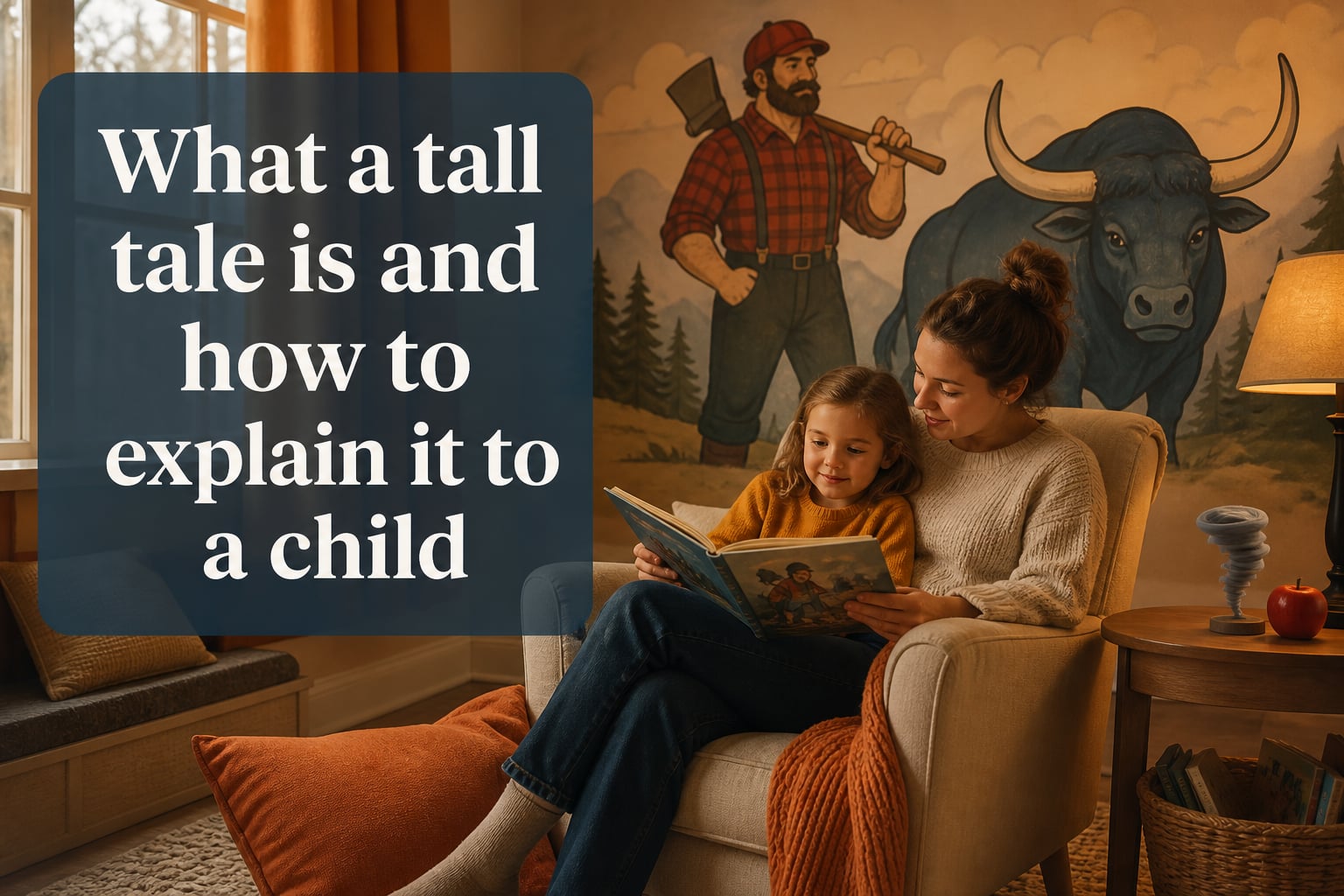
A tall tale is a story with exaggerated characters and impossible events that could not really happen, told for fun and entertainment. Think of a lumberjack so tall he used pine trees as a comb, or a cowboy who lassoed a tornado. Those are tall tales.
If you have ever heard your five-year-old swear they saw a dragon on the way home from school, you are already living with a tall tale teller. The good news is that this kind of storytelling is a healthy, normal part of growing up.
In this guide, I will walk you through what a tall tale is, share famous examples your kids will love, and give you practical steps for explaining tall tales in a way that nurtures imagination while keeping honesty intact.
Table of Contents
What Is a Tall Tale?
A tall tale is a humorous folktale filled with exaggeration that makes ordinary events sound extraordinary. The characters are larger than life, the problems they solve are impossible, and the fun comes from knowing none of it could be real.
When I explain this to my own kids, I use the simplest version I can. I tell them a tall tale is a story where someone stretches the truth so far that it pops like a balloon, and everyone listening gets to laugh about it together.
Tall tales come from the American frontier tradition, where pioneers, loggers, and cowboys sat around campfires trying to outdo each other with wild stories. The best storyteller won bragging rights, and over time these yarns became a beloved piece of American folklore.
The 5 Key Elements of a Tall Tale
Every tall tale shares a recognizable set of ingredients. When you know these elements, you can spot a tall tale instantly and teach your child to recognize them too.
Hyperbole, or extreme exaggeration: A character might eat fifty pancakes in one bite or lift a mountain with one hand. The exaggeration is so over the top that no one could possibly believe it.
A superhuman hero: The main character possesses strength, speed, or skill far beyond any real person. Paul Bunyan clears forests in a single swing, and Pecos Bill rides tornadoes like horses.
A problem solved in an impossible way: The hero faces a challenge and solves it using methods that defy physics and common sense, which is exactly what makes the story funny.
A folksy, conversational tone: Tall tales sound like someone talking to you around a campfire. They use everyday language and often start with phrases like “You won’t believe this, but.”
A setting rooted in real American places: The stories often take place in real locations like the Great Lakes, the Grand Canyon, or the Wild West, which grounds the fantasy in familiar geography.
Famous Tall Tale Characters Kids Will Love
The best way to help a child understand tall tales is to introduce them to the classic characters. Each one demonstrates exaggeration and humor in a way that clicks instantly.
Paul Bunyan is a giant lumberjack who, along with his blue ox Babe, supposedly created the Great Lakes by digging watering holes and carved the Grand Canyon just by dragging his axe behind him.
Johnny Appleseed walked across America planting apple seeds everywhere he went. While he was a real person named John Chapman, the tall tale version of him could talk to animals and wore a pot on his head as a hat.
Pecos Bill was raised by coyotes and grew up to become the toughest cowboy in Texas. He invented the lasso, rode a tornado like a bucking bronco, and dug the Rio Grande with his bare hands.
Davy Crockett was a real frontiersman and politician, but the tall tale version of him killed a bear when he was only three years old and could grin a raccoon right out of a tree.
John Henry was a steel-driving man who raced against a steam drill to prove human muscle could beat a machine. He won the race but died with his hammer in his hand, a hero of strength and determination.
Where Did Tall Tales Come From?
Tall tales grew out of the oral tradition of the American frontier in the 1800s. Settlers, loggers, miners, and cowboys spent long evenings together and passed the time by spinning increasingly outrageous stories.
Storytelling became a form of entertainment and a kind of bragging contest. Each person tried to tell a wilder, funnier story than the last. The best tales were remembered, retold, and eventually written down.
These stories also served a practical purpose. They helped pioneers make sense of a vast, unfamiliar landscape. A canyon that seemed impossibly large became easier to understand if a giant had carved it with a single swing of his axe.
Why Children Tell Tall Tales?
Children between the ages of three and seven are natural tall tale tellers. Their imaginations are exploding, their sense of what is possible versus impossible is still developing, and they are discovering the power of language to captivate an audience.
Child development experts agree that this kind of storytelling is a completely normal developmental milestone. When a four-year-old tells you they saw a dinosaur at the park, they are not being deceitful. They are practicing creativity and testing how words can shape reality.
In my conversations with other parents on forums like Reddit’s r/Parenting, I have seen the same worry surface over and over. Parents ask whether their child’s wild stories are a sign of dishonesty or just imagination. The answer, almost universally from experts, is that this behavior is healthy and even something to celebrate.
Children also tell tall tales because they want to be heard. A boring story about a normal Tuesday at school gets little attention, but a story about a bear chasing the school bus makes everyone listen. Tall tales give kids a way to feel important and interesting.
Tall Tales vs. Lies: How to Tell the Difference
This is the question I hear most from parents. How do you know when your child is telling a tall tale versus telling a lie?
The key difference is intent. A tall tale is told for fun and entertainment, with no goal of deception. The child often smiles or giggles while telling it, and the story is so wild that no reasonable person would believe it. A lie, on the other hand, is told to avoid consequences, gain an advantage, or hide something, and it is designed to be believed.
Ask yourself these three questions. Is the story obviously impossible? Does my child seem to enjoy telling it rather than trying to hide something? Is there nothing to gain from me believing it? If you answer yes to all three, you are almost certainly hearing a tall tale, not a lie.
How to Explain a Tall Tale to a Child?
This is where most resources stop. They define tall tales beautifully but never tell you how to actually explain the concept to a four-year-old standing in your kitchen. Here is the approach I use, broken down by age.
For ages three to five: Keep it physical and playful. Cup your hands together and say, “A tall tale is a story that starts this big,” then stretch your arms wide and say, “and grows this big until it is too silly to be true!” Use a favorite character like Paul Bunyan and ask, “Could a real person be taller than a mountain?” When they laugh and say no, you have taught the concept.
For ages six to eight: Introduce the word exaggeration. Explain that tall tales take something real and stretch it like a rubber band until it snaps into something funny. Read a short tall tale together and pause to ask, “What part of that was real and what part was exaggerated?”
For all ages: Make the distinction between storytelling and truth-telling explicit. Say something like, “Tall tales are wonderful stories we tell for fun, but in real life, we tell the truth so people can trust us.” This frames honesty as a positive choice rather than a restriction on their creativity.
One of my favorite techniques is to create a signal. Agree on a silly word or gesture, like tugging your ear, that means “this is a tall tale.” When your child starts spinning one, they can use the signal, and you both enjoy the story knowing it is playtime for the imagination.
Fun Tall Tale Activities for Kids
Activities make the concept stick. Here are a few my family has tested and loved.
Create your own tall tale: Pick a real person your child knows, like their grandfather or their teacher. Then brainstorm one impossible thing that person could do. Build a short story around it and take turns adding details.
The exaggeration game: Start with a true sentence like “I walked to the store.” Each person adds one layer of exaggeration until the story is completely absurd. This game teaches the building block of every tall tale in a hands-on way.
Read and compare: Read a tall tale like Steven Kellogg’s “Paul Bunyan” alongside a nonfiction book about logging or forests. Ask your child to identify which parts of each book are real and which are exaggeration.
Tall Tales vs. Fables, Myths, and Legends
Children often ask how tall tales differ from other story types they know. Here is a simple way to explain the differences.
Fables teach a moral lesson and usually feature talking animals, like the Tortoise and the Hare. Myths explain natural phenomena through gods and supernatural beings, like how the Greeks explained lightning with Zeus. Legends are based on real historical figures whose deeds grew over time, like Robin Hood. Tall tales are the most openly playful of the group. They exaggerate on purpose for humor and entertainment, and everyone knows the stories are not meant to be taken seriously.
FAQs
What is a tall tale in simple terms?
A tall tale is a funny story filled with exaggeration where characters do impossible things, like a giant lumberjack who dug the Great Lakes with his axe. The stories are told for entertainment and everyone knows they are not true.
Why do children tell tall tales?
Children tell tall tales because their imaginations are developing rapidly between ages three and seven. They are practicing creativity, exploring the power of language, and discovering that exciting stories get attention. It is a normal and healthy part of child development.
What are some famous tall tale characters?
Famous tall tale characters include Paul Bunyan the giant lumberjack, Johnny Appleseed who planted trees across America, Pecos Bill the tornado-riding cowboy, Davy Crockett the king of the wild frontier, and John Henry the steel-driving man.
How do I explain a tall tale to a preschooler?
Use playful, physical language. Tell them a tall tale is a story that starts small and grows bigger and bigger until it is too silly to be true. Then read a story like Paul Bunyan and ask if a real person could be taller than a mountain.
Is my child lying or telling a tall tale?
A tall tale is told for fun with no intent to deceive, and the story is so wild no one would believe it. A lie is told to avoid consequences or hide something and is designed to be believed. If your child is giggling and the story is obviously impossible, it is likely a tall tale.
How can I tell a tall tale from a fable or myth?
Tall tales exaggerate on purpose for humor and are openly acknowledged as not true. Fables teach moral lessons with talking animals, myths explain nature through gods, and legends stretch real historical figures. Tall tales are the most playful of the group.
Wrapping Up: Embracing the Tall Tale
Understanding what a tall tale is and how to explain it to a child gives you a powerful parenting tool. You get to celebrate your child’s creativity while gently teaching the difference between storytelling and truth-telling.
Tall tales connect us to a rich American folklore tradition and give kids permission to dream big, laugh loud, and stretch their imaginations. The next time your little one swears they saw a whale in the bathtub, you will know exactly what to do.
Enjoy the stories. Encourage the imagination. And keep the conversation about honesty open and kind. That is the real secret to raising a child who loves tall tales and tells the truth.