
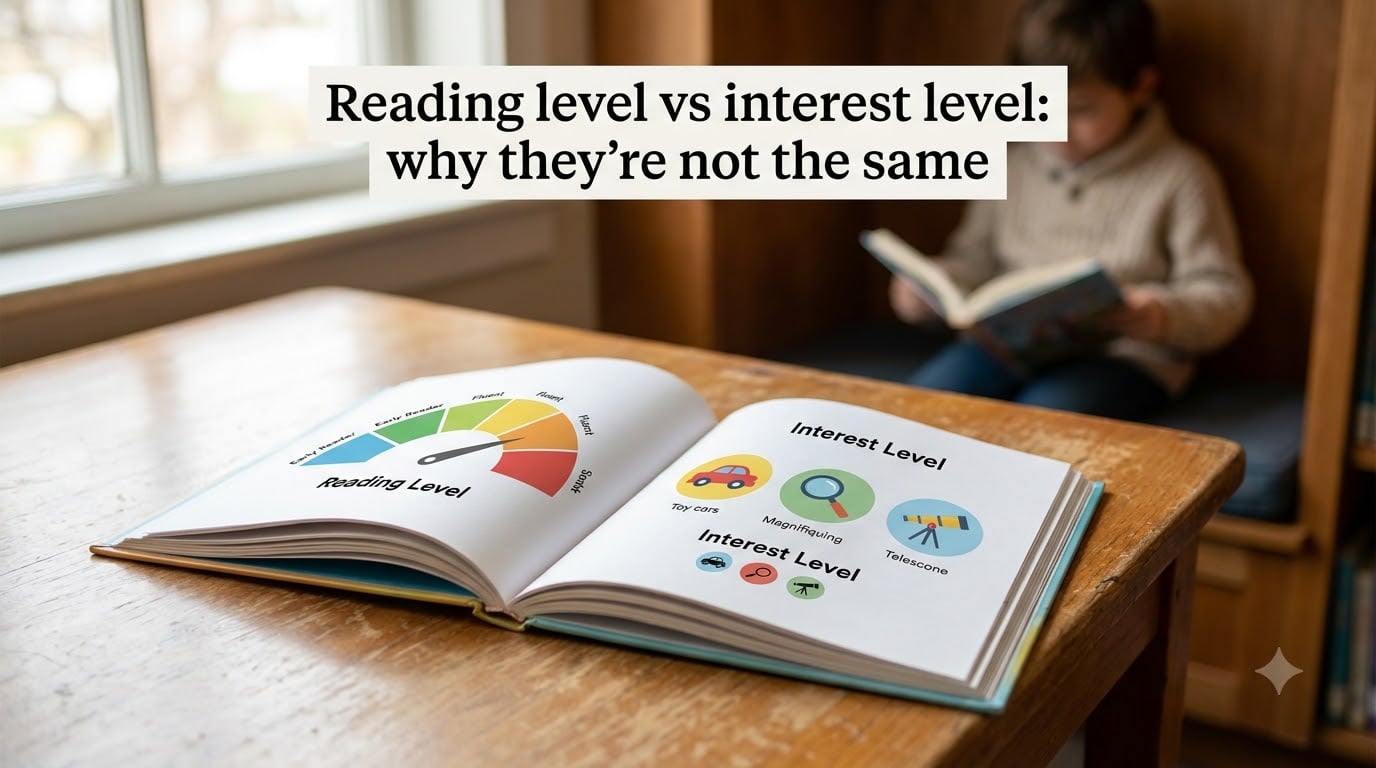
Reading level and interest level measure two completely different things, and confusing them is one of the most common mistakes parents and teachers make when matching children with books. Reading level tells you how hard a book is to decode. Interest level tells you what age the content is meant for. A child can read way above their grade level but still love stories written for younger kids. Another child can decode at grade level but want themes meant for teens. Understanding the difference between reading level vs interest level changes how you pick books for every kid in your life.
I have spent years working with families, teachers, and librarians who wrestle with this exact problem. The same questions come up over and over. Why does my 8-year-old keep picking chapter books meant for 6-year-olds? Why does my struggling 10-year-old refuse anything labeled “easy”? The answer almost always comes back to the same root cause: confusing skill with content. Let me walk you through what each level really means, why they don’t match, and what to do about it.
Table of Contents
What Is Reading Level?
Reading level is a measurement of how difficult a book’s text is to read. It looks at the words, sentences, and structure on the page, then assigns a number or letter that tells you whether a child can decode and understand it on their own.
Reading level is calculated using formulas that consider several measurable factors:
Average sentence length
Word difficulty and vocabulary complexity
Total word count and chapter length
Number of syllables per word
Sentence structure variety
A book at a 2nd grade reading level uses short sentences, common sight words, and simple vocabulary. A book at an 8th grade reading level uses complex sentence structures, abstract vocabulary, and longer chapters that demand sustained attention.
Think about the difference between “The cat sat on the mat” and a paragraph from Harry Potter describing Quidditch rules. Both are written in English. Both tell a story. But the cognitive demand on the reader is completely different. Reading level captures that difference with a number or letter a parent can use as a starting point.
Most leveling systems, like Lexile, ATOS, and DRA, give you a reading level number for almost any children’s book. Schools and libraries use these numbers to recommend books that match a child’s current reading ability. When we say a child reads at a 4.2 grade level, we mean they can comfortably handle text designed for a child about four months into second grade.
What Is Interest Level?
Interest level is a judgment about the content of a book, not the difficulty of its words. It answers a different question: what age reader is the story’s theme, characterization, and plot meant for?
Publishers assign one of four interest level designations to most children’s books:
LG (Lower Grades): K-3rd grade, themes suited to ages 5-8
MG (Middle Grades): 4th-8th grade, themes for ages 9-13
MG+ (Upper Middle): 6th grade and up, more complex themes like divorce or bullying
UG (Upper Grades): 9th-12th grade, teen and young adult content
A book can be written at a 2nd grade reading level but carry an MG interest level if it deals with a parent’s illness or a friend moving away. Conversely, a book written at a high school reading level might have an LG interest level if it tells a simple story about a lost puppy.
Interest level reflects maturity, not skill. The publisher is signaling that certain emotional or thematic content may be too intense, confusing, or simply boring for younger readers, regardless of whether they could technically sound out the words. A 6-year-old might be able to read the words in a book about a child’s grandmother dying, but the emotional content is designed for an older child who has more life experience to process it.
Why Reading Level and Interest Level Are Not the Same
Reading level measures how hard the words are. Interest level measures how mature the content is. These are two independent dimensions of a book, and they can move in opposite directions without warning.
This is the heart of why reading level vs interest level is a real distinction. A book at a 3rd grade reading level can carry a UG interest level (think: a romance novel written in simple English for language learners). A book at a UG reading level can carry an LG interest level (a chapter book with rich vocabulary but a simple friendship story).
The mismatch is actually the norm, not the exception. Real children read in all kinds of ways:
A 7-year-old who reads at a 5th grade level but loves picture books about trucks
A 12-year-old who reads at a 4th grade level but wants novels about high school drama
A 10-year-old who reads right on grade level but only wants graphic novels about superheroes
A 15-year-old who reads at college level but rereads the same Magic Tree House books from age 6
When parents and teachers only look at reading level, they make the mistake of pushing a child toward books that match their skill but bore them, or worse, push a child toward books that match their interest but frustrate them. Neither outcome builds a reader. Understanding both levels helps you choose books that are both appropriately challenging and genuinely engaging.
Reading level and interest level serve different purposes. Reading level protects a child from books that are too hard and demotivating. Interest level protects a child from content they are not emotionally ready for. A good book choice sits in the sweet spot where both work together.
Common Leveling Systems Explained
There is no single universal reading level system. Schools, libraries, and publishers use several different scales, which is one reason this topic gets so confusing. Here is a breakdown of the most common systems you will encounter.
Lexile Measure uses a numerical scale, typically from 200L for beginning readers up to 1600L or higher for advanced texts. A reader’s Lexile measure is determined by assessments, and a book’s Lexile measure comes from computer analysis of its text. The reader’s measure and the book’s measure should be within a certain range for comfortable independent reading.
ATOS Book Level is the scale used by Accelerated Reader, the popular school reading program. It runs from about 0.0 for the simplest early readers up to 13.0 or higher for advanced high school texts. ATOS considers average word count, sentence length, vocabulary difficulty, and other factors to give a decimal score that aligns roughly with grade levels.
DRA (Developmental Reading Assessment) uses numbers from 1 to 80, and is common in elementary schools. A teacher typically administers DRA assessments one-on-one with students, then matches students to books within a recommended DRA range.
Guided Reading Levels (Fountas and Pinnell) use a letter system from A to Z. Kindergarteners typically start at level A or B, and high schoolers read at level X, Y, or Z. This system is often used for small group instruction in classrooms.
Grade Level Equivalents simply assign a grade number to a book, like “3rd grade reading level” or “5th grade reading level.” This is the most intuitive system but also the least precise, because individual students vary widely within a single grade.
Different systems give slightly different numbers for the same book, because they weigh different factors. A book with simple vocabulary but long sentences might score easier on one scale and harder on another. None of these systems account for interest level at all. That is a separate, mostly publisher-driven label.
Reading Levels by Grade: A Quick Reference
While every child develops at their own pace, here is a general guide to what reading level expectations look like by grade. Use this as a starting point, not a rule.
Kindergarten: Letter recognition, simple sight words, short predictable texts
1st grade: Early chapter books, simple sentences, basic vocabulary
2nd grade: Longer chapter books, more complex sentences, growing vocabulary
3rd grade: Transitional readers, longer books, introduction to chapter structure
4th-5th grade: Independent readers, varied genres, longer text with multiple characters
6th-8th grade: Middle school readers, more complex themes, longer sustained reading
9th-12th grade: High school readers, abstract ideas, mature themes, varied genres
A child reading one or two levels above or below their grade is completely normal. A child reading three or more levels off from their grade is where professional assessment becomes valuable, either to identify giftedness or to spot a struggling reader who needs support.
Real-World Scenarios: When the Levels Don’t Match
The theory is useful, but the real test comes in everyday book selection. Here are three common scenarios I hear from parents and teachers, and what the level mismatch looks like in each one.
Scenario 1: The advanced reader who wants “younger” books. A 7-year-old reads at a 4th grade level but keeps asking for Magic Tree House, a series designated for ages 6-9. The reading level on the back of the book says she should be reading chapter books meant for 4th graders. But the interest level matches her age perfectly. The right call: let her enjoy the books she loves. Skill and preference are not the same thing. Forcing her into more complex books kills the joy that made her an advanced reader in the first place.
Scenario 2: The struggling reader who wants “big kid” books. A 10-year-old reads at a 2nd grade level but sees her older sister reading Harry Potter and wants to join in. The reading level is way too hard, but the interest level fits. The right call: don’t hand her Harry Potter, but don’t hand her a “baby book” either. Use high/low books written at lower reading levels but with older themes, like Hatchet or Holes, or let her try the audiobook version of Harry Potter so she can follow the story while building skills.
Scenario 3: The on-level reader with narrow interests. A 9-year-old reads right at grade level but only wants books about Minecraft, sports, or one specific TV show. The reading level is fine, but the interest level might not match the depth of content she could handle. The right call: feed the interest. There are excellent books at her reading level about every topic. A book on Minecraft strategy or her favorite sports team is still building reading skills, vocabulary, and stamina.
In every scenario, the mistake is treating one level as the answer. Reading level alone is not the answer. Interest level alone is not the answer. The best book choice respects both.
How to Choose Books for Children When Levels Don’t Align?
When the levels don’t match, you have more options than you might think. The key is to use the level mismatch as information, not as a rule.
Here are practical methods our team recommends to parents and teachers navigating this exact problem.
Use the 5 finger rule. Open to a random page of the book. Have your child read it aloud. Hold up one finger for every word they don’t know or stumble on. Zero to one fingers: too easy. Two to three fingers: just right. Four to five fingers: too hard for now. This is a quick way to check reading level in real time without any official assessment.
Match interest level to maturity, not age. A book with a MG interest level might be perfect for a mature 8-year-old or completely inappropriate for an immature 12-year-old. Trust your knowledge of the individual child over the label on the back cover.
Allow reading below level for pleasure. Reading a book that is “too easy” is not a waste of time. It builds fluency, confidence, and love of reading. Many adults reread childhood favorites for comfort. Children deserve the same.
Use high/low books to bridge gaps. High/low books are written at lower reading levels but with themes and content that appeal to older readers. They are designed for exactly the mismatch scenario. Examples include the Bluford High series, the Orca Soundings series, and many graphic novels.
Let kids choose what excites them. Research consistently shows that children who choose their own books read more, and read longer, than children whose books are assigned. Interest drives engagement, and engagement drives improvement. A reluctant reader who picks up a book about dinosaurs and finishes it is learning more than a willing reader forced through a “level-appropriate” book they hate.
Talk about the books together. Asking a child what they liked, didn’t like, and what they think will happen next builds comprehension skills that no reading level can measure. A child who can talk about a book is reading successfully, no matter the level.
Why This Distinction Matters for Building Lifelong Readers
The reading level vs interest level distinction is not just a technical classification. It is a roadmap for raising kids who read for life.
When adults obsess over a child reading at “the right level,” they often kill the very motivation that made the child pick up a book in the first place. I have watched kids go from loving reading to hating it because every book they were given was technically perfect and emotionally dead. The opposite is also true. Kids given books that excite them tend to grow into adults who read on their own.
The most important thing a book can do is get finished. A child who finishes a book they loved learns that reading is a pleasure, not a chore. That single lesson pays off for decades. Reading level and interest level are tools to help you find those books, not rules to be followed at all costs.
Frequently Asked Questions
What are the different levels of children’s books?
Children’s books have several leveling measures. Reading level (or Book Level) measures text difficulty using systems like Lexile, ATOS, DRA, and Guided Reading Levels. Interest level measures content maturity using four publisher designations: LG (Lower Grades, K-3), MG (Middle Grades, 4-8), MG+ (Upper Middle, 6+), and UG (Upper Grades, 9-12). Reading level tells you how hard a book is to read. Interest level tells you what age the content suits.
At what level should a 7 year old be reading?
Most 7 year olds (2nd graders) read between a 1.5 and 3.5 grade level, depending on the system. They should be able to handle early chapter books with simple sentences, basic vocabulary, and short chapters. However, every child develops at their own pace, and a 7 year old reading one or two levels above or below this range is normal. What matters most is that the child is progressing and enjoying reading.
What is the 5 finger rule for books?
The 5 finger rule is a quick way to check if a book matches a child’s reading level. Open to a random page and have the child read it aloud. Hold up one finger for every word they don’t know or stumble on. Zero to one fingers means the book is too easy. Two to three fingers means it is just right. Four to five fingers means it is too hard for independent reading right now.
What level should a 10 year old be reading at?
A 10 year old (typically 4th or 5th grade) usually reads between a 4.0 and 6.0 grade level. They should be able to handle chapter books with multiple characters, varied sentence structure, and themes appropriate for ages 9 to 12. By this age, many children enjoy series books, longer novels, and genre fiction. Reading one or two levels off from grade expectations is normal and not a cause for concern.
What is the 3 book rule?
The 3 book rule is a practical strategy to help children build a reading habit. It works like this: have the child pick three books at once. One should be easy, one should be at their level, and one should be a challenge. This gives them options for different moods and reading situations. The easy book builds confidence, the level-appropriate book builds skills, and the challenging book stretches their abilities without pressure to finish.
Final Thoughts on Reading Level vs Interest Level
Reading level and interest level are two different tools for two different jobs. Reading level protects kids from books that are too hard. Interest level protects them from content they are not ready for. When you understand the difference between reading level vs interest level, you can stop treating one as a magic number and start using both to find books that children actually want to read.
The most important takeaway from this guide is simple. Reading level is not the only thing that matters when choosing a book for a child. Interest level, personal preference, and pure enjoyment are just as important. The best book for any reader is one that gets finished with a smile.