
I still remember the afternoon I tried to read Charlotte’s Web to my niece and her two friends. Within four minutes, one was drawing on her arm, another was upside down on the couch, and the third was asking if spiders could jump. I finished the chapter, but nobody remembered what happened in it.
That was the day I started looking for real ways to keep a child engaged during a read-aloud. After a decade of classroom teaching and a few hundred storytimes with my own kids, I have collected the strategies that actually work. This guide combines what I have learned with research from literacy experts, classroom teachers, and homeschool parents who run read-aloud time every single day.
If you are a parent, teacher, librarian, or caregiver trying to keep a child engaged during a read-aloud, you will find a practical plan here. I have broken it into strategies you can try today, activities that keep little hands busy, age-specific tips, and a quick checklist you can print and use before your next storytime.
Table of Contents
How to Keep a Child Engaged During a Read-Aloud: A Complete Guide
Keeping a child engaged during a read-aloud comes down to three things: giving them something to do with their body, something to do with their mind, and frequent chances to respond out loud. The research is clear that children who participate actively during read-alouds remember more vocabulary, build stronger comprehension, and develop a deeper love of stories than children who simply sit and listen.
In the rest of this article I will walk you through interactive read-aloud strategies, quiet hands-on activities, movement breaks, age-specific tips for toddlers through upper elementary, and the mistakes I have personally made so you can skip them. I will also share a quick-reference checklist at the end so you can grab it and go.
Why Engagement Matters During Read-Alouds
Engagement during read-alouds is not just about keeping the room quiet. It directly affects how much language and story structure a child absorbs. A 2015 study in Reading Research Quarterly found that children in interactive read-aloud classrooms scored significantly higher on vocabulary measures than children who heard the same books read passively.
When a child is engaged, their brain is doing three things at once: decoding unfamiliar words, building mental images, and connecting the story to what they already know. Passive listening only does the first of those, which is why so many parents and teachers worry, “Are they even listening?” The answer is usually: not fully, and that is fixable.
The Listening Comprehension Connection
Listening comprehension is the single strongest predictor of later reading comprehension. Researchers like Hollis Scarborough have shown that the listening comprehension track and the decoding track have to grow together for skilled reading to develop. Every interactive read-aloud is a workout for the listening comprehension track.
The practical takeaway is simple: if you can increase engagement during read-aloud, you are directly building the foundation for reading success a few years down the road. That is a big payoff for a small amount of effort.
Interactive Read-Aloud Strategies That Actually Work
Interactive read-aloud strategies turn storytime into a conversation instead of a performance. In my own classroom, I tested passive reading one week and interactive reading the next with the same chapter book. The interactive week produced longer discussions, more accurate recall, and almost zero behavior issues.
Here are the techniques I lean on most. They work whether you are teaching 25 second-graders or reading to two kids at bedtime.
Ask Questions Before, During, and After
Questioning is the cheapest engagement tool you have. Before you open the book, ask one or two prediction questions: “What do you think this story will be about?” or “Look at the cover. What is the character feeling?”
During the read-aloud, pause every few pages to ask a mix of literal questions (“What did the bear find?”) and inferential questions (“Why do you think the bear is hiding?”). After the read-aloud, wrap up with a synthesis question: “What was the most important thing the character learned?”
As a rule of thumb, I aim for one question every 3 to 5 pages for picture books and one every chapter for chapter books. Younger kids need more literal questions. Older kids can handle open-ended ones that have no right answer.
Use Think-Jot-Share and Turn-and-Talk
Think-Jot-Share is a classic Kagan structure that works beautifully during read-alouds. You pause at a meaningful moment, give students 30 seconds to think silently and jot a quick response on a sticky note or whiteboard, and then invite them to share with a partner. I have used this in first grade all the way up to fifth grade and it never fails.
Turn-and-Talk is the simpler cousin. After a question, you simply say, “Turn and talk to your partner for 30 seconds.” This gives every child a chance to rehearse an answer out loud before the whole class hears them, which boosts participation from quiet kids who would never raise a hand.
Both structures turn listening into doing, which is the heart of every strategy on this list.
Add Mandatory Engagement Moments
One technique I learned from a fellow teacher is what she called “mandatory engagement.” Instead of hoping kids will pay attention, you build the read-aloud around structured response points.
Examples include:
Thumbs up if you agree with the character’s choice, thumbs down if you do not.
Hold up a red card when you hear something that does not make sense.
Quietly write one question you would ask the character on a sticky note.
Tap your desk softly when you hear a word you do not know.
These little gestures give kids a job to do, and a kid with a job rarely gets restless.
Quiet Hands-On Activities to Keep Hands Busy
Many kids, especially boys and kinesthetic learners, listen better when their hands are moving. I learned this the hard way when I tried to ban fidget toys during read-aloud and watched attention crater. The fix was not to take the fidget away, it was to make the fidget part of the routine.
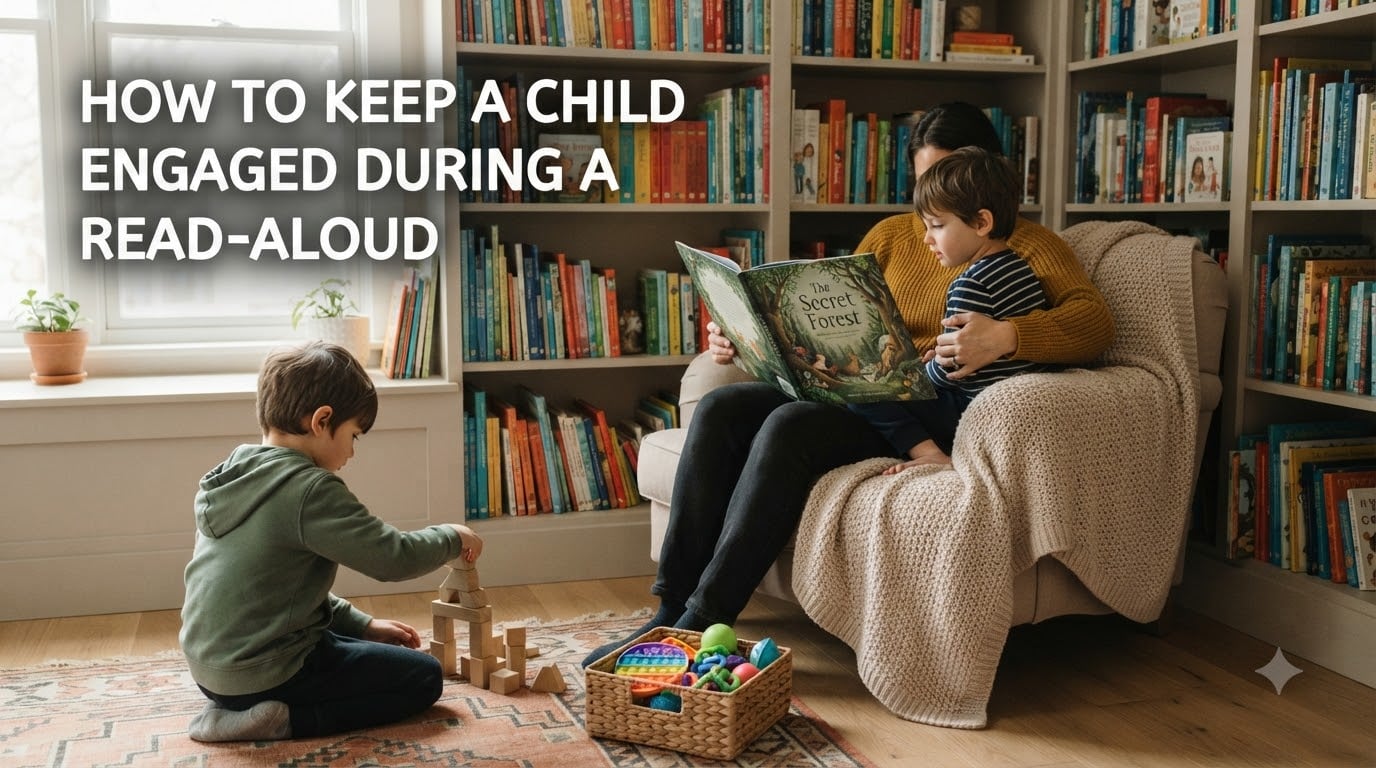
Below are the quiet hands-on activities my family and my students have used successfully during read-aloud. Pick one or two and keep them in a basket near your reading spot so they are ready to go.
Building Toys and Manipulatives
Building toys are the gold standard for quiet listening. LEGO, magnetic tiles, wooden blocks, and pattern blocks all keep hands busy without pulling eyes away from the story for more than a second or two.
In our homeschool, my youngest builds towers while I read. She rarely looks up, but she can answer comprehension questions correctly at the end of every chapter. The building is not a distraction, it is her version of paying attention.
For classroom teachers, a single basket of LEGO bricks or Magna-Tiles works wonders. For parents at bedtime, even a small set of blocks or a wooden train set can buy you 20 minutes of focused listening.
Sensory Bins and Fidget Tools
Sensory bins filled with dry rice, beans, or kinetic sand give kids a calming texture to explore with their fingers. You can hide small alphabet letters or story-themed objects inside to connect the activity to the book.
For shorter read-alouds, a simple fidget tool often does the trick. Think pop-it toys, stretchy strings, small squishy balls, or even a piece of therapy putty. The key is to set the rule that eyes stay on the book or on the listener, not on the fidget.
I have a small collection of quiet fidget tools in a basket next to our reading chair. When my kids pick one up, they know the expectation: hands busy, ears listening, no throwing.
Puzzles, Drawing, and Quiet Crafts
Jigsaw puzzles, coloring pages, and simple crafts are classic read-aloud companions. A 100-piece puzzle in progress that lives under the couch between readings gives a child something to add to while you read.
Drawing is another favorite. Kids can sketch the scene you just read about, draw their favorite character, or design a new cover for the book. Sketching engages the same mental imagery that good readers use, so it actually supports comprehension rather than hurting it.
For crafts, I avoid anything with glue or scissors during the read-aloud itself and save those for after. Anything that requires too much focus pulls attention away from the story.
Movement Breaks and Wiggle-Friendly Options
Some kids, especially toddlers and many boys, cannot sit still for a 20-minute picture book. Forcing them to sit usually backfires. The better move is to build movement into the read-aloud on purpose.
A simple technique is to pause every few pages and have kids act out a key word or phrase. With a story about animals, you might have them hop like a bunny, slither like a snake, or stomp like an elephant. The story continues but bodies get the break they need.
Stand, Stretch, and Walk-and-Listen
Walk-and-Listen is exactly what it sounds like. Instead of reading on the couch, you walk laps around the living room or yard while you read. Many of my most focused read-alouds have happened this way, especially with active kids.
If walking is too much, a simple mid-book stretch break works. Stand up, reach for the ceiling, shake out your hands, sit back down, and keep going. Twenty seconds of movement is usually enough to reset attention for another stretch of listening.
For classroom teachers, a quick “brain break” between chapters is a great way to keep engagement high across longer read-aloud sessions.
Age-Specific Tips for Toddlers and Elementary Kids
The strategies above work across ages, but the way you apply them changes a lot between a two-year-old and a ten-year-old. Here is what I have found works best at each stage.
Toddlers Ages 2-4
Toddlers have short attention spans, typically 3 to 8 minutes for a picture book. Keep read-alouds short and pick interactive books with flaps, textures, or repeated phrases they can say with you.
Movement matters more than quiet activities at this age. Let them stand, wander, or hold a stuffed animal while you read. Ask simple questions like “Where is the bear?” and let them point.
Read the same book five nights in a row. Toddlers love repetition and they will start to “read” parts of the story back to you, which is a huge comprehension win.
Early Elementary Ages 5-8
This is the sweet spot for interactive read-aloud. Kids can sit longer, they love to predict and answer questions, and they enjoy quiet activities that give their hands something to do.
Use Think-Jot-Share, turn-and-talk, and chapter predictions. Build LEGO, color, or do simple crafts during the read-aloud. After the book, ask them to retell the story in their own words, which is a powerful comprehension check.
Older Elementary Ages 9-11
Older kids can handle chapter books with longer sessions and deeper questions. Push toward inferential and evaluative questions: “Do you agree with the character’s choice?” “How would the story change if it were set today?”
This is also a great age for student-led read-alouds, where the kids take turns reading aloud to the group or to a partner. Engagement jumps when they become the reader.
Classroom vs Home: Adapting Strategies for Your Setting
Most read-aloud advice online leans either heavily classroom or heavily homeschool, which is frustrating for the many parents and teachers who do both. Here is how I adapt the same core strategies for each setting.
For classroom teachers: Build in structured turn-and-talk moments, use Kagan structures like Think-Jot-Share, set up quiet fidget baskets, and use mandatory engagement signals to keep 25 kids involved at once. A class timer helps kids self-manage turn-and-talk time.
For homeschool parents: Lean into the cozy side of read-aloud. Build LEGO, color, or do handwork while you read. Choose books that match the season or the kids’ current obsessions. Mix ages by picking books that work on two levels, like The Chronicles of Narnia or Charlotte’s Web.
For librarians and storytime leaders: Plan for movement by mixing songs and movement rhymes into the read-aloud. Keep sessions short, around 20 minutes, and use call-and-response phrasing so every child gets a turn to speak.
Common Mistakes That Kill Read-Aloud Engagement
I have made every mistake on this list at least once, often in front of a classroom full of kids. Share them with anyone who runs read-aloud time so they can skip the learning curve.
Mistake 1: Reading for too long without a pause. Even the best book loses kids if you read straight through for 30 minutes. Build in a pause, a question, or a movement break every 5 to 10 minutes.
Mistake 2: Skipping the prediction question. Jumping straight into the story without a “What do you think this will be about?” question wastes the easiest engagement moment of the session.
Mistake 3: Asking only yes-or-no questions. Yes-or-no questions get one-word answers and do almost nothing for comprehension. Mix in “why” and “how” questions regularly.
Mistake 4: Banning all movement and fidgets. Strict sitting rules usually increase wiggles, not reduce them. Channel the energy instead.
Mistake 5: Picking books the kids do not care about. Engagement follows interest. Survey your kids or students about the topics they love and choose books around those topics at least some of the time.
Mistake 6: Reading in a flat voice. Voice variety is one of the cheapest engagement tools you have. Read the giant’s lines deep, the mouse’s lines squeaky, and the narrator steady. Kids lean in when you perform the story.
Quick-Reference Checklist for Busy Parents and Teachers
Save this checklist on your phone or print it and stick it inside your read-aloud basket. It is everything in this article in one place.
Pick a book your child or class is excited about.
Set up a quiet fidget or building activity basket.
Ask one prediction question before you open the book.
Pause every 3 to 5 pages to ask a mix of literal and inferential questions.
Use Think-Jot-Share or Turn-and-Talk once per session.
Add a mandatory engagement signal, like thumbs up or down, at a key moment.
Build in a 20-second stretch or movement break every 10 minutes.
End with one synthesis question: what was the most important thing the character learned?
Keep total read-aloud time age-appropriate: 5 to 10 minutes for toddlers, 15 to 25 minutes for early elementary, 30 plus minutes for older elementary.
Read with voice variety, even when you are tired.
FAQs
How do you keep kids engaged during read alouds?
Keep kids engaged during read alouds by combining interactive questioning, quiet hands-on activities, and frequent movement breaks. Ask prediction questions before you open the book, pause every few pages for turn-and-talk or think-jot-share, and offer a fidget or building toy so hands stay busy. End with a synthesis question to lock in comprehension.
What are the best read aloud strategies?
The best read aloud strategies are interactive read aloud techniques like questioning, turn-and-talk, think-jot-share, mandatory engagement signals, and voice variety. Pair these with a quiet hands-on activity like LEGO or coloring, build in short movement breaks, and pick books that match the interests of your kids or students.
How do you keep a toddler engaged during a read aloud?
Keep a toddler engaged during a read aloud by keeping sessions short (5 to 10 minutes), choosing interactive books with flaps or repeated phrases, allowing movement and stuffed animals, and asking simple pointing questions like ‘Where is the bear?’ Read favorite books on repeat so toddlers can start to ‘read’ them back to you.
What can kids do while being read to?
Kids can quietly build with LEGO or magnetic tiles, color, draw, work on a jigsaw puzzle, fidget with a pop-it or therapy putty, knit or do simple handwork, or sketch scenes from the story. The key is to choose an activity that does not require visual focus so their ears stay tuned to the read aloud.
How can I tell if my child is actually listening?
You can tell if your child is actually listening by asking specific questions after the read aloud, like ‘What did the character find in the woods?’ or ‘Why was the character sad?’ Kids who were listening will answer accurately even if they were wiggling, building, or drawing during the story. Active bodies do not mean active minds.
How long should a read aloud be for different ages?
Read alouds should run about 5 to 10 minutes for toddlers ages 2 to 4, 15 to 25 minutes for early elementary ages 5 to 8, and 30 plus minutes for older elementary ages 9 to 11. Match the length to attention span and break longer sessions into chapters with short movement breaks in between.
Final Thoughts on Keeping a Child Engaged During a Read-Aloud
Learning how to keep a child engaged during a read-aloud is one of the highest-leverage skills a parent or teacher can build. Every minute you spend reading aloud with intention is a minute spent growing vocabulary, comprehension, attention span, and a love of stories that will last a lifetime.
Pick two or three strategies from this guide, try them at your next read-aloud, and see what changes. You do not have to use every technique at once. Even one new question, one fidget basket, or one chapter prediction can transform storytime in 2026.