
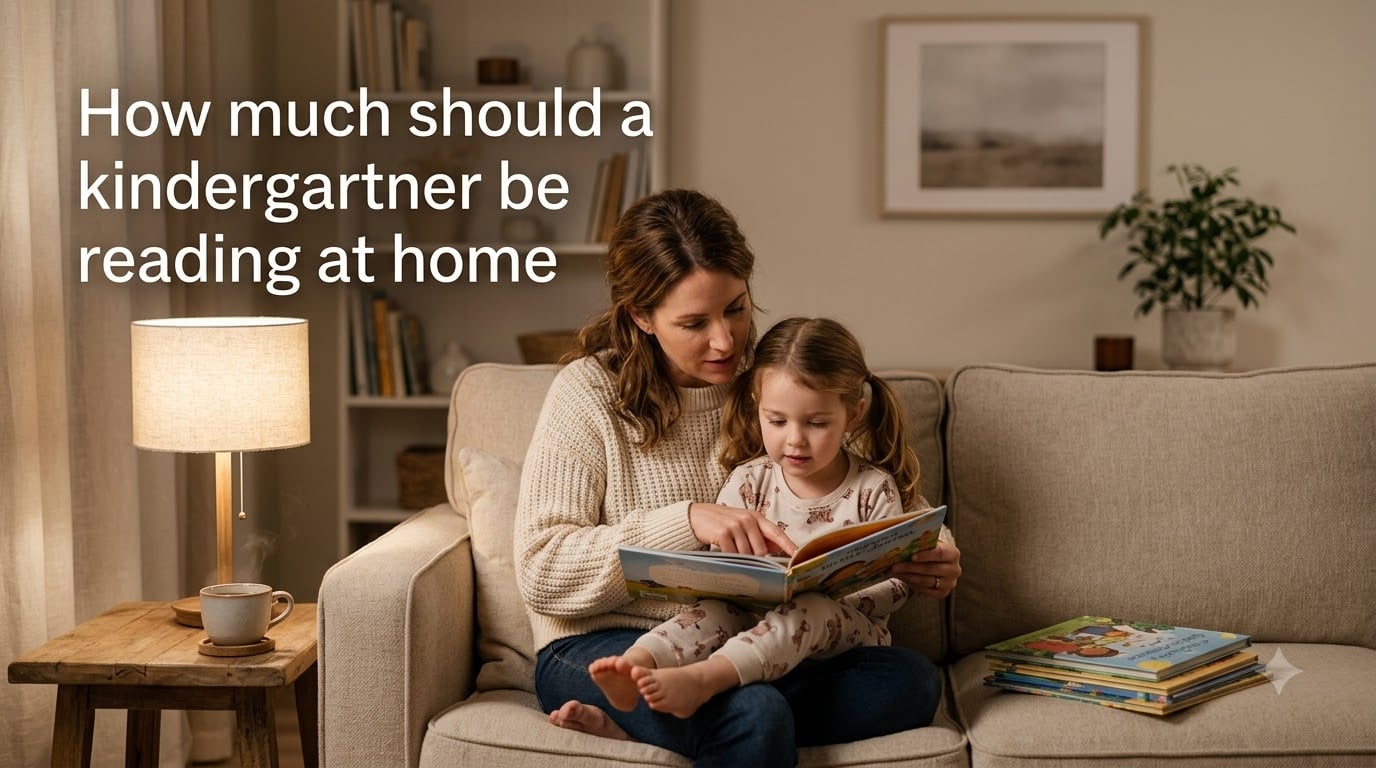
Parents ask us all the time how much should a kindergartner be reading at home, and the short answer is this: most kindergartners benefit from about 10 to 20 minutes of reading practice on 4 to 5 days each week, paired with daily read-aloud time.
That number covers a mix of independent reading, shared reading, and someone reading aloud to your child. The exact minutes matter far less than the consistency and the joy your child feels around books.
In this guide, our team walks you through what kindergarten reading expectations actually look like, how to read those reading levels A through D, what counts as a red flag versus normal variation, and the home routines that build a confident reader.
Table of Contents
What to Expect: Age-Appropriate Kindergarten Reading Expectations
Kindergarten reading expectations follow a fairly predictable arc across the school year, but the pace varies widely from child to child.
In the first weeks of kindergarten, most 5 year olds are still working on letter recognition and the sounds those letters make. By winter, they usually start blending those sounds into simple three letter words like “cat” or “sun.” By the end of kindergarten, many children read short sentences on their own.
Here is the rough progression we see across most classrooms.
Phase 1 (September to December): The Code Breaker. Your child learns the names of letters and the sounds they make. They start recognizing sight words like “the,” “and,” and “is.” Reading at this stage looks like sounding out a word slowly, one letter at a time.
Phase 2 (January to March): The Early Reader. Your child starts reading simple decodable books where most words follow phonics rules. They might read a page of 3 to 5 words on their own and feel proud of every sentence.
Phase 3 (April to June): The Emerging Reader. Reading fluency begins to click. Your child reads short picture books aloud, answers questions about the story, and starts building real reading stamina.
The single biggest point we want to reassure parents about is this: if your child is not reading chapter books by the end of kindergarten, that does not mean they are behind. Many kindergartners finish the year reading at Level C or D, which are beginner stages. The reading explosion that worried parents often expect usually happens in first and second grade.
Average age for reading fluency is around 7 years old, and most teachers will tell you that children who are not reading fluently by the end of first grade still catch up without long term problems when they get the right support.
Kindergarten Reading Benchmarks and Reading Levels Explained
End of kindergarten reading expectations vary by school district and curriculum, but several benchmarks appear in most classrooms across the country.
By the end of kindergarten, schools commonly expect children to know all 26 letter sounds, recognize somewhere between 50 and 100 sight words, and read at Level C or D on a guided reading scale. Some districts set the bar lower, others higher, depending on whether they follow Common Core, a state specific framework, or a phonics based program.
Here is what the reading levels A through D actually mean in practice.
Reading Level A: Children point to words, repeat familiar text from memory, and recognize a few sight words. Books have one short sentence per page with strong picture support.
Reading Level B: Children match spoken words to print, use picture clues, and read a growing list of sight words. Sentences grow to two lines per page.
Reading Level C: Children use phonics patterns to sound out simple CVC words like “cat,” “dog,” and “pig.” They read with some expression and self correct obvious errors.
Reading Level D: Children read short stories with multiple lines per page, tackle longer words using phonics strategies, and begin to read with fluency rather than word by word.
Reading Stage 3 Bob Books that you may hear about in parent forums falls in the C to D range. If your kindergartner is working through Stage 3 Bob Books, they are doing well.
Sight words deserve their own mention because they come up constantly in kindergarten reading expectations. Sight words are high frequency words like “the,” “was,” “said,” and “have” that young readers learn to recognize automatically. By the end of kindergarten, most children know 50 to 100 of these words, with the exact list depending on your child’s school.
You will also hear the term decodable books in kindergarten conversations. Decodable books contain words that follow phonics rules your child has already learned, which lets them practice reading independently. Pattern books are similar but include repeated sentence structures like “I see the cat, I see the dog, I see the pig.” Both formats support beginning readers, and most kindergarten classrooms use a mix.
How Much Should a Kindergartener Read a Day?
This is the question parents search for most often, and the gap our team noticed when reviewing top ranking content is that very few articles give a concrete number. So here is a clear, specific answer.
Most kindergarteners do well with 10 to 20 minutes of reading practice per day, spread across 4 to 5 days per week. That practice can take several forms.
Independent reading (3 to 5 minutes): Your child reads a familiar book aloud to themselves or to you. The goal is to build stamina and confidence.
Shared reading (5 to 10 minutes): You take turns reading pages or you read while your child follows along. This is where new sight words and tricky words get practiced.
Read aloud to your child (15 to 20 minutes): Above your child’s reading level, you read chapter books, picture books, or anything they love. This builds vocabulary, comprehension, and a love of stories far above what independent reading can do alone.
The single most valuable habit is being read to. A kindergartner whose parents read aloud to them every day for 15 to 20 minutes will often hear around 1 million more words per year than a child who is not read to. That exposure matters more for long term reading success than almost any other home activity.
Try not to count the minutes during a bedtime story. If your child is engaged and asking questions, the time investment is already paying off.
Normal Variation vs Red Flags: When to Pay Closer Attention
Reading variation in kindergarten is enormous, and most of it falls within the normal range. Here is what normal variation looks like, so you can stop worrying if your child fits one of these patterns.
One child in the same class reads Level D by April, another reads Level B, and a third is still sounding out most words. All three can be developmentally on track.
Children in dual language immersion programs often read later in English, which is normal and expected.
Summer birthdays, meaning children who just turned 5 when they started kindergarten, often take longer to hit reading milestones than classmates who are nearly 6.
Children with strong verbal skills sometimes read later because they are focused on meaning rather than sounding out words. This often resolves on its own.
Here are behaviors that are worth flagging to your child’s teacher rather than panicking about.
By the end of kindergarten, talk with the teacher if your child cannot recognize most letters by sight, struggles to hear rhyming sounds, avoids all books even when you read aloud together, has trouble following two step directions, or shows no interest in print of any kind.
None of these signs mean your child has a reading disability on their own. They simply mean your child’s teacher should know what you are seeing so they can adjust instruction or suggest a screening.
If you are seeing these patterns at home, ask your school about a reading screening. Most schools use brief assessments like DIBELS to check phonemic awareness, letter naming, and early decoding. A screening does not diagnose anything. It simply tells you whether more support would help.
How to Support Kindergarten Reading at Home Without Pressure
The home routines that build readers are simple, repeatable, and low stress. Our team put together the strategies that kindergarten teachers tell us work best.
Build a daily reading ritual. Pick a consistent time, like right after dinner or before bedtime, and read together for 10 to 20 minutes. The consistency matters more than the exact minutes.
Read books your child chooses. Even if it is the same Mo Willems book for the 47th night in a row. Re reading builds fluency and confidence, and your child will pick harder books when they are ready.
Talk about the pictures before you read the words. Before turning the page, ask “What do you think is happening here?” This builds comprehension and vocabulary without any pressure.
Play with sounds. Kindergarten reading is mostly about hearing sounds in words. Play games like “what word would I have if I change the ‘c’ in ‘cat’ to a ‘b’?” or clap out the syllables in family names. These build phonemic awareness, which is the single biggest predictor of reading success.
Keep decodable books around. Bob Books, the BOB Books series, and similar phonics based sets give children the satisfaction of reading a whole book on their own. A few at the right level in a basket on the couch is a low cost, high payoff setup.
Point out print in the real world. Read signs at the grocery store, sound out the menu at a restaurant, point out words on cereal boxes. Print awareness transfers from everyday life into reading confidence.
Skip the flashcards unless your child loves them. Sight word practice works, but not when it turns reading into a chore. If your child dislikes flashcards, find sight words in the books you already read together instead.
Talk to your child’s teacher. A quick monthly check in about how your child is doing in class is more useful than any home curriculum. Teachers see how your child compares to peers and can flag small issues early.
One last point on pressure: pushing a 5 year old to read before they are ready usually backfires. Children who associate reading with stress at age 5 often avoid reading at age 8. Keep it playful, keep it warm, keep it consistent, and your child’s reading will grow.
Frequently Asked Questions About Kindergarten Reading at Home
What reading level should a kindergartner be at?
Most kindergartners finish the school year reading at Level C or D on a guided reading scale. Level C means your child can sound out simple three letter words like cat and dog. Level D means they read short stories with several lines per page and begin reading with expression. Some children finish at Level B and are still completely on track.
What level should a 5 year old be reading at?
A 5 year old in the middle of kindergarten typically reads at Level B or C, which means they recognize many sight words and can sound out simple CVC words with some help. By the end of kindergarten, most 5 year olds are working toward Level C or D. Children who turn 5 in the summer often hit these milestones a bit later than older classmates, which is normal.
Is it normal for a kindergartner to not read?
Yes, it is completely normal for a kindergartner to not read independently yet. Many children finish kindergarten reading simple one or two word phrases rather than full sentences. Average age for reading fluency is around 7 years old, so most kindergartners are still building the foundation skills like letter sounds and phonemic awareness that lead to real reading in first and second grade.
How much should a kindergartener read a day?
Most kindergarteners do well with 10 to 20 minutes of reading practice on 4 to 5 days per week. This can be split between independent reading, shared reading where you take turns, and being read aloud to. Being read aloud to for 15 to 20 minutes a day is one of the most effective home reading habits at this age.
You Have Everything You Need to Support Your Kindergartener
Here is what we want you to take away about how much should a kindergartner be reading at home in 2026: aim for 10 to 20 minutes of practice most days, build a daily read aloud ritual, and trust that variation is normal.
Your child does not need to finish the year as a fluent reader. They need consistent, joyful exposure to books and a parent who reads with them, not at them. Keep it warm, keep it consistent, and your kindergartener’s reading will grow on its own timeline.