
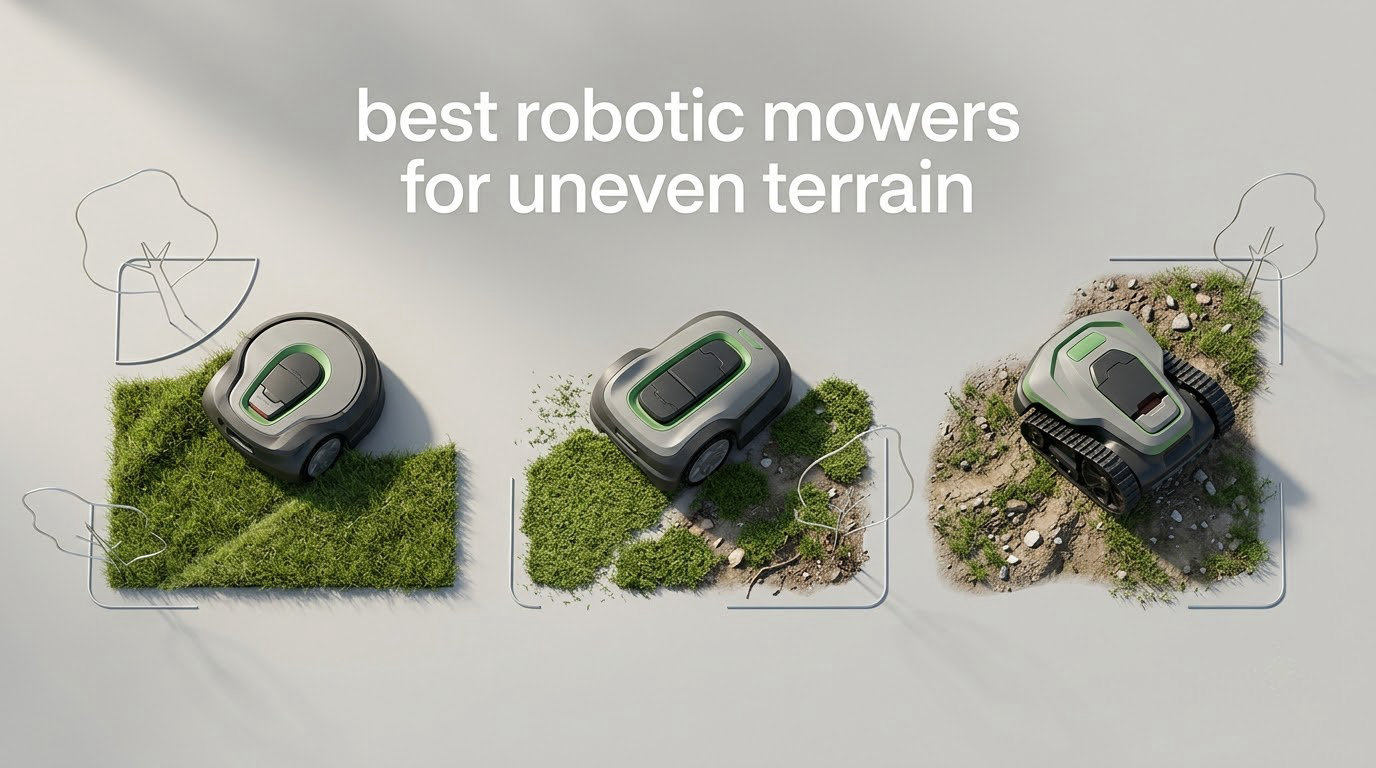
Flat lawns make robot mowers look interchangeable. The moment your yard tilts, dips and grows tree roots, the differences that actually matter come down to slope rating, drive type and ground clearance, and almost nobody publishes a straight answer. That gap is why so many owners end up replacing a machine that spent its life stuck in a rut.
Our team spent 2026‘s mowing season working through the specs, owner reviews and failure reports for twelve robotic mowers designed for uneven terrain, then ranked them on the only things that matter when the ground is not a billiard table. The winner is the Mammotion LUBA mini 2 AWD 1500H, which pairs an 80% slope rating with adaptive suspension that steps over 45 mm of curb or root. If your yard is smaller and your ground is only moderately lumpy, there are quieter and cheaper answers, and we name those too.
Below you will find the full list in order, a side-by-side comparison, and the measuring and preparation steps that decide whether a robot mower is right for your lawn at all. We also flag the yards where a robot is the wrong purchase, because no machine on this list will handle a rock field or a cliff edge, no matter what the box claims.
Table of Contents
Quick Picks: The 3 Best Robotic Mowers for Uneven Terrain in October 2026
The LUBA mini 2 AWD 1500H is the best overall pick for uneven terrain because it is the rare machine that pairs an 80% slope rating with real suspension travel, a 360° LiDAR plus dual-camera navigation stack, and enough owner history to judge it fairly. It handles ditches, holes and root fields that stop lighter machines in their tracks.
For large rough properties, the Mammotion LUBA 3 AWD 3000 covers up to 500 square metres per hour with four independent motors and 50 mm of step-over clearance, and it runs a LiDAR plus NetRTK plus vision fusion stack that holds position under big trees. For the steepest lots, the WORX WR342 carries the highest slope rating in this group at 84%, needs no antenna and no subscription, and steers with a real front wheel instead of skidding.

Mammotion LUBA mini 2 AWD…
- 80% slope rating
- 45mm adaptive suspension
- 360-degree LiDAR plus dual cameras

All 12 Robot Mowers Compared Side by Side in October 2026
Every mower below is wire-free, meaning you map a virtual boundary in the app instead of stapling a perimeter wire to the ground. Slope percentages are manufacturer claims; the practical grade a machine can hold often runs lower, which is why we read the owner reviews alongside the spec sheet. Coverage is the manufacturer’s maximum lawn size.
| Product | Specs | Action |
|---|---|---|
| Mammotion LUBA mini 2 AWD 1500H |
|
Check Latest Price |
| Mammotion LUBA 3 AWD 3000 |
|
Check Latest Price |
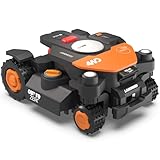
| WORX WR342 4WD |
|
Check Latest Price |
 Segway Navimow i206 AWD Segway Navimow i206 AWD |
|
Check Latest Price |
 Segway Navimow i215 LiDAR Segway Navimow i215 LiDAR |
|
Check Latest Price |
 Sunseeker X5 AWD Sunseeker X5 AWD |
|
Check Latest Price |
 ANTHBOT M5 ANTHBOT M5 |
|
Check Latest Price |
 Dreame A3 AWD 2000 Dreame A3 AWD 2000 |
|
Check Latest Price |
 Segway Navimow i105N Segway Navimow i105N |
|
Check Latest Price |
 ECOVACS GOAT O1000 LiDAR PRO ECOVACS GOAT O1000 LiDAR PRO |
|
Check Latest Price |
 Roborock RockNeo Q110H Roborock RockNeo Q110H |
|
Check Latest Price |
 Mammotion LUBA 2 AWD 3000HX Mammotion LUBA 2 AWD 3000HX |
|
Check Latest Price |
One column deserves a word of caution. Three machines here carry a 45% slope rating, but one of them, the Segway Navimow i105N, is a two-wheel-drive unit whose owners describe a practical limit closer to a 10-degree grade with the standard wheels. Slope ratings are not interchangeable between drive systems, and that is exactly the trap that strands people in a rut.
1. Mammotion LUBA mini 2 AWD 1500H: The Best Robot Mower for Uneven Terrain Overall
(2026 NEW) Mammotion LUBA mini 2 AWD 1500H Robot Lawn Mower with Garage, for 0.37 Acres, 360° LiDAR+Dual-Camera AI Vision, 80% Slope, DropMow, 20 Multi-Zone Management
80% max slope
Two 88W motors
45mm adaptive suspension
0.37 acre
7.9 inch cut
Pros
- Takes extreme slopes
- ditches
- holes and tree roots
- Accurate GPS and RTK boundary tracking
- Quiet enough to run at night
- Dual discs with app height control
Cons
- 0.37-acre mapping cap is a hard limit
- Slow mowing speed
- Two to three hour charge time
This is the machine I would put on the roughest lawn in this roundup. Two independent 88W motors drive all four wheels, and the manufacturer rates it for an 80% climbing grade, which is steep enough to cover most residential hillsides and drainage swales. More important than the headline number is the adaptive suspension, which steps over curbs, roots and thresholds up to 45 mm.
Owners describe it mowing 80% slopes, rough lawns and root-filled ground without drama, and several describe multi-season reliability. That combination of a genuine terrain rating and a real review history is rarer than it should be in this category, where most listings have fewer than 50 reviews.
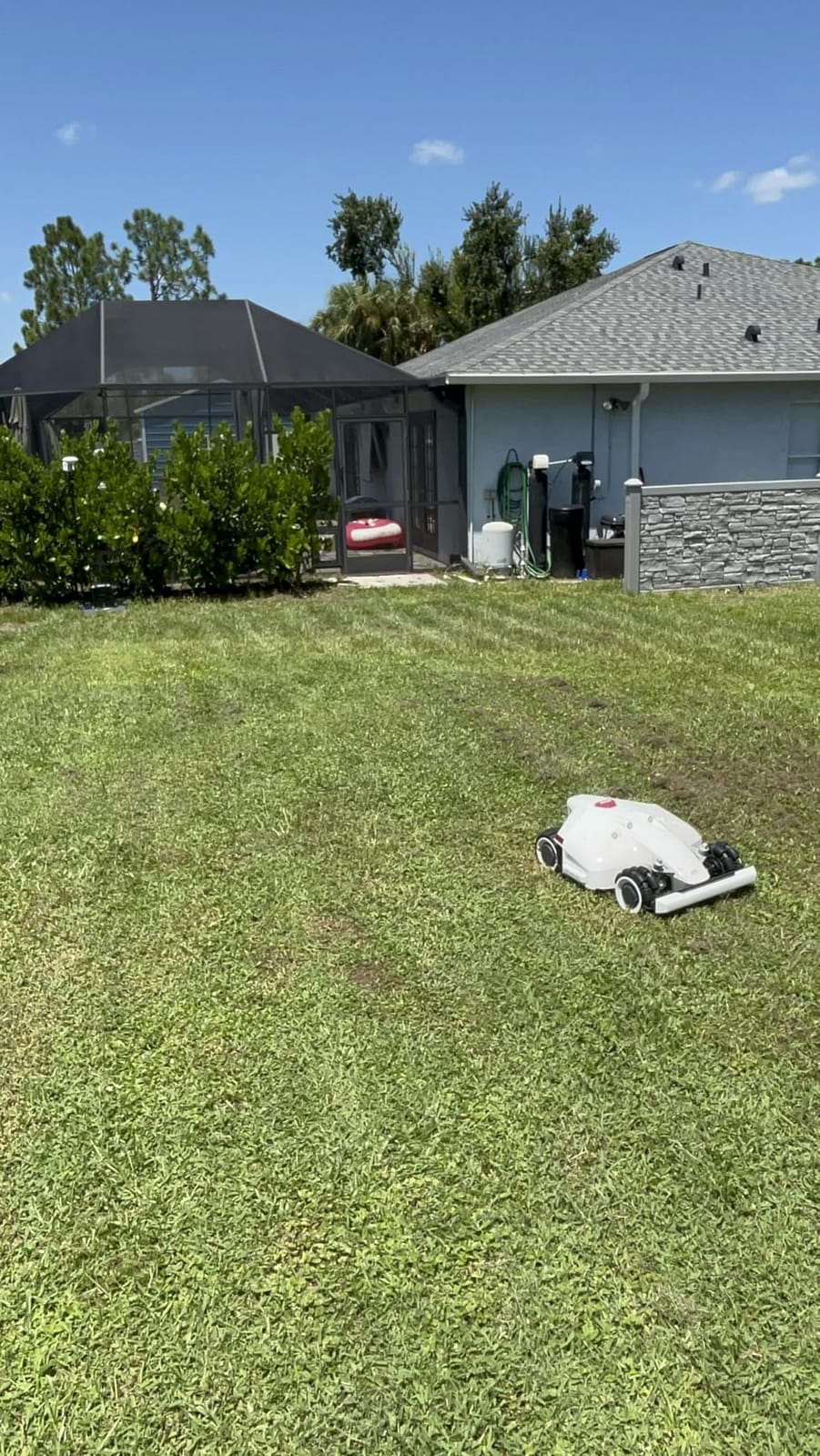
Navigation is a 360° LiDAR with a 45-degree field of view backed by dual-camera AI vision, so it keeps working when satellite signal is poor. It carries up to 20 independent mowing zones and covers roughly 350 square metres per charge, with dual cutting discs that let you set height from 2.2 to 4 inches in the app.
There is a mapping-free DropMow mode if you would rather not draw boundaries at all, and smart charge limits let you hold the machine on a charger during peak electricity hours. For a yard with awkward islands and a slope that worries you, that flexibility matters.
Who the LUBA mini 2 suits
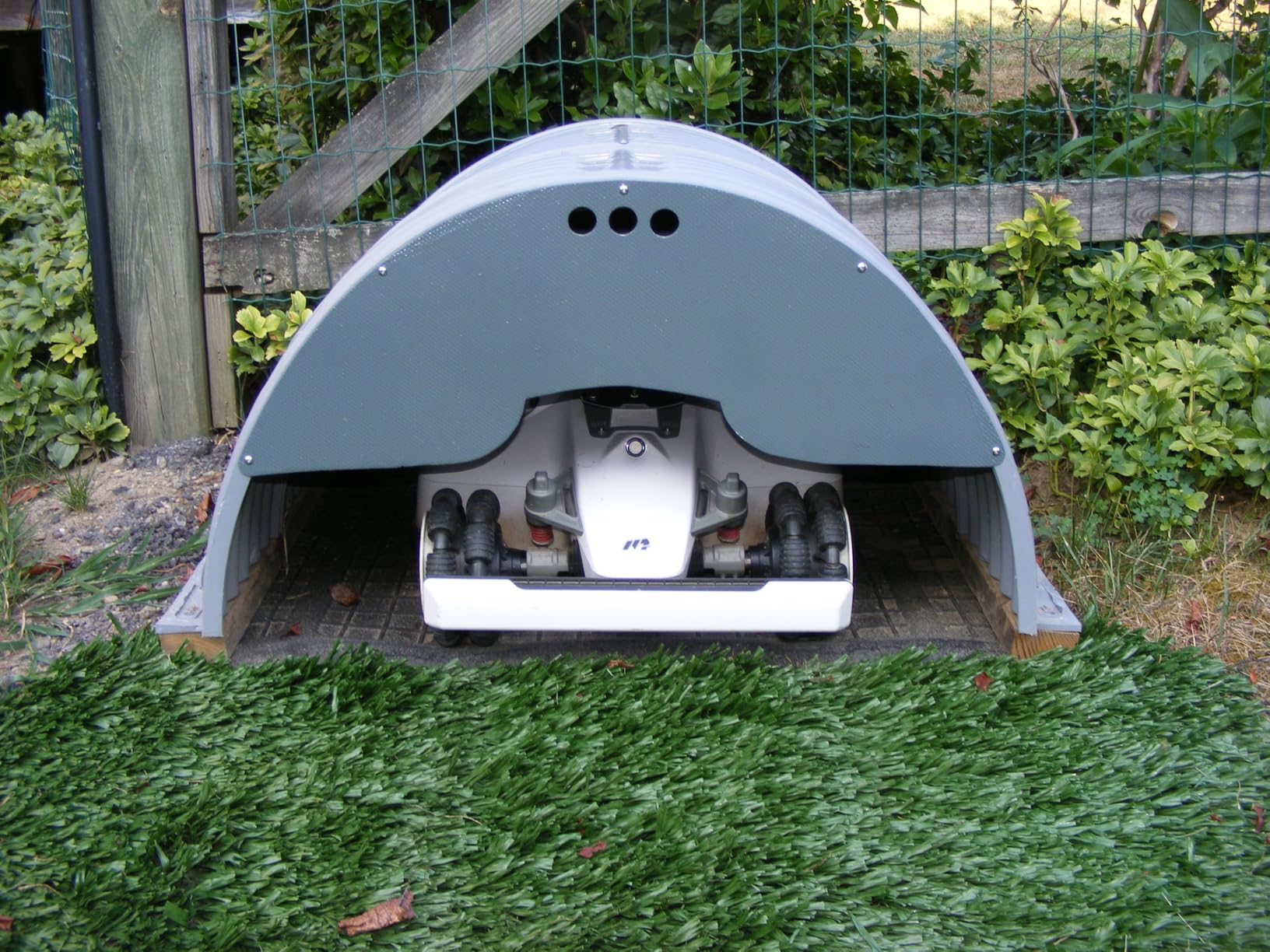
It suits owners of hilly, rocky, rooty yards up to about a third of an acre who currently dread the walk-behind. Multiple owners of properties with ditches, holes and exposed roots report that other robot mowers would not manage the same ground, and the 45 mm step height is the specific reason. The app height range of 2.2 to 4 inches suits anyone who lets grass get long in summer.
Where it falls short
The 0.37-acre map cap is a real ceiling, not a soft target, so a larger property means multiple machines or a different pick. Mowing speed is slow enough that a quarter acre can take most of a day, and charging from 13% to full takes two to three hours, which means the machine is parked for a large part of each cycle. Map editing in the software is awkward, with changes often requiring a re-walk of the boundary, and edges still need occasional manual weedeating.
2. Mammotion LUBA 3 AWD 3000: Best for Large Rough Yards
Mammotion LUBA 3 AWD 3000 Robot Lawn Mower with Cleaning Stand (Ship Separately), 360° LiDAR+NetRTK+AI Vision, AWD for 80% Slopes, 5400 sq.ft/h, Cutting Height 1.0″-2.7″
80% max slope
Four independent motors
50mm step-over
500 sq m per hour
15.7 inch cut
Pros
- Very quiet with a night light
- LiDAR holds position under large trees
- Handles irregular thick turf without getting stuck
- Nimble app-based manual control
Cons
- Battery may not finish a quarter acre in one charge
- Weak online manual
- App map-building hard to use in sunlight
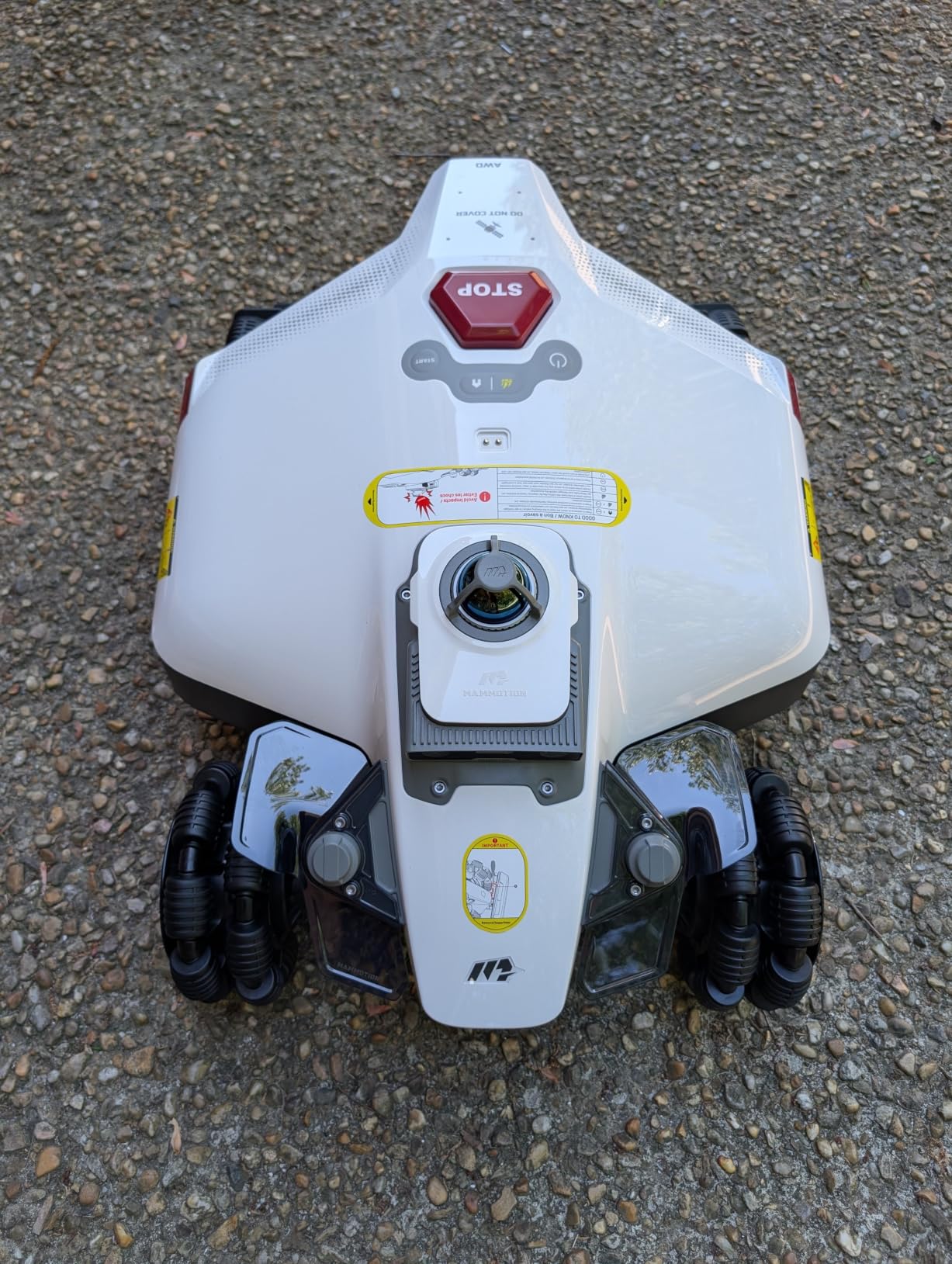
Where the LUBA mini 2 is a machine for one large third of an acre, this one is built for properties well beyond that. It covers up to 500 square metres per hour with a 15.7-inch cutting width, and four independent motors give it an 80% slope capability rated at 38.6 degrees. Adaptive suspension clears curbs, roots and thresholds up to 50 mm, the highest step height in this group.
Navigation is what separates it from most rivals: a 360° LiDAR with scanning range up to 230 feet, combined with NetRTK positioning and dual-camera AI vision. In practice owners credit the LiDAR with holding position under large trees where satellite-only machines wander or stop, and several describe the result as a set-it-and-forget-it machine.
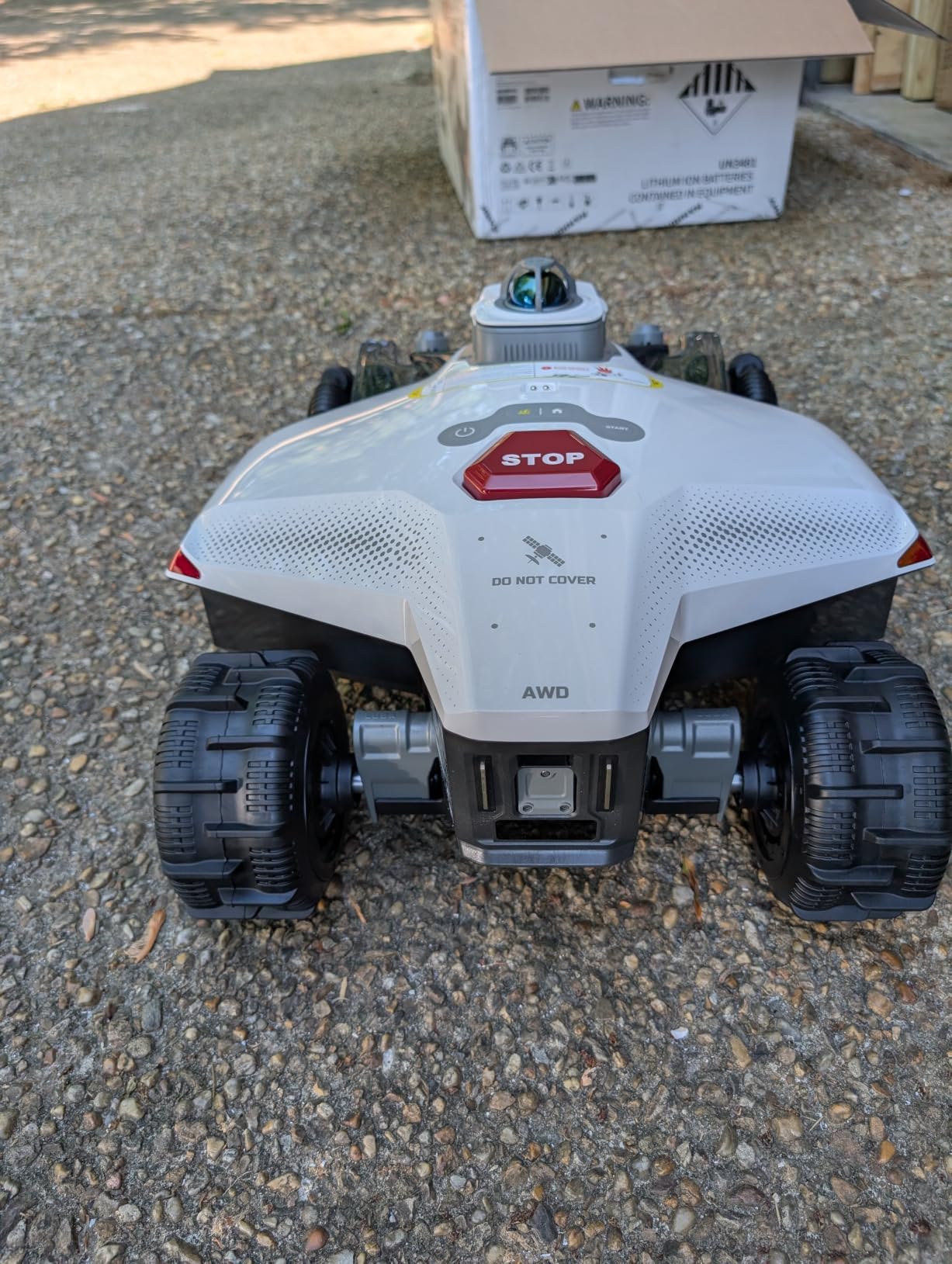
Two 165W high-torque motors drive six-blade discs, a 12Ah battery runs up to 175 minutes per charge, and the app manages up to 30 mowing zones with no-go areas, more than 300 recognised obstacle types, a rain sensor and LTE backup. The cutting height runs from 1.0 to 2.7 inches, which suits warm-season lawns better than tall cool-season grass.
Running costs are described as negligible compared with a gasoline machine, and the near-silent operation with a built-in night light is one of the most repeated positives in the reviews. Owners also like the manual control through the app, which is useful for nudging the machine out of a corner or back onto the dock.
Who the LUBA 3 suits
It suits owners of a full acre or more with hills, or anyone who wants a rough-terrain machine they will not have to replace in three seasons. If your problem is coverage rather than difficulty, this is the one. Buyers with irregular thick turf and many zones report that it works through them without getting stuck, and the 300-plus obstacle recognition is reassuring in a yard with toys, pets and garden furniture.
Where it falls short
At non-default settings the battery may not finish even a quarter-acre lawn in one charge, so you should expect a mid-cycle dock on larger areas. The blade stops during turns, which means extra perimeter passes for clean edges. Documentation is weak, so expect to rely on video tutorials, and the app map-building tool is difficult to use in bright sunlight. Some owners also report WiFi reconnection after firmware updates, and the cleaning stand is a separate item from the mower.
3. WORX WR342: Best for Steep Slopes
WORX Robot Lawn Mower 4WD for 1/2 Acre, No Perimeter Wire, WR342
84% max slope
4WD terrain-adaptive chassis
RTK Cloud with no antenna
8.7 inch cut
3-year warranty
Pros
- Traction on 20 to 30 degree hills
- No antenna and no cloud subscription
- Whisper-quiet and neighbour-approved
- Handles thick St. Augustine grass
- Solid weighted build
Cons
- Needs a dedicated 2.4 GHz WiFi network
- Clumsy app map editing
- No headlight in the US version
- Weeds read as obstacles
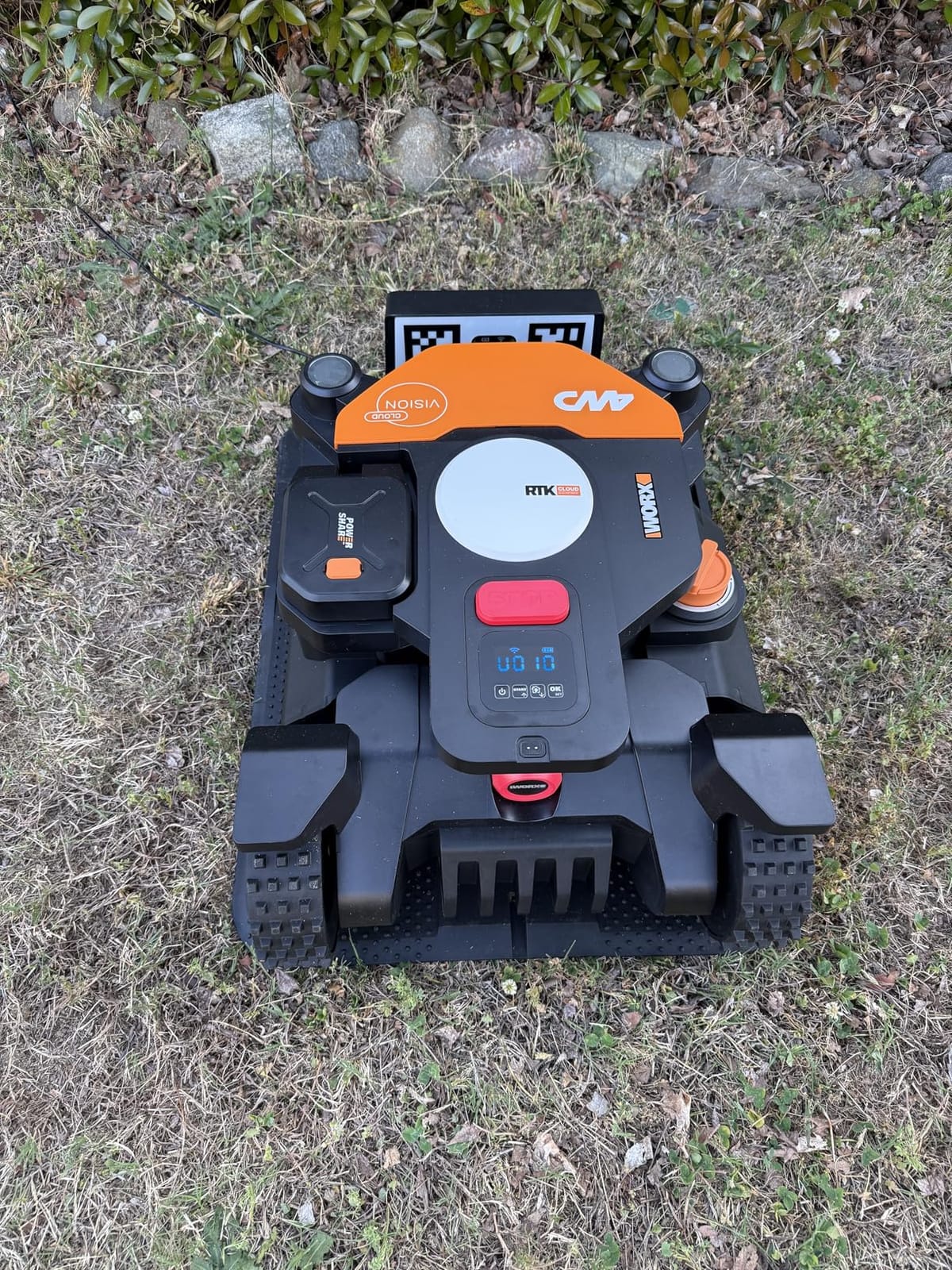
The WR342 carries the highest slope rating in this group at 84%, roughly 40 degrees, on a 4WD terrain-adaptive chassis. Owners who replaced a ride-on mower on a 20 to 30 degree hill describe the change as the difference between mowing the hill and avoiding it. It also cuts thick St. Augustine grass without bogging down, which is a real test of torque on an incline.
Unlike most competitors, it needs no local RTK antenna to install. RTK Cloud positioning runs off the network, and WORX states there is no cloud subscription attached, which removes both an installation step and a recurring line item. V-SLAM sensor fusion takes over in shaded or covered areas where satellite signal degrades.
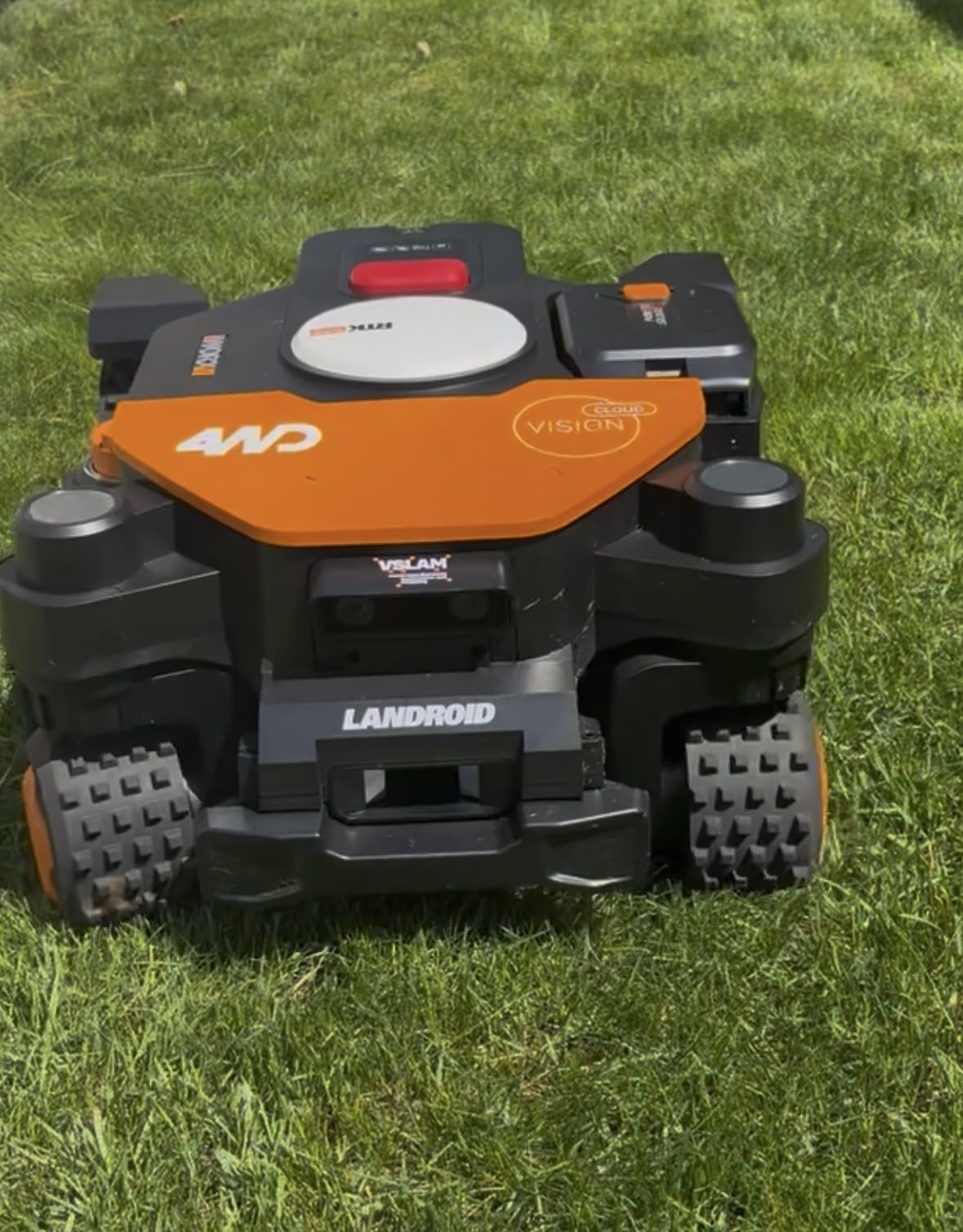
Two details stand out on rough ground. True front-wheel steering means the machine turns without dragging the rear wheels across the turf, which is what causes the torn, scraped grass that owners complain about on skid-steer designs. And a cut-to-zero offset blade cuts close to the border, reducing the strip that a string trimmer has to handle later. The deck is 8.7 inches wide with a cutting height range of 1.57 to 3.54 inches.
Coverage is for lawns up to half an acre. Security comes through Find My Landroid GPS tracking, and the warranty is three years, which is longer than most rivals in this list offer.
Who the WR342 suits
It suits owners with genuinely steep ground, narrow side yards, or a neighbourhood where noise matters, since several owners mention neighbours as part of why they chose it. It is also a good fit for anyone in a warm-climate region with thick St. Augustine turf that stalls lighter machines. The absence of an antenna and any cloud fee makes setup unusually simple for a machine in this class.
Where it falls short
It needs a dedicated 2.4 GHz WiFi network, and some owners had to update firmware before the machine would behave, which is friction at the worst possible moment. App map editing and manual driving controls are described as clumsy, with no easy way to split zones. The US version has no headlight, so it returns to base early at dusk. The vision system treats dandelions and tall weeds as obstacles and circles them, which means extra passes. And with only 17 ratings on record, the long-term evidence here is thin compared with the picks above.
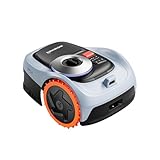
4. Segway Navimow i206 AWD: Best All-Wheel Drive for a Smaller Yard
Segway Navimow i206 AWD Robot Lawn Mower, New i105N, 0.15 Acre, 45% Slopes
45% max slope
All-wheel drive with stability control
Zero-turn steering
17 inch deck
20 mowing zones
Pros
- AWD handled terrain that defeated two previous mowers
- Very quiet
- Zero-turn steering avoids torn turf
- Auto-levels for an even cut on slopes
- Handles oddly shaped yards
Cons
- Auto-mapping can fail and manual zoning is tedious
- Can stick in undulations on new sod
- Works around tall grass clumps for several passes
- In-app support reported as poor
The i206 AWD is the interesting middle of the Navimow range. It drops the capacity to about 0.15 acre but adds all-wheel drive with automotive-grade stability control for slopes up to 45%, which is roughly double what the cheaper two-wheel-drive Navimow manages in real conditions. Owners upgrading from 2WD machines say AWD genuinely changes what terrain can be mowed.
Its 17-inch cutting width is the widest in this roundup, and that width matters on uneven ground because fewer passes means fewer times crossing a rut at an awkward angle. Cutting height adjusts from 2 to 6 centimetres. A 2.5Ah battery covers up to 1,350 square feet per charge, and the app supports up to 20 mowing zones with real-time GPS alerts if the machine is lifted or wanders.
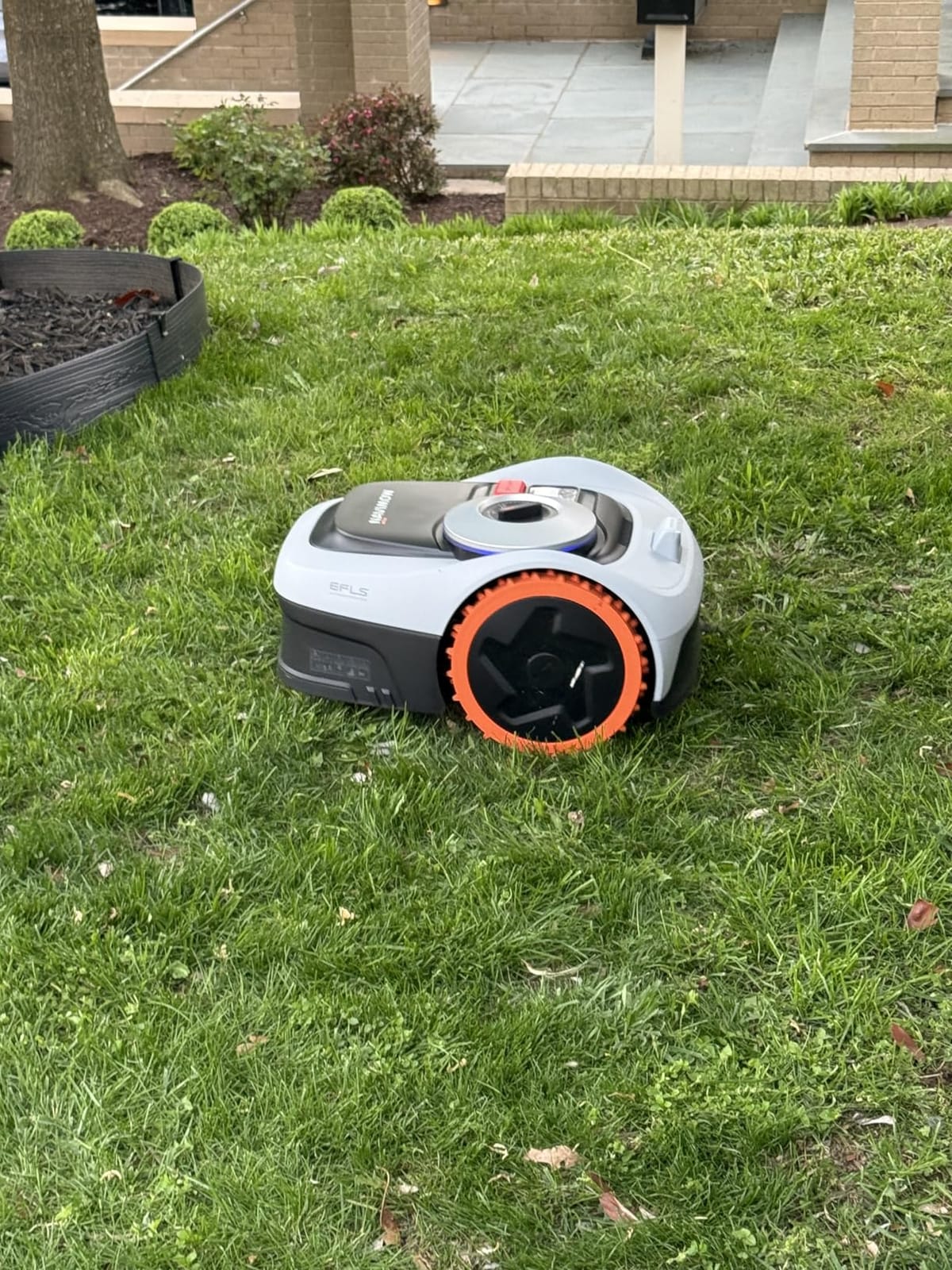
Zero-turn steering is the feature owners praise most after traction itself, because pivoting in place does not scrape or tear turf the way a skid turn does. Adaptive torque delivery adds power on inclines and in thick grass while backing off on easy passes, and the machine auto-adjusts its angle to give an even cut across sloped areas.
Navigation is EFLS Network RTK combined with Vision for one-tap auto mapping at centimetre-level accuracy, with no boundary wire. Buyers with complex, oddly shaped yards report good results, and one owner notes their dogs are not bothered by the noise level.
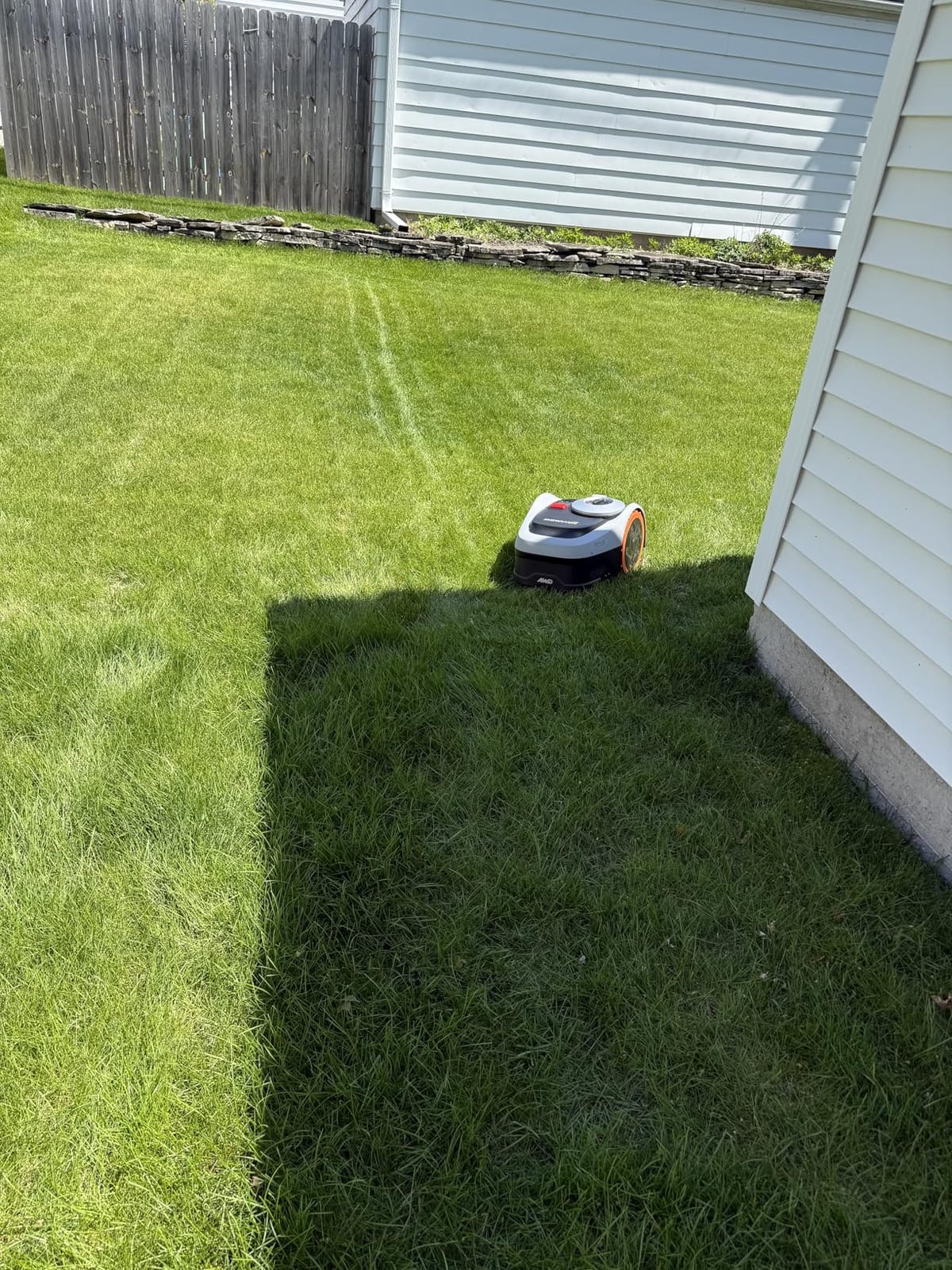
Who the i206 AWD suits
It suits owners with a compact but awkward lawn, maybe a third of an acre with a slope and several beds, who want four-wheel drive without stepping up to a machine covering half an acre or more. Zero-turn steering also makes it a good choice for lawns with many sharp corners and obstacles, since there is no swept path to worry about. For anyone who mows beside sleeping neighbours or nervous dogs, the quiet operation is a genuine benefit.
Where it falls short
Auto-mapping is the weak point. It can fail outright, and walking zones manually is tedious enough that owners look forward to it. It can also catch in the undulations of brand-new sod and stray into mulch beds, and tall isolated grass clumps get circled for several passes. Some fences retain an unmowed swath. In-app customer support has been reported as poor, which matters if you need help mid-setup.
5. Segway Navimow i215 LiDAR: Best When Satellite Signal Is Weak
Segway Navimow i215 LiDAR Robot Lawn Mower, Wire Free Robotic Lawn Mower for 0.37 Acre, LiDAR & Vision Dual Fusion, Auto Mapping, Off-Road Wheels for 45% Slopes, Quiet 59 dB(A) Mowing
45% max slope
Off-road wheels with stability control
Solid-state LiDAR plus vision
59 dB(A)
32.4 pounds
Pros
- Off-road wheels handle 45% grades as claimed
- Works without satellite signal day or night
- Quiet at 59 dB(A) with strong theft protection
- EdgeSense gives a clean cut along fences
- One-tap auto mapping with no wire
Cons
- Small review base limits long-term evidence
- Cut height maximum exceeds what most owners need
- Heavy for manual repositioning
For a yard under heavy tree cover, beside tall fences, or at the end of a drive where cell service is unreliable, the i215 solves the problem that trips up GPS mowers more than terrain does. It runs on solid-state LiDAR with onboard vision, so it navigates without any satellite signal at all, day or night, and the map lives on the machine rather than in the cloud.
Terrain handling comes from off-road wheels paired with Electronic Stability Control for slopes up to 45%. A 100W motor drives a six-blade disc with a 7.1-inch cutting width, and height adjusts from 2 to 4 inches. The drive is a 100W unit, so this is a machine for a lawn up to about 0.37 acre rather than an acreage property.
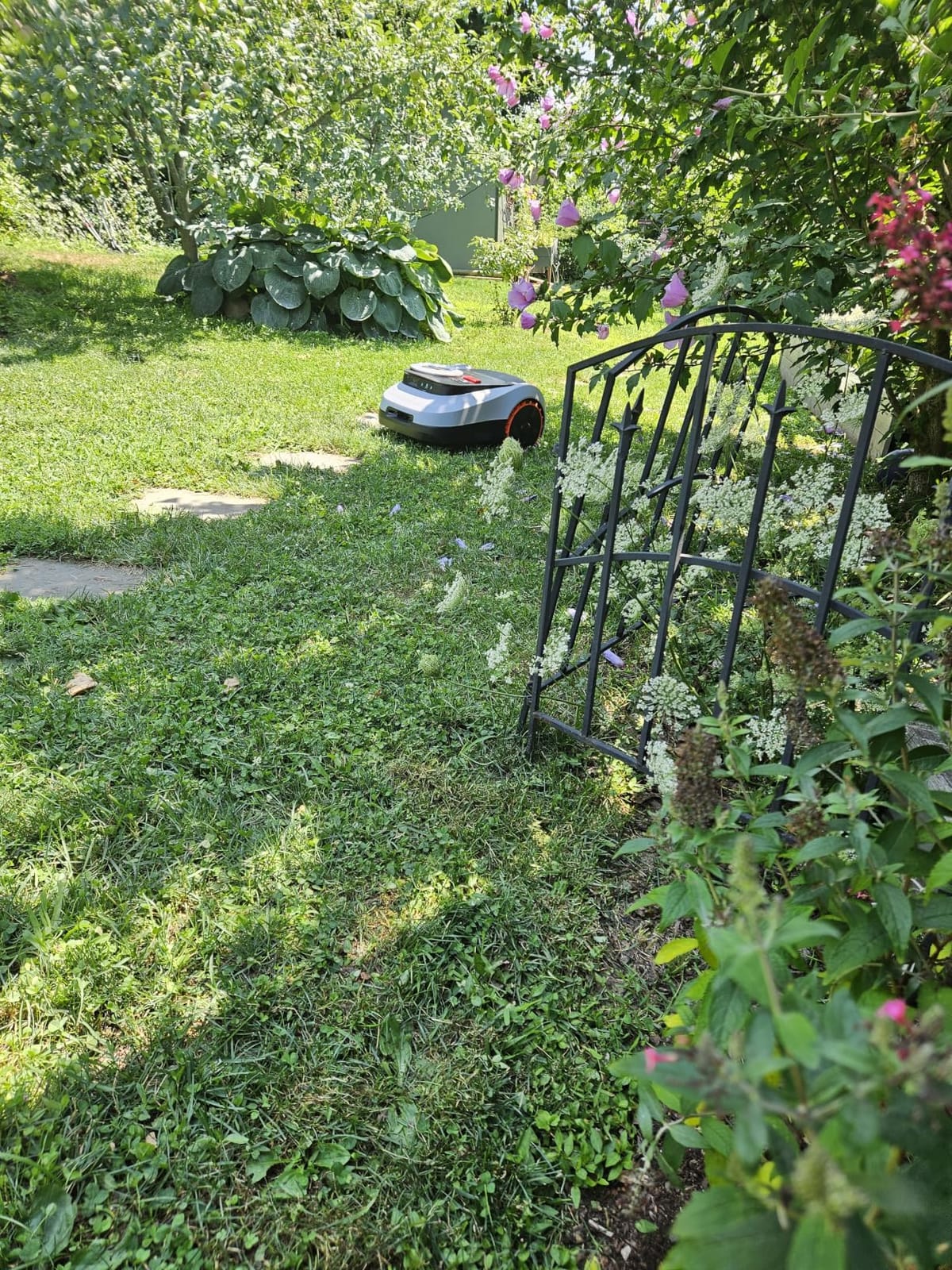
AI VisionFence detects more than 200 obstacle types at 0.4-inch accuracy, which is finer than most competing vision systems. The app supports up to 20 mowing zones with interactive map editing, meaning you can adjust boundaries on screen rather than re-walking the lawn, and the ride-on EdgeSense module gives a noticeably clean cut along fences and pathways.
Security is unusually thorough for this class: GPS, geo-fence, lift detection, Apple Find My alerts and automatic docking in extreme weather. Operation is rated at 59 dB(A), quiet enough to schedule at night.
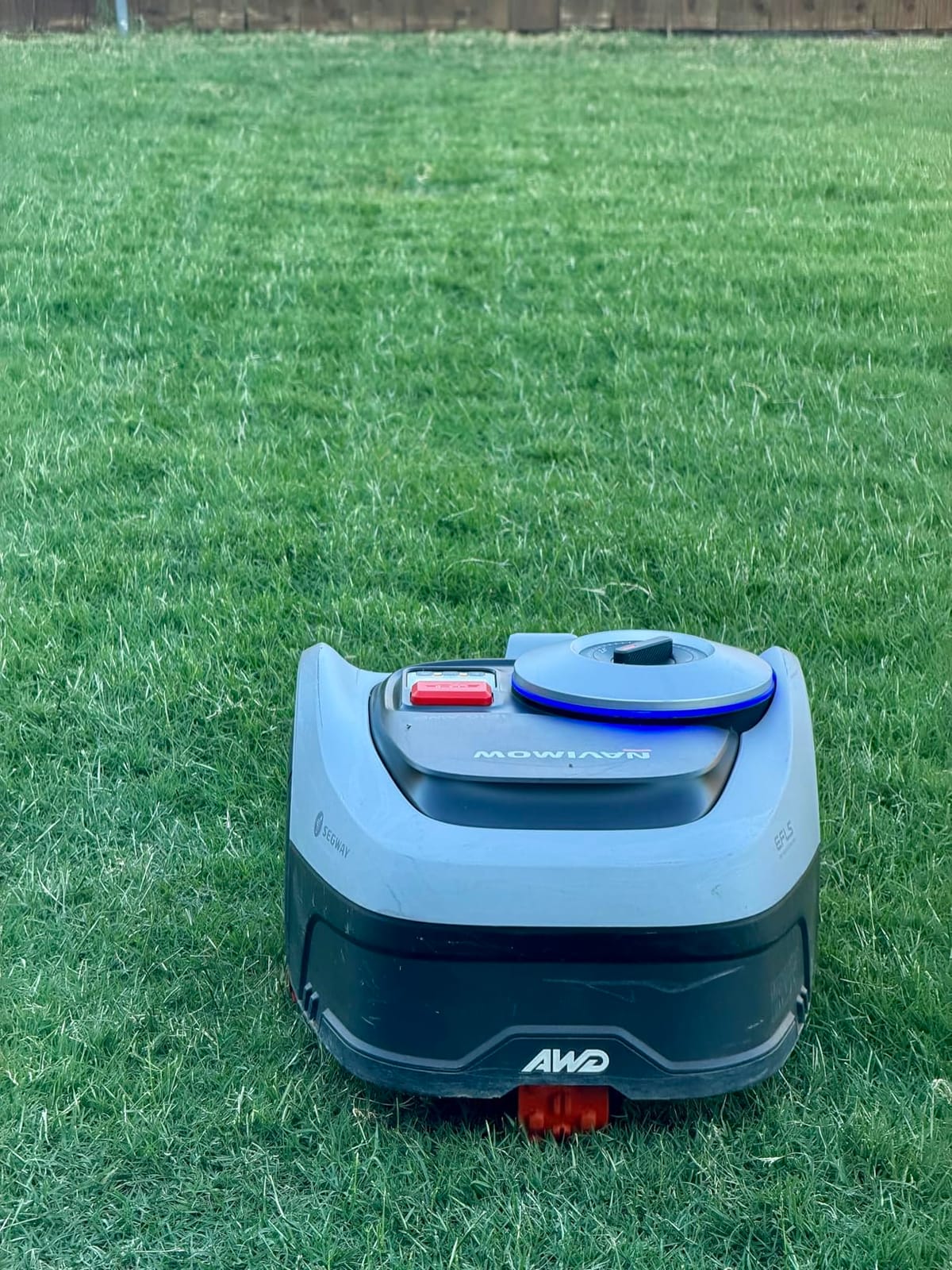
Who the i215 suits
It suits owners whose yard is a shaded hollow under a canopy, or a property where the previous wireless mower kept losing its place. It is a sensible pick for a lawn with a lot of fence line, since the edging module shows up in the reviews as a visible improvement. Anyone who wants navigation that does not depend on a cloud service will appreciate the satellite-free LiDAR approach. Off-road wheels and stability control also make it a solid choice for a 45% grade.
Where it falls short
The main limitation is evidence, not performance. With 46 ratings, long-term durability is less well documented than for the Navimow i105N or i206 AWD, and a 4.4 average from a small sample deserves less weight. The 4-inch maximum cut height goes well beyond what most owners need, so you will rarely use the top of the range. At 32.4 pounds it is also the heaviest machine here, which you will feel if you need to reposition it manually or carry it over a step.
6. Sunseeker X5 AWD: Best for Custom Mowing Patterns
Sunseeker X5 AWD Robot Lawn Mower, RTK, Vision AI, 0.5 Acre, Wire-Free
60% max slope
All-terrain AWD
Floating 8.7 inch cut
1.6 to 3.2 inch height
2-year warranty
Pros
- AWD traction on hilly backyards
- Holds position under trees and shade
- Perfectly straight striping with numbers and symbols
- Easy setup and app control
- Large capacity for a half acre
Cons
- Can catch on slight bumps and grass-to-sidewalk humps
- Needs WiFi extenders on larger properties
- Tall grass is treated as an obstacle
- About 18 inches of edge needs manual trimming
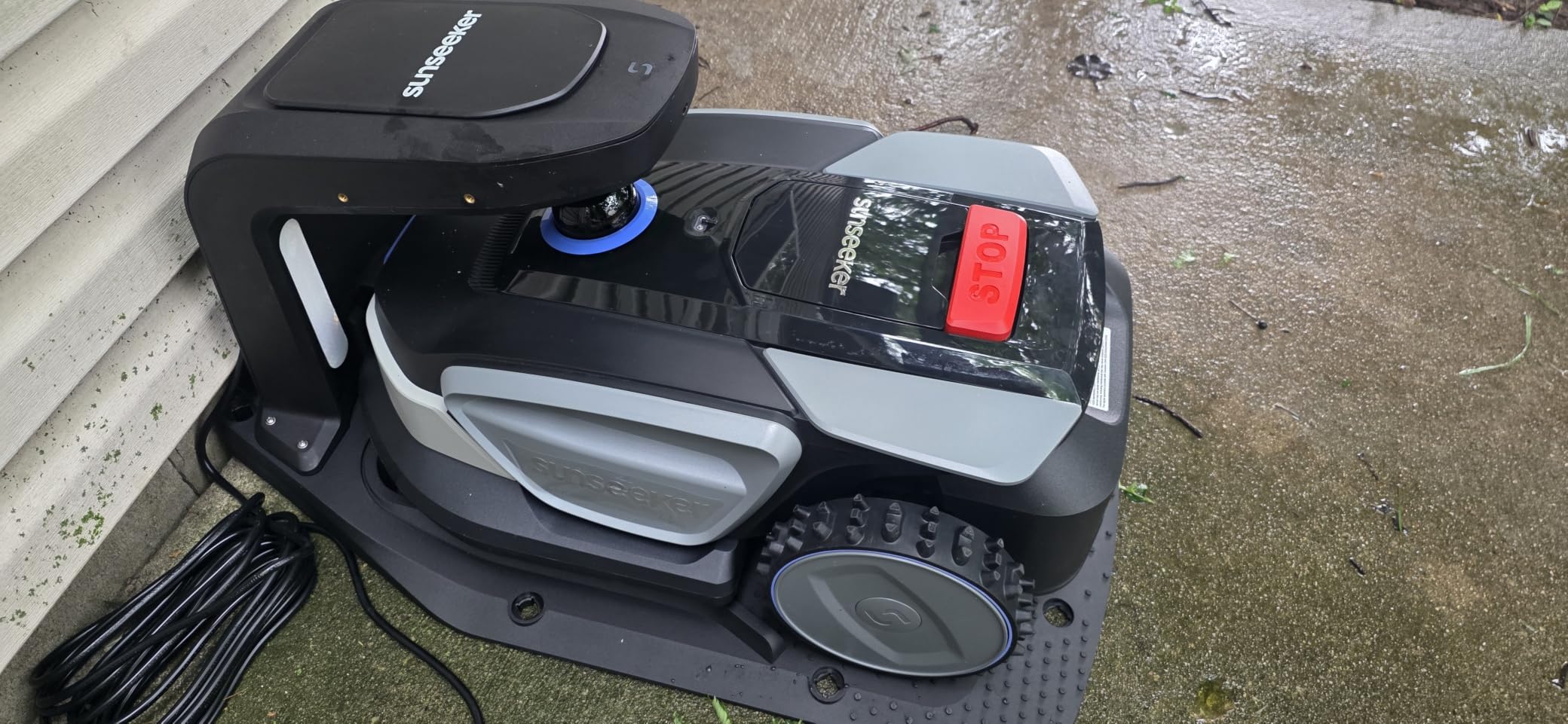
The X5 AWD is the one to consider if the mowing pattern matters to you. Owners specifically praise the straight striping and the ability to cut numbers and symbols into the lawn, which is a niche request that very few machines in this class handle well. The 8.7-inch floating cut follows ground contours, so on a slope the blade height stays relative to the soil rather than to the frame.
Its all-terrain drivetrain uses rugged tires and independent front suspension, rated for slopes up to 30 degrees or 60%, putting it between the 45% machines here and the 80% extreme-slope models. Navigation is RTK combined with V-SLAM and Vision AI, which owners say holds coverage under trees and in weak RTK areas. Coverage runs to about 21,780 square feet.
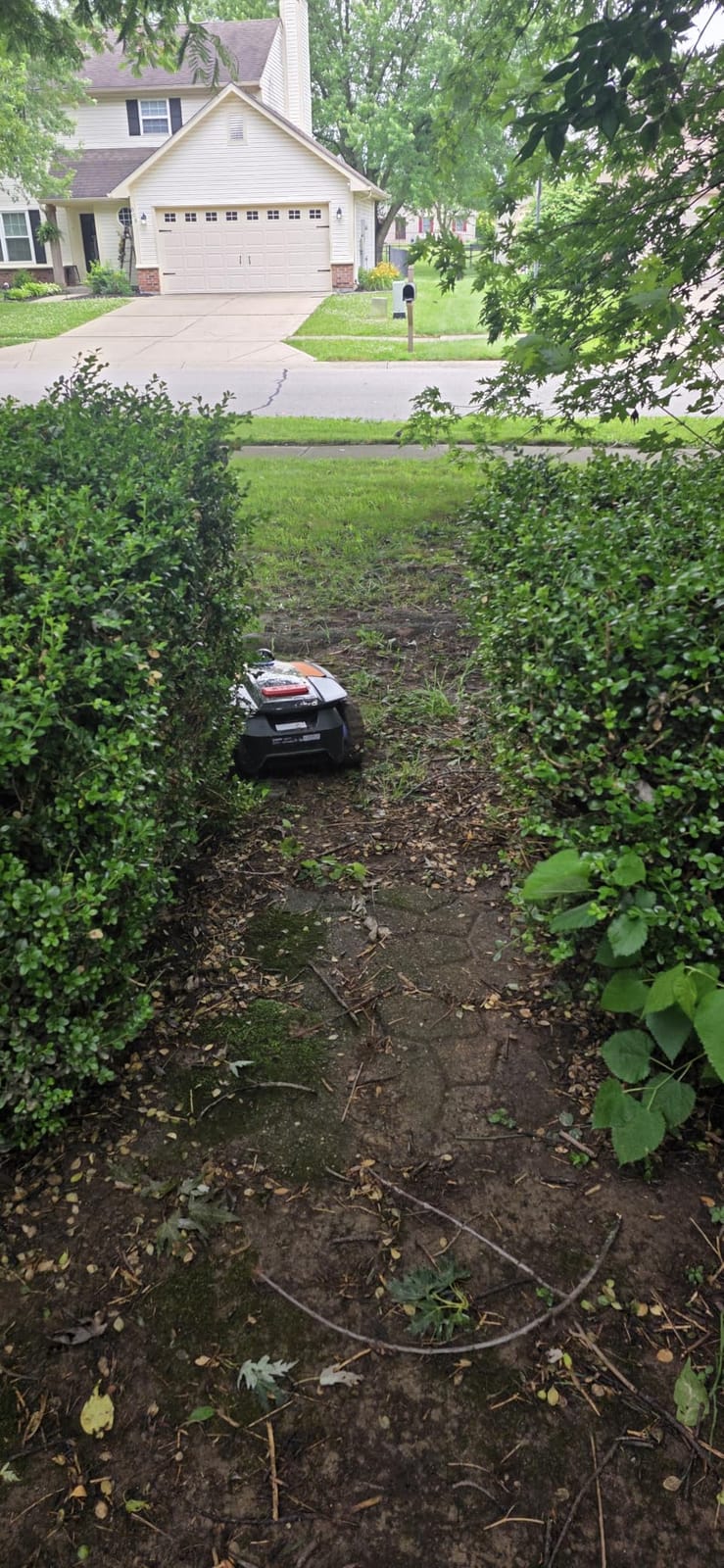
Other useful details: up to five separate maps, virtual boundaries, smart zones and no-go areas, and the ability to pass through 31.5-inch passages, which covers the narrow corridors between raised beds that some machines cannot enter. Operating noise is rated at 60 dB, and cutting height adjusts from 1.6 to 3.2 inches. The warranty is two years with US-based support.
At 26 pounds it is light enough to reposition by hand, which matters on a rough lawn where you may need to lift it once in a while.
Who the X5 AWD suits
It suits owners of a hilly half-acre backyard who care how the lawn looks when it is done, and it is the pick here for a property with several separate lawn areas since it stores up to five maps. The 31.5-inch passage capability is useful if you have garden beds close together. Owners running it in shaded, tree-covered yards report that it keeps working without losing position, which is the main reason to prefer this over a satellite-only machine.
Where it falls short
It can still catch on slight bumps, shallow dips and the humps where grass meets a sidewalk, which is a common source of the getting-stuck complaint. On larger properties you may need WiFi extenders. Tall grass gets read as an obstacle and avoided, so repeat runs are needed in weedy areas. The boundary has to be set back from edges, which leaves roughly 18 inches for manual trimming, and some owners report app programming as unreliable. With 29 ratings, the long-term picture is still forming.
7. ANTHBOT M5: Best Value Pick for Small to Medium Yards
ANTHBOT M5 Robot Lawn Mower 1/8 Acre, Dual Vision+Full-Band RTK Robotic Lawnmower, No Perimeter Wire, App Control Obstacle Avoidance, 45% Slope, Cutting Height, Multi-Zone Mapping
45% max slope
Full-band RTK plus dual cameras
20 work zones
58 dB or below
12 kg
Pros
- Easy wire-free setup with quick auto mapping
- Handles slopes and irregular ground without trouble
- Very quiet at 58 dB or below
- Good value with battery life for a full zone per charge
Cons
- Slow mowing speed needing three passes for an even cut
- Narrow 7.9 inch cutting width means long run times
- Repeated docking on larger lawns
- Leaves an edge strip needing trimming
With 370 ratings behind it, the M5 has more owner evidence than most machines twice its class, and for a yard up to about an eighth of an acre it is the pick we recommend most often. It uses Adaptive Cruise Control alongside RTK positioning and dual-camera vision, and the app generates a virtual map in roughly ten minutes, which is one of the fastest setups we found.
Terrain handling is rated to a 45% gradient, and owners with slopes and irregular ground report that it works without trouble. Two 150-degree HDR cameras recognise more than 1,000 object types, which is the largest library in this roundup, and up to 20 work zones with no-go zones give you real scheduling control. Operation is 58 dB or below, among the quietest machines here.
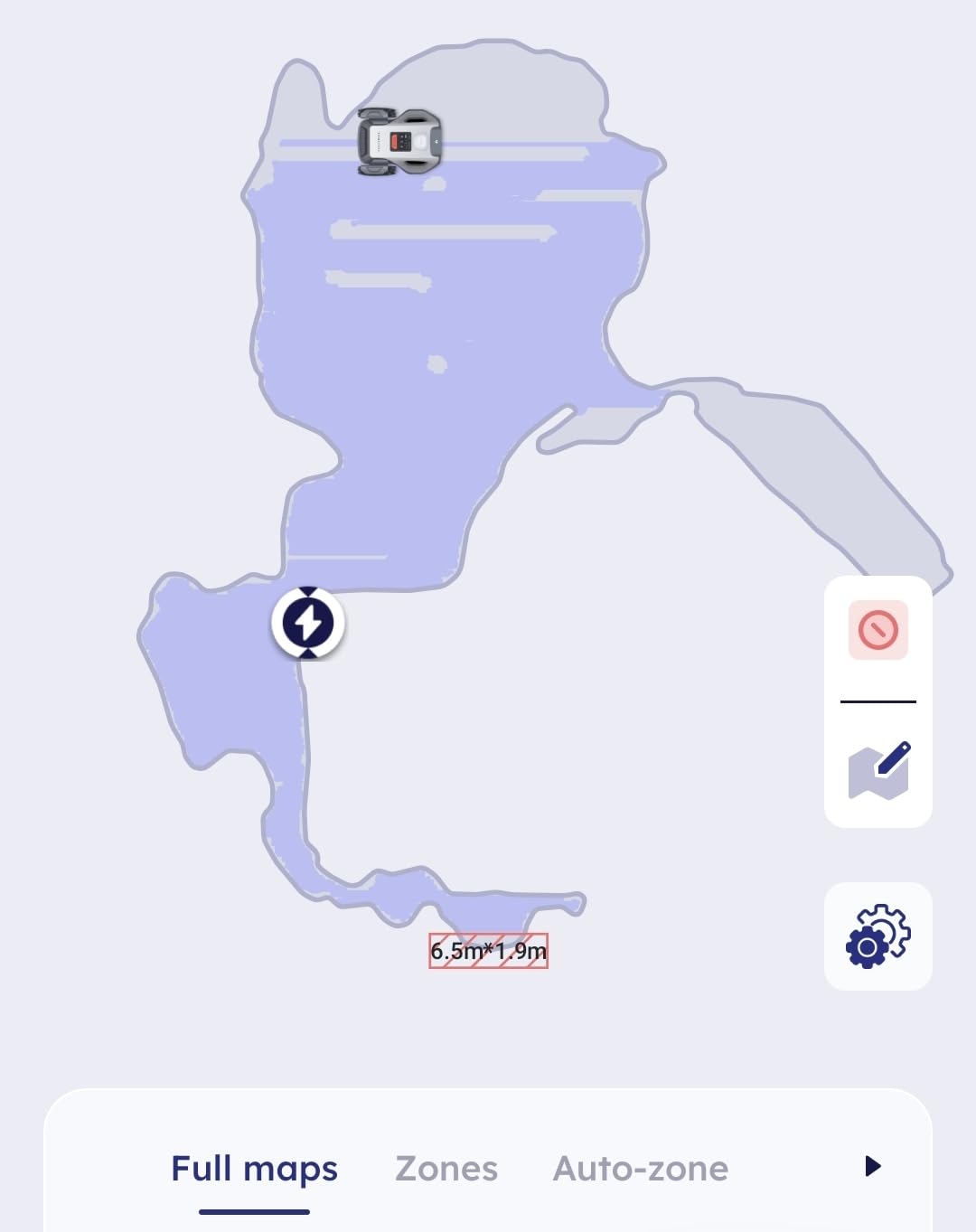
Cutting height adjusts from 1.2 to 2.7 inches across a 7.9-inch cutting width, and the body measures 19.61 by 15.43 by 9.88 inches at 12 kilograms, light enough to lift onto a shelf or reposition without help. Emergency braking is built in, and the app supports over-the-air updates.
Owners frequently describe it as effectively hands-off once configured, which for many people is the deciding factor. The battery supports a full zone mow per charge at typical settings.
Who the M5 suits
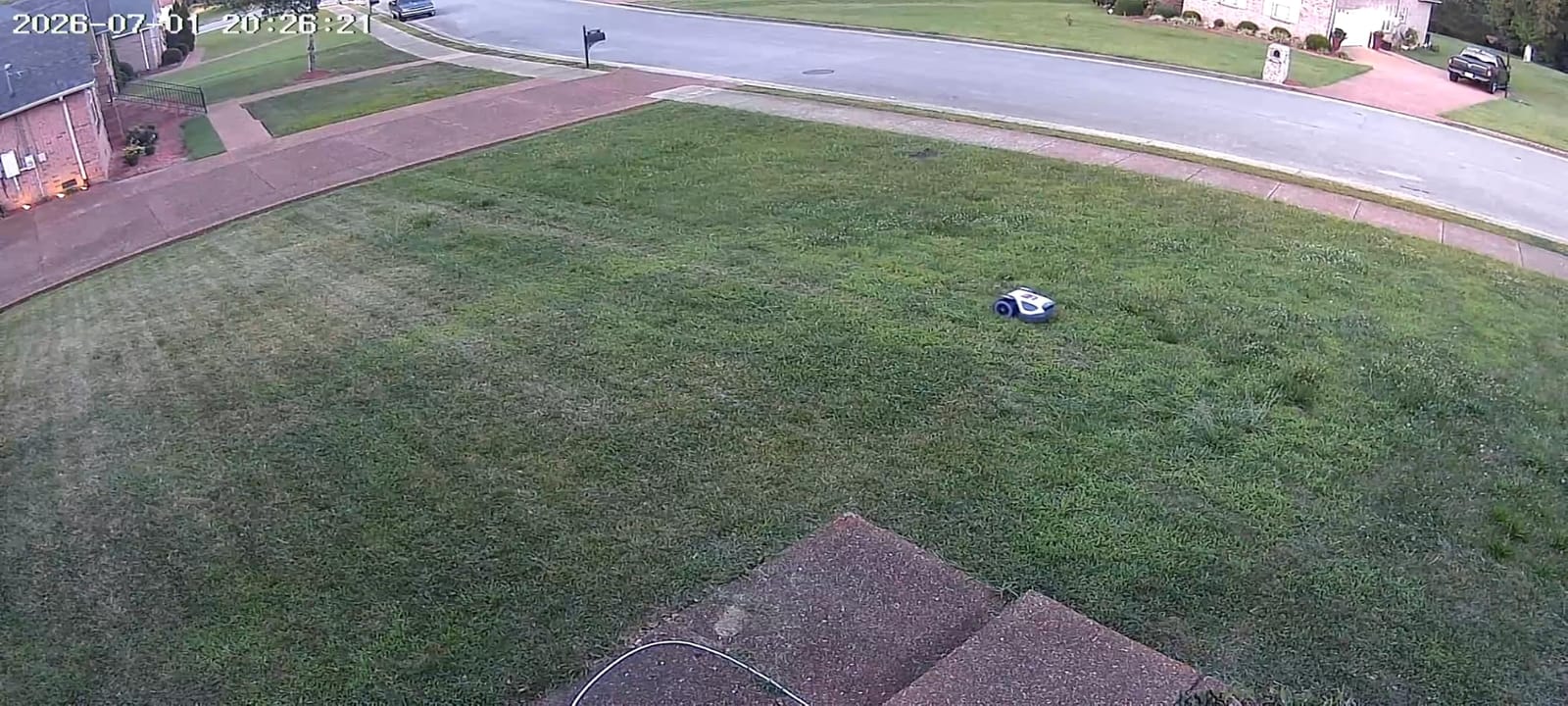
It suits first-time robot mower owners and anyone who dreads a complicated install, since the auto map is quick and the app is not demanding. Small front lawns with a moderate slope, a couple of trees and narrow side paths are its natural territory. It is also a strong choice if you want the most review history available at this budget level, which matters when you cannot test a machine before committing. Quiet operation makes it a good neighbour.
Where it falls short
Mowing speed is the main gripe, and owners say it often needs three passes to get an even cut because the 7.9-inch deck is narrow. That narrow width also means longer run times, and on anything beyond a small lawn you will see repeated docking and recharging. A strip along the edges still needs trimming. It is a machine for a small yard, so if you have half an acre or more of rough ground, look at the larger AWD models instead.
8. Dreame A3 AWD 2000: Best for Fast Charging and Hard Surfaces
(Upgraded) DREAME A3 AWD 2000 LiDAR Robot Lawn Mower, 45-Min Fast Charge
80% max slope
AWD hub motors
2.17 inch obstacle clearance
45-minute fast charge
3-year warranty
Pros
- Easy setup with LiDAR mapping of the yard
- Strong AWD traction on slopes and uneven ground
- Quiet enough to schedule at night
- 45-minute recharge with no recurring monthly fee
Cons
- Only one rating on record so field reliability is unproven
- Battery pack is not user replaceable
- Narrow 7.87 inch cutting width
- Trimmer module needed for the closest edge cut
On paper this is one of the most capable machines in the roundup. AWD hub motors give an 80% incline rating, which works out to 38.7 degrees, and it clears obstacles up to 2.17 inches, the highest figure here. Navigation is 360° LiDAR plus binocular AI vision with no wire and no RTK station, and it recognises more than 300 obstacle types including pets and toys.
The stand-out feature for anyone with an awkward yard is the 45-minute fast charge using the 5A adapter, which the manufacturer puts at 22% faster than the industry standard. With no recurring monthly fee attached, that means the machine spends far more of its day actually mowing. Coverage is for lawns between a quarter and half an acre.
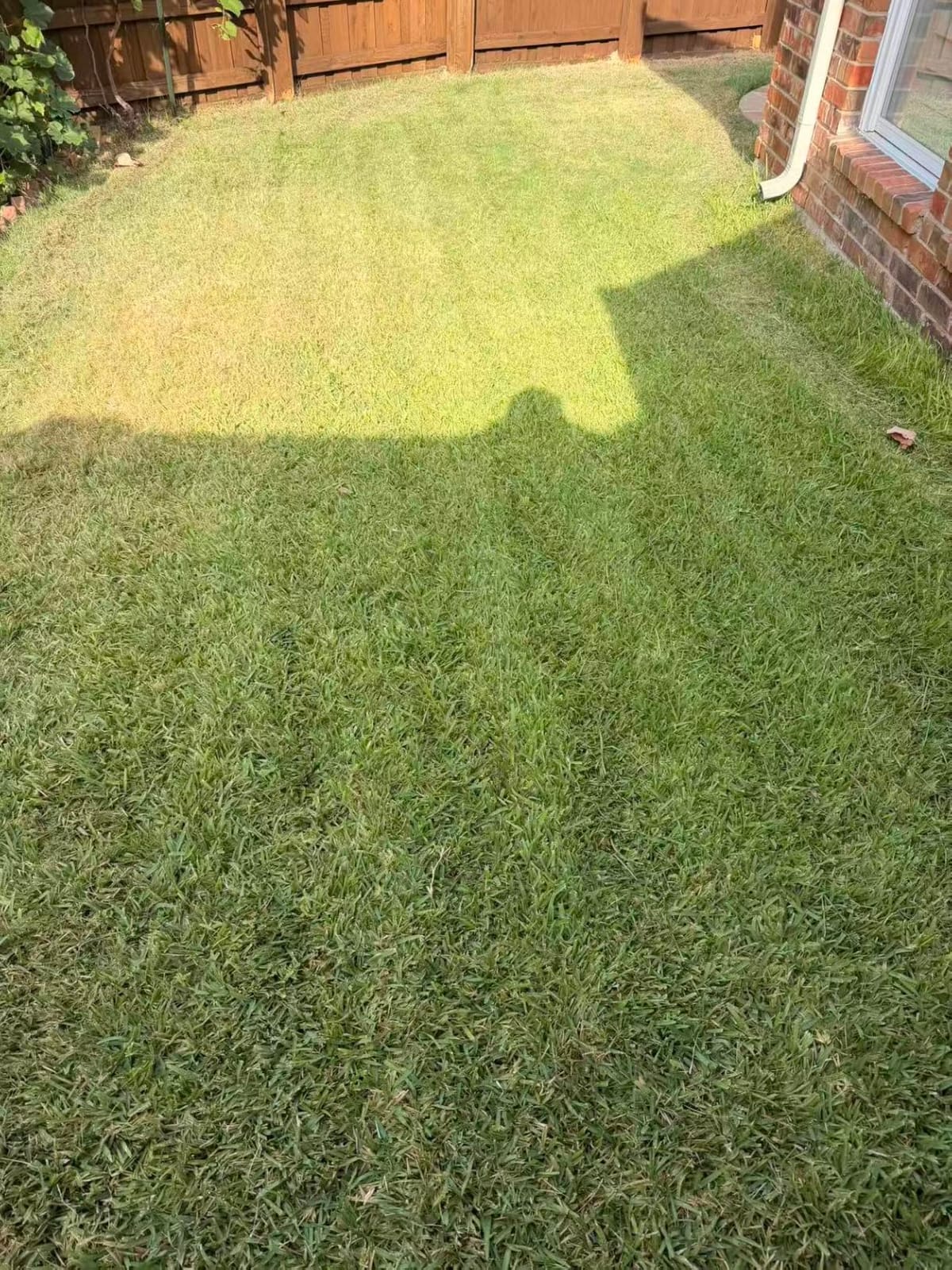
EdgeMaster 2.0 cuts to within 1.97 inches of the boundary, or under 1.18 inches with the optional trimmer module. The chassis is built from hard-anodised aluminium and stainless steel rather than the plastic used by most rivals here, which is a meaningful difference in a machine that gets bumped around on rocky ground. Cutting height runs from 1 to 4 inches across a 7.87-inch deck, and the warranty is three years with a year of 4G service included.
The single owner review available reports easy setup, good LiDAR mapping and effective AWD performance on slopes and uneven ground, and that owner says the machine freed up weekends previously spent mowing.
Who the A3 suits
It suits owners of a quarter to half-acre yard with slopes, stony patches or rough edges who want a machine that spends its day cutting rather than charging. The aluminium and stainless construction is appealing if you have rocks or a stray branch problem, since it is less likely to crack than a plastic shell. The 2.17-inch obstacle clearance gives it an edge on yards with raised roots, and the three-year warranty is the joint-longest here. No monthly fee also simplifies the running cost over a five-year ownership period.
Where it falls short
Be blunt about the evidence: with one rating on record, there is no meaningful field reliability history, and we would not call the 5.0 average a proven result. It is the least-documented machine in this list. The battery pack is not user replaceable, which is a concern for a five-year ownership horizon because a pack replacement may mean a service visit. The 7.87-inch cutting width is narrow for the money, and getting the closest edge cut requires the optional trimmer module.
9. Segway Navimow i105N: Best Wire-Free Value for Small Yards
Segway Navimow i105N Robot Lawn Mower Perimeter Wire Free 1/8 Acre RTK+Vision Robotic Lawnmower, AI-Assisted Mapping, Virtual Boundary, APP Control, 58dB(A) Quiet, Multi-Zone Management
45% claimed slope
EFLS 2.0 RTK plus vision
7.1 inch cut
58 dB(A)
3-year warranty
Pros
- Strong value among wire-free GPS mowers
- RTK plus vision works under heavy tree cover
- Very quiet enough to run at night
- Mows reliably once the map is created
Cons
- Stock wheels give poor traction on slopes
- About a 10-degree effective grade in practice
- VisionFence can miss or invent obstacles
- Map edits require driving the mower to each area
The i105N is the most-reviewed machine in this roundup at 391 ratings, and reviewers consistently call it the best-value wire-free GPS mower for small yards. EFLS 2.0 RTK combined with vision gives centimetre-level positioning, and it holds up under heavy tree cover and in narrow corridors where a satellite-only machine would stall. Operation is rated at 58 dB(A), quiet enough to run at night.
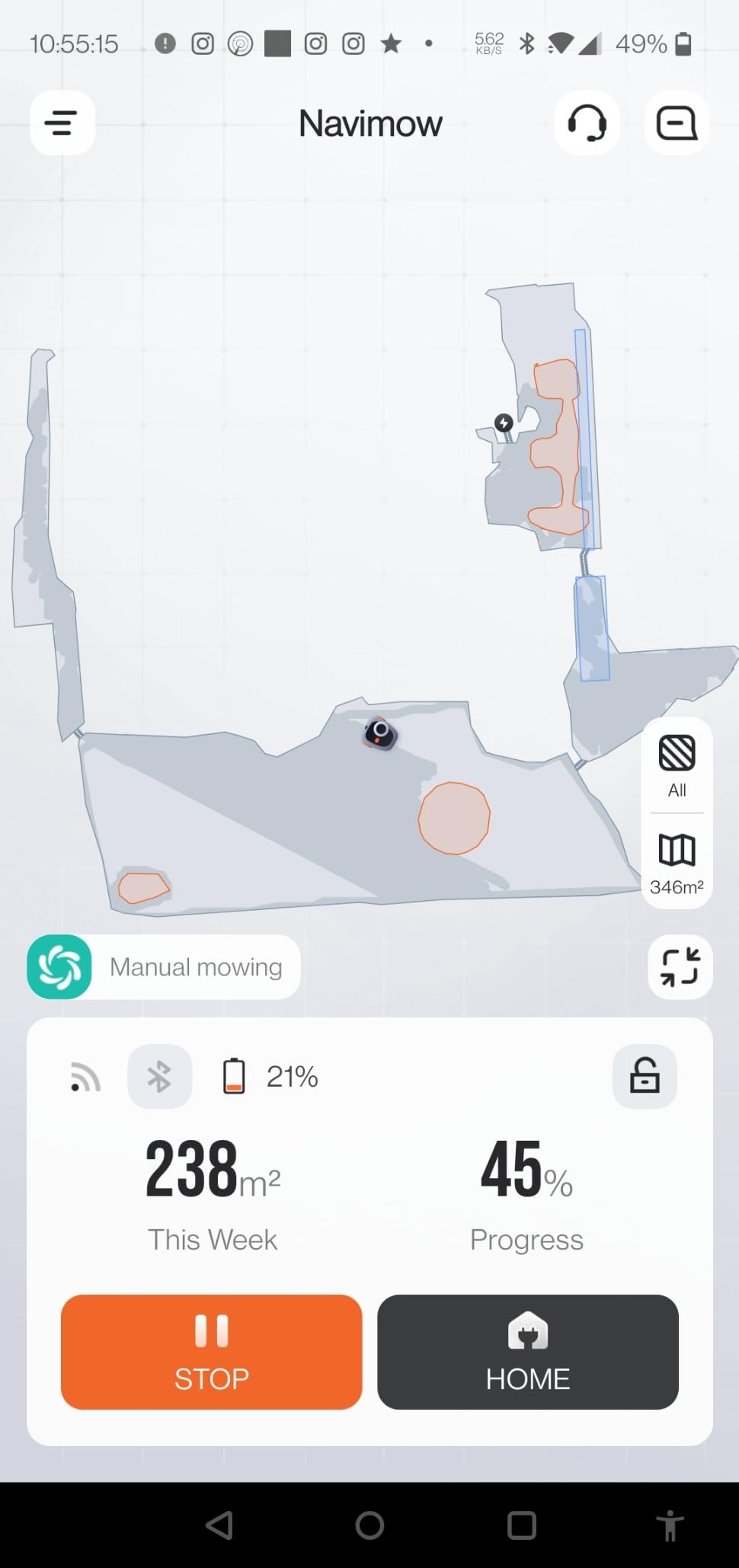
It supports up to 12 mowing zones with app scheduling and mowing-direction control, and planned mowing patterns change direction automatically at full coverage so the cut stripes evenly. A 140-degree camera with AI detection of more than 150 obstacle types handles the usual garden clutter, and the warranty is three years.
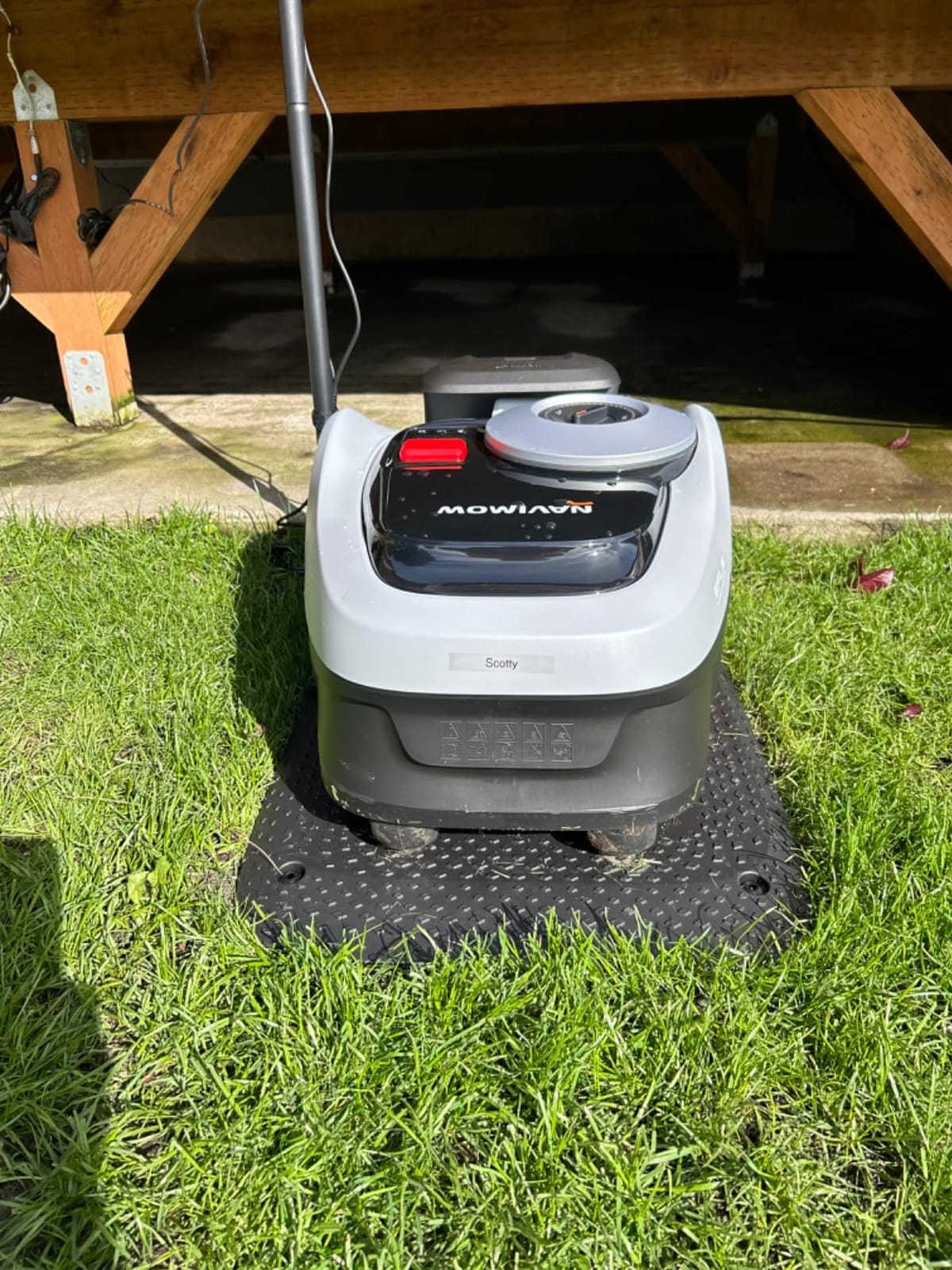
Here is the honest catch, and it matters for this topic. The claimed slope rating is 45%, but the drive is two-wheel and the standard wheels have poor traction on grades. Owners put the effective limit closer to a 10-degree grade on uneven ground, and off-road wheels help but are an accessory. On a genuinely hilly lawn, this is not the machine.
Other reported weaknesses: VisionFence can miss obstacles such as gates, mailboxes and hoses, or detect phantom objects, and editing the map requires physically driving the mower to each area. Garage and accessory costs add up, and the app map can be lost and need re-mapping.
Who the i105N suits
It suits owners of a small, relatively gentle lawn, up to about an eighth of an acre, who want wire-free mapping and quiet operation without a large outlay. The combination of RTK and vision makes it a good choice under tree cover or between buildings where signal is poor. With 391 ratings, you have the largest evidence base of any pick here, which is worth something when you cannot test before buying. The three-year warranty also stands above most of the field.
Where it falls short
If your lawn has a real hill, buy the i206 AWD instead, because traction is the limit here rather than software. VisionFence’s detection is inconsistent, and correcting a missed boundary means walking the mower out to the spot. At 24 pounds it is manageable to lift, and the 7.1-inch cutting width means longer run times on anything but a small patch. Accessory costs, including better wheels, quickly narrow the value gap against the AWD machines.
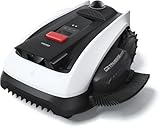
10. ECOVACS GOAT O1000 LiDAR PRO: Best for Edge Trimming and Tight Paths
ECOVACS Goat O1000 LiDAR PRO Robot Lawn Mower, Wire-Free Mapping with LiDAR Navigation, AI Obstacle Avoidance, Smart Edge Mowing, App Control, for Lawns Up to 1/4 Acre
HoloScope 360 dual LiDAR
2 cm positioning
Built-in TruEdge trimmer
0.25 acre
No RTK antenna
Pros
- LiDAR-only navigation needs no antenna and holds signal in shade
- Maps stored locally so cloud outages do not lock you out
- Built-in string trimmer handles edges others cannot
- Very narrow body fits tight paths
- IP rated for hose-down cleaning
Cons
- Small front tires struggle on high grass and curbs
- Single-joystick app control is hard to steer precisely
- Maps cannot be edited freely
- Trimmer will not run along fences
The GOAT O1000 is the pick when your terrain is uneven but modest, and your biggest frustration is edges. It has a built-in TruEdge string trimmer on the front that handles the strip along drives, walks and beds that normally needs a separate trimmer, and owners consistently single that out as the feature that changed their routine. Several have stopped reaching for the string trimmer entirely on small lawns.
Navigation is HoloScope 360-degree dual LiDAR with 2 cm positioning, and it needs no RTK antenna and no perimeter wire. That means no signal mast in the middle of an uneven lawn, and the map is stored locally on the device, so a cloud outage does not lock you out. AI Vision plus 3D time-of-flight LiDAR detect more than 200 obstacle types at 5 cm precision.
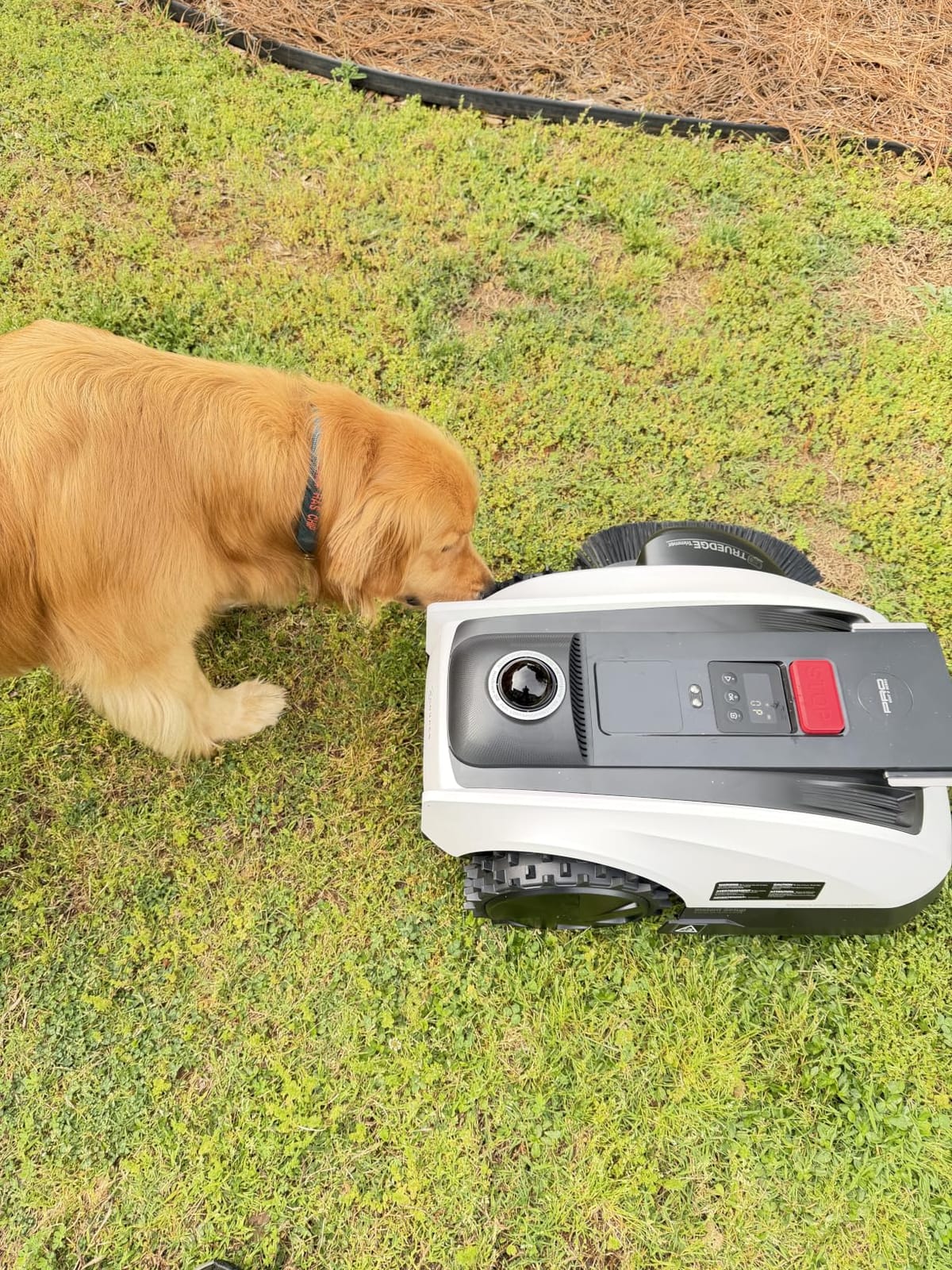
The body is narrow enough to pass 0.8 metre corridors, which is narrower than most competitors and useful between raised beds. The cutting width is 8.66 inches with height from 1.2 to 3.6 inches, and the machine is IP water-rated so you can hose it down after a rough session. The app handles zones, schedules and no-go areas.
This is a quarter-acre machine, so it is for a small lawn with mild unevenness rather than a hillside property.
Who the O1000 suits
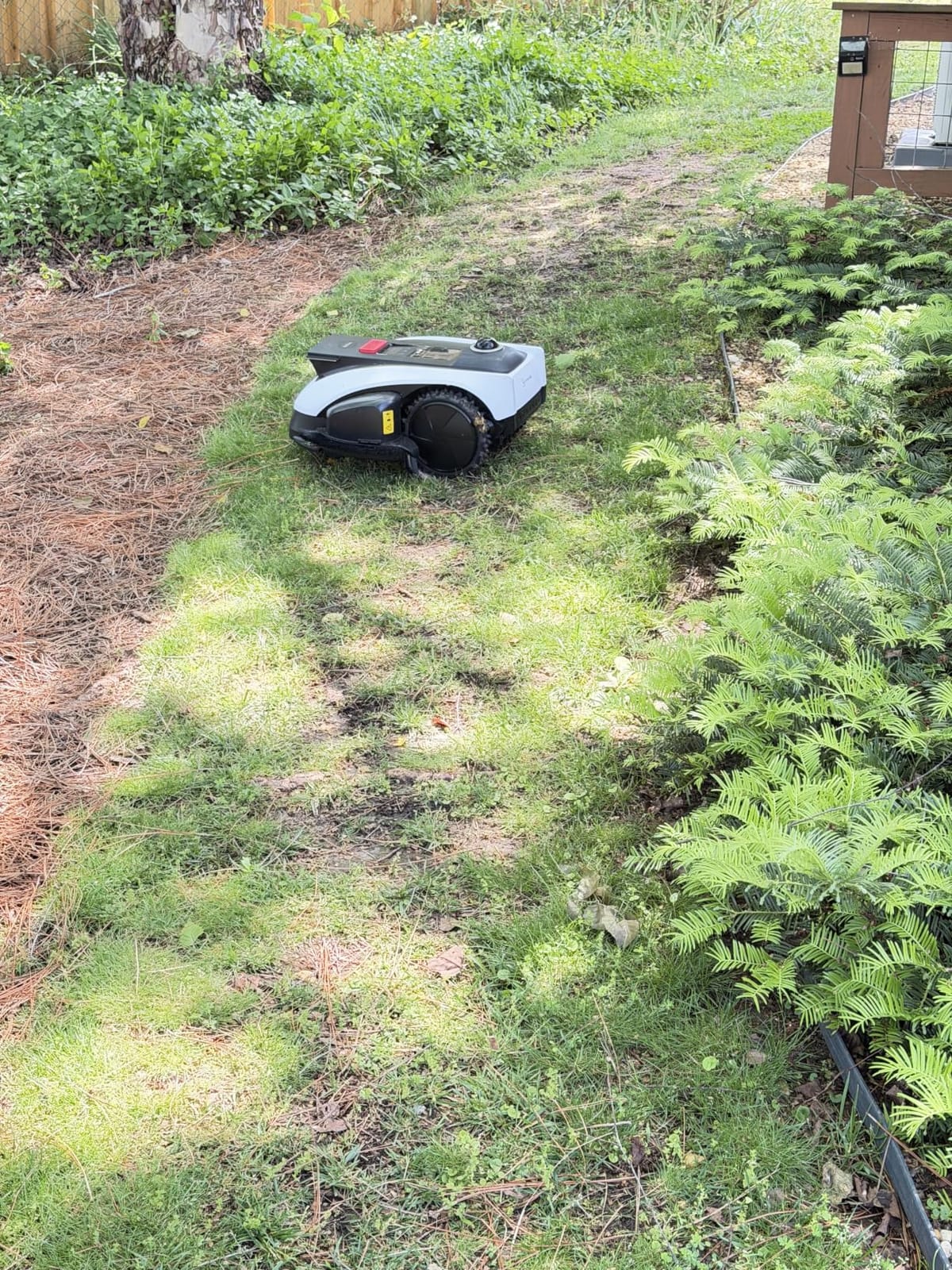
It suits owners of a small yard, up to a quarter acre, where the grass is uneven but not steep and the layout has tight paths or side lawns. The narrow body is the reason it fits where wider machines cannot. It is also a good fit for a property with unreliable internet, since navigation and mapping are entirely local. If you currently spend twenty minutes with a string trimmer after every mow, that saved time changes the value calculation more than anything else here.
Where it falls short
Terrain capability is its limit. The front tires are small and struggle on high grass, curbs and uneven ground, which makes this the wrong choice for the roughest half of our list. The single-joystick app control is difficult to steer precisely during manual mapping, and maps cannot be edited freely, so a boundary change means re-mapping rather than on-screen adjustment. The edge trimmer treats fences as obstacles and will not trim along them, and the roughly 3.2-inch maximum cut height is short for cool-season lawns in summer.
11. Roborock RockNeo Q110H: Best for Narrow Corridors on a Budget
Roborock RockNeo Q110H Robot Lawn Mower, Wire-Free Robotic Lawn Mower with Full-Band RTK + VSLAM Navigation, Auto Mapping, AI Vision Obstacle Avoidance, App Control, 45% Slope, Covers Up to 1/4 Acre
45% max slope
Floating cutting deck
Full-band RTK plus V-SLAM
2.3 ft passages
27 pounds
Pros
- Cuts in perfectly straight lines with a quiet motor and headlights
- Handles hilly yards with beds and trees
- App interface feels familiar and setup is straightforward
- Floating deck transitions over small dips and walkway edges
Cons
- Traction wheels are not strong enough for thick St. Augustine grass
- Manual perimeter mapping required
- Leaves 1 to 1.5 ft uncut along edges and obstacles
- Edge cutting add-on not sold in the US
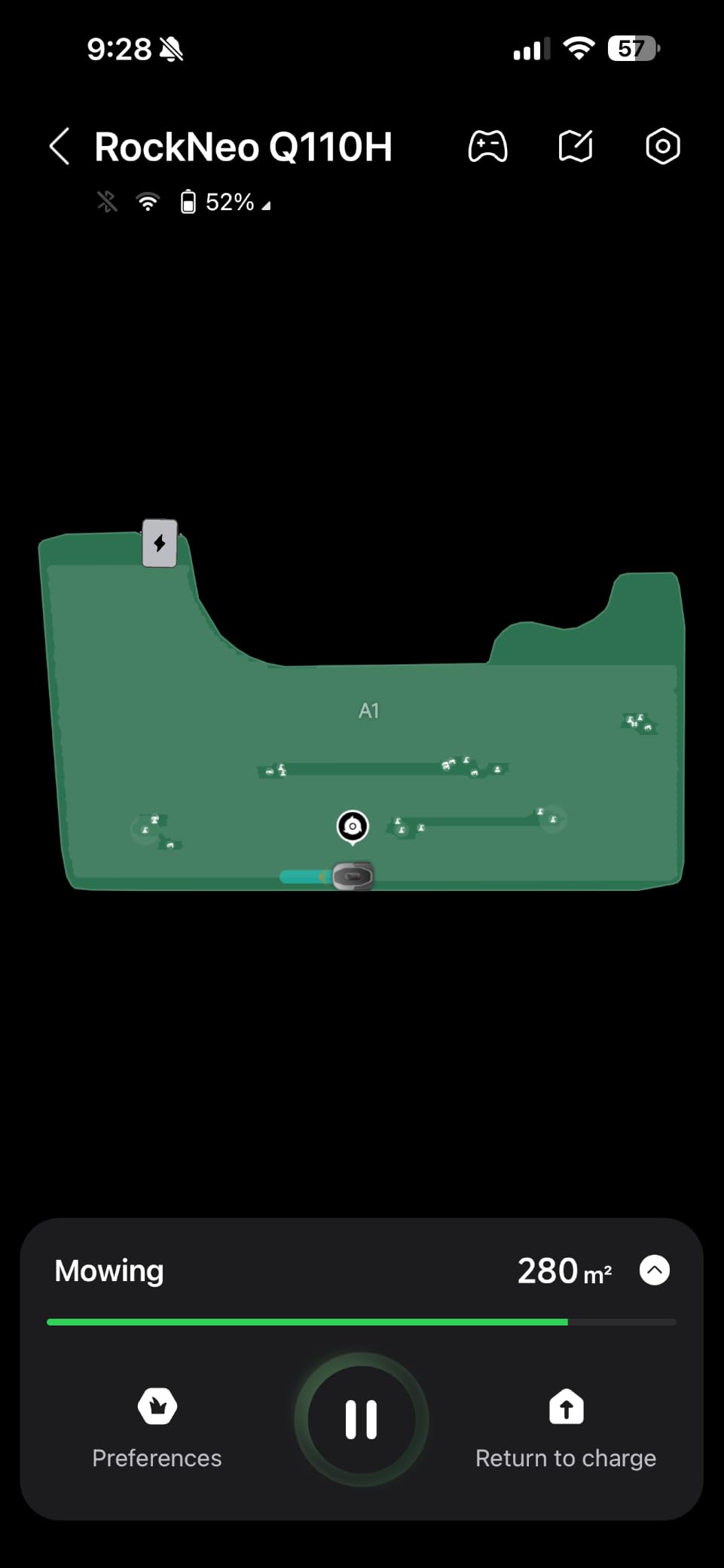
The RockNeo Q110H borrows navigation from Roborock’s vacuum line, and it shows: full-band RTK combined with V-SLAM keeps it stable under tree canopies and beside high fences, and the app is the most familiar of anything in this roundup for anyone who owns a Roborock vacuum. Stereo dual cameras handle obstacle avoidance and roll over low crossable obstacles. It is rated for a 45% slope and 1.57-inch obstacles, and it passes 2.3-foot passages.
The floating cutting deck is the feature that matters most for uneven ground here, because it adapts to contours so the blade height stays constant relative to the soil across dips and small rises. Owners report smooth transitions over walkway edges. The 8.7-inch deck adjusts from 1.6 to 3.1 inches, the battery averages 130 minutes, and PIN lockout with a high-decibel alarm are included out of the box, with an optional 4G anti-theft module.
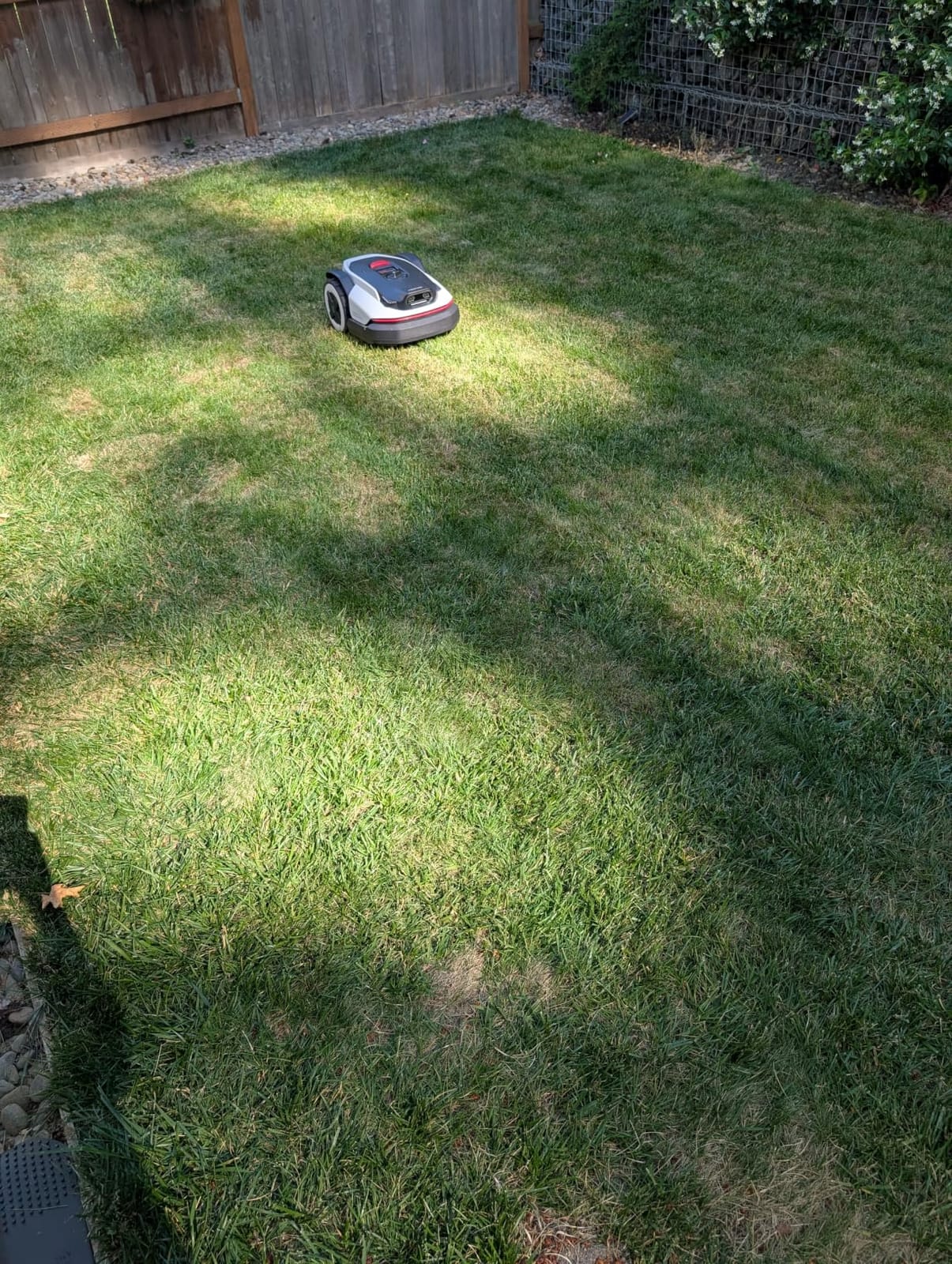
Two mapping modes are offered: Sentisphere AI auto-mapping and app-controlled manual mapping. Coverage is for lawns up to a quarter acre, and at 27 pounds it is one of the heavier machines in the range, so lifting it is a two-hand job.
This is also the lowest-rated machine we include, at 3.8, and the reasons are specific rather than vague.
Who the Q110H suits
It suits owners of a quarter-acre or smaller yard with moderate hills, a lot of tree cover, and passages around 2.3 feet wide, who already use Roborock products and will find the app intuitive. Straight, quiet cutting lines and headlights for night mowing appeal to anyone who likes a tidy striped finish, and the floating deck is a genuine asset if you have small dips and irregular ground rather than a real slope.
Where it falls short
The traction wheels are not strong enough for thick St. Augustine grass, so heavy warm-climate turf is a poor match. Manual perimeter mapping is required and auto-mapping is limited, so expect to spend time with the app before the first mow. Boundary handling is overly conservative and leaves 1 to 1.5 feet of grass along edges and around obstacles, and the edge cutting add-on is not sold in the US, which makes edge handling the weakest point. Maps cannot be edited without walking the mower, and there is no partial zone mowing.
12. Mammotion LUBA 2 AWD 3000HX: Best for Large Multi-Zone Yards
Mammotion LUBA 2 AWD 3000HX Robot Lawn Mower with 4G, All-Wheel-Drive for 80% Slope, Perimeter Wire Free for 0.75 Acre, UltraSense AI Vision & RTK Auto-Mapping, 2.2″-4.0″ Adjustable Cutting Height
80% max slope
165W four-wheel motor
15.7 inch cutting width
Up to 30 mowing areas
4G with GPS anti-theft
Pros
- Handles steep
- bumpy
- hilly ground
- Precise boundary following and clean striping
- Very quiet enough to mow at night with lights
- Manages complex multi-zone yards on a single charge
Cons
- RTK antenna mount sold separately
- Setup is involved
- Turning algorithm tears grass on tight turns
- Can struggle with a small bump such as a driveway ramp
The LUBA 2 AWD 3000HX is the version of Mammotion’s 80% slope machine built for a full acre, and it is the only pick here that manages up to 30 mowing areas. A 165W four-wheel motor handles an 80% grade, which the manufacturer lists as 38 degrees, and the 15.7-inch dual-blade disc covers 400mm of width per pass, so a large rough yard finishes in a reasonable number of cycles.
Navigation combines UltraSense AI vision with RTK auto-mapping, and the vision system is claimed to work under tree cover without a satellite signal, recognising more than 200 object types. Height adjusts from 2.2 to 4.0 inches across five positions. Owners praise precise boundary following and clean striping patterns, and several multi-season owners report good reliability.
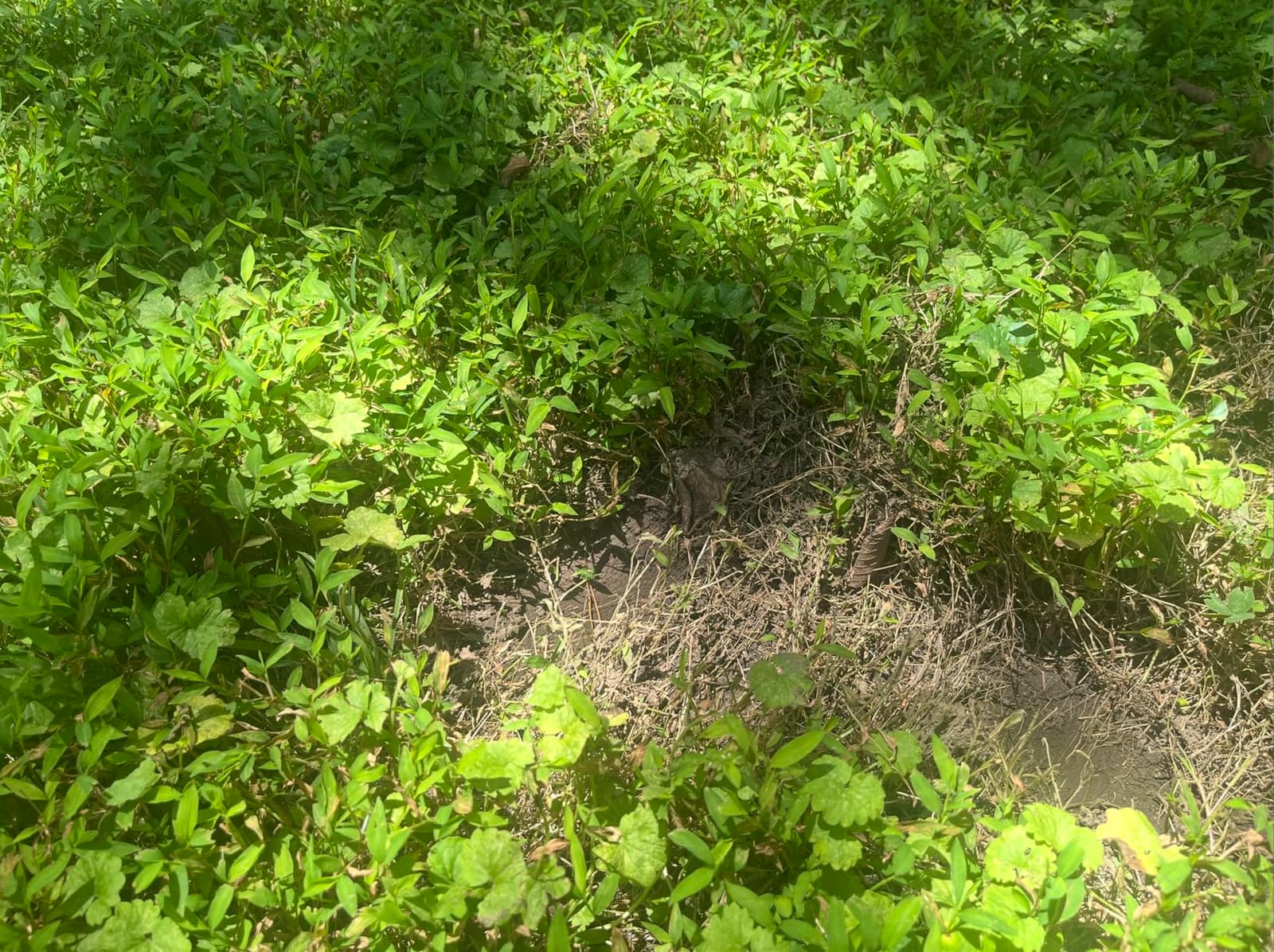
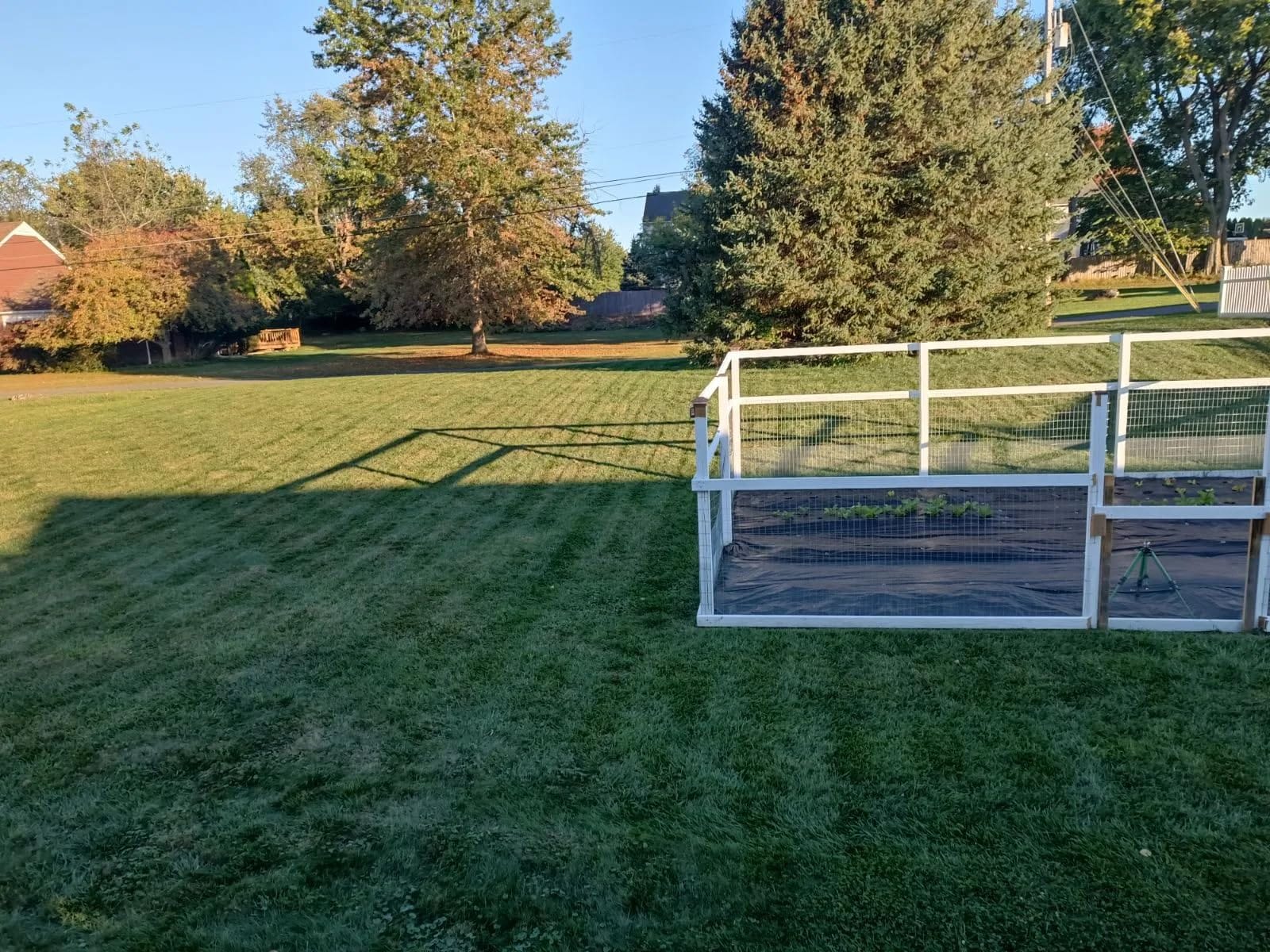
Planned mowing patterns include parallel lines, checkboard, diamond grid and 3D lawn printing, which is unusual at this level. Connectivity covers 4G, Bluetooth and WiFi through the Mammotion app, with GPS tracking and anti-theft protection, and the machine is quiet enough to run at night using its lights. Measured dimensions are 27.1 by 20.2 by 11.9 inches.
Two details catch out buyers. The RTK antenna mount is sold separately, so budget for it before the machine arrives. And the app lets you set smart charge limits and off-peak charging, which is useful if electricity is expensive in your area.
Who the LUBA 2 AWD 3000HX suits
It suits owners of large, hilly properties with many separate lawn areas, flower beds and a complex layout, because 30 zones and a wide deck reduce the number of manual jobs. Anyone with tall dense grass who mows at night to avoid the heat will like the quiet operation and lights. The 80% slope rating and four-wheel motor mean it will keep working where a push mower would struggle, and the clean striping is satisfying on a large open lawn.
Where it falls short
Setup is involved, with RTK antenna mounting and app mapping to work through, and the antenna mount is a separate purchase. The turning algorithm tears grass on some tight turns, so plan zones so the machine has room to manoeuvre. It can also struggle with a small obstacle such as a one to two inch driveway ramp, which is worth checking against your worst feature. It does not mulch leaves, and a 4G subscription applies after the first year, so factor that into a multi-year cost comparison.
How to Measure Your Lawn’s Slope Before You Buy
Most buyers compare slope numbers without knowing which one applies to their yard, which is why the getting-stuck reviews cluster around machines that should have been fine. Measuring takes twenty minutes with a length of string and a spirit level, and the result tells you immediately which of these 12 machines you can rule out.
Slope percentage is rise over run, multiplied by 100. That is the unit manufacturers use, and it is worth learning the conversion because the same hill is quoted in both. A 25% grade is about 14 degrees, 45% is about 24 degrees, 60% is about 31 degrees, and 80% is about 38.7 degrees. If a product page says 84%, that is close to 40 degrees, which is a genuinely serious hill.
To measure, take a string about 15 to 20 feet long and mark both ends. Find the flattest route across your yard, which is usually a contour line rather than a straight run from the house to the far corner, because a straight run measures the average grade and hides the worst section. Stake one end at the top of the slope and hold the other level with the ground at the bottom.
Measure the height at the high end, then measure the horizontal distance from the high point to directly below it. Divide rise by run and multiply by 100. If your string sags noticeably, it is already following the grade, so keep the high end anchored and stretch the rest until it is straight and just touching the ground at the low end.
Then measure three more things. Find the narrowest passage the mower must use, typically between two raised beds, and add a few inches of clearance for error. Measure the tallest step it must cross, whether that is a tree root, a low wall, a driveway lip or an irrigation lip. And find the steepest point anywhere on the property, which is often the drainage swale at the side of the house rather than the hill you were worried about.
Write all four numbers down and match them to the spec sheet. If your worst step is four inches, a machine rated for 45 mm clears it with room to spare, and one rated for 1.57 inches will wedge under it. This simple habit eliminates most of the disappointing purchases in this category.
Navigation Explained: RTK, LiDAR, Vision AI and Boundary Wire
Navigation determines whether the mower knows where your lawn ends and where the tree is, and on uneven ground it matters as much as traction. Four approaches appear in this roundup, and the right choice depends on what blocks your sky and what surrounds your lawn.
RTK GPS is satellite positioning corrected to centimetre accuracy using a correction signal. It is accurate and reliable in open sky, and it needs no boundary wire. Its weakness is anything overhead: a dense tree canopy, a tall fence close to the boundary, or a building can block enough satellites to stop it or send it out of position. The Mammotion LUBA 2 AWD 3000HX, the Sunseeker X5 AWD and the Roborock RockNeo Q110H pair RTK with vision or LiDAR specifically to cover that gap.
LiDAR navigation spins a sensor to build a physical map of the yard. It works with no satellite signal at all, day or night, which makes it the right answer for shaded or enclosed properties. The Segway Navimow i215 LiDAR, the ECOVACS GOAT O1000 LiDAR PRO, the Mammotion LUBA mini 2 and LUBA 3, and the Dreame A3 all use LiDAR, and in each case it means no antenna, no base station and no wire.
Vision AI uses cameras to recognise objects and, in the better systems, to reinforce position when satellites are weak. It is the cheapest layer to add and it works well. The limitation is reliability: a 140-degree camera detecting 150 object types is not the same as a 360-degree LiDAR, and owners of the Navimow i105N report the vision system both missing obstacles like gates and hoses and detecting phantom objects.
Boundary wire is a physical copper wire pinned into the ground. It is the oldest method and the only one that does not depend on satellites, electronics or a network. On uneven ground it has a specific advantage: the wire is a physical object, so it cannot drift or lose signal. Its disadvantage is installation on rough terrain, where pegging wire into frozen or rooty soil across a slope is a long evening and the wire is vulnerable to digging, frost heave and mower contact.
For this topic, sensor fusion is the direction the industry has moved. A machine with two or three navigation layers tolerates far more of what a real uneven yard throws at it than a single-layer machine, and all 12 picks here use at least two layers except the two that lean on LiDAR plus vision alone.
Drive Systems: What Actually Gets a Mower Over Roots and Ruts
Traction is the single most important spec on this list, and it is the one most often summarised as a slope percentage that hides the mechanism behind it. Four things decide whether a machine climbs a bad section or stops in it: how many driven wheels it has, whether the wheels are suspended, how much ground clearance it offers, and whether the cutting deck floats independently of the chassis.
All-wheel drive is the meaningful upgrade. Two-wheel-drive machines on a hill apply drive force to two wheels and let the others slide, which is why the Navimow i105N owners report a practical limit near a 10-degree grade despite a 45% claim. The four-wheel machines here, including the LUBA mini 2, the LUBA 3, the Sunseeker X5 AWD and the Dreame A3, hold climbing ability far better.
Adaptive suspension is the feature that separates the serious terrain machines from the merely capable ones. The LUBA mini 2 uses it to step over curbs, roots and thresholds up to 45 mm, the LUBA 3 manages 50 mm, and the Sunseeker X5 AWD uses independent front suspension for the same job. That is the difference between crossing a root and reversing away from it.
Ground clearance and obstacle height tell you how tall a step can be before the machine jams. Most mowers here handle between 1.57 and 2.17 inches, so a one-inch root is comfortably manageable and a three-inch ledge is not. The Dreame A3 AWD 2000 leads this group at 2.17 inches.
A floating cutting deck follows the contour of the ground, keeping blade height constant relative to the soil rather than the frame. On a lumpy lawn this is what prevents scalping high spots and leaving tufts in hollows, and it is the clearest reason to prefer the LUBA mini 2, the Sunseeker X5 AWD or the Roborock RockNeo Q110H for genuinely uneven ground. The Navimow i206 AWD adds auto-levelling so it cuts an even height across sloped areas, and its zero-turn steering avoids the torn turf that skid turns cause on every other machine.
Prepare Your Yard Before the Mower Arrives
Getting stuck is the most repeated complaint in owner discussions about robot mowers on rough terrain, and almost none of it is caused by a bad machine. The recurring stories describe a mower that stopped in a rut, backed off, tried again, and eventually died on a slope. That pattern almost always traces back to ground conditions, not drive systems.
Fill the holes first. A two-inch depression hidden in grass is a trap for a 45 mm suspension, because the wheels drop in and the chassis grounds out. Walk your lawn and backfill anything deeper than a couple of inches with compacted soil, then let it settle for a few weeks before mapping.
Clear the loose obstacles. Small stones, fallen branches, pine cones and dropped fruit are objects the vision systems either avoid or roll over, and both behaviours interrupt a mowing cycle. Pick them off before the first run rather than rescheduling around them. Cut the perimeter of the lawn with a walk-behind mower once, which flattens the outer edge where the machine is most likely to snag.
Mark the no-go zones. The LUBA 3 supports 30 mowing zones with no-go areas, the Sunseeker X5 AWD stores five separate maps with smart zones, and the Navimow i206 AWD allows up to 20. Use them. Beehives, pond edges, vegetable beds, septic field ditches and low tree branches should be excluded in software rather than discovered by the machine at 2am.
Trim before you map. Edges and fence lines need a string trimmer once at the start. Every machine here leaves some unmowed strip at borders, and doing that work by hand first means the robot can start from an even baseline.
Watch the first week. A newly sodded yard settles and develops undulations that no mower handles well, which is exactly the problem the Navimow i206 AWD owners report. If you have fresh sod, wait until it has rooted down before mapping, and expect a few manual rescues in the meantime.
Confirm your power and network plan. Check that the charging station sits on level ground with a straight run in front of it, and that your phone or WiFi reaches the lawn. The ECOVACS GOAT O1000 LiDAR PRO stores maps locally, so it keeps working through a cloud outage, while RTK Cloud machines need a signal even if they need no antenna.
Boundary Wire vs Wire-Free on Uneven Ground
Every machine in this roundup is wire-free, and on rough ground that is usually the right call, but it is not automatic. A wire is a physical object, so it cannot lose signal under a tree canopy or drift when the ground heaves, and it defines the boundary with an accuracy no GPS matches. On a lawn with a very complex, twisting boundary and heavy tree cover, that reliability has real value.
The cost is installation. Pegging wire across a slope means pushing stakes into ground that may be stony, rooty or frozen, and every crossing has to be sealed. Frost heave can lift a buried wire, and any mower contact cuts it. For a large uneven property the installation can run to a full weekend and may need repair later.
Wire-free mapping asks you to drive the machine around the boundary once, which on uneven ground is quicker and far less frustrating. The accuracy is now good: centimetre-level RTK, 2 cm LiDAR positioning on the ECOVACS GOAT, and vision fusion all land within a few centimetres of the true edge. The real weakness is coverage, not precision, when satellites are blocked.
So the deciding question is your sky and your soil. A yard under heavy tree cover with good, diggable soil is a reasonable candidate for wire. A rocky or root-choked property with partial shade is not, and neither is anything where you want the install done in an afternoon. If you are unsure, choose a machine with a LiDAR layer, because it removes the satellite dependency entirely and works with no antenna and no wire.
What Uneven Terrain Costs to Own Over Five Years
Rough ground wears machines harder than flat lawns. Wheels slip, blades hit stones, and the suspension and drive components take shocks that a flat lawn never applies. Budgeting only for the purchase is how owners get caught out, so here is what actually varies between these picks.
Blades are the cheapest and most frequent item, and on rocky ground you should expect to check them more often. Cutting height range matters here too: a machine that tops out at 1.2 inches, such as the ANTHBOT M5, forces you to mow often on cool-season lawns, which increases blade wear across the board. The LUBA mini 2 and the LUBA 2 AWD 3000HX adjust from 2.2 to 4.0 inches, which lets you let grass grow taller and cut less often.
Battery replacement is the item that can surprise you. The Dreame A3 AWD 2000 has a non-user-replaceable battery pack, which means a pack problem becomes a service event rather than a swap. Machines with app-adjustable charge limits, like the LUBA mini 2 and the LUBA 2 AWD 3000HX, can also be gentler on long-term battery health by staying off the charger overnight.
Warranty length is a decent proxy for how a manufacturer expects the machine to hold up. The Navimow i105N and the WORX WR342 carry three years, the Dreame A3 AWD 2000 carries three years with a year of 4G service, and the Sunseeker X5 AWD carries two years with US-based support. Check what your warranty actually covers, because drive motors and gearboxes are the parts that fail on rough ground and they are not always included.
Connectivity charges are the item people forget. The Dreame A3 AWD 2000 has no recurring monthly fee, and the WORX WR342 states no cloud subscription applies. The Mammotion LUBA 2 AWD 3000HX has a 4G subscription after the first year, and the LUBA 3 AWD 3000HX includes an LTE backup that is worth having on a remote property.
Support and parts access differ more than most spec sheets suggest. A brand with an established dealer network can have a drive motor serviced locally, while a direct-import machine may mean shipping the unit back. On a property with roots and rocks, that difference matters more than any app feature, and it is worth asking your dealer directly before you buy rather than after the first failure.
When a Robot Mower Is the Wrong Choice
Some yards are not a robot mower problem, and no amount of slope rating will fix them. A lawn that is mostly bare rock or shale cannot be mapped meaningfully, because the ground is not continuous enough for wheels or for a floating deck to work. Deep ditches with vertical sides, retaining walls and drop-offs are outside the design intent of every machine here, even the 80% slope models.
Cliffs, ponds with no margin, and very steep banks above a drop are the clearest cases. Every machine here has anti-theft features precisely because falling somewhere is possible, and a mower that tips into water is a total loss. If your property has these, a boundary-wire machine with a geofence is safer than none, and mowing that area by hand is safer still.
For genuinely rough ground, a walk-behind or ride-on machine may serve you better. If your issue is dense, tall, stony grass rather than hills, a brush cutter or a powerful self-propelled mower with large pneumatic tyres will cut through it in a fraction of the time and without a mapping exercise. Many owners who switched to a robot eventually kept a walk-behind for exactly this, using the robot for the mowable majority and the walk-behind for the rough strip along the tree line.
For the steepest hills on a large property, a remote-control or ride-on tracked mower driven by you is the practical answer. You can see the obstacle, you can back out of the rut, and there is no battery charge to manage on a slope. It is more work per session, but the ground gets cut rather than avoided. Several owners in the discussions we reviewed reached this conclusion after their first robot could not cope with the same section twice.
The honest summary: robot mowers are a scheduling convenience, not a terrain solution. If your yard is under about a third of an acre with moderate unevenness, one of the picks here will handle it. If it is larger, steeper, or full of obstacles, plan to keep a walk-behind for the worst ground.
Frequently Asked Questions
Are robot lawn mowers any good on uneven ground?
Yes, provided the machine is built for it. Look for all-wheel drive or a rated climbing grade of 45% or more, adaptive suspension that clears roots and curbs, and a floating cutting deck. Two-wheel-drive machines with a high claimed slope rating often stall on a modest hill, so match the drive system to your worst grade rather than trusting the headline number.
Which robotic lawn mower is best for rough terrain?
The Mammotion LUBA mini 2 AWD 1500H is our top pick, pairing an 80% slope rating with adaptive suspension that steps over obstacles up to 45 mm and a LiDAR plus dual-camera navigation stack. For large properties the Mammotion LUBA 3 AWD 3000 covers more ground per hour, and for the steepest lots the WORX WR342 carries the highest slope rating in this group at 84%.
Do robot mowers handle steep slopes?
They handle them up to a point, and the useful number is the manufacturer’s slope percentage. A 45% rating is roughly 24 degrees, 60% is about 31 degrees and 80% is about 38.7 degrees. Anything beyond a 25% grade generally needs all-wheel drive, and a sustained climb on wet grass will reduce whatever the spec sheet claims.
How do I keep a robot mower from getting stuck on uneven ground?
Most sticking is caused by ground conditions rather than the machine. Fill holes deeper than a couple of inches, remove loose stones and branches, mow and trim the perimeter once by hand, mark no-go zones in the app for ponds, ditches and beds, and wait for fresh sod to root down before mapping. Reserve a walk-behind mower for the roughest strip until the robot proves itself.
Do I need a boundary wire for a rough terrain robot mower?
Usually not. Modern wire-free mowers use RTK, LiDAR or a combination of both, and all 12 picks here are wire-free. A boundary wire is still worth considering on a lawn with a twisting outline and heavy tree cover, since it cannot lose signal, but installing one across rocky or rooty ground is a substantial weekend job. If you want reliability without satellites, choose a LiDAR machine.
How do I measure the slope of my lawn?
Mark a string about 15 to 20 feet long, anchor one end at the top of the hill and hold the other level with the ground at the bottom. Measure the rise at the high end and the horizontal run beneath it, then divide rise by run and multiply by 100 to get a percentage. Measure along the contour of the worst section rather than a straight line from house to fence, and write the number down before you compare spec sheets.
The Verdict on the Best Robotic Mowers for Uneven Terrain in 2026
The Mammotion LUBA mini 2 AWD 1500H is the best robotic mower for uneven terrain in 2026. It is one of very few machines that combines an 80% slope rating, 45 mm of adaptive suspension and LiDAR plus dual-camera navigation with enough owner history, 263 ratings, to trust the claim. For a large rough property, the LUBA 3 AWD 3000 covers more ground per hour and clears 50 mm. For the steepest lot, the WORX WR342 handles 84% grades with no antenna and no subscription.
If your ground is uneven but mild and your yard is small, the ANTHBOT M5 and the ECOVACS GOAT O1000 LiDAR PRO are the sensible picks, and the Segway Navimow i206 AWD is the one to buy if the problem is traction rather than budget. Before any of them arrives, spend a weekend filling holes and clearing obstacles, because preparation decides more outcomes in this category than any spec on the list.