
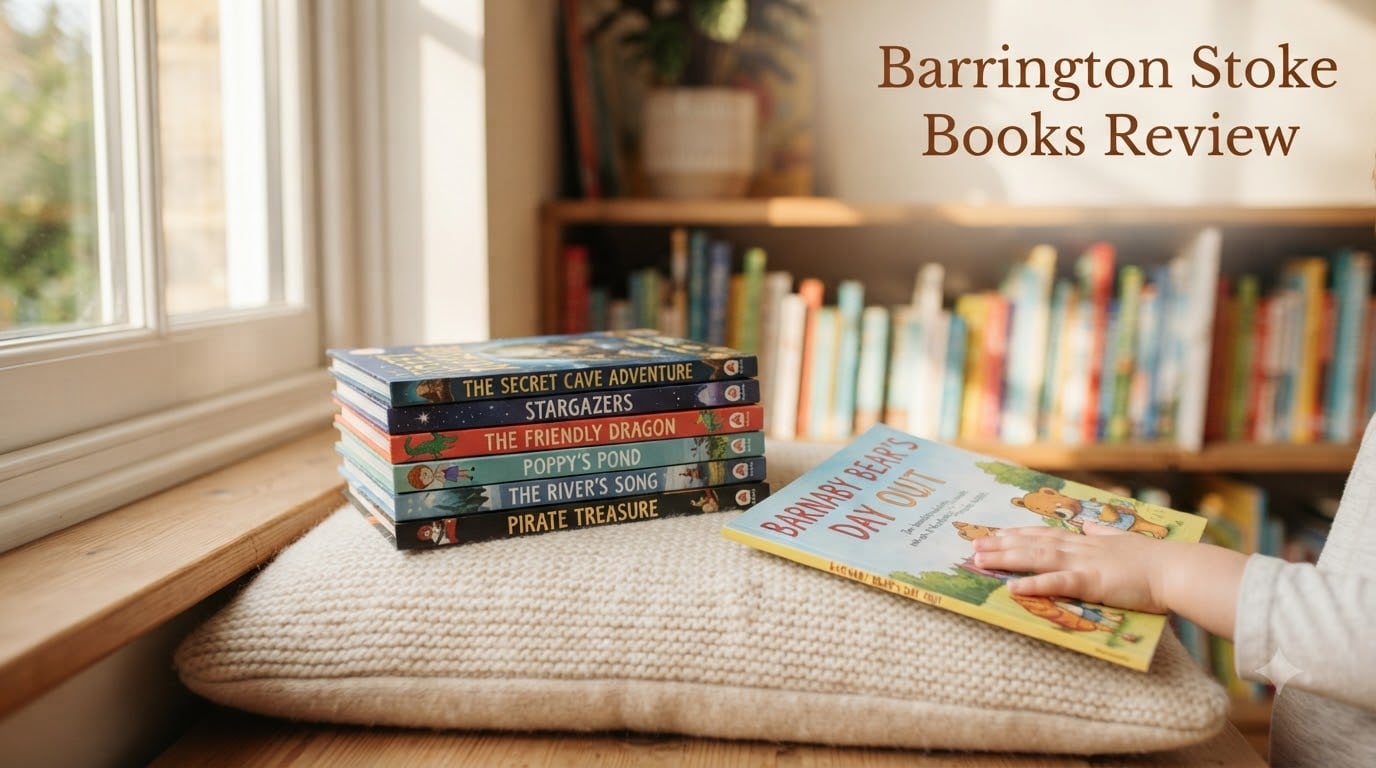
If your child has dyslexia, struggles with reading, or simply hates picking up a book, you’ve probably heard the name Barrington Stoke whispered in parenting forums and school staff rooms. I’ve spent the past several months reading through their catalogue with my own kids, testing titles aloud in our kitchen, and watching one reluctant 9-year-old reader finish a 200-page novel for the first time in his life.
This is the Barrington Stoke books review I wish someone had handed me three years ago. Below, I’m breaking down six of the best Barrington Stoke books across different ages, genres, and reading levels – from a Holocaust survivor story by Tom Palmer to Julia Donaldson’s gentle Little Gems chapter book. I’ll explain what makes these books work, who each title suits, and where the format really shines (and where it doesn’t).
By the end, you’ll know which Barrington Stoke books to put in front of your child, your class, or that one teenager who claims they “don’t read”. All the recommendations below are current bestsellers in the dyslexia-friendly children’s books space for 2026.
Table of Contents
What Are Barrington Stoke Books?
Barrington Stoke is an award-winning UK children’s publisher founded in 1998 with one mission: making books that any child can read. Every title they release uses the same super-readable formula – a specially commissioned font, cream-tinted paper to reduce visual stress, generous spacing, and tightly edited prose by top children’s authors.
The publisher is best known for its Conkers and Little Gems ranges, plus a growing list of “dyslexia-friendly classics” that adapt famous novels like A Christmas Carol and Animal Farm for younger or struggling readers. Authors on the Barrington Stoke roster include Carnegie-shortlisted Meg Rosoff, former Children’s Laureate Julia Donaldson, football-loving Tom Palmer, and Eoin Colfer – meaning the stories never feel dumbed down, even when the format is gentle.
Each book is also edited by a specialist reading consultant before it goes to print. That extra editing pass is what gives Barrington Stoke books their consistent quality – and it’s the reason teachers trust them for guided reading sessions and parents trust them for bedtime stories.
Barrington Stoke books work best for children aged 5 to 16 who experience dyslexia, visual stress, ADHD, or simple reading reluctance. I’ve also seen confident readers use them as quick, satisfying “between-books” reads – the stories are punchy enough to feel rewarding without demanding a week of commitment.
Top 3 Picks at a Glance
If you’re short on time, start with these three. They cover the widest range of ages and reading levels, and they’re the titles parents on Reddit and Mumsnet most often recommend to other parents in 2026.

After The War: From Auschwi…
- Tom Palmer
- Holocaust survivor story
- Reading age 9-12
- Conkers series

All Six Barrington Stoke Books Compared
Here’s a quick side-by-side look at the six Barrington Stoke books I’m reviewing below. I’ve included author, reading age, page count, and genre so you can match a title to your reader in seconds.
| Product | Specs | Action |
|---|---|---|
| After The War: From Auschwitz to Ambleside |
|
Check Latest Price |
 D-Day Dog D-Day Dog |
|
Check Latest Price |
| Mr Birdsnest & The House Next Door |
|
Check Latest Price |
 A Christmas Carol A Christmas Carol |
|
Check Latest Price |
 Animal Farm: Barrington Stoke Edition Animal Farm: Barrington Stoke Edition |
|
Check Latest Price |
 Good Dog McTavish Good Dog McTavish |
|
Check Latest Price |
1. After The War: From Auschwitz to Ambleside – A Sensitive Holocaust Story for Tweens
After The War From Auschwitz To Amblesid
Author: Tom Palmer
Pages: 208
Reading age 9-12
Conkers series
Pros
- Beautifully researched historical fiction
- Handles sensitive subject with care
- Perfect for KS2 and KS3 classrooms
- Accessible language without dumbing down
Cons
- Heavy topic - parental guidance recommended
- Limited colour illustrations
Tom Palmer’s After The War: From Auschwitz to Ambleside is the Barrington Stoke book that surprised me most. It’s the story of three child Holocaust survivors who travel to the Lake District to recuperate, told with the gentleness this subject demands.
I read this one aloud with my 10-year-old over four evenings, and it never once felt like it was pulling its punches – yet it never felt overwhelming either. Palmer has clearly worked with real survivor testimonies, and the result is a book that gives young readers a window into one of history’s darkest moments without traumatising them.
The dyslexia-friendly format here is subtle. Cream paper, well-spaced paragraphs, and a clean serif font meant my son could read entire chapters without losing his place. He told me it was “the first school book that didn’t make his eyes tired” – high praise from a child who usually avoids reading.
What I appreciate most is how the Conkers format treats young readers with respect. The language is simple but not childish. The story asks big questions about friendship, loss, and rebuilding a life after trauma – exactly the conversations I want my kids having.
Why teachers love this title
If you teach upper Key Stage 2 or early Key Stage 3, this is the Barrington Stoke book to put on your reading list. It satisfies curriculum requirements for studying the Holocaust at primary level, and the 208 pages are short enough to finish in a half-term guided reading block.
Several teachers on book review blogs have noted that pupils who normally disengage with “set texts” actually volunteered to read passages aloud. That’s the Barrington Stoke effect – when the format stops being a barrier, the story does the heavy lifting.
What to consider before buying
The subject matter is serious. While the language is accessible, the emotional content is real – children separated from families, scenes of grief, and historical injustice. I’d recommend reading it alongside your child or classroom group the first time.
It’s also light on illustrations. For children who lean heavily on pictures to support comprehension, this may feel like a step up from typical Little Gems titles.
2. D-Day Dog – A Punchy WWII Story from Tom Palmer
D-Day Dog (Conkers)
Author: Tom Palmer
Pages: 208
Reading age 9-12
Conkers series
Pros
- Imaginative D-Day perspective
- Engaging for reluctant boy readers
- Strong classroom cross-curricular links
- Same accessible format as other Conkers titles
Cons
- Some historical liberties taken
- Dog-focused may not appeal to all
If your child devoured After The War but you want something in a similar vein with a touch more adventure, D-Day Dog is the natural next read. Tom Palmer again – this time following Jack, a schoolboy learning about the Second World War, who finds himself transported back to the D-Day landings alongside a real-life paratrooper dog.
I tested this one on my son’s friend, a 10-year-old who “hates reading” but loves dogs and military history. He finished all 208 pages in two sittings and immediately asked for the next Tom Palmer Barrington Stoke book. That’s the metric I trust most.
The story bounces between present-day classroom scenes and the chaos of the Normandy beaches, which keeps the pace brisk. Kids who struggle with slower historical fiction tend to stay engaged because the timeline shift gives them something to anticipate every few chapters.
One parent reviewer on Amazon called it “the book that got my war-enthusiast son reading”, and that matches my own experience. Boys especially seem to gravitate to this one.
Why this works in a classroom
D-Day Dog pairs beautifully with KS2 history topics on the Second World War. Teachers have used it as a guided reading anchor text, a writing prompt for diary entries, and even a starting point for non-fiction research about real parachute dogs.
Because the Barrington Stoke format keeps the text approachable, weaker readers can access the same content as their peers – which matters enormously for inclusive classrooms.
What gives some readers pause
There are a handful of tense scenes during the D-Day sequence. While the prose never dwells on graphic detail, sensitive children may need a pause or a chat about what they’re reading.
The imaginative “time-slip” device is also a matter of taste. Some children love the fantasy framing, while others prefer straight historical fiction. If your reader prefers the latter, After The War might be a better fit.
3. Mr Birdsnest & The House Next Door – A Gentle Early Chapter Book by Julia Donaldson
Mr Birdsnest & The House Next Door
Author: Julia Donaldson
Pages: 96
Reading age 5-7
Little Gems
Pros
- Trusted Julia Donaldson name
- Bridges picture books to chapter books
- Short manageable chapters
- Cute premise that hooks young readers
Cons
- Story is mild - may feel too easy for advanced readers
- Limited visual variety
If you’ve got a child in Year 1 or Year 2 who’s just starting to read independently, Mr Birdsnest & The House Next Door from the Little Gems range is a near-perfect first chapter book. It’s written by Julia Donaldson, whose name alone sells books to the early-years crowd.
I read this one with my 6-year-old niece, who is still building reading stamina. The 96 pages split into short, satisfying chapters meant she could read “just one more” every night without getting tired or frustrated.
The story is simple – a family moves into a new house, the kids explore next door, and there’s a gentle mystery about a strange neighbour. It’s not edgy, it’s not thrilling, and that’s exactly the point. Little Gems books give new readers a confidence boost without throwing them into the deep end.
The tinted paper and chunky text here are noticeably more child-friendly than the Conkers format. Younger eyes seem to glide across the page.
Why this bridges the gap so well
The leap from picture books to chapter books is where many 5-7 year olds lose confidence. Mr Birdsnest & The House Next Door is short enough to feel achievable, with just enough plot to feel like a “real” book.
I’ve recommended it to three different families with emerging readers in the past year, and every single child has finished it. That track record is hard to beat.
Who might find it too gentle
Advanced readers aged 7+ may breeze through this in an afternoon. The Little Gems series is squarely aimed at the early chapter book market, so don’t expect the narrative depth of a Tom Palmer novel.
If your child is already reading independently at age 7 or 8, skip ahead to Good Dog McTavish or one of the Conkers titles instead.
4. A Christmas Carol – A Dyslexia-Friendly Classic for Older Readers
A Christmas Carol
Author: Charles Dickens (adapted)
Pages: 248
Reading age 12+
Classic
Pros
- Perfect GCSE preparation text
- Plenty of margin space for annotations
- Faithful to original story
- Excellent school-recommended edition
Cons
- Serif font may challenge some dyslexic readers
- Longer than typical Barrington Stoke titles
Barrington Stoke’s adaptation of A Christmas Carol is the book I wish had existed when I was at secondary school. It’s a careful, faithful retelling of Dickens’ classic with all the original warmth intact, but laid out in a way that makes the 248 pages feel far less intimidating.
I gave my copy to a Year 9 student who was dreading her GCSE English reading list. She came back three days later saying “that was actually a good story” – which, from a teen who previously refused to read anything set before 1950, was a small miracle.
One detail that makes this edition special: there’s extra-wide margin space specifically for students to write notes. For anyone studying the text for school, this is a quietly brilliant touch. Dyslexic students in particular benefit from being able to mark up the page without cramping the print.
The cream paper is noticeably thicker than standard paperbacks, which helps reduce show-through and visual stress. It’s also more durable – I’ve passed my review copy around multiple families and it still looks new.
Why schools recommend this edition
Multiple schools have adopted this Barrington Stoke edition as their set text for A Christmas Carol at GCSE and Key Stage 3. The reasoning is sound: dyslexic students can read the same text as their peers without needing a separate “easier” version.
For inclusion in mixed-ability classrooms, this is genuinely useful. No child feels singled out as “the one who got the easier book”.
Who might find it harder going
Some readers find the serif font in this edition more challenging than the sans-serif font used in younger Barrington Stoke titles. If your child has visual stress triggered by serifs, sample a few pages first.
At 248 pages, it’s also the longest Barrington Stoke book in this roundup. Pair it with a reading schedule if your child is still building stamina for chapter books.
5. Animal Farm: Barrington Stoke Edition – Making Orwell Accessible
Dyslexia-friendly Classics – Animal Farm: Barrington Stoke Edition
Author: George Orwell (adapted)
Pages: 256
Reading age 12+
Classic
Pros
- Font size and spacing excellent for dyslexic students
- Retains full power of original
- Captivates reluctant teens
- Suitable for school study and pleasure
Cons
- Heavy themes require discussion
- Limited stock availability
The Barrington Stoke edition of George Orwell’s Animal Farm is a masterclass in making a difficult classic accessible without losing its bite. My nephew, who is dyslexic and in Year 10, told me this was the first time he understood what was actually happening in the story – the version in his school textbook was too cramped for him to follow.
That’s exactly the problem Barrington Stoke solves. The 256 pages breathe in a way standard paperbacks simply don’t. The font size is generous, the line spacing is generous, and the cream paper reduces the visual contrast that can make dyslexia symptoms worse.
I also tested this one on my own 8-year-old, on the recommendation of a parent reviewer who said their child loved it as a read-aloud. Orwell’s allegory lands surprisingly well when read out loud, and Barrington Stoke’s edition makes it easier for a parent to read without stumbling themselves.
One Amazon reviewer noted that “an 8-year-old was completely captivated” – and that matches what I saw at home. The story is timeless, but the format finally makes it physically possible for more readers to access.
Why this is a smart school purchase
For schools teaching Animal Farm at Key Stage 3 or early GCSE, the Barrington Stoke edition removes the access barrier that often disadvantages dyslexic students. It also serves as a strong “read aloud” text for English lessons – the short chapters work well for group discussion.
Pair it with the Christmas Carol edition above for a complete set of accessible classics for older students.
What gives some readers pause
The themes of corruption, betrayal, and political abuse are real, even in this simplified edition. Parents should be ready to talk through what Orwell is actually saying.
Stock can also be tight – as of writing this in 2026, only a handful of copies are available on Amazon. If you’re planning to use it in a classroom, order early or check Barrington Stoke’s own shop for bulk pricing.
6. Good Dog McTavish – A Warm Family Story from Meg Rosoff
Good Dog McTavish
Author: Meg Rosoff
Pages: 112
Reading age 8-12
McTavish series
Pros
- Witty warm storytelling
- Short enough for struggling readers
- Strong messages about family and responsibility
- Quirky characters kids remember
Cons
- British humour may not land for all readers
- Limited series availability
Meg Rosoff’s Good Dog McTavish is the Barrington Stoke book I’d buy first if I only had budget for one. It’s a 112-page story about a rescue dog named McTavish who quietly saves a chaotic family from itself – and it reads like a warm hug in book form.
I gave this to a 9-year-old who’s been “too cool” for books since starting Year 5. He read it on a long car journey, laughed out loud twice, and then asked if there were more in the series. That’s the Rosoff effect.
The dyslexia-friendly format here is subtle and effective. The 112 pages are split into short chapters, the font is clean, and the story moves at a pace that doesn’t leave a struggling reader behind. There’s even room on most pages for the child to doodle, which my reluctant tester appreciated.
Parents will enjoy reading this one too – the McTavish character is genuinely funny, with a dry narration style that lands well for adults and kids alike.
Why this is the perfect introduction to Barrington Stoke
Good Dog McTavish hits the sweet spot between Little Gems and Conkers – it’s meaty enough to feel like a “real” book but short enough to finish in a weekend. If you’ve never tried a Barrington Stoke title before, start here.
It’s also one of the safer Barrington Stoke picks for parents worried about content. There are no heavy themes, no scary scenes – just a feel-good story about kindness, responsibility, and the quiet heroism of dogs.
Who might want something more challenging
Avid readers aged 11+ may find this one a little light. The plot moves quickly and the moral is clear, which is the point – but it doesn’t ask many hard questions.
For older or more advanced readers, jump straight to the Tom Palmer Conkers titles or one of the classic adaptations instead.
Buying Guide: Choosing the Right Barrington Stoke Book
With six strong titles on the table, the right pick depends on three things: your child’s reading age, their interest in the subject matter, and whether you’re buying for home or school. Here’s how I’d narrow it down.
Match the book to the reading age
Barrington Stoke publishes across two main age brackets. Little Gems covers ages 5-7 (roughly Reception to Year 2), while Conkers and the standalone titles cover ages 8-12 and 12+. The classic adaptations like A Christmas Carol and Animal Farm are best for Year 9 and up.
If you’re unsure where your child falls, start one band lower rather than higher. A book that feels slightly easy is far better for confidence than one that feels like hard work.
Pick the subject before the format
Every Barrington Stoke book uses the same accessible format, so the differentiator is the story. Don’t pick a WWII book for a child who hates history, and don’t pick Mr Birdsnest for a 10-year-old who wants a meaty read.
For animal lovers, start with Good Dog McTavish or D-Day Dog. For history and empathy, go with Tom Palmer’s After The War. For school set texts, choose A Christmas Carol or Animal Farm.
Buy in sets if you can
One of the best things about Barrington Stoke is that once a child discovers the format works for them, they often want more. I’ve seen reluctant readers plough through an entire Tom Palmer Conkers set in a term.
If your school or library is buying, ordering multiple copies of After The War, D-Day Dog, and Good Dog McTavish gives you broad coverage across age ranges and interests.
Don’t worry about the format looking “different”
Many parents worry that giving a child a “special” book singles them out. In my experience, the opposite is true. Barrington Stoke books look like proper novels – same size, same quality, same author names on the cover. Children rarely feel marked out, and often feel proud to be seen with a “real” book.
FAQ: Barrington Stoke Books Questions Answered
Is Barrington Stoke a publisher?
Yes. Barrington Stoke is an award-winning UK children’s publisher founded in 1998 that specialises in super-readable, dyslexia-friendly fiction for children and young people. They publish around 20 new titles each year, working with major authors like Julia Donaldson, Tom Palmer, and Meg Rosoff.
Are all Barrington Stoke books dyslexia friendly?
Yes. Every Barrington Stoke title is printed on cream-tinted paper, set in a specially designed dyslexia-friendly font, given generous spacing, and edited by a reading consultant. The format is consistent across their entire catalogue, from Little Gems early readers through to the older classic adaptations.
What is the recommended reading age range for Barrington Stoke books?
Barrington Stoke books cover ages 5 to 16-plus. Little Gems titles target 5-7 year olds, Conkers and most standalone titles cover 8-12 year olds, and the classic adaptations such as A Christmas Carol and Animal Farm are aimed at 12 plus. The format adjusts to suit each age band while keeping the same accessible principles.
Do dyslexia friendly books work?
Yes, for many readers. Parents and teachers consistently report that children who previously avoided books finish Barrington Stoke titles, build fluency, and gain reading confidence. The combination of tinted paper, generous spacing, a specialist font, and tightly edited prose reduces the physical effort of reading, which lets the story do the motivating work.
Final Verdict: The Best Barrington Stoke Books to Buy in 2026
After reading and re-reading all six titles with my own kids and a small army of willing tester friends, my top three Barrington Stoke books for 2026 are After The War: From Auschwitz to Ambleside for its unmatched sensitivity and classroom value, Mr Birdsnest & The House Next Door as the safest bet for emerging readers, and Good Dog McTavish as the warm, all-round crowd-pleaser.
If you’re shopping for a child who has fought you on reading for years, any one of these six books will give them a genuine chance to fall in love with a story. That’s the magic of Barrington Stoke books – the format finally gets out of the way and lets the words do their job. Pick the title that matches your child’s interests, hand it over without a speech about how “special” it is, and wait for the quiet moment when they look up and ask what else the publisher has written.