
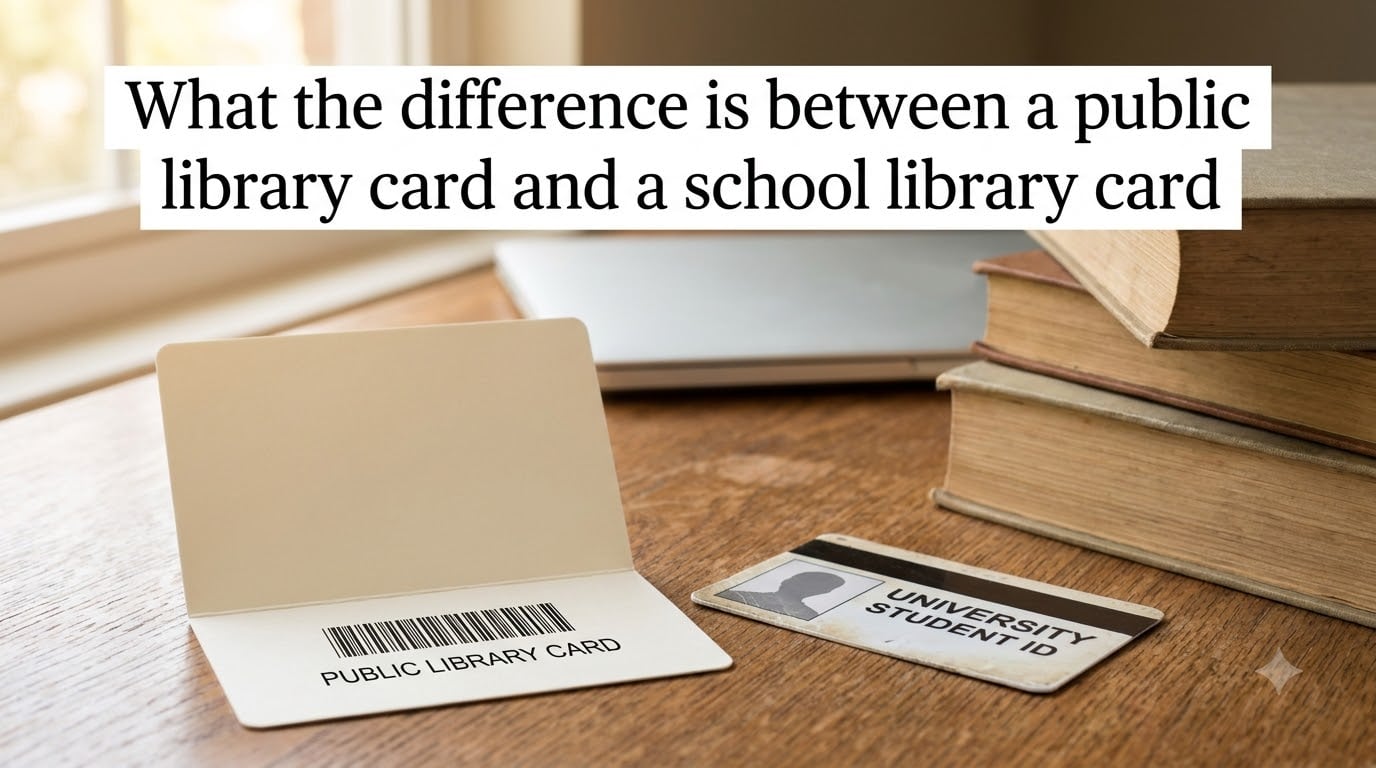
The difference between a public library card and a school library card comes down to who issues them, who can use them, and what resources each one unlocks. A public library card is issued by your local public library system and gives residents access to books, digital media, and community programs. A school library card is tied to an educational institution and serves students and staff within that school. Both are useful, but they work in different ways.
I have helped parents, students, and teachers sort through library card options for years, and I have seen the same confusion come up again and again. By the end of this guide, you will know exactly how each card works, what it gives you, and when it makes sense to hold both.
Table of Contents
What Is a Public Library Card?
A public library card is a free membership issued by your local public library system. It is available to residents who live within the library’s service area, and it unlocks borrowing privileges for physical and digital materials.
When you sign up, you typically get a physical card or a digital card number tied to your name. From there, you can borrow books, audiobooks, DVDs, and access streaming services, online databases, and museum passes through your library’s website.
Public libraries are funded by local taxes, which is why the card is free for residents. Some systems also offer cards to non-residents for a small annual fee, which is helpful if you live outside the service area but want access to those digital resources.
What Is a School Library Card?
A school library card is a card issued through a school, such as a K-12 public school, private school, or college. It is designed to support students, teachers, and staff with curriculum needs, homework help, and classroom reading.
Unlike a public library card, a school library card is usually managed by the school librarian or media center. In some school districts, like GCPS, the student’s school ID doubles as the library card. In others, students receive a separate card tied to the school’s catalog system.
School library cards generally grant access to the school’s physical collection and any digital databases the school subscribes to. They are not designed for casual browsing of bestsellers or community programs the way a public library card is.
Key Differences Between Public and School Library Cards
The biggest difference between a public library card and a school library card is scope. Public cards cover a community-wide collection and digital resources. School cards cover an academic collection tailored to the school’s curriculum.
Here is a quick side-by-side look at how they compare:
| Feature | Public Library Card | School Library Card |
|---|---|---|
| Issued by | Local public library system | School or school district |
| Who can get one | Residents, sometimes non-residents for a fee | Enrolled students, teachers, staff |
| Physical borrowing | Books, DVDs, audiobooks, sometimes tools | Books and media in the school library |
| Digital resources | E-books, audiobooks, databases, streaming | Curriculum-aligned databases, research tools |
| Community programs | Story times, classes, museum passes | Generally not included |
| Cost | Free for residents | Free for enrolled students |
| Loan periods | 2-3 weeks typical, with renewals | 1-2 weeks typical, limited renewals |
This table makes the practical gap clear. If you want the widest selection of reading material plus digital access, a public library card delivers more. If you need academic research tools aligned to your courses, a school library card is purpose-built for that.
Eligibility Requirements Comparison
Eligibility for a public library card usually hinges on residency. Most systems require proof of address, such as a utility bill, lease, or government mail, plus a photo ID like a driver’s license. Some libraries waive requirements for students enrolled in a local school.
School library cards do not require proof of address because eligibility is automatic once you are enrolled. The school verifies your student or staff status, and the card is issued through the library media center.
Here is a short eligibility checklist for both card types:
Public library card: Photo ID, proof of address (utility bill, lease, or government mail), sometimes proof of property ownership for non-resident fee waivers.
School library card: Active enrollment or employment with the issuing school. No ID or address proof required.
For college students, the rules get more interesting. Many college libraries only grant borrowing privileges to enrolled students, but some public libraries extend student exemptions for residency if you attend a school in their service area.
Borrowing Privileges and Checkout Limits
Public library cards typically allow more items per checkout than school cards. Most public systems let you borrow 10 to 50 physical items at a time, with loan periods of two to three weeks and easy online renewals.
School library cards are more restrictive because the collection is smaller and shared. The Chicago Public Library student card, for example, limits students to 5 physical items. Some schools limit checkout to 2-3 books at a time so every student has access to popular titles.
Renewals also work differently. With a public library card, you can usually renew items online as long as no one has placed a hold. School library renewals typically require a librarian’s approval, and reference materials often cannot be renewed at all.
Digital Resources Access by Card Type
This is where the public library card really shines. Most public library systems give you free access to e-books and audiobooks through apps like Libby or OverDrive, plus streaming services like Kanopy or Hoopla, and research databases such as JSTOR or Consumer Reports.
School library cards focus on academic databases aligned to K-12 or college coursework. Think ProQuest, EBSCO, Gale, and similar research platforms. These resources are great for papers and projects, but you will not find bestsellers or family entertainment here.
Many power users I know hold both cards so they can use school resources for academic work and public library resources for leisure reading, e-books, and streaming.
How to Get Each Type of Library Card?
Getting a public library card is straightforward. Visit your local branch with a photo ID and proof of address, fill out a short application, and you will usually walk out with a card the same day. Many systems now let you sign up online and use a digital card number immediately.
Getting a school library card happens at the start of the school year or when you enroll. Your school librarian will create the account, often linked to your student ID. There is no paperwork for families to fill out at home.
Quick steps for each:
For a public card: Find your local library’s website, check the eligibility list, gather ID and proof of address, and apply online or in person.
For a school card: Register at your school’s media center at the start of the term. Your librarian handles setup.
Can You Have Both a Public and School Library Card?
Yes, you can have both, and I recommend it for most students. Holding both cards gives you academic research tools from the school plus leisure reading, streaming, and community programs from the public library.
There is no rule against it. Each system is independent, and using both simply means more access. Many families in my network keep both active so kids can borrow school readers from the public library and supplement classroom assignments with public library e-books.
Just remember that school library cards typically expire when you graduate or leave the school. Public library cards stay active as long as you live in the service area, and most systems let you renew them online every few years.
Frequently Asked Questions
Can I use my school library card at the public library?
No, school library cards only work at the issuing school. To borrow from the public library, you need a public library card tied to your residency.
Can you have a library card at two different libraries?
Yes, you can hold library cards from multiple public library systems, and many students also keep a school library card. Each system is independent and there is no rule against having several active cards.
Do college students need a public library card?
It depends on your needs. Your college card covers academic research, but a public library card gives you access to bestsellers, streaming, and community programs most college libraries do not offer.
What are the three types of cards found in a library?
The three common types are public library cards, school library cards, and special or institutional cards such as teacher cards, non-resident cards, and digital-only cards.
Final Thoughts on Choosing the Right Library Card
The difference between a public library card and a school library card really comes down to who issues it and what it unlocks. Public library cards open the door to broad community resources, while school library cards focus on academic needs within a single school.
If you are a student, sign up for both. Your school card covers research and classroom needs, and your public card covers everything else, from weekend reading to free museum passes. Check your local library’s website today to see what is available in 2026, and ask your school librarian how to activate your student account.