
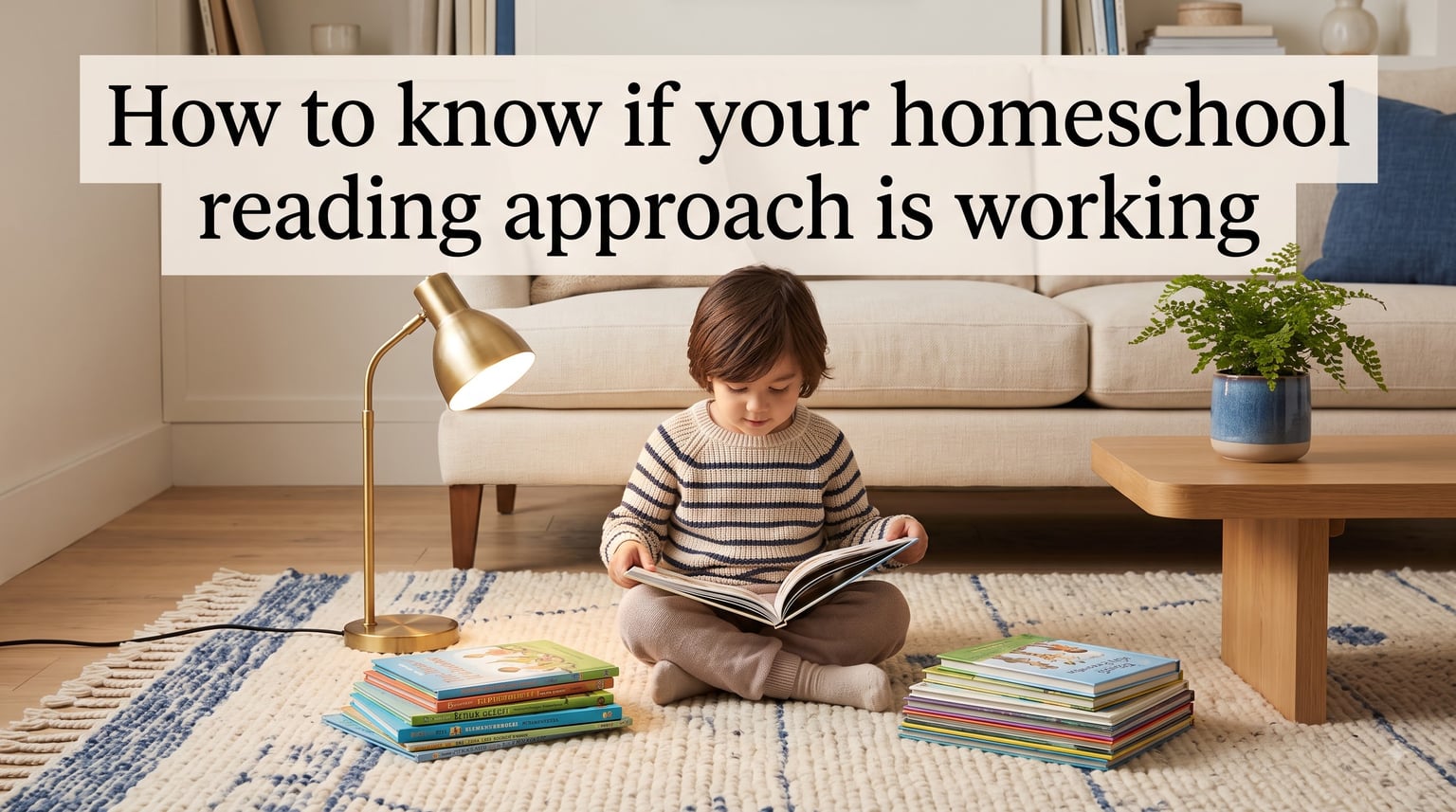
You know your homeschool reading approach is working when your child shows steady growth in both reading skill and enjoyment, reads independently without tears, and can talk back to you about what they just read. The clearest sign is a child who picks up a book on their own and stays with it — not because you assigned it, but because they want to.
If you have been second-guessing your curriculum or wondering whether your child is “on track,” this guide will help you understand how to know if your homeschool reading approach is working using practical, test-free indicators you can check today.
Many homeschool parents worry silently about whether they are doing enough. The fear often comes from comparing your child to a neighbour’s child or to grade-level benchmarks that were designed for classrooms, not kitchen tables. Let’s replace that anxiety with concrete signs you can look for.
Table of Contents
What “Working” Actually Means for Homeschool Reading
A working reading approach produces three things at once: growing skill, growing confidence, and growing enjoyment. Skill without enjoyment produces a child who can read but avoids it. Enjoyment without skill produces a child who loves stories but cannot access them independently. You need all three.
“Working” does not mean your child reads two grade levels ahead. It does not mean they finished a curriculum by May. It means they are moving forward at a pace that fits them, in a way that builds rather than breaks their relationship with books.
Think of reading success as a slope, not a step. A child climbing steadily, even slowly, is on track. A child who has stalled for months — or who is moving backward — needs your attention. The slope matters more than the speed.
It also helps to separate decoding (sounding out words) from comprehension (understanding them) from fluency (reading smoothly). A child can be strong in one and weak in another, and that is normal at different stages.
Signs Your Approach Is Working: Green Flags
These are the indicators I look for first when a parent asks me whether their reading instruction is on the right track. You do not need to see all of them every day, but you should see most of them most weeks.
Your child chooses to read on their own. This is the single most reliable sign that reading is working. When a child picks up a book without being asked, the approach is doing its job.
Reading stamina is growing. A child who could focus on a book for five minutes six months ago and can now sit with one for twenty minutes is making real progress, even if their decoding level looks similar.
They self-correct while reading aloud. When a child notices their own mistake and goes back to fix it, that shows they are monitoring meaning — not just parroting sounds.
They talk about what they read. Spontaneous retelling, asking questions about the story, or connecting the book to their own life all signal comprehension is happening.
They attempt unfamiliar words instead of shutting down. A reader who tries to sound out a hard word has confidence in their phonics tools. A reader who freezes or guesses wildly may need more support.
Reading time does not end in tears. Occasional frustration is normal. Daily tears are a signal, not a phase to push through.
They ask for the next book, chapter, or series. Hunger for more is the gold standard. If your child is begging for one more chapter, your approach is working.
Notice what is not on this list: reading at a specific grade level, completing a workbook, or scoring well on a quiz. Those are classroom metrics. Homeschool success is measured in engagement and steady growth.
Red Flags That Signal Your Approach Needs Adjustment
One bad day means nothing. A pattern over four to six weeks means something. Here are the warning signs worth taking seriously.
Consistent avoidance tactics. If your child needs the bathroom, a snack, or a sharp pencil every single time reading is mentioned, something about the approach is hurting.
Guessing instead of decoding. A child who looks at the first letter and guesses the rest of the word has learned a survival strategy, not a reading skill. This is common with whole-language-heavy instruction.
No progress in fluency over several months. If your child reads the same simple text just as haltingly in March as they did in October, the phonics foundation may have gaps.
Comprehension disappears with harder text. If your child understands a story you read to them but cannot understand the same level of text they read themselves, fluency is the bottleneck.
Physical signs of strain. Headaches, stomach aches, extreme fatigue, or claiming the words “move on the page” warrant a closer look. These can indicate visual processing issues or dyslexia.
You are dreading reading time too. If teaching reading has become a daily battle that damages your relationship, the approach — not the child — needs to change.
None of these red flags mean you have failed. They mean the current approach is a poor fit, which is exactly what assessment is supposed to reveal.
Green Flags vs Red Flags: Quick Comparison
Use this table as a fast pulse check. Run down the left column and count how many describe your child this month.
| Green Flag (Approach Working) | Red Flag (Adjust Approach) |
|---|---|
| Reads voluntarily for pleasure | Avoids reading at all costs |
| Attempts unfamiliar words | Guesses from first letter only |
| Self-corrects mistakes | Does not notice errors |
| Retells stories unprompted | Cannot recall what was just read |
| Stamina slowly increasing | Stamina flat for months |
| Asks for “one more chapter” | Asks “are we done yet?” |
| Connects books to real life | Reading feels like a chore |
| Reading time is mostly calm | Reading time ends in tears regularly |
If you see mostly green flags, keep doing what you are doing. If red flags dominate, jump to the assessment and learning-gaps sections below.
Simple Assessment Methods You Can Use at Home
You do not need a formal test to evaluate reading progress. These methods, pulled from experienced homeschool parents, give you a clear picture without making your child feel examined.
1. The Five-Finger Check
Hand your child a book at their interest level. Have them read one page aloud. For every word they cannot read, they hold up a finger. Zero or one finger means the book is too easy. Two or three fingers means it is just right. Four or five fingers means it is too hard for independent reading — though fine for read-aloud time.
2. Narration
After your child reads a short passage or chapter, ask them to tell you what happened in their own words. Do not quiz them with specific questions. Just listen. A child who narrates back the events in sequence, with detail and sometimes emotion, is comprehending well. A child who shrugs or gives a one-word answer may need easier text or more discussion.
3. Reading Aloud to You
Have your child read aloud to you for five minutes once a week. Note how many words they read correctly, how smoothly they group phrases, and how expressively they read. Track this informally over months. You will hear progress before you can measure it on paper.
4. Keep a Simple Reading Log
Write down the title, date, and one sentence of your child’s reaction to each book they finish. Over a few months, patterns emerge — which genres they love, when their stamina grew, when they moved from picture books to chapter books. This log becomes your most reassuring assessment tool.
5. Free Online Placement Checks
Programs like Reading Eggs and other reading platforms offer free placement tests that place a child at a reading level. Use these as a snapshot, not a verdict. They are useful for confirming what you already suspect and for spotting gaps you might have missed.
6. The Library Test
Watch what your child gravitates toward at the library when no one is steering them. Their choices tell you their true reading level and interests far more accurately than any assessment.
Age-Appropriate Progress Markers
Children learn to read on wildly different timelines. These markers are wide ranges, not deadlines. Use them as a compass, not a clock.
Kindergarten Through Grade 2 (Ages 5–8)
At this stage, expect children to learn letter sounds, begin blending sounds into words, recognise common sight words, and slowly move from decodable readers to simple storybooks. By around age 7 or 8, many children are reading easy chapter books with support.
Do not panic if your 6-year-old is not reading yet. Some children — especially boys and children with summer birthdays — simply need more time. Read aloud daily, surround them with books, and trust the process unless other red flags appear.
Grades 3 Through 5 (Ages 8–11)
This is the “reading to learn” stage. Children should be reading independently, building stamina with longer chapter books, and starting to understand different genres. Comprehension deepens — they begin to infer meaning, predict outcomes, and summarise plots.
If a child in this range is still struggling to decode, that is a stronger signal than the same struggle at age 6. Consider a structured phonics review or a screening for dyslexia.
Middle School (Ages 11–14)
By this stage, reading should feel automatic. The focus shifts to critical reading — understanding bias, comparing texts, and engaging with nonfiction. A child this age who still avoids reading entirely may have an unaddressed gap or an undiagnosed learning difference.
How to Identify and Address Learning Gaps
Learning gaps are normal. Every reader has them. The goal is not to prevent gaps but to notice them early and address them before they widen.
Spotting the Gap
A learning gap usually shows up as a specific sticking point. Your child might read smoothly until they hit a particular phonics pattern (like vowel teams or silent letters) and then fall apart. Or they might decode well but cannot answer a single question about what they read. The gap is usually narrow and specific.
Closing the Gap
Once you spot the gap, slow down and target it directly. Use decodable texts that focus on the missing skill. Spend five to ten minutes a day on just that pattern until it clicks. Then move on.
Resist the urge to abandon your entire curriculum because of one gap. A small targeted intervention beats a giant overhaul almost every time.
When the Gap Is Bigger Than a Lesson
If your child is multiple years behind and the gaps seem to be everywhere, step back to the foundations. A structured literacy program — something built on the science of reading with explicit, systematic phonics — is the most reliable route back to grade level. Programs based on Orton-Gillingham principles work well for struggling readers, including children with dyslexia.
Patience vs Problem: When to Wait and When to Act
This is the question homeschool parents ask most often: how do I know whether to give it more time or get help?
Give it more time when your child is young (under 7), shows interest in books, is making slow but visible progress, and reads without distress. Many late bloomers simply need another six months.
Act now when your child is over 7 and not making progress despite consistent instruction, when reading causes daily distress, when there is a family history of dyslexia, or when you see physical symptoms like eye strain or letters “moving.” In those cases, a professional screening is the kind, not the alarmist, choice.
The cost of waiting too long is a child who decides they are “bad at reading” and carries that belief for years. The cost of acting too early is usually just a bit of time and money spent on a screening that comes back normal. When in doubt, screen.
Frequently Asked Questions
What is the hardest age to homeschool?
Many parents find ages 7 to 9 the hardest stretch, because that is when reading is expected to click and children develop at very different speeds. The pressure to compare your child to grade-level benchmarks peaks here. Once reading fluency settles in, later years often feel easier.
How do I test my homeschooled child’s reading level?
You can use free placement tests from programs like Reading Eggs, run the five-finger check on library books, ask your child to read a short passage aloud and count correct words per minute, or use a standardised reading assessment such as the DORA or a Brigance screener. For most homeschoolers, a combination of reading-aloud observation and narration works as well as any formal test.
What is the 5 4 3 2 1 reading strategy?
The 5 4 3 2 1 strategy is a comprehension routine where students list 5 words, 4 phrases, 3 sentences, 2 questions, and 1 connection from a text. It forces engagement with what was read and doubles as a quick comprehension check. A similar and well-known framework is PQ4R: Preview, Question, Read, Reflect, Recite, Review.
What percentage of homeschooled kids are successful?
Studies routinely show homeschooled children scoring above the national average on standardised tests regardless of parent education level or income. Success in reading specifically is strongly linked to daily read-aloud time, access to books, and a parent who models reading for pleasure.
Trust What You Are Seeing
Knowing how to know if your homeschool reading approach is working comes down to watching your child, not a checklist. If they are growing in skill, confidence, and enjoyment — even slowly — your approach is working. If you see red flags clustering for more than a month, adjust with intention, not panic.
Keep reading aloud, keep books everywhere, and keep the relationship with your child bigger than the relationship with the curriculum. The single most powerful assessment tool you have is your own daily observation. You are closer to the answer than you think.