
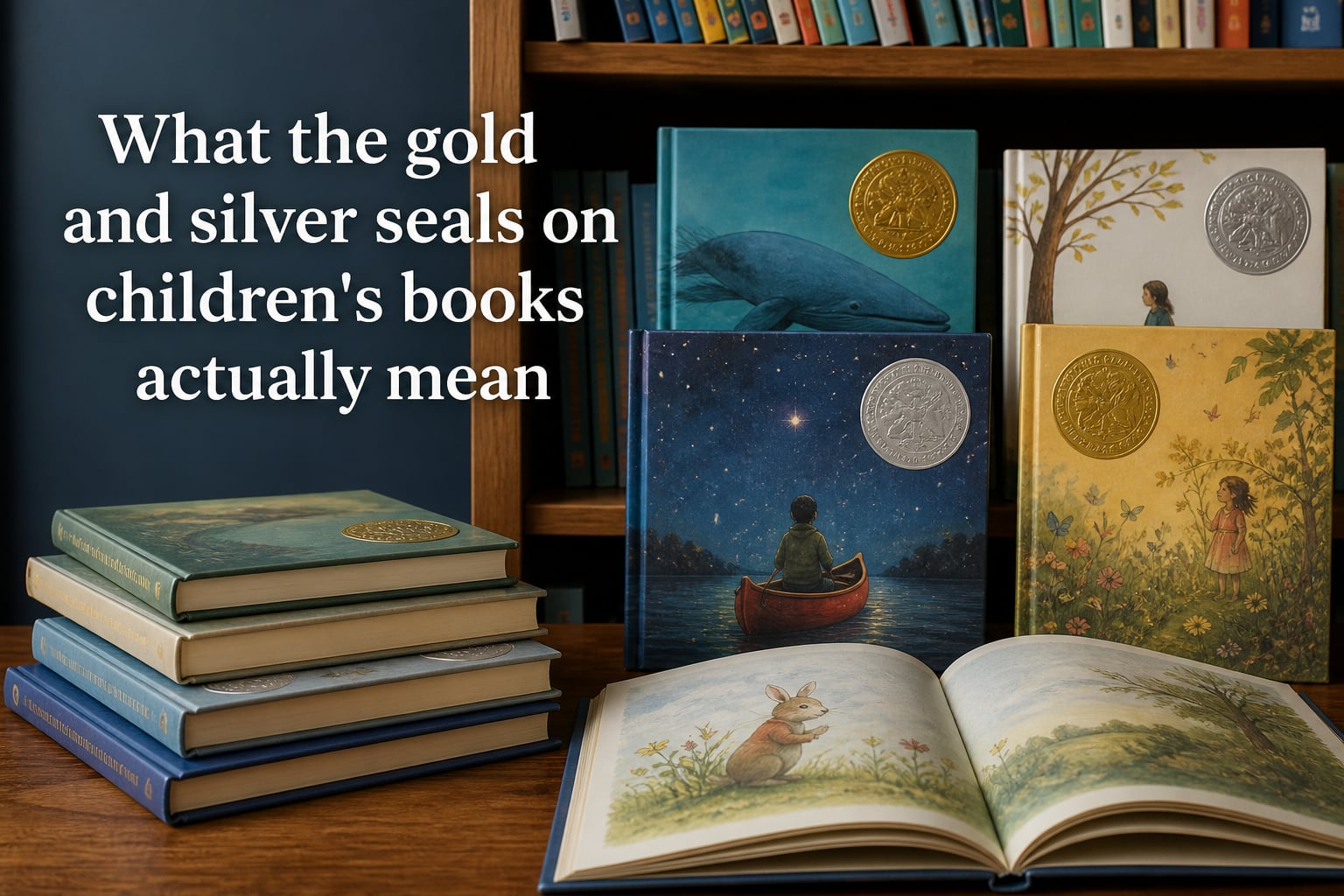
If you have ever picked up a children’s book and noticed a round gold or silver sticker on the cover, you are looking at something special. Those gold and silver seals on children’s books are not random decorations. They are marks of excellence awarded by the American Library Association (ALA) to the best children’s books published each year.
A gold seal means the book won the Medal, the top honor. A silver seal means the book was named an Honor title, which is essentially a runner-up. Both seals signal that a book has earned recognition from a committee of library professionals who read hundreds of books before making their selection.
Understanding what these seals mean helps parents, grandparents, teachers, and librarians quickly identify high-quality books. I have spent years helping families build home libraries, and these seals are one of the most reliable shortcuts for finding books worth your time and money.
Table of Contents
What the Gold Seal on a Children’s Book Means?
The gold seal on a children’s book cover marks a Medal winner, the single highest award given in its category for that year. When you see that round gold sticker, you are holding a book that a committee of librarians judged to be the absolute best of the best.
There are two main gold seals you will encounter. One features the profile of a child reading a book, representing the Newbery Medal for writing excellence. The other shows a rider on a galloping horse, representing the Caldecott Medal for illustration excellence. The design on the seal tells you which award the book won.
The seals are round and roughly the size of a half-dollar coin. Publishers affix them to the front cover of paperback editions and add them to the cover artwork of hardcover printings. The physical medals themselves are made of bronze, but the cover seals are printed in gold foil to make them instantly recognizable on bookstore and library shelves.
Each year, only one book receives the gold Newbery Medal and one book receives the gold Caldecott Medal. That exclusivity is what makes the gold seal so meaningful. Out of thousands of children’s books published annually, only two earn that top gold seal.
What the Silver Seal on a Children’s Book Means
The silver seal marks an Honor Book, which is the designation given to strong runner-up selections. These books did not win the Medal, but the committee determined they were worthy of special recognition. In the children’s book world, a silver seal is still a major achievement.
Unlike the gold Medal, which goes to exactly one book per award each year, multiple Honor books can be named. Some years see two or three Honor selections, while other years might recognize four or five. The committee has discretion to honor as many or as few books as they feel deserve it.
Honor books receive the same seal design as the Medal winner, but the foil is silver instead of gold. This visual distinction makes it easy to tell at a glance whether you are looking at the top winner or an Honor selection.
I often tell parents not to overlook silver-seal books. Honor selections are frequently just as beloved by children as the Medal winners, and sometimes more so. The selection process is subjective, and a book that did not win the gold can absolutely become a family favorite or a classroom staple.
The Newbery Medal: Gold Seal for Writing Excellence
The Newbery Medal is awarded each year to the author of the most distinguished contribution to American literature for children. If you see a gold seal with the image of a child reading a book, that is the Newbery Medal. It honors the writing itself, including the story, characters, themes, and prose.
Established in 1922, the Newbery Medal is the oldest children’s book award in the world. It was named after John Newbery, an eighteenth-century English bookseller who is often credited as the father of modern children’s literature publishing. The award has been given every year without interruption for over a century.
The Association for Library Service to Children (ALSC), a division of the American Library Association, administers the Newbery Medal. A committee of fifteen members reads and evaluates eligible books throughout the year before deliberating and voting at the ALA Midwinter Meeting, typically held in January.
Some of the most famous Newbery Medal winners include A Wrinkle in Time by Madeleine L’Engle (1963), Bridge to Terabithia by Katherine Paterson (1978), The Giver by Lois Lowry (1994), and The Graveyard Book by Neil Gaiman (2009). These books have sold millions of copies and are now considered classics of children’s literature.
The Newbery Medal typically goes to chapter books and middle-grade novels rather than picture books. That is because the award recognizes writing excellence, and longer text-based works give authors more room to demonstrate literary skill. However, picture books are eligible too, and a few have won over the years.
The Caldecott Medal: Gold Seal for Illustration Excellence
The Caldecott Medal is awarded each year to the artist of the most distinguished American picture book for children. When you see a gold seal featuring a rider on a galloping horse, you are looking at a Caldecott winner. Unlike the Newbery, the Caldecott specifically honors the illustrator, not the writer.
Established in 1938, the Caldecott Medal was created because many people felt the Newbery Medal overlooked picture books and illustration as an art form. The award was named after Randolph Caldecott, a nineteenth-century English illustrator whose work heavily influenced the development of children’s picture book illustration.
The selection criteria focus on what the committee calls “pictorial interpretation.” The committee evaluates the artistic technique, the appropriateness of the art style for the story, how well the illustrations carry the narrative, and the overall excellence of execution. The text matters only in how it relates to the pictures.
Famous Caldecott Medal winners include Where the Wild Things Are by Maurice Sendak (1964), The Polar Express by Chris Van Allsburg (1986), Officer Buckle and Gloria by Peggy Rathmann (1996), and The Adventures of Beekle: The Unimaginary Friend by Dan Santat (2015). These books are celebrated as much for their art as for their stories.
The Caldecott committee can name one Medal winner and multiple Honor books each year. Because picture books represent a different kind of achievement than novels, the Caldecott and Newbery awards complement each other perfectly. Together, they recognize the two main pillars of children’s literature: writing and illustration.
How the American Library Association Selects Winners
The selection process for both the Newbery and Caldecott Medals is rigorous and designed to identify genuinely outstanding books. Committees are composed of librarians and children’s literature experts who serve one-year terms. Members are elected by their peers within the ALSC division of the ALA.
Throughout the year, committee members read and evaluate books that publishers submit for consideration. The ALA defines eligible books as those originally published in the United States during the calendar year, written or illustrated by citizens or residents of the United States. This American focus is written into the award criteria.
The word that drives the entire evaluation is “distinguished.” The ALA defines this as marked by excellence in quality, notably or outstandingly individual, and distinguished by eminence, distinction, or excellence. Committee members debate what makes a book distinguished during months of discussion.
Winners are announced at a press conference during the ALA Midwinter Meeting in January. This announcement is one of the most anticipated events in the children’s publishing world. The moment the medals are revealed, publishers immediately begin adding gold and silver seals to new printings, and bookstores and libraries place large orders.
This transparent, committee-based process is exactly why these awards carry so much weight. The people making the decisions are not marketers or reviewers paid by publishers. They are independent library professionals whose job is to serve readers. That independence is the foundation of the trust those seals represent.
Other Award Seals You Might See on Children’s Books
While the Newbery and Caldecott Medals are the most famous, the ALA and other organizations award several additional seals you might spot on children’s books. Recognizing these seals gives you an even broader toolkit for identifying quality literature.
The Coretta Scott King Award honors African American authors and illustrators whose books demonstrate an appreciation of African American culture and universal human values. The award uses gold seals for the winning author and illustrator, with silver seals for Honor recipients. It has been awarded since 1970.
The Pura Belpre Award recognizes Latino writers and illustrators whose work best portrays, affirms, and celebrates the Latino cultural experience. Established in 1996, it is presented jointly by the ALSC and REFORMA, the National Association to Promote Library and Information Services to Latinos. Gold seals mark winners, and silver seals mark Honors.
The Theodor Seuss Geisel Award, named after the beloved children’s author, honors the most distinguished American book for beginning readers published each year in English. The seal features the Geisel name and is a reliable indicator that a book is well-suited for children just learning to read independently.
The Robert F. Sibert Informational Book Award goes to the most distinguished informational book for children. If your child loves nonfiction, animals, history, or science, the Sibert seal is one to watch for.
Each of these awards has its own seal design, so you can learn to recognize them just as you would the Newbery and Caldecott seals. The common thread is that all are administered by the American Library Association and follow the same rigorous committee-based evaluation process.
One thing to watch out for is that not every seal on a book cover represents a legitimate, rigorously judged award. Some publisher-created awards or pay-to-enter contests produce seals that look impressive but do not carry the same weight as ALA awards. If you see a seal you do not recognize, a quick search for the award name can tell you whether it is independently judged or essentially a marketing label.
How to Use Seals to Pick Great Books for Kids?
Now that you know what the gold and silver seals on children’s books mean, here is how to put that knowledge to work. These seals are a practical tool for building a quality home library, selecting gifts, or putting together classroom reading lists.
Start by training your eye to spot the round seals on book covers. Gold foil means Medal winner and silver foil means Honor Book. Then check the design on the seal to identify which award the book received. The child reading a book means Newbery, the horse and rider means Caldecott, and other designs correspond to the awards described above.
When you are at the library, ask the children’s librarian to point you toward the award shelf. Most public libraries maintain a dedicated section for Newbery and Caldecott winners, and many also shelve Coretta Scott King and Pura Belpre recipients there. This is one of the fastest ways to fill your reading list with proven books.
For gift giving, Medal winners are a safe bet because they represent the single best book in their category for that year. Honor books are equally strong choices, and sometimes easier to find because more titles receive the silver seal. Either way, you can feel confident that a book carrying an ALA seal has been thoroughly vetted by professionals.
If you want to explore beyond the most recent winners, the ALA publishes complete lists of all past Newbery and Caldecott Medal and Honor books going back to the awards’ founding. These lists are available free on the ALA website and are a goldmine for discovering older classics your child might love.
I have found that children themselves often learn to recognize the seals, too. Kids who know that the gold sticker means the book is award-winning often get excited to read it. That simple visual cue can turn book selection from a chore into a treasure hunt.
FAQs
What is the gold seal on children’s books?
The gold seal on a children’s book indicates that the book won the Newbery Medal or Caldecott Medal, the highest honor in its category. The Newbery Medal recognizes writing excellence, while the Caldecott Medal recognizes illustration excellence. Only one book wins each medal per year.
What is the silver seal on children’s books?
The silver seal marks a Newbery or Caldecott Honor Book, which is essentially a runner-up to the Medal winner. Honor books are still considered award-winning quality, and multiple Honor books can be named each year. The seal design matches the Medal winner’s but uses silver foil instead of gold.
What is the gold circle on books?
The round gold circle on a children’s book cover is the seal for a Newbery Medal or Caldecott Medal winner. The Newbery seal shows a child reading a book, and the Caldecott seal shows a rider on a galloping horse. Both are awarded annually by the American Library Association.
What is the highest award for children’s books?
The Newbery Medal, awarded annually since 1922 for the most distinguished contribution to American literature for children, is widely considered the highest award in children’s literature. The Caldecott Medal, awarded since 1938 for illustration, is its equivalent for picture books. Both are administered by the American Library Association.
What does it mean to be on the ALA Notable Children’s Book Award list?
Being on the ALA Notable Children’s Books list means a book was selected by a committee of the Association for Library Service to Children as one of the best children’s books published that year. The list includes fiction, nonfiction, picture books, and poetry. Notable books do not always carry a seal on the cover, but the designation is still a strong quality indicator.
What awards do children’s books get?
Children’s books can receive many awards, including the Newbery Medal for writing, the Caldecott Medal for illustration, the Coretta Scott King Award for African American authors and illustrators, the Pura Belpre Award for Latino creators, the Geisel Award for beginning readers, and the Sibert Award for informational books. All are administered by the American Library Association.
Conclusion
Those gold and silver seals on children’s books carry real meaning. Gold means a Medal winner, the single best book in its category for that year. Silver means an Honor Book, a recognized runner-up that is still among the finest children’s literature available. Both are awarded through a rigorous, transparent process run by the American Library Association.
Next time you are shopping for a children’s book or browsing the library shelves, look for those round seals. They are one of the most dependable ways to identify books that have been judged by professionals to be truly outstanding. Whether gold or silver, a seal from the Newbery, Caldecott, or other ALA awards tells you that the book in your hands is something special.