
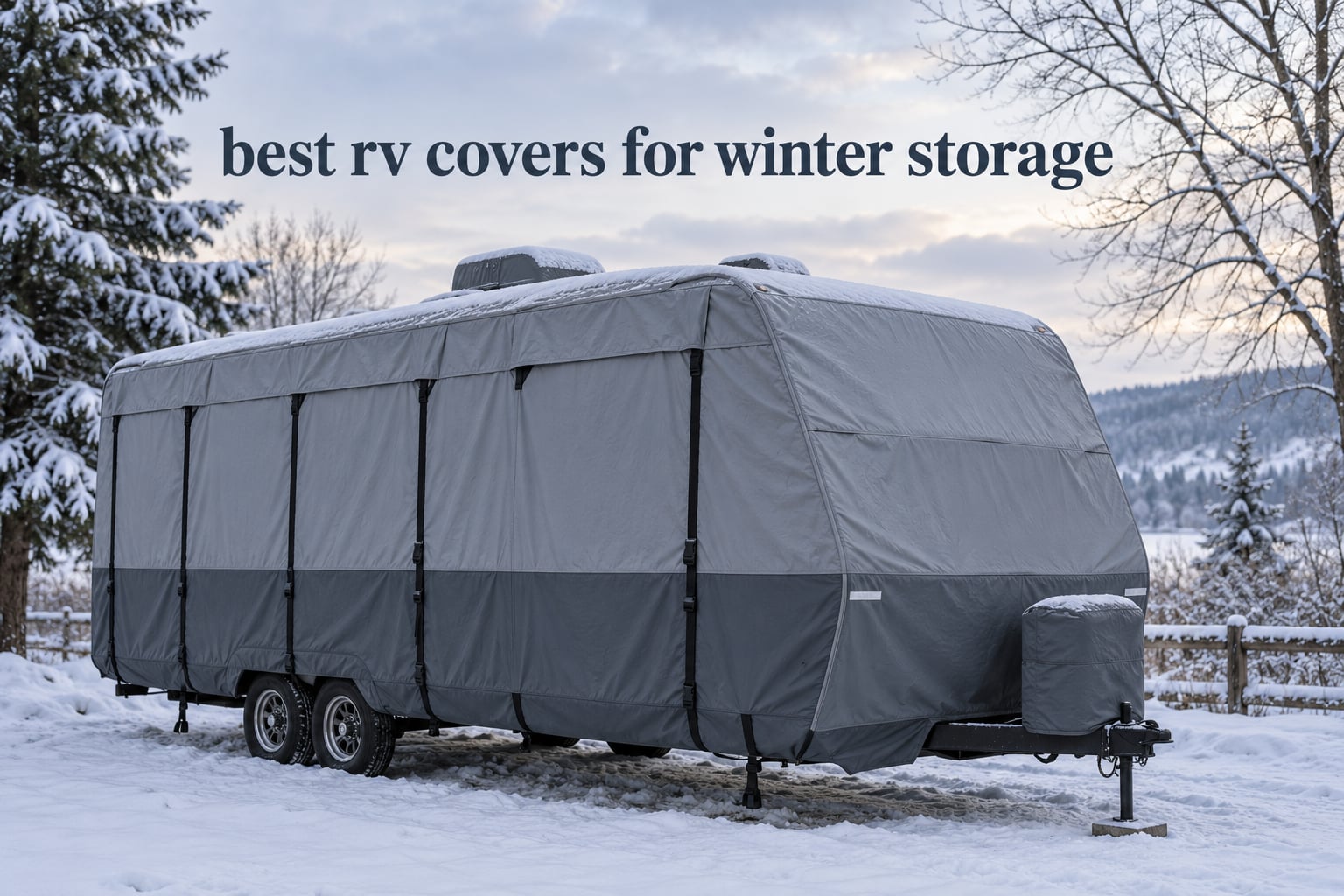
An uncovered RV sitting outside through January and February takes a slow, steady beating. Snow loads the roof, freeze-thaw cycles work at every seal and trim strip, UV keeps oxidizing paint and decals, and one stiff storm can leave a limb or a satellite dish pointed somewhere else entirely. That is why the best RV covers for winter storage exist, and why choosing the right one matters more than most buyers expect.
We looked at every layer count, strap system, vent layout and warranty term across the current crop of winter covers, and we read what owners actually report after a few seasons rather than a few weeks. The eight covers below are the ones that hold up when the wind finds a hem. All of them are sized for outdoor long-term storage, which is a different job than the thin sheets sold for weekend weather.
Storage indoors always beats storage under a cover, and we will say that plainly before the product list starts. If you have a barn, a pole barn or a dealer lot with covered space, use it. Everything here is for the majority of owners storing a rig in a driveway, at a campground pad or in an open storage yard. If you are building out the inside of your rig this winter, our guide to TVs for RV use is the other project worth getting right, and on the weeks the rig is not stored at all, our kids table and chair sets roundup covers the indoor half of winter life.
Table of Contents
Should You Even Cover an RV for Winter?
Yes, an RV cover is worth it for winter storage as long as the fabric is breathable, the vents are real, and the cover is tight enough that it cannot flap. Indoor storage is better, and a cover is the second-best option. A cover blocks snow, ice, hail, UV and tree debris, and it cuts the spring cleanup, but a non-breathable or loose cover traps condensation and does more harm than good.
That conditional matters. The forum consensus across RV owner groups is blunt: a well-fitted cover with side and roof vents prevents mold, and a loose or non-breathable one causes it. Clean and dry the rig before you cover it. That single habit separates covers that last five winters from covers that dry-rot after two.
Top 3 Picks for RV Covers for Winter Storage in 2026
Mofeez 9-Layer Cover, 24-27 ft
- 9-layer tear-resistant build
- 6 ventilation ports
- Roll-up zipper door
- Full accessory kit

Leader Accessories Windproo…
- 9-layer composite top
- 4 zippered panels and 6 vents
- Reinforced buckle system
- 2-year warranty

Umbrauto 9-Ply Cover, 24-27 ft
- 9-ply roof with 3-ply sides
- 6 air vents and 4 zippered panels
- Wind ropes and extra straps
- 3-year warranty
Best RV Covers for Winter Storage (October 2026)
| Product | Specs | Action |
|---|---|---|
| Mofeez 9-Layer Cover, 24-27 ft |
|
Check Latest Price |
| Leader Accessories Windproof, 27-30 ft |
|
Check Latest Price |
 RVMasking 9-Layer Cover, 22-24 ft RVMasking 9-Layer Cover, 22-24 ft |
|
Check Latest Price |
| Umbrauto 9-Ply Cover, 24-27 ft |
|
Check Latest Price |
 VINPATIO 9-Layer Cover, 20-22 ft VINPATIO 9-Layer Cover, 20-22 ft |
|
Check Latest Price |
 DikaSun 9-Layer Fifth Wheel, 34-37 ft DikaSun 9-Layer Fifth Wheel, 34-37 ft |
|
Check Latest Price |
 FRUNO Oxford Cover, 37-41 ft Fifth Wheel FRUNO Oxford Cover, 37-41 ft Fifth Wheel |
|
Check Latest Price |
 K-Musculo 8-Layer Cover, 18-20 ft K-Musculo 8-Layer Cover, 18-20 ft |
|
Check Latest Price |
1. Mofeez 9-Layer Cover for 24-27 ft Travel Trailers
Mofeez Travel Trailer RV Cover 9 Layers for 24′-27′ Camper Cover RV Covers
9-layer tear-resistant build
Fits 24-27 ft trailers
330 x 102 x 104 inches
34.8 pounds
Pros
- Thick 9-layer panel with 110g non-woven sides
- 6 ventilation ports plus a roll-up zipper door
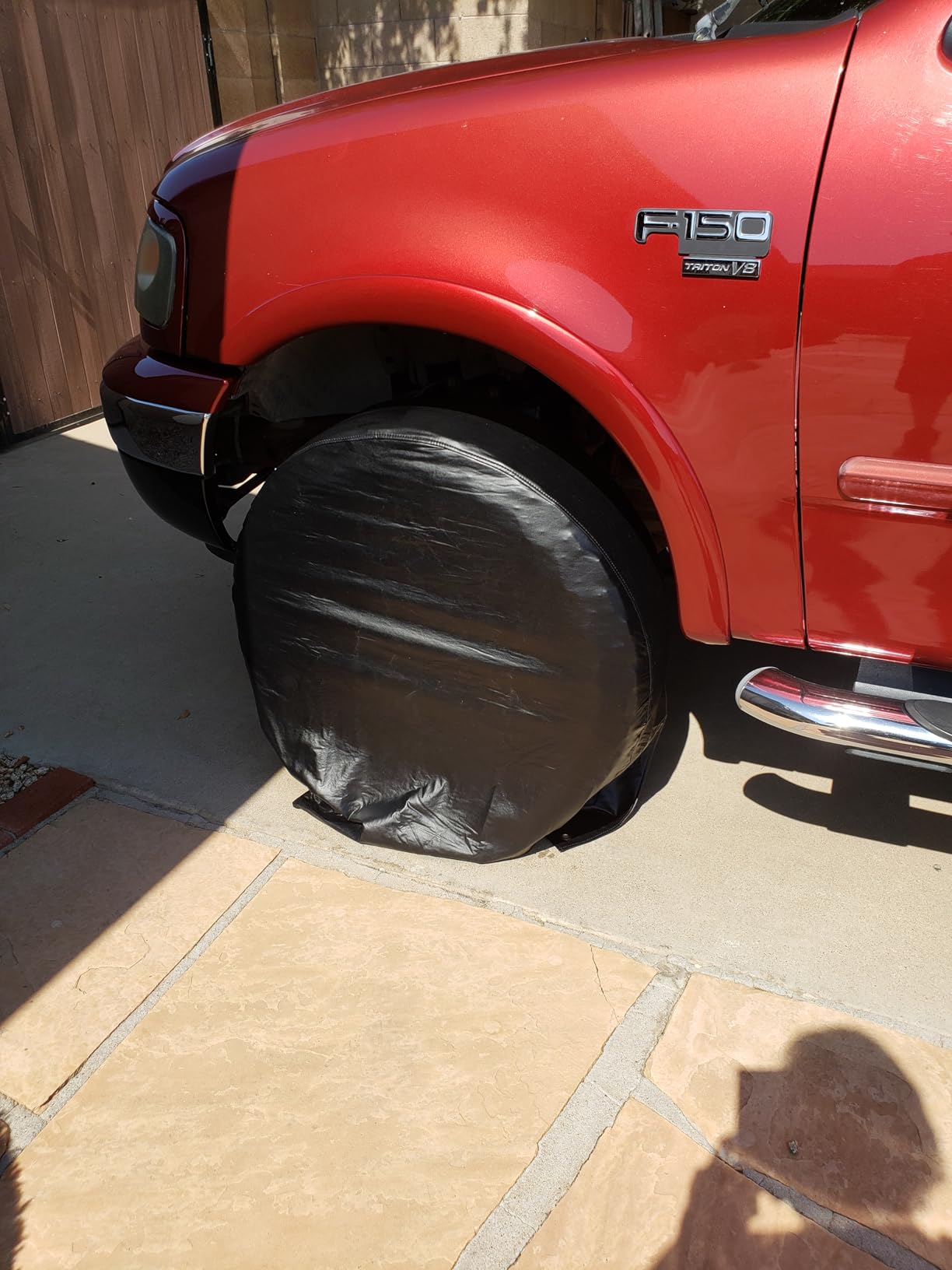
- Accessory kit includes tire covers
- jack cover
- ladder cover and 6 gutter covers
- Reflective strips front and rear
- Weighted buckle toss bag speeds up installation
Cons
- Vehicle specific fit
- so measurement errors show immediately
- Loose material can bag at the rear if you size up
This is the cover I keep coming back to for mid-size travel trailers. The build is a 9-layer panel structure with 110g non-woven side fabric, which is the combination that decides whether a cover survives a windy January or splits along a seam by the second spring. It weighs 34.8 pounds, so it is not a one-person job on a 25-footer without a step ladder.
What sets it apart from the crowd is the accessory kit. You get four tire covers, a tongue jack cover, a ladder cover, six sponge gutter covers, adhesive repair patches, a storage bag, four elastic hook bands and a weighted buckle toss bag. That toss bag is a small thing that saves a great deal of frustration on a tall trailer, because it throws the weighted end of each bottom strap to the far side instead of you leaning under the rig.
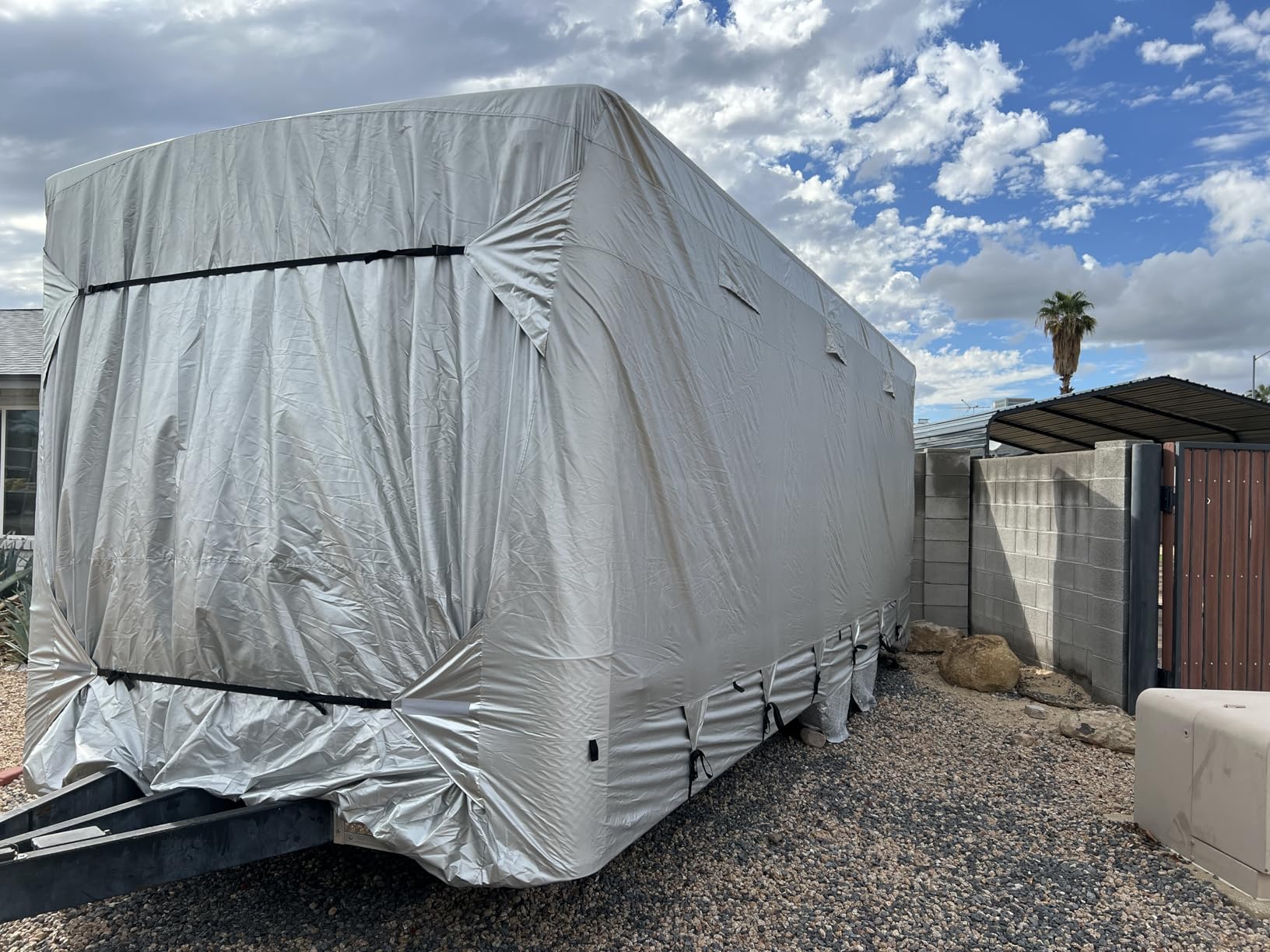
The ventilation is the other reason it earns the top spot. Six side ventilation openings let trapped vapor escape, and the roll-up zipper door means you can get to the interior without stripping the whole cover in a rainstorm. Owners consistently call out the zipper and the reflective strips as the features they did not expect to use and now rely on every time.
Reviewers report a genuine 4.5 average across more than three thousand reviews, and the recurring praise lines up with what we looked at: thick material, a complete kit, and a strap system that holds. The honest limitation is sizing. Fit is vehicle specific, so if you are between sizes, buy the smaller one, because extra material bags at the rear and becomes a sail.
What you should check before ordering
Measure your trailer including the ladder, the spare tire and any rooftop AC, then compare against the listed 330 x 102 x 104 inch footprint. If your rig is right on the boundary of the 24 to 27 foot range, work out which measurement is actually driving your decision before you commit.
Also decide how many people are installing it. The 34.8 pound weight is realistic to wrestle over a 30-foot trailer solo, but far more pleasant with one helper and a ladder on hand.
Where it falls short
Vehicle specific sizing means there is no forgiving universal fit, and sizing up is the common owner error we saw repeated. Loose excess material at the rear catches wind and rubs the finish, which is the exact problem the cover was supposed to prevent.
Count the accessories against what you already own. If your rig came with a ladder cover and you store it indoors for the rest of the year, part of this kit is redundant. That is a fair trade against a heavier, thicker roof panel.
2. Leader Accessories Windproof Cover for 27-30 ft Travel Trailers
Leader Accessories Windproof 27-30 ft Travel Trailer RV Cover Extra Thick
9-layer composite top
Fits 27-30 ft trailers
366 x 102 x 104 inches
Water repellent
Pros
- 9-layer composite fabric with waterproof membrane and UV coating
- Reinforced windproof system with elastic corner hems and inner locking buckles
- 4 rollable zippered panels plus 6 air vents
- Kit covers tire covers
- jack cover
- ladder cover
- 6 gutter protectors and storage bag
- Reflective front and rear strips
Cons
- Average rating trails the leaders in this list
- Side panels are 110g non-woven
- thinner than the reinforced top
- Some reports of long-term fabric or seam failure after several seasons
This cover has the largest review count in the group, and it is the one most owners describe installing in about half an hour. The top is a 9-layer thickened composite with a waterproof membrane and a high-density UV coating, and the windproof system is the selling point: front and rear tension panels, elastic corner hems and inner locking buckles that hold the bottom down without pinching the fabric.
It is listed as a universal fit rather than a vehicle specific fit, which makes it easier to order on a deadline. The listed footprint is 366 x 102 x 104 inches, and it weighs 34.8 pounds, essentially the same as our top pick.
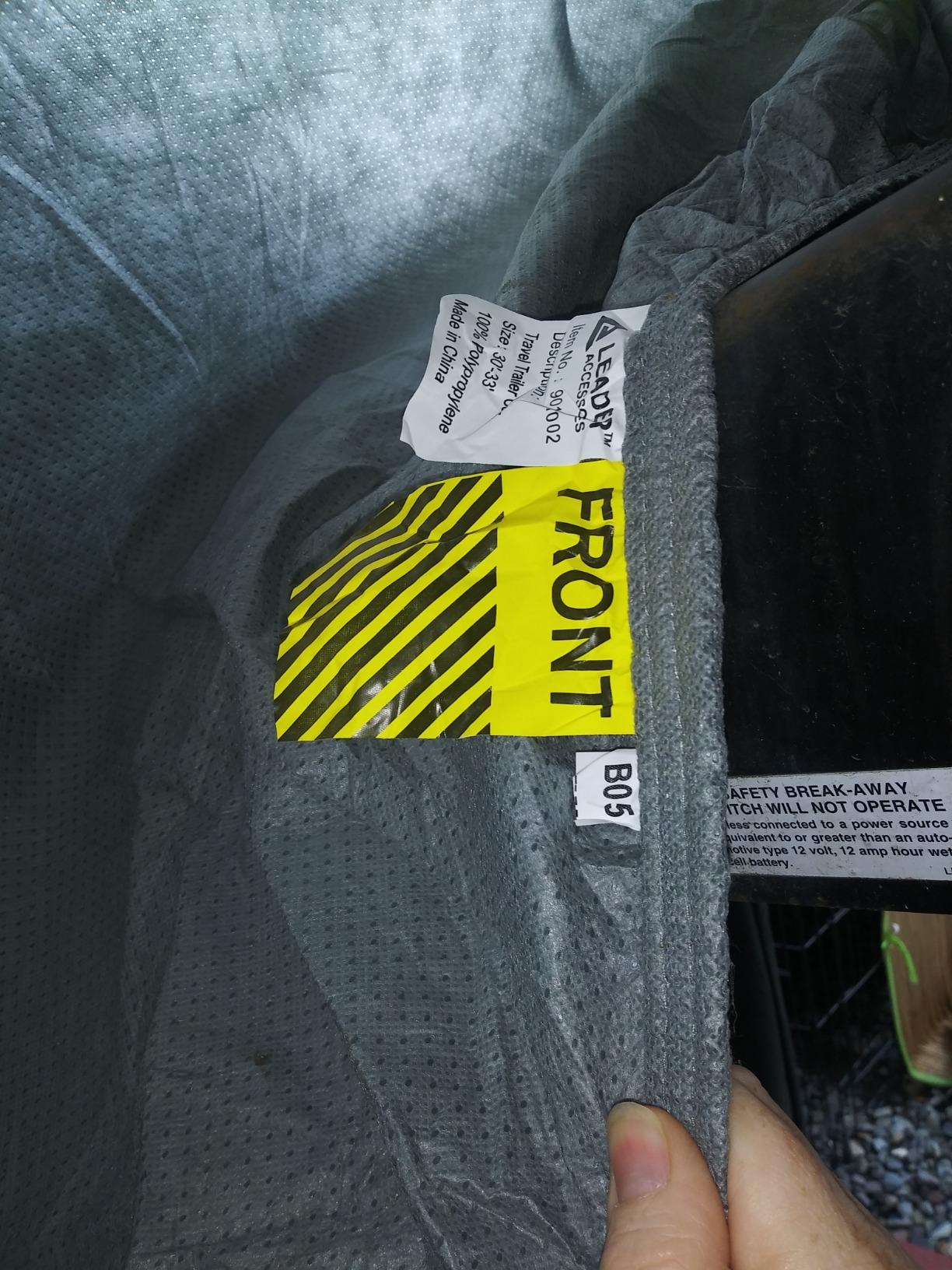
The bundled kit is generous. Four tire covers, a tongue jack cover, a toss bag, a ladder cover, a repair patch, six gutter protectors and a storage bag all come in the box. For an owner buying once and forgetting about it for five months, that removes most of the extra shopping.
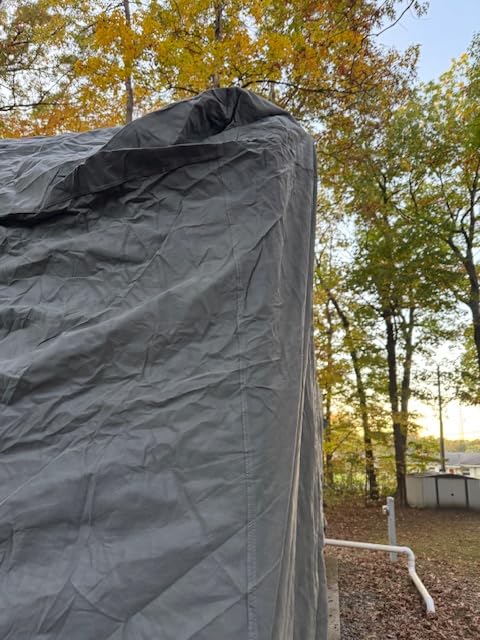
Here is the trade-off. Its 4.1 average is the lowest of the covers we recommend, and the review distribution shows a real share of one-star reports, mostly about fabric degradation or seam and strap failure after multiple seasons. Owners also note that the side panels are 110g breathable non-woven, noticeably thinner than the reinforced top, so the sides are the first place to inspect each spring.
What you should check before ordering
Decide whether the universal fit works for your roofline. If you have a tall rooftop AC or a raised air conditioner shroud, the listed height of 104 inches is tight, and a cover that fits the width but not the height is useless.
The included repair patch is worth keeping. Owners who patch small tears in the side fabric early report that the cover stays in service; owners who leave them until spring find the tear has run.
Where it falls short
Thin side fabric and a mixed long-term durability record are the two soft spots. If you are storing in a high-wind plains location or right on a shoreline, a heavier side panel is worth the step up.
Some reviews also report incomplete accessory shipments. Check the box against the list before you put the cover on, because a missing gutter protector is easy to overlook and hard to replace later.
3. RVMasking 9-Layer Cover for 22-24 ft Travel Trailers
RVMasking Travel Trailer RV Cover, 9-Layer Heavy Duty Waterproof,22-24ft
9-layer non-woven fabric
Fits 22-24 ft trailers
Over-roof and bottom straps
Reinforced 8 corners
Pros
- Extra-long horizontal bottom strap plus over-roof straps resist billowing
- 9-layer non-woven fabric with 4% anti-UV composite
- Reinforced patches on all 8 corners with heightened rear patches
- Generous kit with tire covers
- propane tank cover
- jack cover and 6 gutter covers
- Responsive warranty service
Cons
- Corner failure reported under heavy snow load after several seasons
- Hand-cut repair patch with no roof-material patching
- One-inch straps are narrower than some competing covers
- Strap labelling in the manual is ambiguous
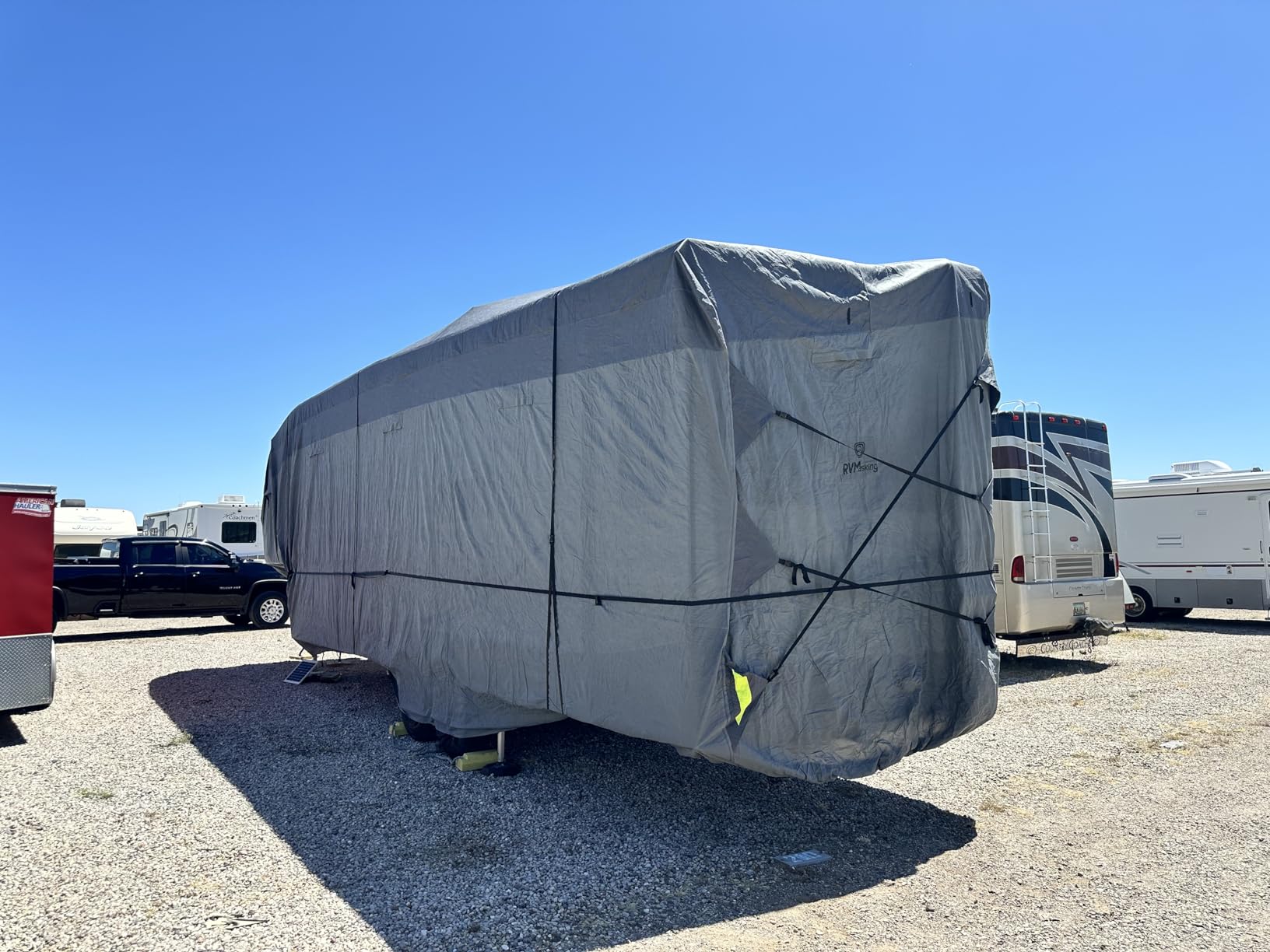
If you want the most aggressively strapped cover in this roundup, this is it. The extra-long horizontal bottom strap runs across the full width beneath the trailer, and the over-roof straps cross the ridge, so the cover cannot billow away from the sides in a gust. That is the single most common failure mode we found in owner discussions, and this design attacks it head on.
The fabric is 9-layer non-woven with a 4% anti-UV composite and a water-repellent outer coating. All eight corners get reinforced patches, and the rear corners get heightened patches sized for the edge of a ladder. That detail matters more than it sounds, because ladder corners are exactly where covers usually give up.
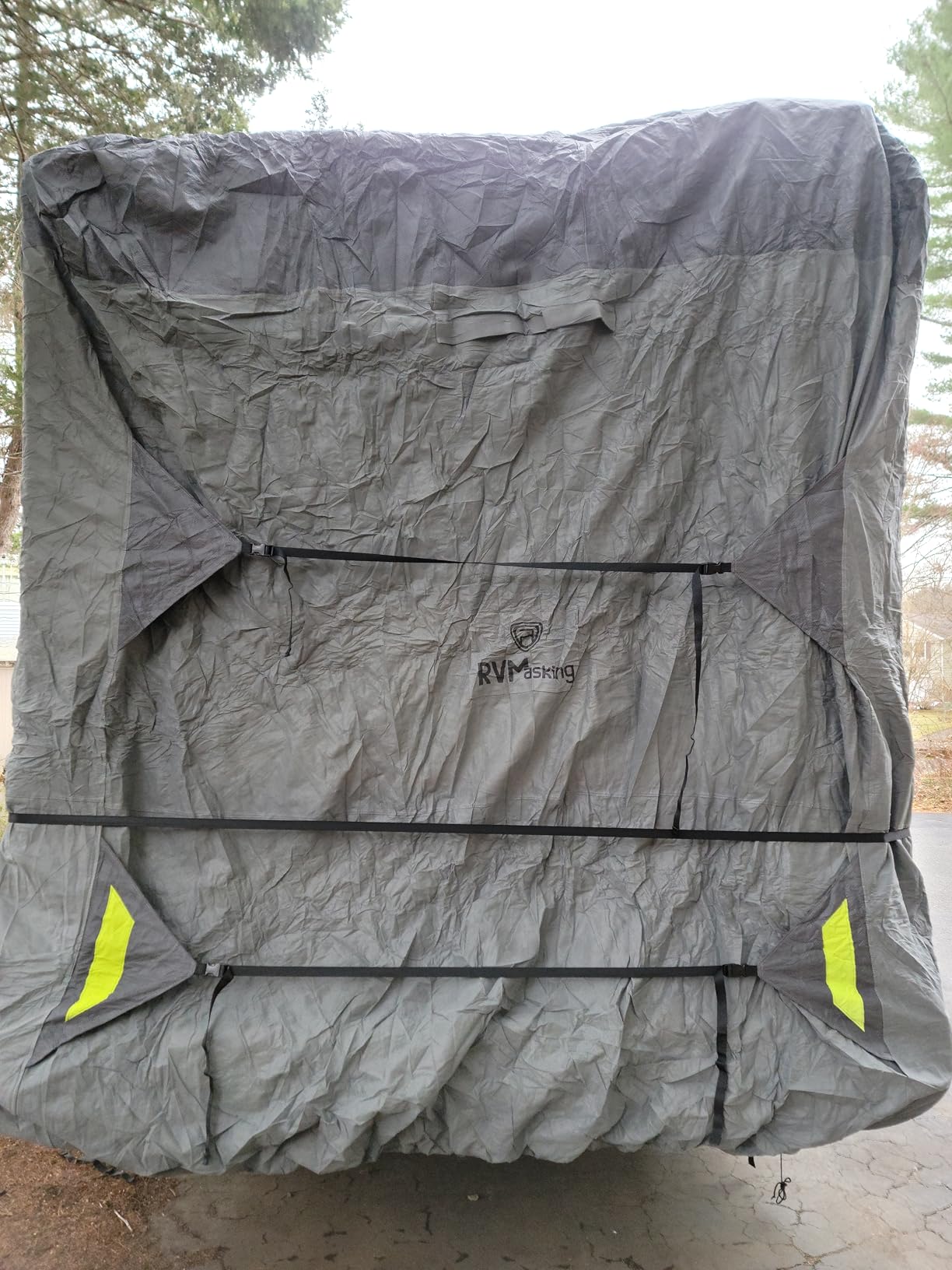
Long-term owners report three to four winters of service and praise the multiple strapping methods and the zipper hardware. The accessory kit is also the widest here in some ways: four tire covers, a propane tank cover, a tongue jack cover, six gutter spout covers, weighted toss sticks and a repair patch.
There is one failure pattern we would watch closely. Reviews report tearing at roof-mounted air conditioner corners under heavy snow load after a few seasons. If your trailer carries a roof AC and you are in a snow belt, plan to clear snow off the cover through the winter rather than letting it sit and load those corners.
What you should check before ordering
Confirm your trailer falls in the 22 to 24 foot range for the variant you are ordering. Sizing varies by variant on this cover, so the number on the listing matters more than the brand.
Read the strap diagram before you install. Owners specifically flag that the manual labelling is ambiguous, and mislabeled anchors are the fastest way to end up with one side tighter than the other.
Where it falls short
The repair patch is hand-cut and does not include roof-material patching, so it fixes a side panel tear but not a roof panel. On a cover this heavily loaded in wind, that is a real gap rather than a minor one.
The straps are one inch wide, narrower than some competing covers. That is fine in moderate conditions, but on an exposed site in a high-wind region, wider straps would be preferable.
4. Umbrauto 9-Ply Cover for 24-27 ft Trailers and Toy Haulers
Umbrauto Travel Trailer RV Cover 24′ ~ 27′ – Upgraded 9-Layers Top Camper Cover, Waterproof & Windproof Heavy Duty Toy Hauler RV Cover for Winter Snow with Tongue Jack Cover, Gutter Covers
9-ply roof with 3-ply sides
Fits 24-27 ft campers
6 air vents and 4 zippered panels
3-year warranty
Pros
- 9-ply non-woven roof with 3-ply reinforced sides and UV additives
- 6 bottom windproof straps
- internal reinforced buckles and 3 extra straps
- 6 air vents to reduce wind pressure and speed drying
- 4 zippered panels
- reflective strips and weighted buckle toss bag
- 3-year warranty with responsive service
Cons
- Bottom straps can loosen through a windy season and need re-tightening
- Sewn-in strap anchors can pull free in severe storms on larger rigs
This is the most thoughtfully reinforced cover in the roundup on a per-dollar basis, and the only one that combines a 9-ply roof with separately rated 3-ply side panels. That split build is what makes it heavier to install but far more durable where it counts, since the roof takes snow and sun while the sides take wind.
The securing system is unusually dense: six bottom windproof straps, internal reinforced buckles, and three extra body-securing straps. The kit adds six wind ropes, three extra windproof straps, a tongue jack cover, a ladder cover, a storage bag, six sponge gutter covers and a repair patch.
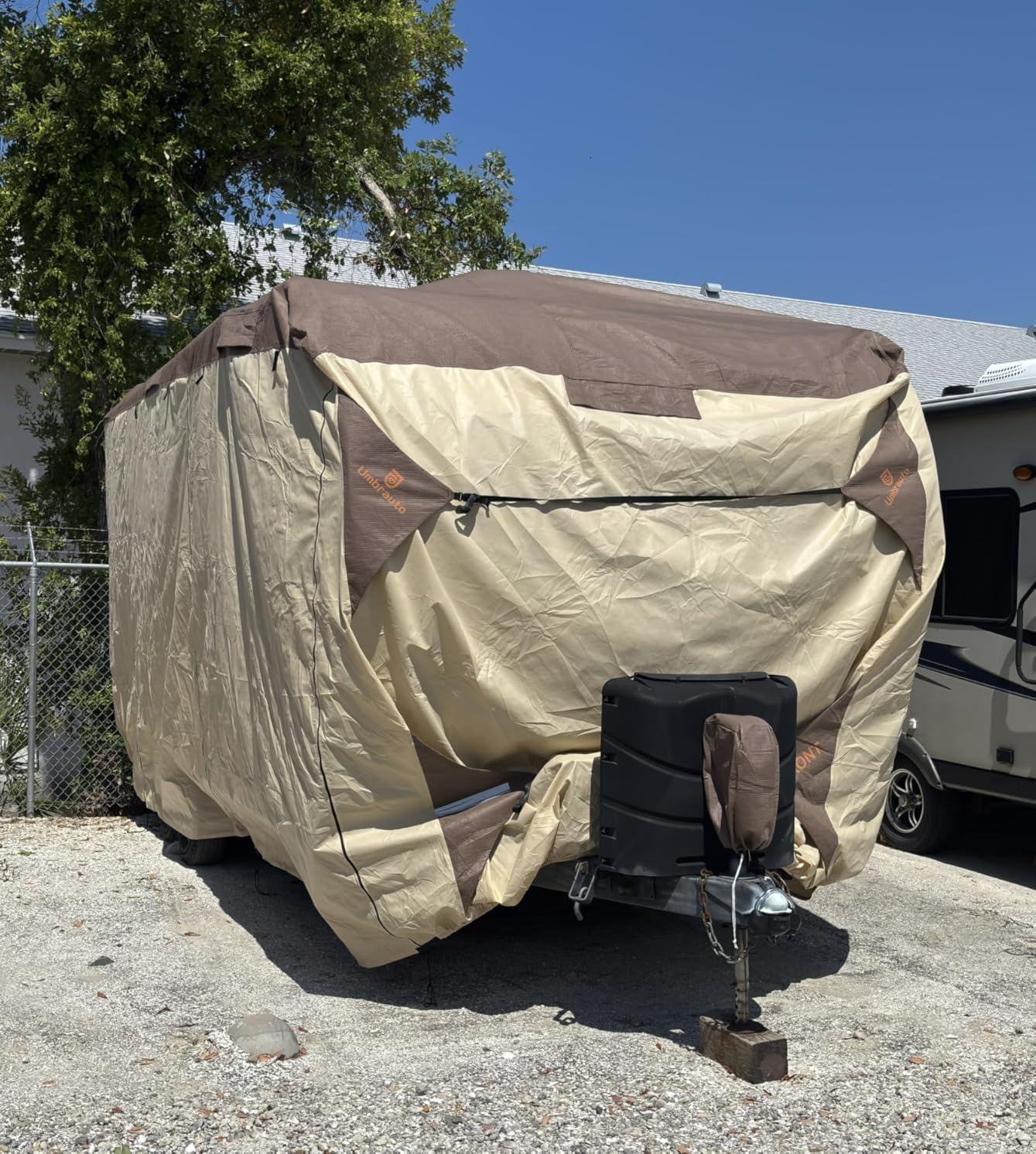
Six air vents positioned to reduce wind pressure and speed drying, four zippered access panels, and reflective strips front and rear round out a feature list that is generous without being padded. The warranty runs three years, which is longer than most covers in this class.
Owners report easy installation, a close fit and good all-season protection, and customer service is described as fast, with warranty replacements shipped at no cost. The complaint worth knowing is that bottom straps loosen over a windy season and need periodic re-tightening, which is a five-minute job if you check monthly and a disaster if you never check at all.
What you should check before ordering
Measure before purchase, as the listing instructs. Fit is vehicle specific, and the difference between the 24-foot and 27-foot variants is meaningful on a curved front cap.
Plan for two people. The layered build is not light, and installing it solo on a tall trailer is where most of the frustration in reviews comes from.
Where it falls short
One detailed report describes clip failure at sewn strap positions on a large rig in a severe storm. The straps themselves held; the sewn anchors did not. If you are covering a big coach rather than a trailer, that is a specific risk to weigh.
Loose hardware also means a scheduled maintenance commitment. Budget a walk-around every month or so between October and March, which is realistic for anyone already checking on a stored rig.
5. VINPATIO 9-Layer Cover for 20-22 ft Trailers
VINPATIO RV Cover 20-22ft: 9 Layers Heavy Duty RV & Trailer Cover, Travel Trailer Cover, Camper Cover, Toy Hauler Cover with Extra Windproof Straps, Tongue Jack Cover, Gutter Covers
9-ply non-woven top
Fits 20-22 ft rigs
2000mm PU coating
3-year warranty
Pros
- Top upgraded from 3 layers to 9-ply non-woven with waterproof membrane and anti-UV treatment
- 100% waterproof PU coating rated to 2000mm
- 4 rollable zippered doors
- 3 on the right side and 1 at the rear
- Windproof straps plus 6 sponge drain gutter covers
- 3-year warranty honored with fast replacement
Cons
- Runs large
- so excess material can lead to seam tearing in high wind
- Sharp edges should be padded before installation
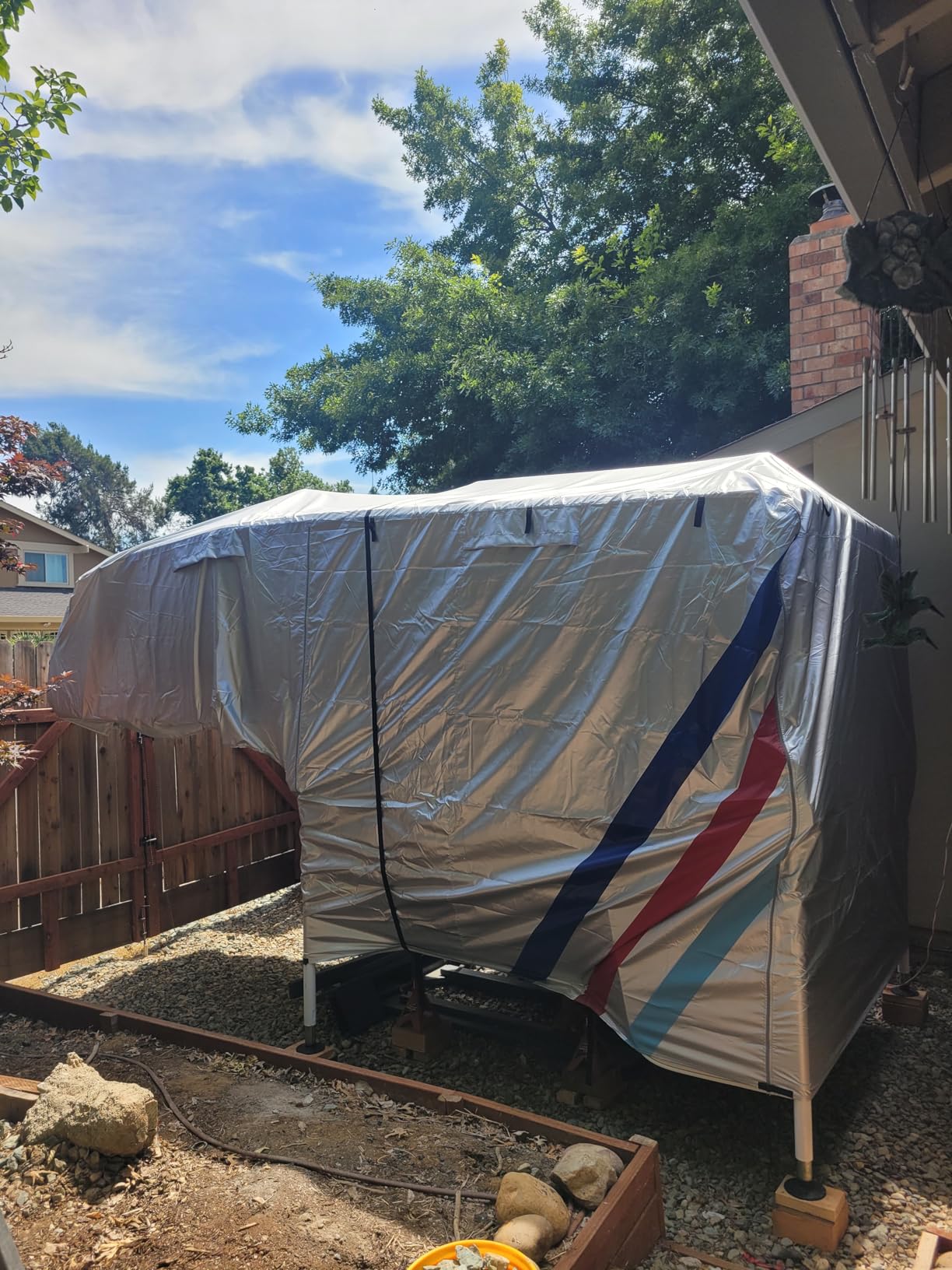
Small trailers get skipped in most roundups, which is odd, because pop-ups and short travel trailers are the easiest to cover badly. The most common mistake is buying a cover from a much larger class, and this one is correctly sized for 20 to 22 foot rigs.
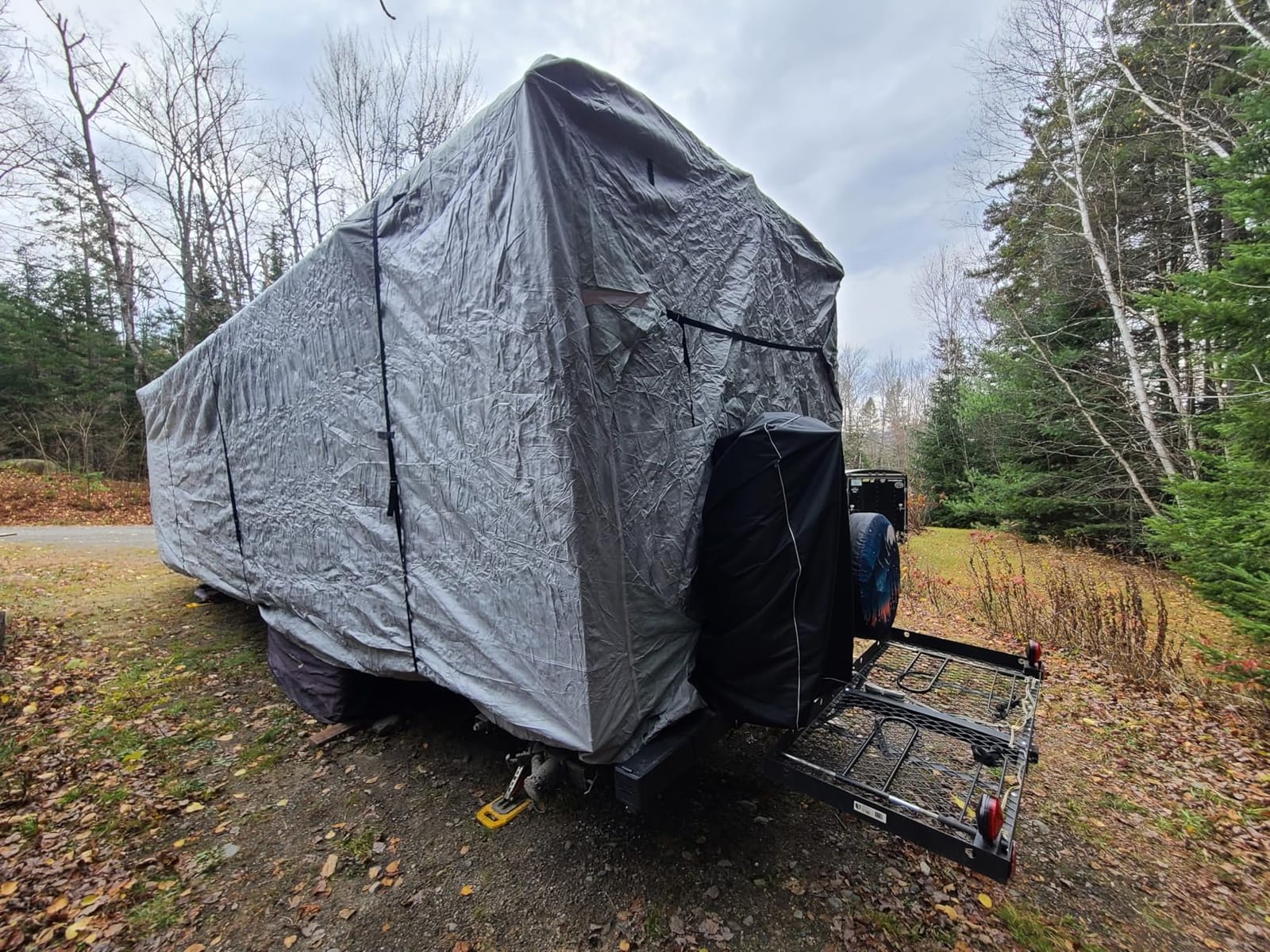
The build is a 9-ply non-woven top with a built-in waterproof membrane and anti-UV treatment, backed by a PU coating rated to 2000mm. That rating is the useful number here, since it describes how much standing water the fabric sheds before it wicks through.
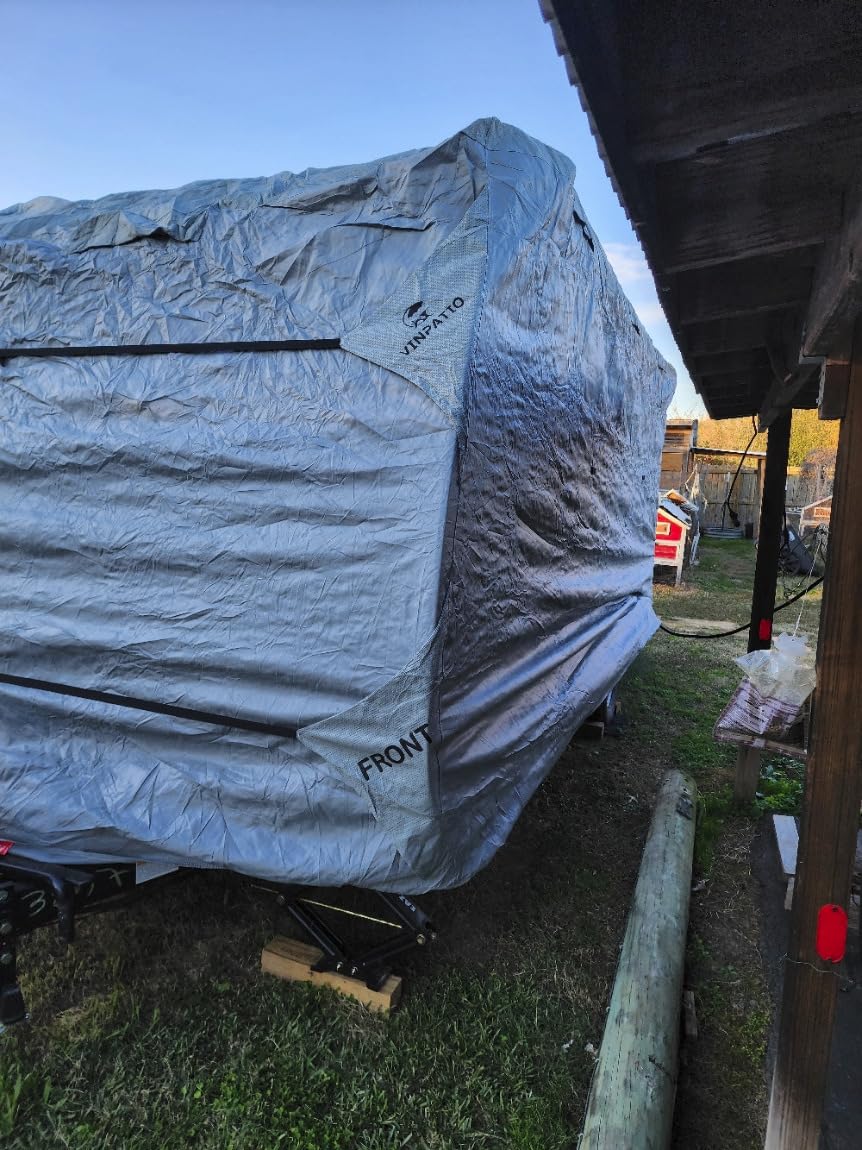
Four rollable zippered doors, three along the right side and one at the rear, give you interior access without removing the cover. Six sponge drain gutter covers protect the roof edge during installation, which matters because installing over sharp trim is the most common source of small tears.
Owners report a snug, well-made cover that installs quickly, survives storms without rips and repels water effectively. The three-year warranty is repeatedly highlighted as fast and hassle-free, including no-cost replacements.
What you should check before ordering
This cover runs generously, which several buyers treat as a feature because the excess material also reaches the tanks and tongue. Decide which view you have. If you want a close fit, size down rather than up.
Pad sharp roof edges with towels or foam before you install. This is the brand’s own recommendation, and it is good advice for any non-woven cover.
Where it falls short
Extra material becomes a liability in high wind. If excess fabric bags and the seams start to carry load, that is where the tearing reports come from, so this is a fair-weather-trailer cover more than an exposed-site cover.
The listed protection level is water resistant with a PU coating, rather than the fully waterproof labeling used by some competitors. For most climates that difference is academic, but in a driving-rain region it is worth noting.
6. DikaSun 9-Layer Cover for 34-37 ft Fifth Wheels
5th Wheel RV Covers 34′ ~ 37′, Upgraded 9-Layers Top Heavy-Duty Fifth Wheel Travel Trailer Cover, Windproof Waterproof Toy Hauler Camper Cover RV Skirting for Winter Snow Protection
9-ply top with extra UV protection
Fits 34-37 ft fifth wheels
450 x 102 x 121 inches
3-year warranty
Pros
- 9-ply non-woven top with breathable polypropylene for bird waste
- dust and scratch protection
- UV protection stated 25% above ordinary covers
- Elastic bottom hem with adjustable chassis-crossing straps and front tension panels
- 4 rollable zippered panels with anti-scratch sleeves plus 4 vent flaps per side
- Reflective panels and full securing kit included
Cons
- Waterproofing is inconsistent across sizes
- with leaking reported on smaller variants
- Under-trailer securing straps can be too short in wind
- Buckle stitching has pulled out on some covers
- Material can snag on sharp roof edges during installation
Fifth wheels are the hardest covers to buy well, mostly because the pin box changes the shape of the front and no travel trailer cover fits them properly. This one is listed at 450 x 102 x 121 inches for 34 to 37 foot fifth wheels, with the manufacturer instruction to add a foot for roof AC.
The top is a 9-ply non-woven with breathable polypropylene, and the brand states UV protection runs 25% above ordinary covers. For a fifth wheel parked in an open lot with no shade all winter, that is a meaningful spec rather than marketing filler.
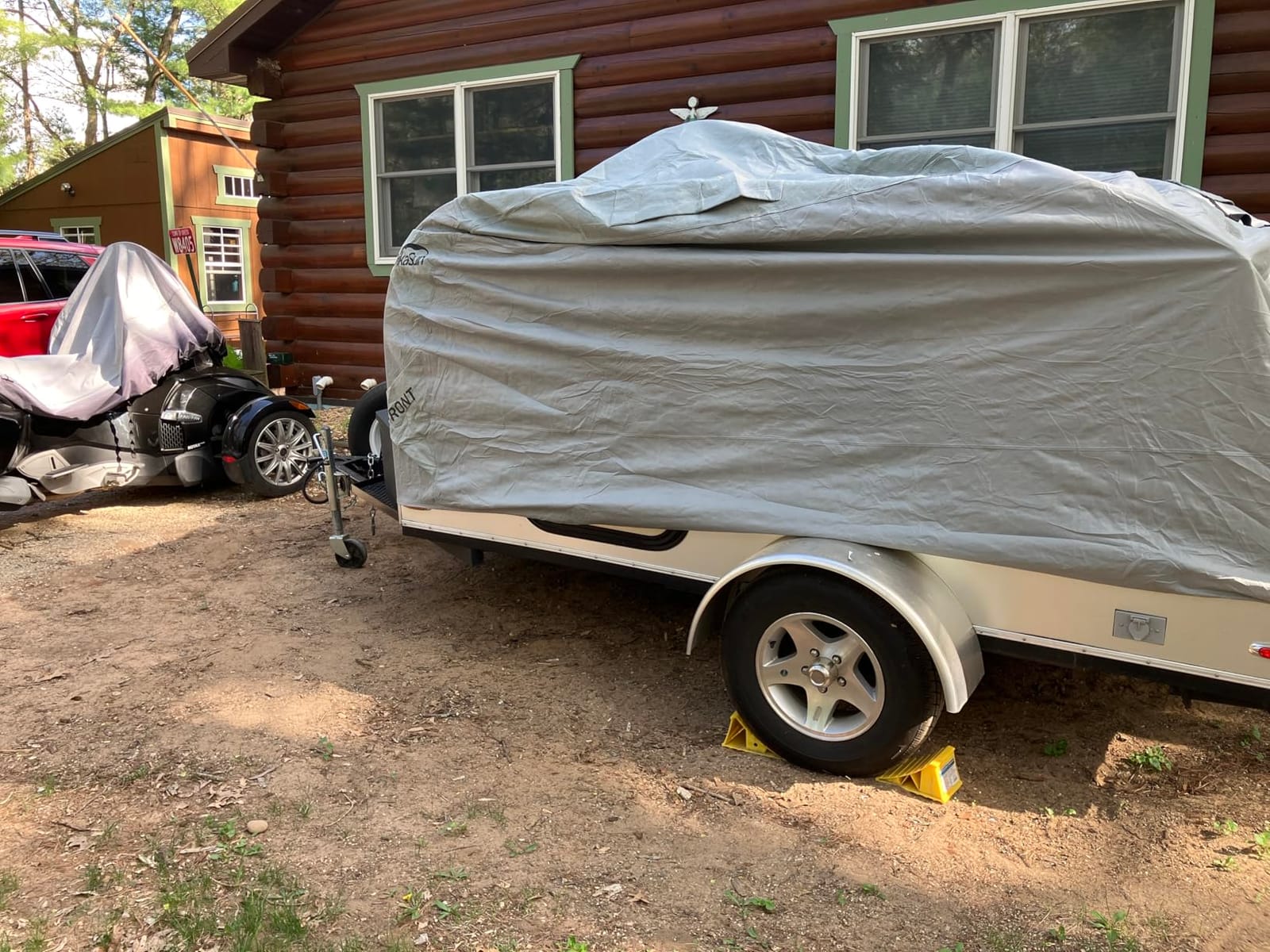
The bottom edge uses an elastic hem with adjustable straps that cross under the chassis, plus front tension panels. That combination is what stops wind getting underneath and lifting the whole cover, which is the failure mode owners describe most often with tall fifth wheels.
Four rollable zippered panels come with anti-scratch sleeves, and there are four air vent flaps per side, which is the highest vent count in this roundup. Owners report accurate sizing, good sun protection and plenty of tie-down points.
What you should check before ordering
Confirm your fifth wheel is in the 34 to 37 foot band and add a foot if you have a roof AC. Measure including the bumper, ladder and spare tire.
Check the under-trailer strap length on your particular chassis. This is the cover’s most reported weakness in wind, and on some frame configurations the standard straps fall short.
Where it falls short
Waterproofing is inconsistent. Reviews on smaller variants of this brand report leaking and roof pooling, so treat the waterproof labeling with care if you are buying a short version of a similar cover.
Some buckle stitching has pulled out of position, and the material can snag on sharp roof edges during installation. Padding the edges, as we recommend for any woven cover, reduces the risk.
7. FRUNO Oxford Fabric Cover for 37-41 ft Fifth Wheels
FRUNO Oxford Fabric 5th Wheel RV Cover Fits 37′-41′ Waterproof Rip-Resistant Anti-UV Fifth Wheel Toy Hauler Camper Cover for Winter Snow with 4 Tire Covers and Gutter Covers
300D Oxford top with 150D sides
Fits 37-41 ft fifth wheels
Rated -4F to 120F
2-year support
Pros
- Heavy-duty 300D Oxford top with 150D Oxford sides and dense PU coating
- Rated for extreme temperatures from -4F to 120F
- Side-mounted straps plus elastic hem
- tension panels and 2 lashing straps
- 4 rollable zippered panels with concealed velcro straps
- Set includes 4 tire covers
- 6 gutter covers
- 2 repair patches and a storage bag
Cons
- Heavier and bulkier than non-woven covers
- so a two-person install
- Instructions are in poor English and hard to follow
- One report of seams and zipper seams separating within weeks
Every other cover in this roundup is non-woven or composite. This one is a true woven Oxford build, with a 300D top, 150D sides and a dense PU coating, and it carries a stated temperature range of -4F to 120F. If your storage site hits deep cold, that rating is the reason to look here first.
Wind security is handled with side-fixed straps, an elastic hem, adjustable front and rear tension panels and two separate lashing straps. Four rollable zippered panels use concealed velcro straps, which hold them in place for prolonged access rather than flapping loose while you work.
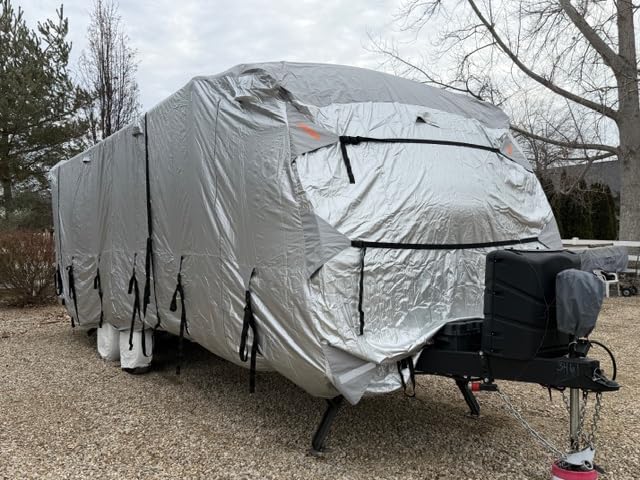
Owners in snowy and rainy regions report the fabric stays waterproof, sheds snow and resists wind without shifting, and they credit the reinforced corner patches for reducing tearing. That is exactly the durability profile you want on a 40-foot rig through a northern winter.
Installation takes roughly 45 minutes to two hours depending on conditions, and owners consistently describe it as easier with helpers. Customer service is praised for no-questions replacement under the two-year support term.
What you should check before ordering
Confirm the fit measurement: include the bumper, ladder and spare tire but exclude the hitch. On a fifth wheel that sounds obvious, and it is still the most common ordering mistake we see described.
Budget for a helper. Woven Oxford fabric is heavier and bulkier than non-woven alternatives, and the install is genuinely a two-person job on a rig this size.
Where it falls short
The instructions are in poor English and hard to follow on orientation. Owners work around it, but allow more time and expect to look at photos rather than diagrams.
One review reports seams and zipper seams coming apart within weeks. It is a single report rather than a pattern, but on a cover this heavy it is worth photographing the seams after installation so you have a record.
8. K-Musculo 8-Layer Corner Cover for 18-20 ft Trailers
K-Musculo RV Cover, Heavy Duty Travel Trailer Cover with 8-Layer Corner Protection, Windproof & Waterproof Camper Cover with 4 Tire Cover & Tongue Jack Cover(18-20 FT
8-layer corners, 4-layer top
Fits 18-20 ft trailers
240 x 105 x 108 inches
6 vents
Pros
- 8 layers of corner fabric and 4 layers on top for anti-scratch protection
- Kit includes 10 securing straps
- 6 gutter covers
- 4 tire covers
- 2 repair patches and a storage bag
- 4 side vents plus 2 front and rear vents reduce wind pressure and moisture
- One rollable zipper door and 5 reflective strips for night visibility
Cons
- Material is thinner than some buyers expect
- Effectively a two- or three-person install with thin instructions
- Bulky to fold back into the storage bag
This is the entry point for pop-ups and very short travel trailers, and it solves the sizing problem cleanly. The listed footprint is 240 x 105 x 108 inches for 18 to 20 foot rigs, and the manufacturer is explicit that you measure including the ladder, spare tire, AC and antennas.
The build puts the material where damage happens: eight layers of corner fabric and four layers across the top. That is a sensible allocation of weight, since corners are what contact sharp trim and what owners report failing first on cheaper covers.
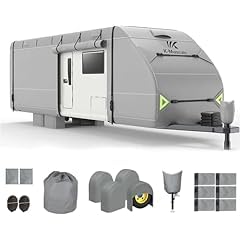
Ten securing straps come in the kit, which is the highest strap count here, along with six gutter covers, four tire covers, two repair patches, a tongue jack cover and a storage bag. Four side vents plus two front and rear vents keep air moving under the cover, which is the difference between a cover that prevents mold and one that causes it.
Owners confirm a good fit when measured correctly and report strong wind and snow performance for the size. They also note that the cover is lightweight and easy to remove once you are familiar with it.
What you should check before ordering
Measure thoroughly before you order. Fit is vehicle specific, and the measurement guidance on this listing is the most complete of any cover here, including the explicit instruction to include rooftop accessories.
Plan for help. Owners consistently describe this as a two- or three-person install, and one report mentions difficulty getting it over a larger fifth wheel, so it is worth keeping to a smaller trailer.
Where it falls short
The material is thinner than some buyers expect, and the instructions are minimal on some variants, with joined words that make the diagrams harder to read.
It is bulky to fold back into the storage bag. That sounds cosmetic, but a cover you resent packing is a cover that gets left crumpled in a corner, and crumpled covers develop mildew in the off-season.
How to Measure Your RV for the Right Cover
Getting the measurement right matters more than the brand. A cover that is one size too small will not go over the AC unit, and one size too large bags in the wind and rubs your finish. Take ten minutes and a tape measure before you order.
Measure the length from the front of the front cap to the rear bumper or spare tire. Do not include the hitch or tongue jack.
Measure the width at the widest point of the rig, including any slide-out housings or exterior storage.
Measure the height from the ground to the highest point, and add the height of your roof AC unit if one is fitted.
Include antennas, the ladder, roof vents and any satellite dish in the height measurement.
Compare all three numbers against the listed dimensions, not just the foot length in the product name.
If you fall between two sizes, choose the smaller option for a vehicle specific fit and the larger option only if you want the cover to reach the tongue and tanks.
Two points of confusion come up repeatedly in owner discussions. First, roof AC units are the number one reason covers get returned, and the guidance from the manufacturer site versus retailers sometimes differs. Measure your actual AC height and add it yourself rather than relying on either. Second, published dimensions sometimes refer to the packed product rather than the deployed footprint, so confirm against the fit range stated for your trailer length.
Cover Materials and Layer Count Explained
Layer count is the number buyers fixate on, and it matters, but it is not the whole story. A 9-ply cover with a thin, loosely woven side panel will fail at the side long before the roof gives up. Look at where the material is thickest and how the seams are finished.
Polypropylene and non-woven fabrics are the dominant construction in this roundup. They are lightweight, inexpensive, tear-resistant and easy to fold, and they handle UV well. Their weakness is edge abrasion, which is exactly why reinforced corner patches exist and why you should pad sharp trim before installing.
Woven Oxford fabric is heavier and bulkier, but it resists snagging and holds its shape under load. FRUNO uses a 300D Oxford top with 150D sides, and owners report it sheds snow and holds position in wind better than non-woven covers of similar price.
A waterproof membrane or PU coating is what separates a rain cover from a water-resistant one. VINPATIO publishes a 2000mm PU coating rating, which is a concrete number you can compare rather than a vague waterproof claim. Mofeez, Umbrauto and DikaSun all specify membranes or protective coatings in the top panel.
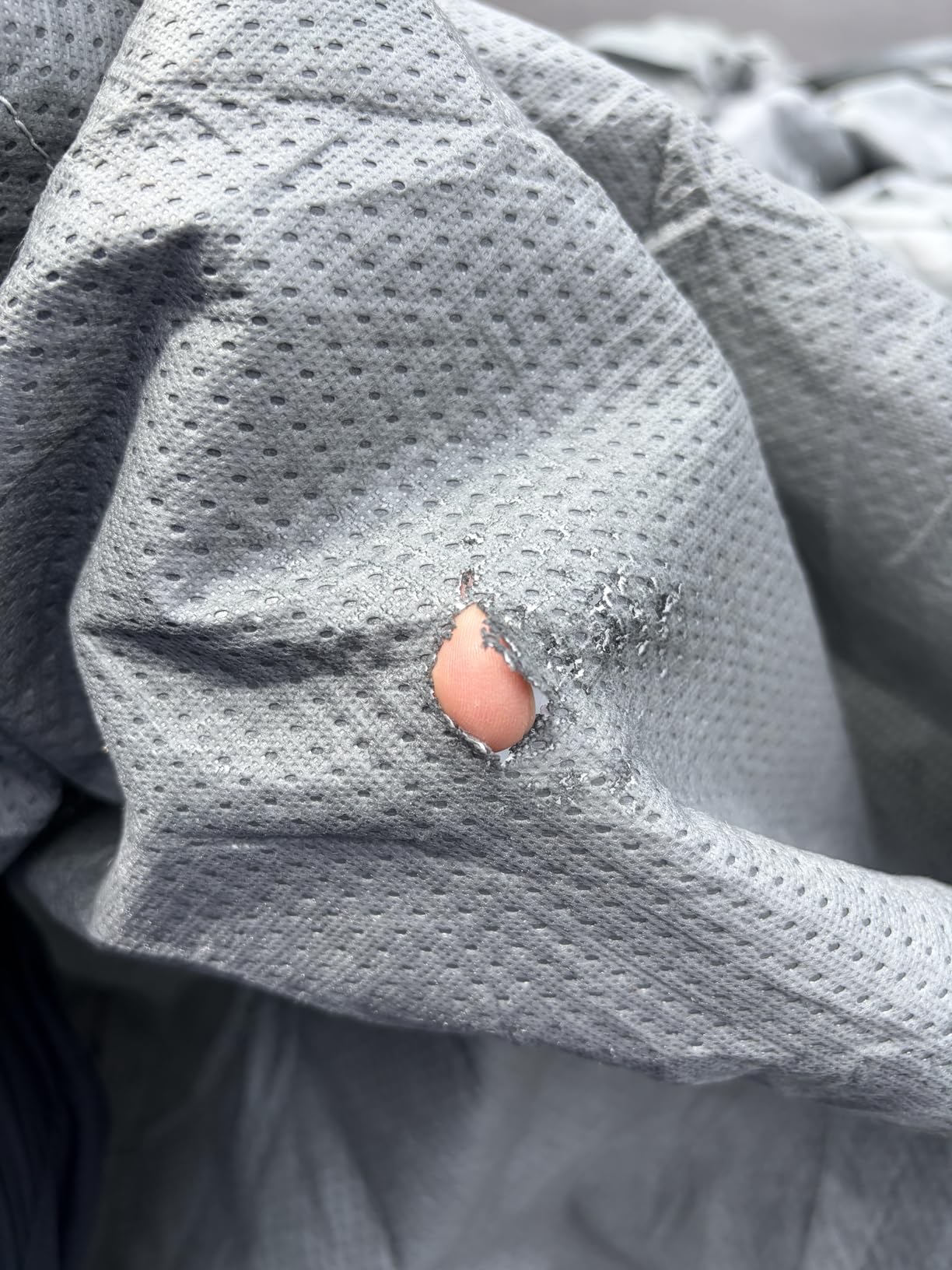
Dry rot is the failure mode owners fear most, and it is diagnosable. Press a thumb hard into a suspicious area. If the fabric feels spongy or crushes without springing back, the fibers have broken down and the panel is done. Clean, dry rot cannot be patched back into service.
Wind, Flapping and Paint Damage
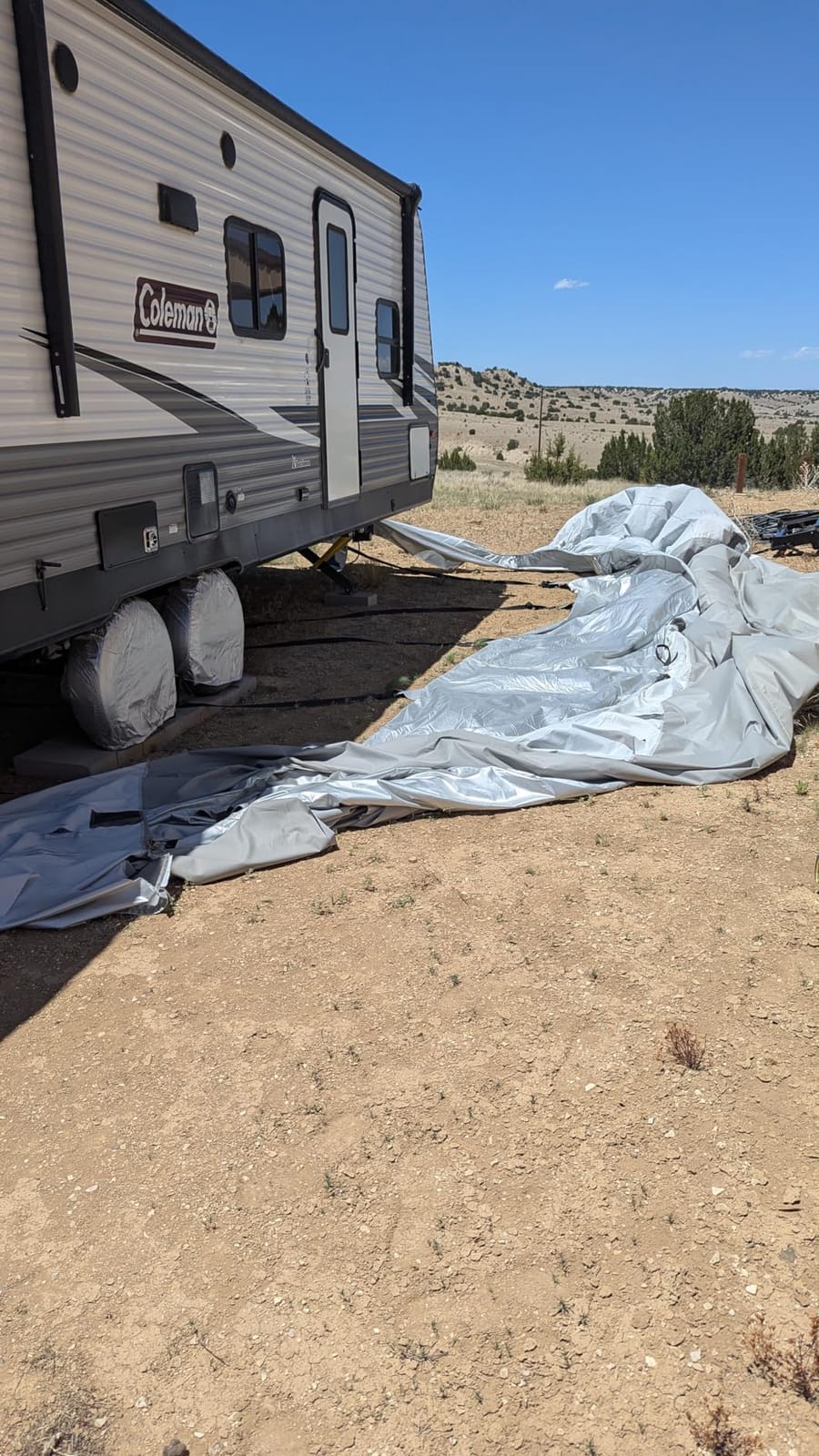
A cover that flaps in the wind will abrade your paint and gelcoat, and that is the single most common complaint we found in owner discussions. Flapping is not cosmetic. Each gust flexes the fabric against the finish, and repeat flexing dulls clear coat long before it does visible damage.
The fix is tensioning, and the correct answer is not as tight as most owners assume. Tight enough that the fabric does not ripple or lift at the hem. Loose enough that you can slide a flat hand under the bottom strap without straining, and loose enough that the built-in vents are not crushed flat, since crushed vents turn a breathable cover into a moisture trap.
Check your straps monthly between October and March. Most strap loosening is gradual, and five minutes of re-tightening in November avoids a loose cover by February. If the fabric still flaps between checks, the problem is fit or strap count, not tension, and the cover needs more bottom securing points rather than tighter straps.
Padding sharp roof edges with towels or foam before installation removes the other abrasion source entirely. It takes five minutes and it is the most common piece of advice owners give each other in forums.
Why a Tarp Is Not an RV Cover
Tarps are the obvious cheaper alternative and they are a bad idea for an RV. Four reasons come up every time we look.
A tarp traps moisture. It has no vents and no breathable inner layer, so condensation collects underneath and drives mold and mildew into the finish.
A tarp cannot be secured properly. Rope and tarp corners have nothing to grab on an RV, so wind gets underneath and lifts it.
One tarp rarely covers a whole rig. You need several, with overlapping seams that trap more water than a single fitted cover.
A tarp carries no warranty, no repair path and no fit guidance. When it tears in February, there is nothing to replace it with.
The cost difference over three winters is usually recovered by the first failed cover. Treat the tarp as a short-term emergency measure for a storm, not as winter storage.
Winter Prep Checklist Before You Cover Your RV
A cover protects a rig, but it does not winterize one. Owners who report the longest cover life all describe the same routine beforehand, and cleaning the exterior well before covering is the step they credit most.
Wash and dry the RV completely. Do not cover a wet rig, because trapped moisture in a wet trailer is what starts mold.
Clear the rain gutters and downspouts of leaves and debris so meltwater drains away from the cover instead of pooling behind it.
Winterize the plumbing: drain lines, add antifreeze to the waste and freshwater systems, and disconnect and store the hose.
Disconnect and store the batteries, or place them on a maintainer if you have shore power at the storage site.
Lower the stabilizer jacks onto wood or concrete pads, not onto the cover or soft ground. They will settle over the winter.
Close and lock all windows, vents and roof AC openings so moisture cannot enter from above.
Skirt or enclose the underbelly if mice are a problem in your area. A cover does not stop rodents, and they will find the underbelly opening.
On stabilizers, the short answer owners agree on: yes, leave them down and supported through winter. They should bear weight on their own pads, with nothing hanging off them and nothing resting on the tongue jack. Retract them before you move the rig, and check them after a heavy thaw.
And if the rig still gets used for the occasional cold-weather weekend rather than sitting all season, our winter coats for toddlers guide is worth reading before the first cold snap.
Snow Load, Ice and How to Clear a Covered RV
Snow on a cover is a separate load problem, and owners report corner failure at roof AC units under sustained snow weight. Clear it before it settles, not after.
Work from the edges inward so you are never pushing a slab toward the low point.
Use a plastic shovel or a roof rake with a nylon head. Steel edges cut non-woven and woven fabric alike.
Push snow off rather than lifting it, to avoid dragging grit across the roof and the cover.
Clear the gutter line and the area around roof vents and AC units, where ice dams start.
Never climb onto a covered RV. Walk the roof only when it is bare, and treat any roof as load-bearing unknown when it is not.
Ice is the harder problem. Do not chip ice directly against the cover or the finish with a steel tool. Apply a plastic-safe de-icer and let it work, then clear what falls. Ice damming along the roof edge is a drainage problem more often than a cover problem, which is why clearing gutters before you cover matters so much.
How to Store Your Cover in the Summer
The cover itself needs care or it becomes a storage problem of its own. The most common complaint from owners is a cover that develops mildew inside its own storage bag.
Let the cover dry fully before folding it. This is the rule that prevents nearly all of it. A wet cover folded into a bag stays wet, and a bag is exactly the enclosed, still environment where mildew starts.
Brush off snow, grit and leaf debris before you fold, and clean any mud off so it does not set into the fabric. Keep the repair patches and the manual in the same bag, because a patch you cannot find is a patch you will not use.
Store it somewhere dry and ventilated rather than sealed in a hot shed or a damp garage corner. If your summers are mild and your rig is uncovered for only a few months, recheck the fabric before folding it back out next autumn.
Frequently Asked Questions
Should you put a cover on your travel trailer?
Yes, for winter storage a cover is worth it, but only if the fabric is breathable, the vents are real and the cover is tight enough not to flap. Indoor storage is still better. A loose or non-breathable cover traps condensation and causes mold, so clean and dry the rig before covering and re-tighten the straps monthly through winter.
What is the best roof cover for an RV to use in the winter?
The best winter roof cover is a multi-ply non-woven or woven Oxford fabric with a waterproof membrane, a Tyvek-style waterproof top panel and built-in vents. For snow belt climates, prioritize a high layer count on the top, reinforced corner patches at the roof AC, and elastic hems with enough bottom straps to stop wind lift.
Are tarps okay for covering an RV?
No. A tarp traps moisture because it has no vents or breathable layer, cannot be secured to an RV so wind lifts it, usually needs several overlapping pieces to cover one rig, and carries no warranty or repair path. Treat a tarp as a short-term storm measure, not as winter storage.
How do I measure my RV for a cover?
Measure the length from front cap to rear bumper without the hitch, the width at the widest point including slide-out housings, and the height from the ground to the highest point. Add the height of your roof AC unit and include antennas, the ladder and roof vents. Compare all three numbers against the listed dimensions, not just the trailer length in the product name.
How thick should an RV cover be for snow?
Look for a high layer count on the top panel, since the roof carries the snow load, and reinforced corner patches where the cover meets a roof AC unit. Five to nine plies with a waterproof membrane handles typical snow load when you clear it regularly. Thinner side panels are more exposed to wind tearing than to snow, so check the side fabric rating separately.
The Best RV Covers for Winter Storage
After working through the specs, the owner reports and the failure patterns, our best RV covers for winter storage shortlist comes down to this. The Mofeez 9-layer cover is the editor’s choice, with the best balance of thickness, ventilation and a genuinely complete accessory kit across more than three thousand reviews. Buy the size that matches your trailer rather than the size that seems safer.
For a 27 to 30 foot trailer on a tighter budget, the Leader Accessories Windproof cover gives you the most hardware per dollar, though its side fabric thins out sooner. For fifth wheels, match the DikaSun to 34 to 37 foot rigs and the FRUNO Oxford build to anything 37 feet and up, where the heavier woven fabric earns its bulk. Smaller trailers are served by the VINPATIO for 20 to 22 feet and the K-Musculo for 18 to 20 feet.
Whatever you choose, dry the rig first, tension it without crushing the vents, and clear snow before it settles. If you are outfitting the inside while the rig sits covered, our winter bedding picks are worth a look before the cold sets in.