
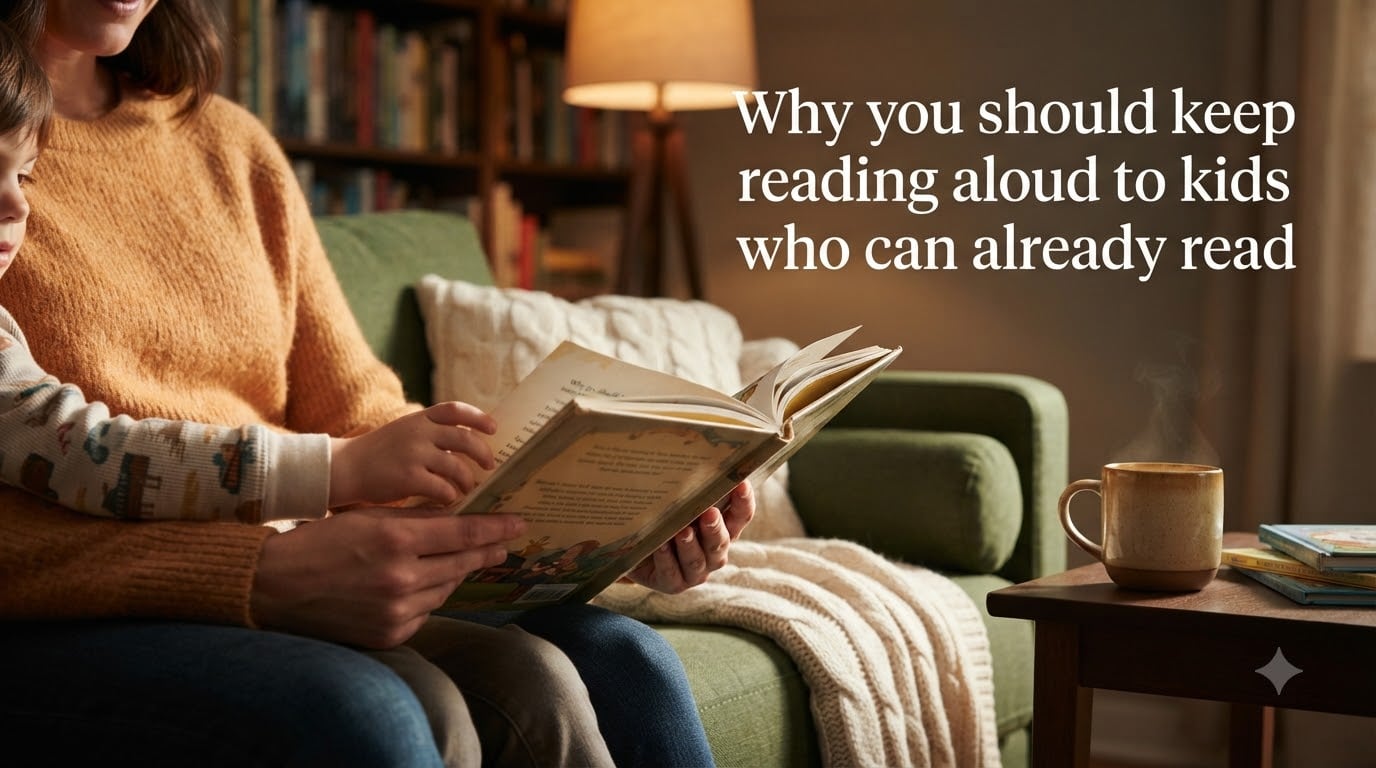
Reading aloud to kids who can already read remains one of the most powerful habits a parent can maintain, because a child’s listening comprehension stays well above their independent reading level until roughly eighth grade. Brain scan research shows that hearing stories activates the same neural pathways involved in processing language, building vocabulary, and developing empathy. Yet only about 17% of parents read aloud to children ages 9 to 11, according to data from Scholastic.
I remember the night my daughter, then eight, finished her first chapter book on her own. She beamed. I felt proud. And then a quiet thought crept in: do I still need to read to her? The short answer is yes, and the research behind that answer surprised me enough to change our entire evening routine.
Our team spent weeks digging through university studies, parent forums on Reddit, and expert guidance from organizations like the American Academy of Pediatrics. What we found consistently challenges the assumption that read-aloud time ends when independent reading begins. This article breaks down exactly why continuing matters, what the science says, and how to make it work even with a teenager who rolls their eyes.
If you have ever wondered why you should keep reading aloud to kids who can already read, the benefits fall into five core areas: cognitive development, vocabulary growth, empathy, academic performance, and family bonding. Let us walk through each one with the evidence behind it.
Table of Contents
What Happens to the Brain When You Read Aloud
When you read aloud to your child, you are doing something independent reading alone cannot replicate. You are modeling fluent, expressive language while your child’s brain processes story structure, vocabulary, and emotional context all at once.
Researchers at Carnegie Mellon University used brain imaging to study what happens during read-aloud sessions. They found that hearing a story activates the pan-temporal lobe, the area of the brain involved in semantic processing, or meaning-making from language. This activation happens regardless of whether the child could read the words independently.
What this means practically is that listening to a story gives a child access to ideas, sentence structures, and vocabulary that they could not yet decode on their own. Their brain is doing heavy lifting with language that is more complex than what they could manage solo. That gap between listening level and reading level is where the magic happens.
The neurochemical benefits matter too. Shared reading triggers oxytocin release in both parent and child, strengthening the emotional bond. At the same time, cortisol levels drop. Multiple parents in Reddit’s r/Parenting community described their read-aloud routine as the one part of the day when tension disappears and everyone actually relaxes.
Reading Aloud Builds Bigger Vocabulary Than Independent Reading
Here is a statistic that changed how I think about reading: a child’s receptive vocabulary, the words they understand when they hear them, runs about two grade levels ahead of their expressive vocabulary, the words they can read and use themselves. This gap persists until around age 13 or 14.
That gap is exactly why reading aloud to older kids matters. When your nine-year-old reads independently, they encounter words at their reading level. When you read to them, they encounter words at their listening level, which is significantly higher. They absorb richer, more complex language than they could ever access on their own.
A landmark study from the University of Toronto found that children’s books contain roughly 50% more rare words than typical adult conversation and even more than prime-time television. So the language your child hears during read-aloud time is more sophisticated than almost anything else in their daily life.
Think about it this way. A fourth grader reading a fourth-grade book practices decoding. That same fourth grader listening to a sixth or seventh-grade level novel absorbs advanced vocabulary in context, with your voice providing the pronunciation, emphasis, and meaning clues. Both activities are valuable, but only one stretches their language ceiling.
How Reading Aloud Develops Empathy in Older Kids
Reading aloud is sometimes called the empathy machine, and for good reason. Stories put children inside someone else’s experience in a way that few other activities can match. When you read together, you can pause and ask, how do you think that character felt? That conversation does not happen during silent reading.
Dr. Rudine Sims Bishop introduced the concept of books as mirrors, windows, and sliding glass doors. Mirrors reflect a child’s own experience. Windows show them lives different from their own. Sliding glass doors let them walk into those different lives imaginatively. Reading aloud together lets you guide your child through all three.
Research from the New School for Social Research found that people who read literary fiction score higher on tests measuring the ability to understand others’ mental states, a skill called theory of mind. Reading aloud to older kids gives them repeated practice stepping into different perspectives while you are right there to discuss what comes up.
Teachers on Reddit’s r/AskTeachers consistently report that they can tell which students were read to regularly. Those children show stronger comprehension, longer attention spans, and more sensitivity to social dynamics in the classroom. The empathy built through years of shared reading shows up everywhere.
Academic Benefits of Reading Aloud to Independent Readers
The academic case for continuing to read aloud past the independent reading milestone is strong. A frequently cited study by Dr. Joseph Price at Brigham Young University found that an additional year of daily reading aloud increased a child’s performance on standardized reading and math tests by a meaningful margin.
One reason is that read-aloud time stretches a child’s attention span. In an era of six-second videos and constant notifications, sitting still for a chapter of a book is genuinely challenging for many kids. Regular shared reading builds the sustained attention that schoolwork demands.
Reading aloud also models comprehension strategies. When you pause to ask a prediction question, clarify a confusing passage, or connect the story to something in real life, you are teaching your child how good readers think. Children internalize these strategies and apply them during independent reading later.
The Scholastic Kids and Family Reading Report found that children whose parents continued reading aloud into the tween years reported stronger attitudes toward reading overall. They read more independently, not less. The read-aloud habit feeds rather than replaces independent reading.
Family Bonding and Stress Reduction Through Shared Reading
Reading aloud creates a shared experience that few other activities can match. Families who read together develop inside jokes, references to characters, and a collective imagination that strengthens their connection. One parent on Reddit described how their family still quotes a line from a book they read together three years ago.
In our home, the read-aloud hour became a natural pause button. After a day of school, homework, screens, and activities, those thirty minutes reset the tone. My daughter and I both relaxed. Research backs this up. The simple act of sitting close and sharing a story lowers stress hormones for both parent and child.
Reading aloud is also one of the most effective screen time alternatives available. Instead of fighting about turning off a tablet, you are offering something genuinely engaging. The story pulls them in, the physical closeness grounds them, and the screens fade into the background without a battle.
For families with mixed age groups, reading aloud is one of the few activities that genuinely works for everyone. A well-chosen book can captivate a six-year-old and a twelve-year-old at the same time. The older child gets more from the plot, the younger child enjoys the surface story, and both share the experience.
Reading Aloud to Kids Who Can Already Read: Modeling Fluency
Fluency is more than reading fast. It is reading with expression, proper pacing, and an understanding of how punctuation shapes meaning. Children develop fluency primarily by hearing fluent readers, which is why reading aloud to kids who can already read remains so valuable.
When you read with expression, changing your voice for different characters, slowing down at suspenseful moments, pausing at commas, you demonstrate what good reading sounds like. Your child absorbs these patterns and reproduces them in their own reading over time.
The pause-and-discuss approach deepens this benefit. Stopping every few pages to talk about what just happened models active reading. You show your child that reading is not passive decoding but an ongoing conversation with the text. This habit transfers directly to their independent reading.
If you feel self-conscious about your reading voice, you are not alone. Many parents on Reddit shared this worry. The truth is your child does not need a professional narrator. They need your voice, your attention, and your willingness to be fully present with a story. That is what makes it matter.
Practical Tips for Reading Aloud to Older Kids and Teens
Knowing the benefits is one thing. Actually making read-aloud time work with an older child or a teenager is another. Here is what we learned from research, experts, and dozens of parents who have been there.
First, let your child help choose the books. Ownership increases engagement dramatically. Take turns picking, or alternate chapters. If your child picks something you would never choose, read it anyway. Their enthusiasm will carry you through.
Second, pick books slightly above their independent reading level. This is where the vocabulary and comprehension benefits are strongest. Chapter books with complex plots, historical fiction, and fantasy series all work well. Ask a librarian for recommendations tailored to your child’s age and interests.
Third, do not stop at bedtime. Read aloud during car rides using audiobooks, after dinner, or on lazy weekend mornings. The routine matters less than the consistency. Find a time that works for your family schedule and protect it.
Fourth, for reluctant older kids, frame it differently. Do not call it reading time. Call it story time, or just say you want to share a book you think they will love. Let them doodle, build with Legos, or stretch while you read. Many kids listen better when their hands are busy.
Fifth, for teenagers, try shared reading rather than pure read-aloud. Read the same book independently and discuss it, or alternate reading chapters out loud together. Audiobooks count too. Listening together in the car counts just as much as sitting on the couch.
Sixth, for mixed-age households, choose books with layered storytelling. A story that works on the surface for younger kids will often have deeper themes that older kids and even adults appreciate. Series like these become family traditions.
Finally, keep it pressure-free. No quizzes, no vocabulary drills, no comprehension worksheets. The goal is to associate reading with warmth, connection, and pleasure. The academic benefits will follow naturally from that foundation.
Common Objections to Reading Aloud (And Why They Are Wrong)
The most common objection is simple: my child can read on their own, so why should I still read to them? The answer is that listening comprehension runs about two years ahead of reading comprehension. Your child can understand far more complex stories by ear than by eye. Reading aloud stretches that ceiling.
Another frequent concern is time. Between homework, sports, dinner, and everything else, where is the extra twenty minutes? The reality is that read-aloud time often replaces less valuable screen time. Even fifteen minutes a day, five days a week, adds up to over an hour of rich language exposure weekly.
Some parents worry their child is too old. My kid is eleven, they will think it is babyish. Forum data tells a different story. Children themselves report wanting to be read to well into their teenage years, even when they do not admit it out loud. The Scholastic report found that 40% of kids ages 6 to 11 whose parents had stopped reading aloud wished it had continued.
The last objection is about the parent’s own reading ability. I am not a good reader. Your child does not need perfection. They need consistency, presence, and a shared story. If reading aloud feels hard, audiobooks provide the same benefits. Press play, sit together, and let the story do the work.
FAQs
Why is it important to read aloud to children?
Reading aloud exposes children to vocabulary and language patterns more complex than they can read independently, builds empathy through story exposure, models fluent reading, and strengthens family bonds. Research shows children’s listening comprehension stays above their reading level until about eighth grade, making read-aloud time valuable well past the independent reading milestone.
What are the benefits of reading aloud to children outweigh?
The benefits of reading aloud to children outweigh those of independent reading alone in three key areas: access to higher-level vocabulary, development of empathy through guided discussion, and stronger family connection. Reading aloud also reduces stress, models fluency, and improves academic performance across reading and math.
Why should caretakers retell stories children have already heard?
Retelling or rereading familiar stories builds comprehension through repetition, lets children notice details they missed the first time, and creates a sense of comfort and predictability. Familiar stories also give children the confidence to discuss plot, character motivation, and themes more deeply than a first read allows.
What is the 5 finger rule for reading?
The 5 finger rule helps children choose books at the right independent reading level. Open to any page and have the child read. For each word they do not know, hold up one finger. Zero or one finger means the book is too easy. Five fingers means it is too hard for independent reading but may be perfect for reading aloud together.
Conclusion
Reading aloud to kids who can already read is not a holdover from their younger years. It is a distinct and irreplaceable practice that builds vocabulary, develops empathy, strengthens academic skills, reduces stress, and deepens family connection. The research is clear: children’s listening level runs far ahead of their reading level, and shared reading is how you close that gap intentionally.
Start tonight. Pick a book slightly above your child’s reading level, find fifteen minutes, and read together. The benefits compound over years, and the memories last far longer than any single story. That is why you should keep reading aloud, long after the moment they first read on their own.