
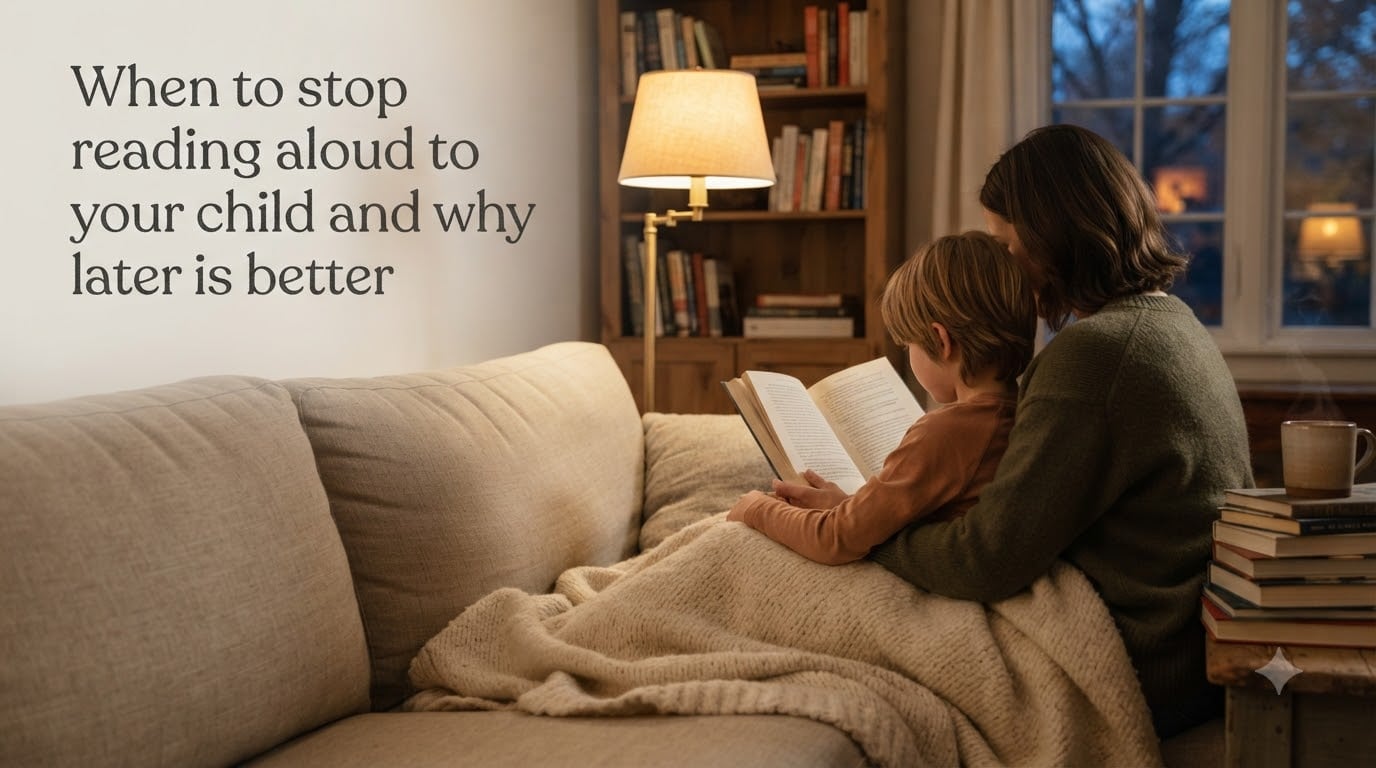
When my daughter turned eight, I quietly packed away the picture books and assumed our nightly read-aloud ritual was over. She could read chapter books on her own now, so why keep going? That decision lasted about three weeks.
It took one tired evening, when I pulled Charlotte’s Web off the shelf almost by accident, to realize what I had given up. She curled into the couch without being asked. We laughed at Templeton. We both cried at the end. That night taught me something research had been saying for years: when you stop reading aloud to your child is much later than most parents think, and later really is better.
If you’re wondering when to stop reading aloud to your child, the short answer is: don’t. Not yet. Not at seven, not at nine, not even at twelve. Here’s the research, the reasoning, and the practical tips to keep the ritual alive far longer than you imagined.
Table of Contents
When Do Most Parents Stop Reading Aloud?
Most parents stop reading aloud to their children far earlier than developmental experts recommend. The numbers are striking.
According to the Scholastic Kids & Family Reading Report, 91% of parents read aloud to their children at age five. By age nine, that number drops to just 17%. Somewhere between kindergarten and upper elementary, the practice quietly disappears from most households.
Why the sudden stop? A few common reasons:
- Children learn to read independently, and parents assume their job is done
- Older kids start resisting or seem embarrassed by bedtime stories
- Schedules get busier with homework, activities, and screens
- Parents feel self-conscious reading chapter books above a child’s perceived reading level
The problem is that this drop-off aligns with the exact years when reading aloud offers the most cognitive payoff. The years parents tend to give up are the years researchers wish they wouldn’t.
The Listening Age vs Reading Age Concept
Here is the single most important concept for any parent wondering when to stop reading aloud: a child’s listening age is almost always higher than their reading age, and the gap stays wide for years.
By age seven or eight, most children can decode simple words and follow a basic story on their own. But their listening comprehension, the ability to understand, process, and think about complex language when it is spoken to them, runs roughly two to three grade levels ahead. Children’s listening skills typically catch up to their reading skills only around age 13.
Think about what that means in practice. A third grader reading at grade level can comfortably handle a book written for third graders. But if you read aloud to that same child, they can understand and enjoy a book written for fifth or sixth graders. You are giving them access to richer vocabulary, more complex plots, and more sophisticated themes than they could reach on their own.
When you stop reading aloud at age eight, you close the door on roughly five more years of advanced literary exposure. The child who still has read-aloud time at twelve has been fed a steady diet of language and stories that builds vocabulary, comprehension, and background knowledge every single night.
7 Key Benefits of Reading to Older Children
The benefits of continuing to read aloud to older children stack up faster than most parents realize. Here are the seven that matter most.
- Vocabulary growth accelerates. Read-aloud books expose children to words and sentence structures two to three grade levels above what they can read. Studies show children hear roughly 1.4 million more words when parents read aloud regularly compared to peers who stop early.
- Comprehension skills deepen. Hearing fluent reading models how skilled readers handle pacing, expression, and complex grammar. Children absorb these patterns without even trying.
- Bonding time survives the tween years. Once kids stop wanting hugs in public, a shared chapter book is one of the last socially acceptable ways to be physically close and emotionally connected every day.
- Imagination stays strong. Listening to a story activates different mental imagery than reading one silently. Children who are read to develop stronger visualization skills and creative thinking.
- Empathy expands. Complex characters with messy motives teach kids to sit with ambiguity and consider other perspectives. Long-form read-alouds give more room for this than any short video or quick conversation.
- Conversation grows richer. Chapter books give parents and kids something to talk about beyond homework and chores. Dinner conversations stay warmer when both people are thinking about the same fictional world.
- Reading becomes associated with pleasure. A child who was read to throughout elementary school enters middle school seeing books as a source of joy, not just a school task.
Few of these benefits happen when a child reads alone. Almost all of them depend on an adult voice in the room.
Signs Your Child Is Ready for More Independent Reading
None of this means you should force a ten-year-old to sit still for picture books. The shift toward independence is real, and it is healthy. The trick is recognizing the signs of readiness without using them as a reason to quit reading aloud entirely.
Your child may be ready for more independent reading time when you notice:
- They voluntarily pick up books and read for pleasure on their own
- They start finishing their own books faster than you can acquire new ones
- They want to discuss plot questions or character motivations before bed
- They begin recommending books to you
- They sit through chapter books by themselves that you would have previously read aloud
None of these signs mean the read-aloud has to end. They simply mean your child has developed a healthy parallel reading life. Many families keep reading aloud while their child also reads independently, and that hybrid approach is often the sweet spot.
What matters is recognizing that independent reading readiness and read-aloud readiness are two different things. A child can be ready for one without being ready for the other.
How to Make Reading Aloud Work for Tweens and Teens
Continuing to read aloud past age nine takes a few adjustments. The ritual looks different for a twelve-year-old than for a five-year-old, and that is okay.
Here is what actually works in our home and in the homes of dozens of parents who have shared their experiences.
Pick books above their reading level. If your child reads at a fourth-grade level but you are reading aloud a sixth or seventh-grade book, you are doing it right. Pick titles that would frustrate them on their own but spark joy when heard.
Try side-by-side reading. Around age ten or eleven, many kids start wanting to read ahead. Let them. You can each read your own copy of the same book and meet up to discuss chapters. Some families read the same chapter aloud together. Some take turns reading paragraphs.
Drop the bedtime framing. Twelve-year-olds do not want to be told it’s story time. Reframe it as reading together, listening to a book on the couch, or audiobook time during dinner. The label matters less than the habit.
Use audiobooks on long drives. This counts. If your child resists sitting still but you have a 30-minute car ride, an audiobook the whole family listens to together is read-aloud time with extra steps.
Respect resistance without giving up. If your child says they don’t want to be read to anymore, ask if they would like to choose the book instead. Often resistance is about losing control, not losing the practice. Let them pick. Let them skip a night. Then come back to it.
Read the books they love. If your tween is obsessed with Percy Jackson, read Percy Jackson aloud. If your teen wants to discuss dystopian fiction, hand them The Hunger Games and read it in parallel. The book does not have to be literary. It has to be read together.
Recommended Read-Aloud Books by Age
Choosing the right book matters more than picking the perfect book. Here are reliable read-aloud choices that work for each age range.
Ages 7 to 9 (independent readers, advanced listeners):
- Charlotte’s Web by E.B. White
- The BFG by Roald Dahl
- Mr. Popper’s Penguins by Richard and Florence Atwater
- Fantastic Mr. Fox by Roald Dahl
Ages 9 to 11 (ready for richer stories and longer arcs):
- The Hobbit by J.R.R. Tolkien
- Bridge to Terabithia by Katherine Paterson
- Harry Potter and the Sorcerer’s Stone by J.K. Rowling
- Where the Mountain Meets the Moon by Grace Lin
Ages 11 to 13 (preteens and early teens):
- Percy Jackson: The Lightning Thief by Rick Riordan
- Holes by Louis Sachar
- The Westing Game by Ellen Raskin
- A Wrinkle in Time by Madeleine L’Engle
The right book is one your child will beg to keep reading. Skip the ones that feel like homework.
Frequently Asked Questions
What age should I stop reading to my child?
Most child development experts recommend continuing to read aloud until at least age 11 or 12, and many suggest continuing through the teen years. Reading aloud stops being developmentally necessary only when both the child and the parent no longer enjoy it. Scholastic research shows children typically have a higher listening age than reading age until about 13, so reading aloud continues to provide access to richer material throughout elementary and early middle school.
What is the 7 7 7 rule for kids?
The 7 7 7 rule is a popular parenting guideline suggesting that a child should eat dinner with family at least 7 times a week, spend 7 minutes of one-on-one time with each parent daily, and go outside for at least 7 minutes each day. It is unrelated to reading aloud specifically, but it complements read-aloud habits by reinforcing daily connection rituals.
When to stop reading aloud to a child who can read on their own?
You do not need to stop reading aloud just because a child can read independently. Listening comprehension continues to develop past reading comprehension until roughly age 13, so children benefit from hearing books above their own reading level. Many parents continue read-aloud sessions well into middle school, switching to chapter books, audiobooks, or side-by-side reading as the child grows.
Should I still read to my 10 year old?
Yes. Reading to a 10 year old is still highly beneficial, even if the child reads fluently on their own. A 10 year old’s listening comprehension typically runs two to three grade levels above their independent reading level, so read-aloud time exposes them to richer vocabulary and more complex stories. Many 10 year olds still enjoy being read to, especially at bedtime or during family reading time.
The Bottom Line on Reading Aloud
When to stop reading aloud to your child is less about hitting a magic age and more about whether the practice still serves both of you. For most families, the answer is much later than they expected.
The research is clear. Children’s listening age runs ahead of their reading age until roughly 13. Reading aloud builds vocabulary, deepens comprehension, strengthens bonds, and keeps books associated with warmth rather than work. The families who keep reading aloud past age nine are giving their kids a quiet, lasting advantage.
If your child can already read on their own, keep reading anyway. Pick a chapter book above their level, settle into the couch, and see what happens. In my experience, it is rarely the child who asks to stop.