
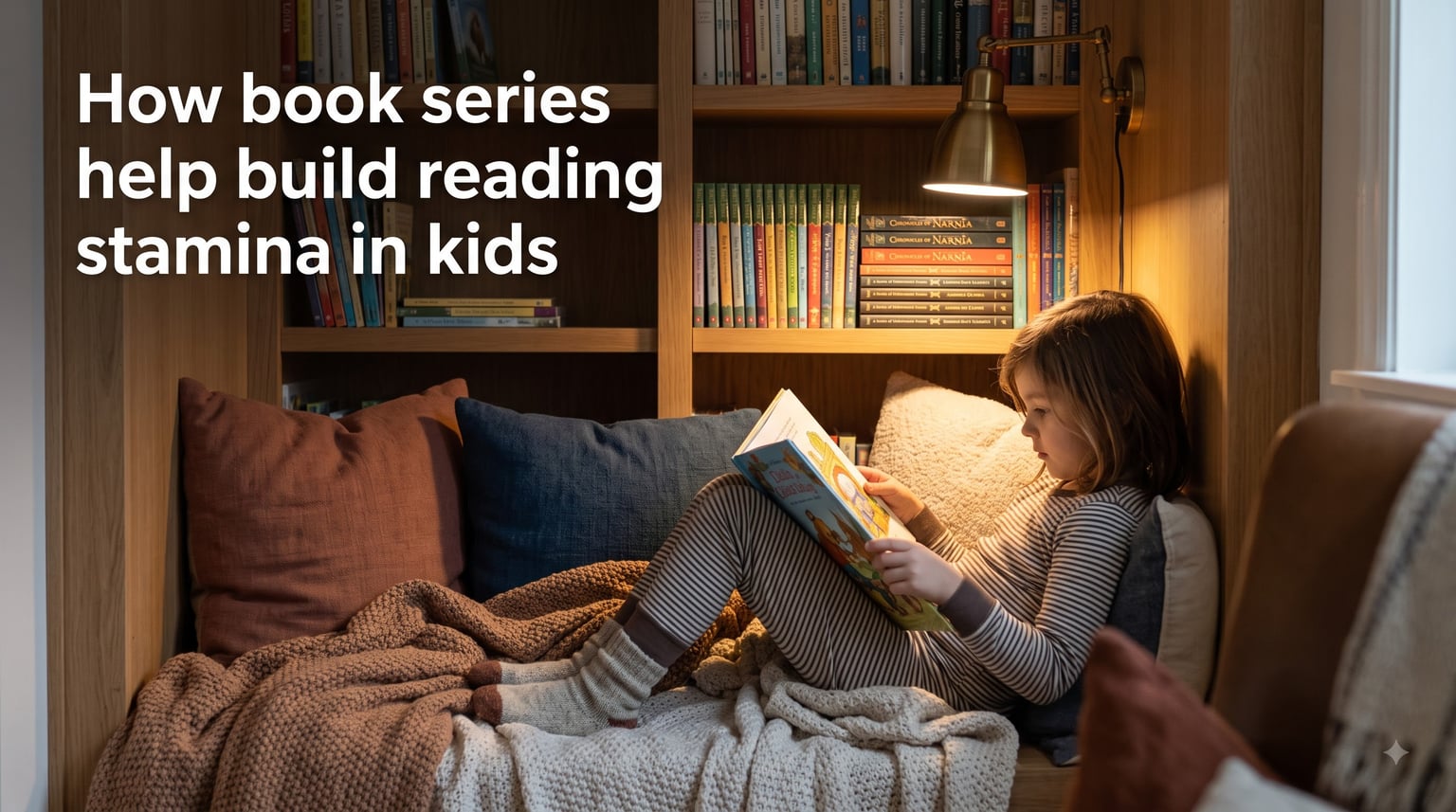
Last month, my nephew finished his first chapter book. He sat cross-legged on the living room rug, turned the final page, and immediately asked, “Do they have another one?” That single question captures exactly why book series help build reading stamina in kids better than almost anything else I have seen in fifteen years of working with young readers.
Reading stamina is the ability to focus, follow a story, and read independently for longer stretches. It does not arrive overnight. The good news is that the right book series can quietly stretch a child’s attention, build confidence, and turn reluctant readers into kids who ask for “just one more chapter.”
In this guide, I will walk you through what reading stamina actually is, how book series work as a stamina-building tool, and which series I recommend for different ages. I will also share practical strategies our team has tested with families and classrooms.
Table of Contents
What Is Reading Stamina and Why Does It Matter?
Reading stamina is a child’s ability to read independently and stay focused for an extended period without losing comprehension or interest. Think of it like a muscle. Short, picture-heavy books are the warm-up. Chapter books and longer novels are the workout that builds real endurance.
Research consistently shows that children who can sustain attention during reading perform better academically across subjects, not just in language arts. Stamina supports vocabulary growth, working memory, and the patience required for math word problems and science reading passages alike.
Today, building that stamina is harder than ever. Phones, tablets, and short-form video have rewired how young brains handle attention. Many kids can focus for two minutes on a screen but lose interest after five minutes with a book. That gap is what parents and teachers are working against every day.
Here is the encouraging part. Reading stamina is trainable. With consistent practice and the right materials, most kids can dramatically extend their reading time within a few months. And book series are one of the most reliable tools I have found for that training.
How Book Series Help Build Reading Stamina in Kids
Book series help build reading stamina in kids through five key mechanisms. Each one removes a small barrier that would otherwise chip away at attention and motivation.
1. Familiar Characters Reduce Cognitive Load
When a child opens the second or third book in a series, they already know who the characters are, how they talk, and what their world looks like. That familiarity means their brain spends less energy orienting and more energy reading. Less mental overhead translates directly into longer focus.
2. Predictable Structure Builds Confidence
Most children’s series follow a reliable pattern. Same chapter length, same type of illustrations, similar pacing. That predictability lowers anxiety for emerging readers and lets them settle into the rhythm of the book faster. Confidence compounds quickly when a child knows exactly what to expect.
3. Narrative Momentum Carries Them Forward
The single biggest reason series build stamina is momentum. A child who finishes one book already knows the next one is waiting on the shelf. There is no gap, no decision fatigue about what to read next. The story simply continues, and so does the reading habit.
4. Lower Decision Fatigue
Picking a book is surprisingly hard for kids. With a series, the choice is already made. That removal of friction matters more than most parents realize. When my own daughter was learning to read, I watched her flip between five picture books for ten minutes without reading any of them. The moment we started a Branches series, she sat down and read for twenty-five minutes straight.
5. Shared Social Experience
Series create a sense of community. Kids talk about Magic Tree House at lunch. They argue about which Percy Jackson book is best. That social layer turns reading from a solitary task into a shared cultural experience, which is a powerful motivator for sustained practice.
The Psychology Behind Series and Reading Motivation
Book series tap into several well-documented psychological drivers. Understanding them helps parents and teachers choose the right series for the right child.
The first is the reward loop. Every chapter in a series typically ends with a small cliffhanger or a satisfying moment of resolution. That micro-reward triggers dopamine, the same chemical released when kids beat a level in a video game. Reading starts to feel like a game they want to keep playing.
The second is the sunk-cost effect, but in a positive way. Once a child has invested time learning characters and plotlines, they are naturally motivated to keep going. Quitting mid-series feels like abandoning friends. That emotional investment pulls them through longer books they would otherwise abandon.
The third is identity formation. When a kid identifies as “a Wings of Fire reader” or “a Harry Potter fan,” reading becomes part of who they are. Identity-based habits are the stickiest. Our team has seen kids who previously refused to read suddenly beg for library trips once they found their series.
None of this works without the right starting point. A series that is too easy feels boring. One that is too hard feels punishing. The sweet spot is what educators call a “just right book,” and series make finding that sweet spot easier because each book in the series is calibrated to the same level.
Best Book Series for Building Reading Stamina by Age
Choosing the right series matters more than choosing the perfect book. Below are the series our team and the parents we work with return to again and again, organized by age group.
Early Readers (Ages 5 to 7)
Scholastic Branches (Owl Diaries, Dragon Masters, Missy Piggle-Wiggle): Short chapters, generous illustrations, and consistent formatting make these ideal first chapter books. Most pages have about three sentences and a full-color picture.
Elephant and Piggie by Mo Willems: For kids not quite ready for chapters, this series builds the dialogue-reading stamina that chapter books require. Kids read back and forth between two characters, which feels like play.
Fly Guy by Tedd Arnold: Funny, fast-paced, and built around a boy and his pet fly. The humor keeps reluctant readers turning pages even when they do not realize they are reading.
Middle Readers (Ages 8 to 10)
Magic Tree House by Mary Pope Osborne: With over 60 books, this series offers nearly endless momentum. Each book is self-contained, so a child can dip in and out without feeling lost.
Junie B. Jones by Barbara Park: The first-person voice and short chapters work beautifully for kids who think they do not like reading. Junie’s personality pulls even hesitant readers along.
Dog Man by Dav Pilkey: A graphic novel series that consistently wins over kids who say they hate books. Reading volume goes up significantly once a child discovers graphic novels.
Older Readers (Ages 10 to 12)
Harry Potter by J.K. Rowling: The classic series stamina builder. The books grow in length as the reader grows in skill, which feels like leveling up alongside the characters.
Percy Jackson and the Olympians by Rick Riordan: Fast-paced, funny, and full of relatable middle-school drama. Kids who finish one book almost always reach for the next.
Wings of Fire by Tui T. Sutherland: A dragon fantasy series with deep world-building. Great for kids who love animals, worldbuilding, and longer chapter books.
Series for Reluctant Readers
If your child currently resists reading, start with one of these high-engagement series:
Diary of a Wimpy Kid: Combines text and cartoons in a format kids instantly recognize.
Dog Man and Cat Kid Comic Club: Graphic novels that build reading confidence fast.
I Survived: Historical fiction told in short, suspenseful chapters.
Who Was?: Biographical series that turns reluctant readers into curious ones.
Practical Strategies for Parents and Teachers
Choosing the right series is only half the work. The other half is building routines and habits that turn reading into a daily practice. Here are the strategies our team has found most effective.
Start with the First Book Together
Read the first book in a series aloud or alongside your child. This gives them a feel for the characters, the pace, and the world before they tackle it alone. Once they are hooked, hand them book two.
Keep the Next Book Ready
The single most effective strategy I have seen is having the next book physically waiting on the nightstand or in the backpack. The instant a child finishes one book, the next one is right there. No trips to the library, no shopping, no waiting. The story keeps moving.
Set Incremental Reading Goals
Do not start with “read for 30 minutes.” Start with 10 minutes. When your child consistently meets 10, bump to 15. Celebrate each step. Reading stamina grows through small, repeated wins, not through dramatic leaps.
Use a Simple Progress Tracker
A basic chart on the fridge works wonders. Let your child color in a square for every 15 minutes of reading, every chapter finished, or every book completed. Visible progress builds motivation.
Match Books to Mood and Moment
Long car ride? Audiobook version of a favorite series. Quiet evening before bed? A cozy chapter book. Sick day at home? A fast-paced graphic novel series. Meeting kids where they are is how stamina becomes a lifestyle instead of a chore.
Let Kids See You Reading
Children mimic what they see. If they regularly watch you reading a book, magazine, or even long-form article on your phone, they absorb that reading is a normal adult activity. Modeling matters more than lectures.
Common Roadblocks and How to Handle Them
Even with the right series, kids hit bumps. Here is how to handle the four most common ones.
Mid-Series Boredom
It is normal for a child to lose steam halfway through a long series. When that happens, do not push. Switch to a different series for a week, then circle back. The first series will be waiting, and your child will usually return with fresh energy.
Books That Are Too Easy or Too Hard
If your child is breezing through a series without effort, bump up the next series in difficulty. If they are struggling, step back to an easier series. The goal is engagement, not challenge for its own sake.
Screen Time Competition
You do not have to eliminate screens. Try the 20-minute rule. After 20 minutes of reading, your child earns screen time. Most kids will read longer than 20 minutes once they get into a story, which makes the rule a non-issue.
Post-Break Reading Slumps
After summer or holiday breaks, many kids lose reading momentum. Keep one series active during breaks, even if reading sessions are shorter. A consistent series is the easiest way to bounce back into a reading routine.
Frequently Asked Questions
How to increase a child’s reading stamina?
The most reliable way to increase a child’s reading stamina is to give them access to book series at the right reading level. Start with short sessions of 10 to 15 minutes, choose books with familiar characters and predictable structure, and keep the next book in the series ready to go. Gradually extend reading time as your child’s focus improves.
How do book series help build reading stamina in kids?
Book series build reading stamina by reducing cognitive load through familiar characters, providing predictable structure that builds confidence, and creating narrative momentum that carries kids from one book to the next. They also lower decision fatigue since the next read is already chosen, and they create social bonds when kids discuss series with friends.
What is the 5 4 3 2 1 reading strategy?
The 5 4 3 2 1 reading strategy is a countdown framework used by teachers and parents to help kids transition into independent reading. It works like this: 5 minutes of reading aloud together, 4 minutes of shared reading, 3 minutes of partner reading, 2 minutes of whispered reading, and 1 minute of silent independent reading. The gradual reduction in support builds stamina and confidence.
What are the best book series for reluctant readers?
The best book series for reluctant readers combine short chapters, humor, and strong visuals. Top picks include Diary of a Wimpy Kid, Dog Man, Magic Tree House, I Survived, and Captain Underpants. Graphic novel series like Wings of Fire and Bone are also excellent because they turn page-turning into a visual, fast-paced experience.
Final Thoughts on Building Lifelong Readers
Book series help build reading stamina in kids because they remove the friction that wears readers down. Familiar characters mean less work. Predictable structure means less anxiety. A waiting shelf of sequels means no decision paralysis. Every one of those small wins adds up to longer, more confident reading sessions.
If you take one thing from this guide, take this. Find a series that matches your child’s reading level and interests, start at the beginning, and keep the next book ready. The stamina will follow.
Reading is one of the few skills that pays dividends for an entire lifetime. A book series is the simplest on-ramp I have found to get kids there.