
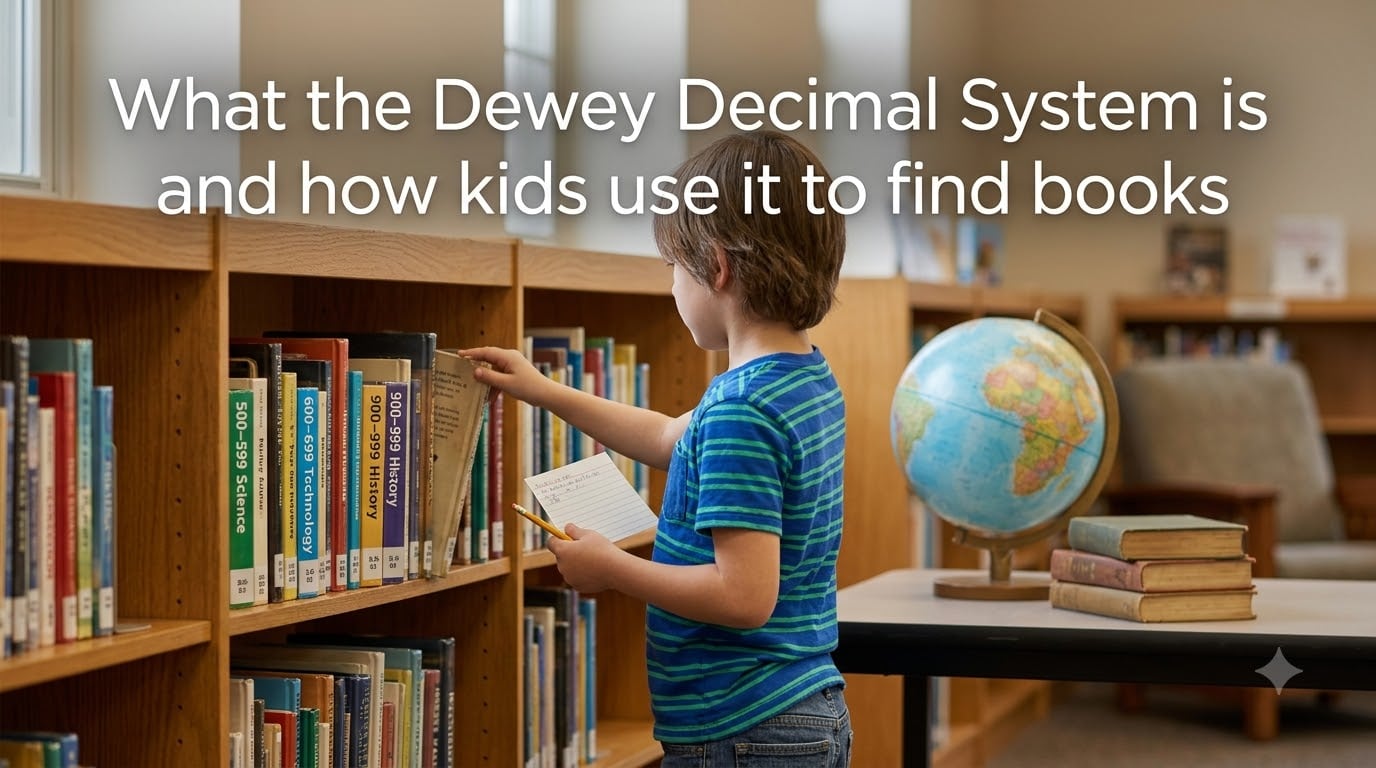
The Dewey Decimal System is a library classification method that organizes non-fiction books by subject using numbers from 000 to 999. Each number maps to a topic, so a kid looking for dinosaur books, drawing guides, or space facts can walk to one shelf area and find everything related together. It was created in 1876 by Melvil Dewey, and most school and public libraries in the United States still use it today.
For kids, the system turns a wall of confusing spines into a treasure map. Instead of scanning thousands of books randomly, a young reader can learn ten big categories, find the matching number, and go straight to the shelf that holds their topic. Once a child understands the basics, they can browse the library independently, which is one of the biggest confidence boosts a young reader can get.
In this guide I break down what the Dewey Decimal System is, walk through the ten main categories with real examples kids care about, explain call numbers in plain language, and share a simple step-by-step process a child can follow to find any book. I also include memory tricks, common frustrations librarians see, and why some libraries are moving away from Dewey.
Table of Contents
What Is the Dewey Decimal System (and Why Libraries Use It)
The Dewey Decimal System, also called the Dewey Decimal Classification, is a numerical way to organize non-fiction books by subject. Each subject gets a number between 000 and 999, and books on that subject are shelved in numerical order so similar topics sit side by side.
Libraries use it because it solves a real problem: a library with twenty thousand books is unusable if everything is mixed together. The Dewey system groups books by what they are about, which means a child searching for books on volcanoes will find every volcano book in the same spot rather than scattered by author or title.
The system also scales. A big library can add decimal points to the main number to make subtopics. For example, 500 is science, 550 is earth science, and 551.21 is volcanoes. That narrow number is enough to bring a kid face-to-face with exactly the books they need.
A Quick History: Melvil Dewey and the 1876 System
The system was published in 1876 by Melvil Dewey, an American librarian who was frustrated by how disorganized libraries were in the 1800s. Books were often arranged by size or by the date they were purchased, which made finding anything almost impossible.
Dewey’s idea was simple but powerful: assign every subject a number, then shelve books by that number. His system caught on fast because it worked for tiny school libraries and huge city libraries alike. Over the years, the Dewey Decimal Classification has been updated continuously and is now in its 23rd edition, used by over 200,000 libraries across more than 135 countries.
One detail worth knowing is that Melvil Dewey also helped found the American Library Association and created the first library school. His influence on how we experience libraries today is hard to overstate, even though some of his personal history is now viewed critically by the profession.
The 10 Main Categories From 000 to 900 Explained for Kids
The Dewey Decimal System splits all knowledge into ten main categories, each one hundred numbers wide. Here is the full list with kid-friendly examples so young readers can picture what lives on each shelf.
000 – General works, computers, and information: Encyclopedias, almanacs, books about the internet, and collections of unusual facts. Kids love the Guinness World Records books, which often sit here.
100 – Philosophy and psychology: Books about feelings, how the mind works, right and wrong, and big questions. A child book about managing anger or understanding dreams lands in this section.
200 – Religion: Books about world religions, myths, and spirituality. This includes stories from Greek and Norse mythology that many kids enjoy.
300 – Social sciences: Government, jobs, transportation, holidays, fairy tales, and folk tales. Yes, classic fairy tales are technically shelved in 398.2, a number many librarians can recite from memory.
400 – Language: Dictionaries, grammar, sign language, and foreign language books. A kid learning Spanish or American Sign Language will find resources here.
500 – Science: Animals, plants, weather, space, rocks, and the human body. This is one of the most popular sections for curious kids, and the home of the dinosaurs at 567.9.
600 – Technology and applied science: Medicine, cooking, engineering, cars, pets, and farming. Cookbooks for kids usually live around 641.5.
700 – Arts and recreation: Drawing, painting, music, sports, crafts, and games. A child who wants step-by-step drawing books will spend a lot of time in the 740s.
800 – Literature: Poetry, plays, and writing guides. This is different from the fiction section, which is usually shelved separately by author last name.
900 – History and geography: World history, U.S. history, biographies, travel, and exploration. Books about ancient Egypt, pirates, and presidents sit here.
How Call Numbers Work and Why They Appear on Every Shelf
A call number is the small label on the spine of a library book that tells you exactly where it lives. In a Dewey library, the call number starts with the Dewey number, followed by the first letters of the author’s last name. For example, a book about volcanoes by an author named Thompson might have the call number 551.21 THO.
The first part, 551.21, is the Dewey Decimal number that matches the subject. The second part, THO, is added so books with the same Dewey number are arranged alphabetically by author. That means if a child remembers only the author’s last name, they can still find the book within the subject section.
Books are shelved in numerical order, left to right, top to bottom, just like counting. A kid standing in front of the 500s can run a finger along the spines and watch the numbers climb: 500, 501, 502, all the way to 599. That visual pattern is exactly why the system click for so many young readers once they see it in person.
One common confusion: fiction books usually do not get a Dewey number. Most libraries shelve fiction alphabetically by the author’s last name, often labeled with an F or FIC on the spine. The Dewey system technically includes literature at 800, but in practice most libraries pull novels out into their own section to make browsing easier.
How Kids Use the Dewey Decimal System to Find Books Step by Step
Here is the simple process I teach kids to use the Dewey Decimal System to find books on their own. It works in almost any school or public library.
Step 1: Pick the topic. Have the child say out loud what they want to read about. Dinosaur fossils, soccer drills, drawing cats, whatever it is.
Step 2: Match the topic to one of the ten big categories. Soccer is recreation, so that is the 700s. Dinosaurs are animals and science, so that is the 500s.
Step 3: Use the library catalog to narrow the number. Most catalogs will show the full Dewey number, like 796.334 for soccer or 567.9 for dinosaurs. Write the number down or snap a photo.
Step 4: Walk to the right shelf range. Libraries post range signs showing which numbers live where, so a kid can find the 500 aisle or the 700 aisle the same way they find an aisle in a grocery store.
Step 5: Count along the spines. Walk slowly along the shelf watching the numbers climb until the photo matches. Then pull the book.
Step 6: Browse the neighbors. This is the secret weapon. Once a kid is standing at the right number, the books on either side are about the same topic, so they often discover something even better than what they came for. That serendipity is what makes libraries magical.
If a topic could fit in two categories, try both. A book about the science of cooking might sit in 500 or in 600 depending on the angle. Librarians call this cross-referencing, and it is a normal part of using Dewey, not a sign the system is broken.
Helpful Tips and Memory Tricks for Young Readers
Memorizing all ten categories is the hardest part for kids, especially before they have learned decimals in math class. A few tricks help.
Use the “hundreds rhyme”: zero is general, one is mind, two is faith, three is society, four is words, five is science, six is making things, seven is fun, eight is stories, nine is history. It is silly, but kids remember it.
Focus on the four most-used sections first. For most children, the 500s (animals and space), the 700s (drawing and sports), the 900s (history and biographies), and the 600s (cooking and pets) cover the bulk of what they actually search for. Master those four and the rest falls into place.
Make a personal cheat sheet. Have the child write the ten categories on an index card and keep it in their backpack or bookmark it on a phone. Looking it up once is faster than guessing.
Ask the librarian. Children’s librarians know Dewey cold, and most are thrilled to walk a kid to the right shelf. Encouraging a child to ask for help builds exactly the independence we want from the library.
Criticisms and Alternatives: Why Some Libraries Move Away From Dewey
The Dewey Decimal System is not without criticism, and some libraries are shifting to alternatives. Knowing this helps kids and parents understand why their library might look different.
The most common complaint is that Dewey is built for librarian organization, not for reader browsing. A child who has not learned decimals yet can find numbers like 551.21 confusing, and some subject groupings feel outdated or reflect a Western bias that made sense in 1876 but less so today.
Some public libraries, especially in the children’s section, now arrange books by genre or audience, similar to a bookstore. This approach, sometimes called BISAC or a neighborhood model, prioritizes what kids actually look for, like “Dinosaurs” or “Graphic Novels,” over strict subject numbers.
School libraries are more likely to keep Dewey because it teaches research skills that carry into college and adult life. So while a child may see a hybrid setup in one library and full Dewey in another, the underlying skill of finding books by subject is still worth learning today.
Frequently Asked Questions
Can you explain the Dewey Decimal System to kids?
The Dewey Decimal System is a way libraries sort non-fiction books by subject using numbers from 000 to 999. Each subject gets its own number, so all the dinosaur books sit together, all the drawing books sit together, and a kid can find a topic by looking up the matching number.
How to find books using the Dewey Decimal System?
Pick your topic, match it to one of the ten main categories (000 to 900), look up the full Dewey number in the library catalog, walk to that shelf range, then count along the spines until the numbers match. Browse the books on either side to find even more on the same subject.
Why are libraries getting rid of the Dewey Decimal System?
Some libraries, especially in children’s sections, switch to bookstore-style or genre-based arrangements because Dewey can feel unintuitive for young readers who have not learned decimals yet. School libraries usually keep Dewey because it teaches research skills kids will use through college.
How to classify books using the Dewey Decimal System?
First assign one of the ten main categories (000 to 900) based on the book’s subject. Then narrow it with a decimal number for the specific subtopic, and add the first letters of the author’s last name to form the call number, like 551.21 THO for a volcano book by Thompson.
Is fiction shelved in the Dewey Decimal System?
Technically literature lives in the 800s, but most libraries pull novels into a separate fiction section arranged alphabetically by the author’s last name. The Dewey numbers are mainly used for non-fiction, which is why kids usually see an F or FIC label on story books instead of a number.
Final Thoughts: Helping Kids Feel Confident in the Library
The Dewey Decimal System is, at its heart, a simple idea: give every subject a number and put books on the same topic together. Once a child grasps that one concept, the rest is practice.
Helping kids use the Dewey Decimal System to find books is not about memorizing all thousand numbers. It is about teaching them the ten big categories, showing them how call numbers point to a shelf, and giving them the confidence to walk into a library knowing they can find anything on their own.
Start small. Help your child master the four or five categories they care about most, make a quick cheat sheet, and let them lead the next library visit. That moment when a kid runs to the right shelf without help is worth every minute spent learning the system.