
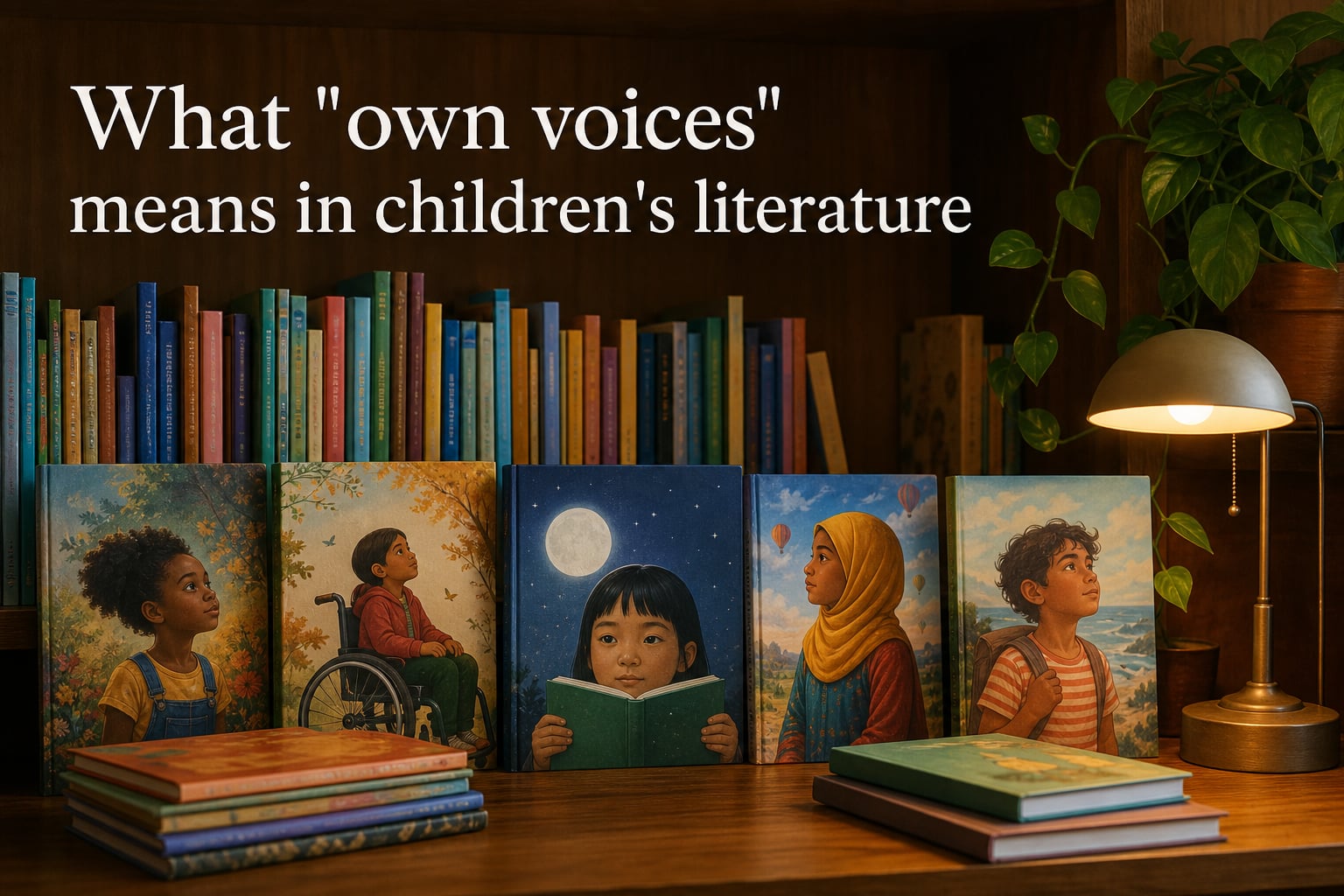
Own Voices (often written as #OwnVoices) is a term coined by author Corinne Duyvis in 2015 to describe children’s books written by authors who share the same marginalized identity as their main characters.
When a Black author writes a Black protagonist, or an autistic writer creates an autistic main character, that book is considered Own Voices. The label exists to signal that the story comes from lived experience rather than an outsider’s perspective.
In this guide, I’ll walk you through the origin of the term, why it caught fire in the children’s literature world, what happened when the We Need Diverse Books organization stepped back from using it, and how you can still find authentic Own Voices books for the kids in your life.
Table of Contents
What Does “Own Voices” Mean in Children’s Literature?
Own Voices describes a book where the author and the main character share a marginalized or underrepresented identity. That identity might be related to race, ethnicity, disability, religion, sexual orientation, gender identity, socioeconomic class, or any combination of these.
The hashtag version, #OwnVoices, started on Twitter in 2015 and quickly spread across book communities, librarians, parents, and educators who wanted a simple way to flag books with authentic representation.
Before Own Voices became a label, readers often had no easy way to tell whether a diverse character was written from the inside or from the outside. A white author writing a Black protagonist looked the same on the shelf as a Black author writing the same kind of character. Own Voices gave readers a way to surface that difference and reward publishers who sought out authentic voices.
Common identities covered by Own Voices include:
- Racial and ethnic minorities (Black, Latinx, Asian, Indigenous, Middle Eastern, and others)
- People with disabilities (physical, intellectual, neurodivergent, chronic illness)
- LGBTQ+ identities
- Religious minorities
- Lower-income experiences
- Body size diversity
- Mental health conditions
- Immigrant and refugee experiences
The point is not that Own Voices books are automatically better than books by outsiders writing diverse characters. The point is that they bring lived experience to the page, which often shows up as cultural nuance, accurate dialect, realistic family dynamics, and an emotional truth that is harder to fake.
The Origin of Own Voices: Corinne Duyvis and the 2015 Hashtag
Dutch American author Corinne Duyvis introduced the term Own Voices on her blog in 2015. She wanted a shorthand for books where authors wrote from their own identities rather than writing characters whose lives were unfamiliar to them.
Duyvis explained that the term was meant to help readers, reviewers, and librarians quickly identify which diverse books were written with firsthand knowledge. It also gave marginalized authors a way to be credited for that lived experience in marketing and conversation.
The hashtag exploded during the same year that the We Need Diverse Books (WNDB) campaign went viral. WNDB grew out of a 2014 online conversation among book lovers who wanted more diversity in children’s publishing. The movement produced measurable results: more diverse books on shelves, more diverse gatekeepers in publishing, and more public discussion about whose stories get told.
Own Voices and WNDB became closely linked in the public mind. Many people assumed that Own Voices was an official WNDB program, though it was actually a separate community-driven label that WNDB promoted.
Why Own Voices Books Matter for Young Readers
Children’s literature shapes how kids understand themselves and the world around them. Professor Rudine Sims Bishop famously described books as windows, mirrors, and sliding glass doors. Mirrors reflect a child’s own identity back at them. Windows let them see into lives different from their own. Sliding glass doors let them walk into other worlds entirely.
Own Voices books tend to produce stronger mirrors. When a child who is Black, autistic, queer, Muslim, or any other marginalized identity sees a character who looks and lives like them, the reflection is sharper and more affirming. A child who has never seen themselves in a book can suddenly feel seen.
For readers who do not share those identities, Own Voices books offer more accurate windows. A non-disabled reader can pick up an Own Voices autism book and trust that the author knows what she is writing about. That trust is hard to earn from an outsider.
Research on reading and empathy suggests that stories help children develop perspective-taking skills. Authentic stories, written from the inside, tend to produce stronger empathy gains than stories that borrow or invent marginalized experiences.
There is also a publishing reality behind the label. For decades, the children’s book industry has been dominated by white, cisgender, able-bodied authors and editors. Own Voices emerged as a way to push back against that homogeneity and center authors who had been pushed to the margins.
The Own Voices Label Today: Where Things Stand in 2026
Eleven years after Duyvis coined the term, Own Voices is both more visible and more contested than ever. The label still circulates widely on social media, in library catalogs, and in publisher marketing. Many librarians and parents still use it to make quick book selections.
At the same time, major institutions have backed away from the term. In 2021, We Need Diverse Books issued a public statement announcing that they would discontinue the use of Own Voices. The organization explained that the label had been weaponized in ways that hurt the authors it was meant to support.
WNDB pointed to several problems:
- Pressure on authors to disclose personal details publicly, including identities they considered private
- Online harassment of authors whose identities did not match reader expectations
- Authors from marginalized groups being forced into what WNDB called “the diversity spokesperson role”
- Use of the term to gate-keep who was “marginalized enough” to count
The organization now uses phrases like “authors from marginalized identities” and emphasizes that diverse books should be judged by the quality of their stories, not by the identity of the author.
Despite this shift, Own Voices has not disappeared. Many readers and book communities still find it useful as a quick shorthand. Libraries continue to use it as a catalog term. Publishers still mention it in back cover copy. The label has become part of the broader vocabulary of children’s literature, even as its parent organization has retired it.
The Controversy Surrounding #OwnVoices
The Own Voices label has always had critics. Some argue that it puts authors in an awkward position where they have to prove their identity to be believed. Others point out that the label can flatten the differences within a single identity group. A Black author from the rural South has a different experience than a Black author from an urban coastal city, and the label does not capture that nuance.
Critics also worry about identity policing. Once Own Voices became a marketing tool, some readers began interrogating authors about whether they were really part of the identity they were writing about. That pressure can be especially heavy for authors with intersectional identities, who may not match any one community’s expectations.
There is also a debate about whether Own Voices books are inherently better than other diverse books. Many excellent books feature diverse characters written by authors from outside those identities, particularly when those authors do their homework, hire sensitivity readers, and listen to feedback.
The honest answer is that Own Voices is a useful signal but not a guarantee of quality. It tells you the author has personal experience with the identity she is writing about, but it does not replace careful editing, thoughtful storytelling, or respectful collaboration with readers from that community.
How to Find Authentic Own Voices Books for Kids
Even with the controversy, Own Voices remains a practical tool for parents, educators, and librarians who want to build diverse bookshelves. Here are some tips I use when selecting books for my own family and recommending them to others.
Look up the author. A quick search will usually tell you whether the author identifies with the community she is writing about. Many authors discuss their identities in interviews, bios, or essays.
Check curated lists from trusted sources. Public libraries, school librarians, and organizations like WNDB still publish recommended reading lists organized by identity and topic.
Follow book community accounts on social media. Readers, reviewers, and librarians who focus on diverse literature often tag books with #OwnVoices or note when a book is written from lived experience.
Read the book yourself first when possible. Especially for sensitive topics, taking ten minutes to skim a picture book or read the first chapter of a middle grade novel will tell you a lot about whether the representation feels authentic.
Pay attention to sensitivity readers. Many publishers now use sensitivity readers from the relevant community. A note about that collaboration on the author’s acknowledgments page or in interviews is a good sign.
Build relationships with independent bookstores and local librarians. They tend to have deeper knowledge of diverse books than algorithms and often know which authors share the identities of their characters.
Mix Own Voices books with other diverse books. A healthy bookshelf has room for both authors writing from lived experience and authors writing across identity lines with care and respect.
Frequently Asked Questions About Own Voices
What is Own Voices in literature?
Own Voices is a term for books written by authors who share the same marginalized identity as their main characters. It was coined in 2015 by author Corinne Duyvis and is often used as the hashtag #OwnVoices to flag books with authentic representation.
Who coined the term Own Voices?
Author Corinne Duyvis coined the term Own Voices in 2015. She introduced it on her blog and on Twitter as a shorthand for books where authors wrote about characters who shared their own marginalized identities.
What is the controversy surrounding #OwnVoices?
The controversy centers on pressure for authors to publicly disclose personal identities, online harassment of authors whose identities do not match reader expectations, and the term being used to gate-keep who counts as marginalized enough. We Need Diverse Books discontinued use of the label in 2021 partly because of these concerns.
How do I find Own Voices books for my child?
Start by looking up the author to confirm shared identity, check curated lists from public libraries and organizations like We Need Diverse Books, follow diverse book reviewers on social media, and read books yourself when possible to evaluate authenticity.
Why did We Need Diverse Books stop using the Own Voices label?
We Need Diverse Books announced in 2021 that they would stop using the Own Voices label. The organization cited concerns about authors being pressured to disclose private identities, being harassed online, and being forced into spokesperson roles for their identity groups. They now use phrases like authors from marginalized identities instead.
The Lasting Value of Own Voices in Children’s Literature
Own Voices has reshaped how the children’s literature world talks about representation. The term gave readers, librarians, and booksellers a quick way to surface authors with lived experience, and it pushed publishers to invest in those voices.
Eleven years on, the label is more complicated than it used to be. Some institutions have stepped back. Some authors have mixed feelings. But the underlying idea, that marginalized authors deserve a seat at the table and that their lived experience adds something valuable, has only grown stronger.
For parents, educators, and anyone who puts books into a child’s hands, Own Voices remains a useful signal. Use it as a starting point, do your own homework, and remember that a great bookshelf holds both mirrors written from the inside and windows opened carefully from the outside.