
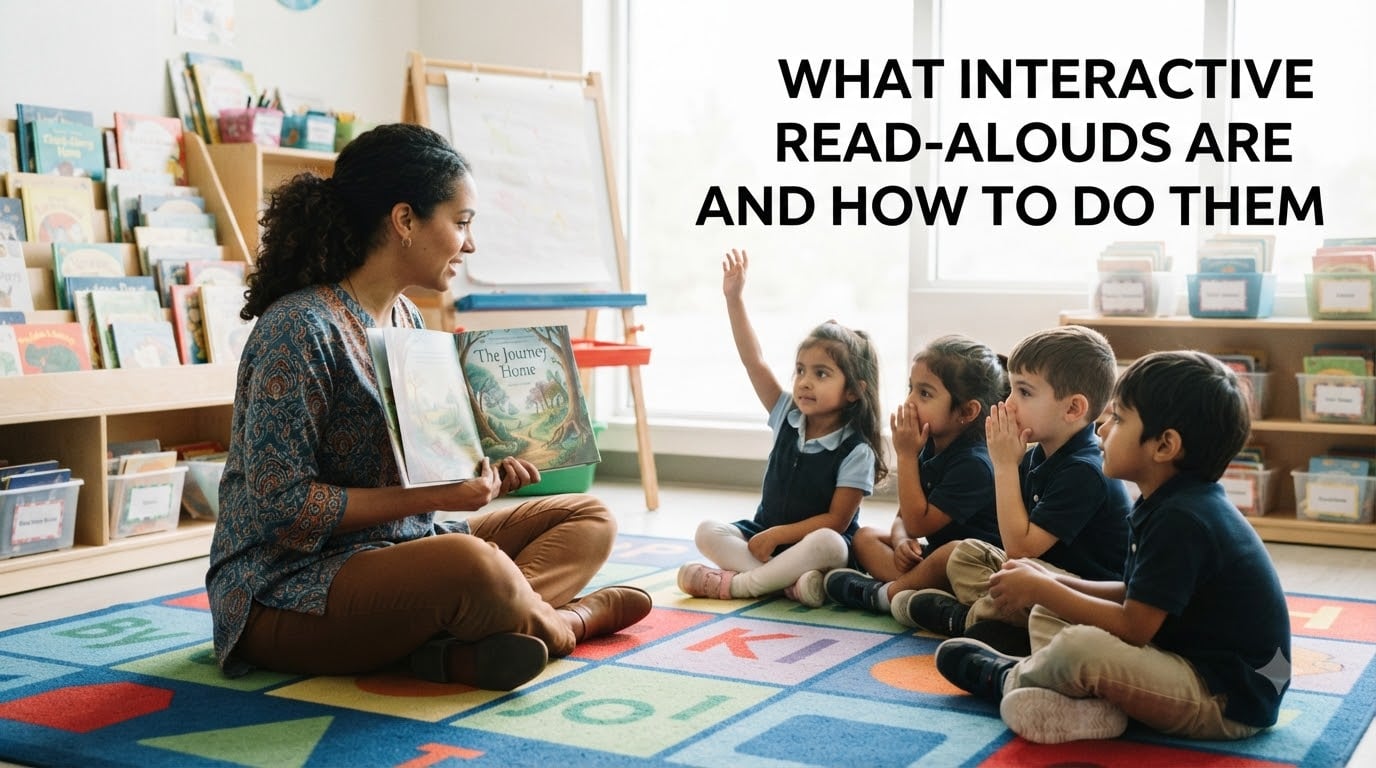
Interactive read-alouds transform the simple act of reading to children into a powerful teaching strategy. Instead of asking students to sit quietly and listen, you invite them into the story through planned questions, discussions, and hands-on responses. This approach builds comprehension, vocabulary, and a genuine love of reading.
In this guide, I will walk you through what interactive read-alouds are, why they matter, and exactly how to do them step by step. Whether you teach preschool, kindergarten, or early elementary grades, you will find practical strategies you can use in your classroom this week.
Table of Contents
What Are Interactive Read-Alouds?
An interactive read-aloud is a whole-group teaching strategy where a teacher reads a selected text aloud while intentionally pausing to engage students in discussion, thinking, and response. Unlike a traditional read-aloud where children simply listen, an interactive read-aloud builds in moments for students to talk, wonder, predict, and connect with the text.
The key word is intentional. Every stopping point, question, and activity is planned in advance. You choose specific pages to pause on, decide what to ask, and pick the interaction format that fits the moment.
Interactive Read-Aloud vs. Regular Read-Aloud
A regular read-aloud is reading a book to children for enjoyment. That has value on its own. An interactive read-aloud goes further by making the reading a teaching event where students actively construct meaning alongside you.
Teachers on Reddit frequently ask how the two differ. The simplest answer: in a regular read-aloud, students receive the story. In an interactive read-aloud, students help build the understanding of the story through structured participation.
Why Interactive Read-Alouds Matter
Interactive read-alouds matter because they give every student access to grade-level text, regardless of their independent reading ability. Struggling readers, English language learners, and confident readers all participate at the same level during a read-aloud. The teacher carries the decoding load so students can focus on comprehension.
Here are the core benefits:
Listening comprehension grows: Students hear fluent reading and build the mental skills to understand increasingly complex texts.
Vocabulary expands: Children encounter rich, challenging words in context, which sticks better than word lists.
Fluency gets modeled: Students hear what expressive, paced, accurate reading sounds like and begin to mimic it.
Community forms: Sharing a story and discussing it together builds a classroom culture rooted in shared literary knowledge.
Engagement rises: When students know they will talk, act, and respond, they pay closer attention to the text.
Research from Reading Rockets and Fountas and Pinnell consistently shows that students who experience interactive read-alouds develop stronger comprehension strategies than those who only experience passive listening.
How to Do Interactive Read-Alouds
Learning how to do interactive read-alouds comes down to preparation and intentional planning. The magic happens before you ever open the book. Here is a step-by-step process you can follow.
Step 1: Choose the right text. Select a book that is slightly above what most students could read on their own. Look for rich vocabulary, a compelling storyline, and opportunities for discussion. Picture books with strong characters work well for younger students.
Step 2: Read the book yourself first. Read it cover to cover before bringing it to your class. Note the natural stopping points where students might predict, question, or react. Mark 3 to 5 places to pause, not more, so you do not break the flow of the story.
Step 3: Plan your questions. Write down 3 to 5 questions tied to your stopping points. Mix literal questions with inferential ones. For example, ask “What do you think will happen next?” alongside “Why do you think the character felt that way?”
Step 4: Choose your interaction strategy. Decide how students will respond at each stop. Use turn and talk for quick predictions. Use think-pair-share for deeper questions. Use stop and jot when you want students to write or draw their thinking.
Step 5: Introduce the text. Before reading, build background knowledge. Show the cover, discuss the title, and ask students what they notice or wonder. This primes their thinking and activates prior knowledge.
Step 6: Read with expression. Bring the book to life through your voice. Change tone for different characters. Pause for dramatic effect. Your modeling of fluent, expressive reading teaches students what good reading sounds like.
Step 7: Stop and interact. At each planned stopping point, follow through with your chosen strategy. Keep interactions brief so the story does not lose momentum. Two to three minutes per stop is plenty.
Step 8: Discuss and wrap up. After reading, bring students back together for a closing discussion. Ask a big-picture question that ties the story together. Let students share their favorite moments and what they learned.
The Before, During, and After Framework
Most effective interactive read-alouds follow a before, during, and after structure. This framework keeps your lesson organized and ensures students engage with the text at every stage.
Before Reading
Set the stage before you read a single word. Introduce the title and author, take a picture walk through the book, and activate prior knowledge. Ask students what they already know about the topic or theme.
This is also when you front-load tricky vocabulary. Pull out 2 to 3 key words students will encounter and give them a quick, kid-friendly definition. Pre-teaching vocabulary helps students follow the story without getting stuck.
During Reading
While reading, pause at your planned stopping points to engage students. This is where turn and talk, think-alouds, and prediction questions come in. Model your own thinking out loud so students see how a reader processes text.
Say things like, “I’m noticing that the character looks worried here. I wonder why?” Your think-aloud gives students a window into the reading process and teaches them to monitor their own comprehension.
After Reading
After the final page, move into a deeper discussion. Ask open-ended questions that invite multiple answers. Have students revisit their earlier predictions to see if they were right. Connect the story to students’ lives and to other books they have read.
This is also a great time for a creative response. Students can act out a scene, draw their favorite part, or write a letter to a character. These responses solidify understanding and give you a window into what students took from the text.
Interaction Strategies That Keep Students Engaged
The right interaction strategies keep energy high and learning deep. Here are the most effective techniques teachers use during interactive read-alouds.
Turn and Talk: Students turn to a partner and briefly share a thought. This works well for quick predictions and reactions. Every student gets a turn to speak, which boosts participation.
Think-Pair-Share: Students think about a question silently, discuss with a partner, then share with the whole group. This gives quieter students time to gather their thoughts before speaking in front of the class.
Stop and Jot: Students write or draw a quick response on paper or a whiteboard. This works well for older students who can record their thinking and gives you a tangible way to check understanding.
Thumbs Up, Thumbs Down: A fast check for understanding. Ask a yes-or-no question and have students respond with thumbs. This keeps the pace moving while giving you a quick read on the room.
Act It Out: Students use gestures or short skits to show what is happening in the story. This is especially powerful for young learners who process ideas through movement.
Think-Alouds: The teacher pauses to share their own thinking out loud. This models the comprehension strategies good readers use, like questioning, inferring, and visualizing.
Mix and match these strategies throughout a single read-aloud. Variety keeps students alert and prevents any one technique from feeling stale.
How to Select Books for Interactive Read-Alouds
Book selection can make or break an interactive read-aloud. The right book has enough depth to support discussion but is accessible enough for students to follow when read aloud.
Look for these qualities when choosing a text:
Slightly above reading level: The text should stretch students without frustrating them.
Rich vocabulary: Look for books that introduce interesting words in a meaningful context.
Strong story or characters: Books with emotional depth or a clear problem spark the best discussions.
Engaging illustrations: Pictures give young readers entry points into the story and support comprehension.
Diverse representation: Choose books that reflect students’ identities and introduce them to new perspectives.
For preschool and kindergarten, short picture books with repetitive text and bold illustrations work well. For first and second grade, you can move toward longer stories with more complex plots. Repeated read-alouds of the same book across several days also work beautifully, letting students go deeper each time.
Common Mistakes to Avoid
Teachers on education forums often share what goes wrong with interactive read-alouds. Here are the most common pitfalls and how to fix them.
Stopping too often: Pausing on every page breaks the story’s flow and frustrates students. Stick to 3 to 5 planned stops. Quality matters more than quantity.
Asking only yes-or-no questions: Closed questions shut down discussion. Replace “Did you like the story?” with “What was the most surprising part?”
Not pre-reading the book: Reading a book cold makes it nearly impossible to plan meaningful stops. Always read it yourself first.
Skipping shy students: Some children will not volunteer to speak in front of the group. Turn and talk gives every student a voice, even the quiet ones.
Forgetting to model thinking: If you only ask questions and never share your own thinking, students miss out on seeing how a skilled reader processes text. Add think-alouds to your routine.
FAQs
What are interactive read-alouds and why are they important?
Interactive read-alouds are whole-group teaching sessions where a teacher reads a selected text aloud while pausing to engage students in discussion, prediction, and response. They are important because they build listening comprehension, expand vocabulary, model fluent reading, and give every student access to grade-level text regardless of their independent reading ability.
How do you make a read-aloud interactive?
To make a read-aloud interactive, plan 3 to 5 stopping points in advance, choose a specific interaction strategy for each stop (like turn and talk or think-pair-share), pre-teach key vocabulary, and model your own thinking out loud. Intentional planning is what separates an interactive read-aloud from a passive one.
What is the structure of an interactive read-aloud lesson?
Most interactive read-alouds follow a before, during, and after structure. Before reading, you introduce the text and activate prior knowledge. During reading, you pause at planned points for student interaction. After reading, you hold a closing discussion and invite students to respond creatively to the story.
What are some interactive read-aloud strategies?
Effective strategies include turn and talk, think-pair-share, stop and jot, thumbs up thumbs down, act it out, and teacher think-alouds. Mixing several strategies within a single read-aloud keeps students engaged and prevents any one technique from feeling repetitive.
How do you select books for interactive read-alouds?
Choose books that are slightly above students’ independent reading level, feature rich vocabulary and strong characters, include engaging illustrations, and offer diverse representation. Short picture books work well for preschool and kindergarten, while longer stories suit first and second grade classrooms.
Conclusion
Interactive read-alouds turn story time into one of the most powerful teaching moments in your day. By planning intentional stops, choosing the right interaction strategies, and following a clear before, during, and after framework, you help every student build comprehension, vocabulary, and a lasting love of reading. Pick a book this week, mark three stopping points, and try your first interactive read-aloud. Your students will thank you.