
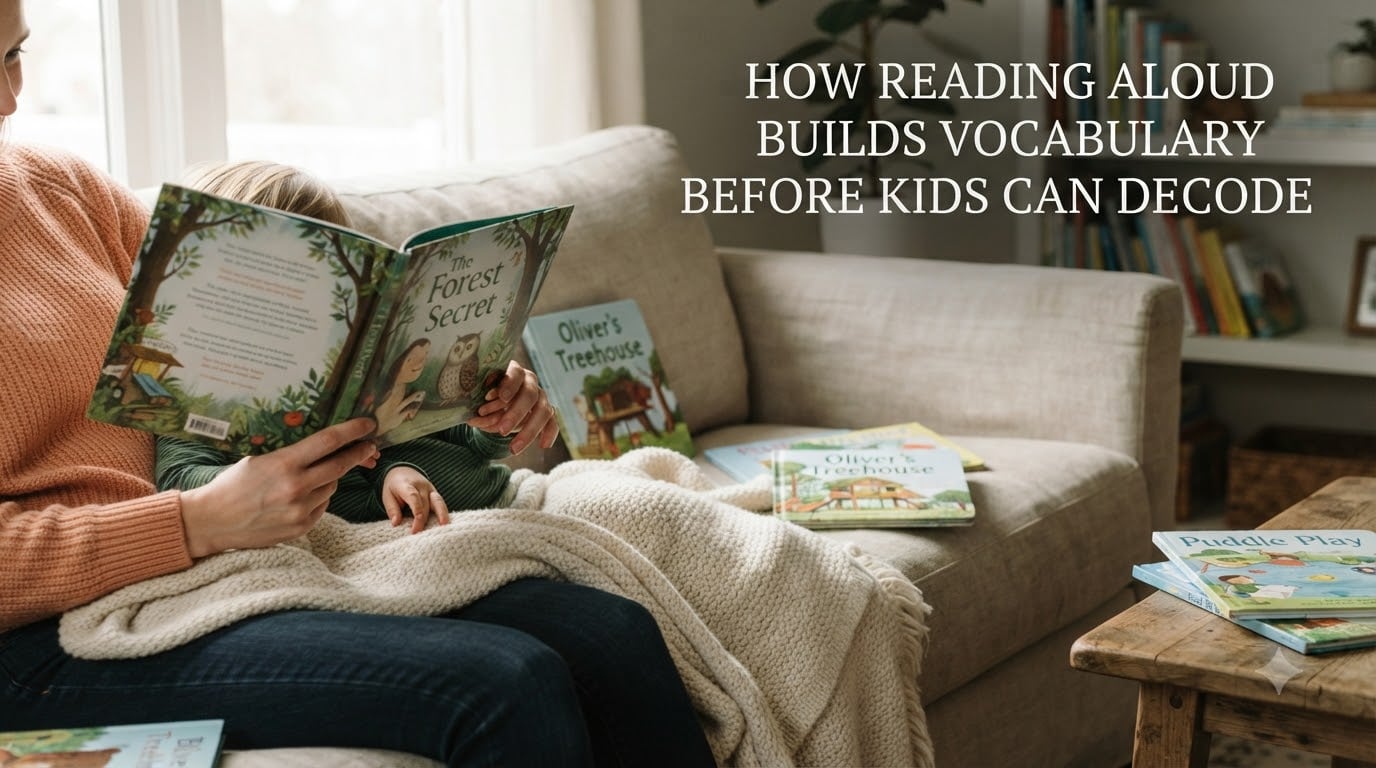
Reading aloud to young children is one of the most powerful tools parents have for building vocabulary long before a child can sound out their first word. When you read stories aloud, your child hears rich, varied language they would never encounter in everyday conversation. This listening vocabulary becomes the foundation for reading comprehension once decoding skills arrive.
Our team has spent years researching early literacy development, and the research consistently points to one truth: the words children hear in books shape the words they will eventually read. This guide breaks down exactly how reading aloud builds vocabulary before kids can decode, what the science says, and which read-aloud strategies work best at each age.
Whether you are reading to a six-month-old or a four-year-old, you are giving them a massive head start. Here is everything you need to know about how reading aloud builds vocabulary before kids can decode.
Table of Contents
What Does It Mean That Reading Aloud Builds Vocabulary Before Decoding?
Before children learn to decode (the ability to sound out written words by matching letters to sounds), they build an enormous listening vocabulary through spoken language. This is called receptive vocabulary, the words a child understands when they hear them. Expressive vocabulary, by contrast, includes the words a child can use in their own speech.
Reading aloud accelerates receptive vocabulary growth because books contain far more diverse and complex words than everyday conversation. A child who has heard words like “enormous,” “seldom,” or “furious” in stories will recognize and understand those words when they finally encounter them in print years later.
This creates a critical chain: listening vocabulary feeds into reading comprehension. When a child decodes a word on a page, they can only understand it if that word already exists in their oral vocabulary. Reading aloud fills that word bank years ahead of time.
How Reading Aloud Builds Vocabulary Before Kids Can Decode
The mechanism behind how reading aloud builds vocabulary before kids can decode comes down to language exposure. Research from Massaro (2017) found that reading aloud is actually more effective than spoken conversation for teaching children new words. The structured, repetitive, and context-rich language of picture books gives children multiple clues to figure out what unfamiliar words mean.
Here is why books outperform everyday speech for vocabulary building:
Children’s picture books contain approximately 50% more rare words than everyday conversation between parents and children.
Books provide context clues like illustrations, story structure, and surrounding sentences that help children infer word meanings naturally.
Repetition within stories gives children repeated exposure to the same new words in slightly different contexts, which strengthens memory.
Reading sessions are focused, distraction-free language experiences compared to the noisy background of daily life.
This matters enormously because children cannot learn words they never hear. The more rare and varied vocabulary a child encounters through read-alouds, the larger their mental word bank becomes before formal reading instruction even starts.
The Science: How Oral Language Builds the Reading Brain
Brain research backs up what literacy experts have observed for decades. Brain scans show that hearing stories activates the parts of a child’s brain associated with visual imagery, narrative processing, and word meaning. When a child listens to a story, their brain is doing serious work building the neural pathways that support both language and literacy.
A landmark study from Cincinnati Children’s Hospital found that children who were read to regularly showed greater activation in brain regions supporting mental imagery and narrative comprehension. In other words, hearing stories physically shapes the reading brain.
Oral language development also supports phonemic awareness, the ability to hear and manipulate individual sounds in spoken words. Phonemic awareness is one of the strongest predictors of later reading success. When children listen to rhyming books, alliteration, and playful language, they become attuned to the sound structure of language itself.
Reading aloud also builds background knowledge. Stories expose children to concepts, places, animals, and experiences they may not encounter in daily life. This background knowledge becomes essential for reading comprehension later. A child who has heard books about the ocean will understand a decoding-level text about sea creatures far better than a child with no such exposure.
From Listening Vocabulary to Reading Vocabulary
The connection between oral language and decoding is best understood through what researchers call the Simple View of Reading. This framework states that reading comprehension equals decoding ability multiplied by listening comprehension. If either factor is weak, reading suffers.
Consider what happens when a child encounters an unfamiliar written word. Even if they successfully sound it out, they only understand the text if that word already lives in their oral vocabulary. A child who has never heard the word “trotted” can decode it perfectly and still have no idea what it means.
This is why reading aloud is not optional preparation. It is the foundation. The vocabulary gap between children who are read to frequently and those who are not can reach thousands of words by age five, and that gap predicts reading achievement for years to come.
The practical takeaway is simple: the more words you put into your child’s listening vocabulary now, the easier decoding will be when the time comes. Reading aloud essentially pre-loads the meanings so that sounding out words becomes the only new skill to master.
Practical Read-Aloud Strategies That Build Vocabulary
Knowing that reading aloud builds vocabulary is one thing. Doing it effectively is another. Our team has compiled the research-backed read-aloud strategies that give you the biggest vocabulary return for your reading time.
Use the PEER Method for Interactive Reading
Dialogic reading, developed by researcher Grover Whitehurst, uses a simple four-step sequence called PEER. First, you Prompt the child to say something about the book. Then you Evaluate their response. Next you Expand on what they said by adding detail or a new word. Finally, you Repeat the prompt to let them practice the new language.
This turns passive listening into active language use, which deepens vocabulary retention dramatically compared to simply reading straight through.
Stop and Explain New Words
When you encounter a word your child probably does not know, pause briefly. Give a quick, kid-friendly definition using words they already understand. Then keep reading. You do not need to turn every story into a vocabulary lesson, but choosing one or two target words per book builds what literacy researchers call word consciousness.
Researchers like Isabel Beck recommend focusing on Tier 2 words. These are high-utility words that appear frequently in written language but less often in casual speech, words like “reluctant,” “obvious,” or “persist.” These give children the biggest payoff for reading comprehension later.
Embrace Repetition
If your child wants the same book for the tenth night in a row, let them. Repetition is one of the most powerful vocabulary-building tools available. Each re-reading deepens a child’s understanding of the story and reinforces the new words within it. Studies show that children learn more vocabulary from hearing a book multiple times than from hearing several different books once.
Take Picture Walks
Before reading the text, flip through the book and talk about the illustrations together. Ask your child what they think is happening and what might happen next. This builds prediction skills, exposes them to story language, and primes their brain to absorb vocabulary when you read the actual words.
Age-Specific Guidance for Building Vocabulary Through Reading
Different ages need different approaches. Here is how to adapt your read-aloud practice as your child grows.
Infants (0 to 12 Months)
It is never too early to start. Babies benefit from hearing the rhythm and melody of language even before they understand individual words. Choose sturdy board books with high-contrast images and simple text. Name objects, make animal sounds, and read with warmth and expression. The goal at this age is building a love of books and tuning the baby’s ear to language patterns.
Toddlers (1 to 3 Years)
Toddlers thrive on repetition, rhyming text, and books about familiar daily experiences. Encourage them to point to objects, finish predictable sentences, and repeat favorite words. Do not worry if they wander off mid-book. Keep sessions short and follow their lead. Even five minutes of engaged reading builds vocabulary over time.
Preschoolers (3 to 5 Years)
Preschoolers are ready for longer stories, more complex plots, and richer vocabulary. This is the prime age for introducing Tier 2 words and having real conversations about books. Ask open-ended questions like “Why do you think the character felt that way?” Let them retell the story in their own words to strengthen both comprehension and expressive vocabulary.
How to Choose Vocabulary-Rich Books for Preschoolers
Not all books are equal when it comes to vocabulary building. The research is clear that children’s books contain significantly more rare words than typical parent-child conversation, but some books are richer than others.
Look for books with descriptive language, varied sentence structures, and interesting verbs and adjectives. Classic picture books and award-winning titles tend to offer stronger vocabulary than books based on television shows. Folk tales and fables often contain memorable, unusual words because of their storytelling traditions.
Do not avoid books because they contain words your child does not know yet. That is exactly the point. The richest vocabulary growth happens when children encounter words slightly beyond their current level and figure out meanings from context.
Common Mistakes to Avoid During Read-Alouds
Even the most well-intentioned read-aloud sessions can lose their vocabulary-building power if a few common pitfalls creep in. Here is what to watch for.
Rushing through the story without pausing reduces comprehension and skips over vocabulary opportunities. Slow down and let the language sink in. Skipping or simplifying hard words deprives your child of the exposure they need. Read the actual text and trust the context to do its work.
Reading passively without any conversation limits retention. Even a few questions or comments per book make a big difference. And while screen-based read-along videos can supplement, they do not replace the interactive, responsive experience of a parent reading aloud. The back-and-forth is where the magic happens.
FAQs
Does reading aloud improve vocabulary?
Yes. Research consistently shows that children who are read to regularly develop significantly larger vocabularies than those who are not. Children’s books contain approximately 50% more rare words than everyday conversation, giving kids exposure to language they would never hear otherwise. Over time, this exposure translates into measurable vocabulary gains.
Why are read alouds crucial to developing a child’s vocabulary?
Read alouds are crucial because they expose children to rich, varied language beyond what everyday speech provides. Books use more diverse vocabulary, complex sentence structures, and unfamiliar concepts. This exposure builds a listening vocabulary that becomes the foundation for reading comprehension once children learn to decode text.
How does oral language influence decoding skills?
Oral language and decoding are connected through the Simple View of Reading. When a child decodes a written word, they can only understand it if that word already exists in their oral vocabulary. Reading aloud pre-loads word meanings so that sounding out text becomes the only new skill to learn, making decoding faster and comprehension deeper.
How can read alouds help develop vocabulary?
Read alouds develop vocabulary through repeated exposure to new words in meaningful context. Strategies like pausing to explain unfamiliar words, using the PEER interactive reading method, embracing repetition, and taking picture walks all maximize vocabulary growth. Choosing books with rich, descriptive language ensures children encounter words they would not hear in daily conversation.
What are the benefits of reading alouds in preschool?
Reading alouds in the preschool years build vocabulary, phonemic awareness, background knowledge, attention span, and a love of books. Children who are read to frequently enter school with thousands more words in their listening vocabulary, which gives them a strong foundation for learning to read and comprehending text independently.
Conclusion
Reading aloud is the single most effective way to build your child’s vocabulary before they can decode a single word. The rich, varied language in books fills their listening vocabulary with words they will eventually need for reading comprehension. Brain research confirms that hearing stories physically shapes the neural pathways that support literacy.
You do not need expensive programs or perfect techniques. You need books, consistency, and a willingness to pause and talk about new words. Whether your child is an infant hearing the rhythm of language for the first time or a preschooler ready for richer stories, every read-aloud session deposits new words into their growing mental word bank.
Understanding how reading aloud builds vocabulary before kids can decode gives you the why behind the routine. Now grab a book, find a cozy spot, and start reading. Your child’s reading brain is under construction, and you are the architect.