
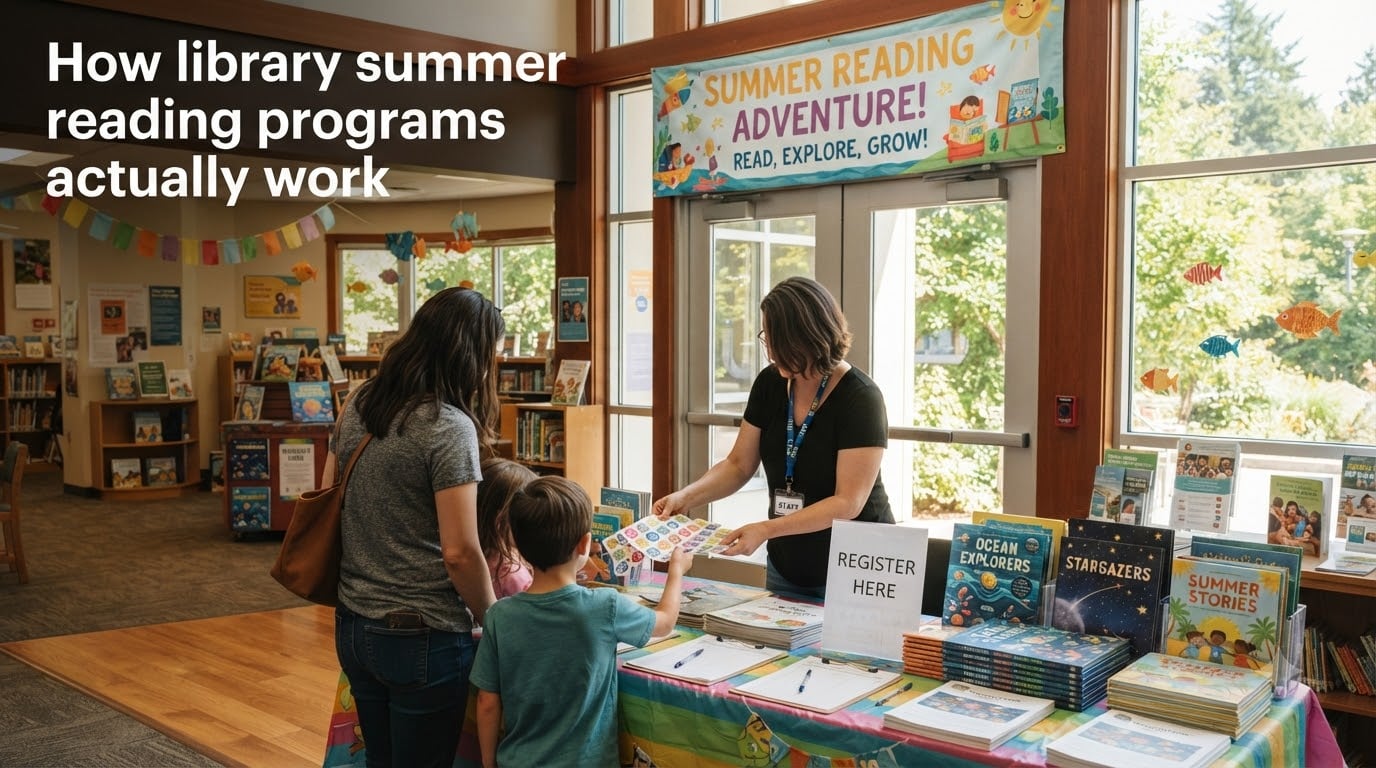
Every summer, thousands of public libraries open their doors and invite kids, teens, and adults to sign up for one of the oldest literacy traditions in America. If you’ve ever wondered how library summer reading programs actually work behind the scenes, this guide walks you through the whole system. From the moment you register to the final prize pickup, I’ll show you what happens, who runs it, and why libraries do things the way they do.
I’ve spent years talking with librarians, watching my own kids earn stickers, and digging into how tracking apps like Beanstack function. Whether you’re a parent, a teacher, or a curious adult, here’s the real picture of how library summer reading programs work today.
Table of Contents
What Is a Library Summer Reading Program?
A library summer reading program is a structured initiative run by public libraries to keep people reading during the summer break. The goal is simple: prevent summer learning loss while building a lifelong love of books. Most programs run from late May or early June through August, though exact dates vary by library system.
At their core, these programs combine three ingredients. You get a reading goal (minutes, books, or pages), a tracking method (paper logs or digital apps), and a reward structure (stickers, badges, prizes, or drawing entries). The combination keeps participants motivated and gives librarians measurable proof that the program worked.
Research backs this up. Studies summarized by the Urban Libraries Council show that summer reading programs improve reading achievement and increase kids’ desire to read. The Louisiana Library Association lists 11 documented benefits, from vocabulary growth to stronger family engagement. The reading habit matters more than the prize, but the prize is what gets people through the door.
How Library Summer Reading Programs Work: Step by Step
Programs vary by library, but most follow a predictable flow. Here is how a typical summer reading program actually works from signup to celebration.
Step 1: Pre-launch planning. Months before summer starts, library staff choose a theme, design reading challenges, order prizes, and configure their tracking software. This is the part most patrons never see.
Step 2: Kickoff event. Most libraries host a launch day or week with entertainment, sign-up booths, and free books. It doubles as marketing and community celebration.
Step 3: Registration. Participants create an account, pick an age division, and set a personal reading goal. This usually takes five minutes or less.
Step 4: Reading period. For 6 to 10 weeks, participants read or complete challenges on their own time. They log progress weekly or as they finish books.
Step 5: Mid-summer checkpoints. Many libraries hand out milestone prizes partway through. A free book at 5 hours, a coupon at 10 hours, or a small toy at 15 hours keeps momentum alive.
Step 6: Completion and final reward. Hit your goal and you earn a completion certificate, a grand prize entry, or an invitation to the closing celebration.
Step 7: Wrap-up reporting. Staff tally participation numbers, write reports for funders, and start planning next year. This data drives grant applications and library funding decisions.
Registration and Sign-Up Process
Registration used to mean filling out a paper card at the front desk. Today, most libraries offer online sign-up through apps like Beanstack or their own website. Walk-in registration is still available everywhere.
When you sign up, the system asks for basic details: name, age or birth year, contact info, and a library card number. Some libraries let non-cardholders participate, though cardholders often get access to more prizes.
You also choose your reading goal. Children’s programs often default to a set number of minutes or books. Teens and adults usually set their own goal. I like that flexibility because it removes the one-size-fits-none pressure.
After registration, you receive a welcome packet, a reading log (digital or paper), and often a small free book or coupon from a local sponsor. From there, you’re officially enrolled.
Tracking Methods: Minutes vs Books vs Pages
This is where the great library debate lives. Should programs track reading by minutes, books, or pages? Librarians argue about this constantly, and a recent thread on r/librarians called it “one of the biggest arguments in our system.” Here’s how each method actually works.
Minutes tracking. You log how long you read. This rewards slow, careful readers and lets audiobooks count equally. Critics say minutes are easy to inflate. One common benchmark I see: 12 hours over 2 months works out to about 15 minutes of reading per night, which is realistic for most families.
Books tracking. You log each completed book. This rewards finishers and is easy for kids to understand. Critics say it discourages graphic novels, short stories, and thick books equally.
Pages tracking. You log total pages read. This rewards dense books but creates weird incentives. A 600-page fantasy novel counts more than a tight 80-page novella.
Many libraries tried combining minutes and books but found it too complicated for staff. Some now use a hybrid: minutes for younger kids, books for older readers. If you want your library to switch methods, your feedback matters. Librarians read survey results carefully.
Digital Tracking: Beanstack and Reading Apps
Beanstack is the dominant tracking platform in public libraries. It powers thousands of programs and handles registration, logging, badge earning, and prize redemption in one place. If your library uses Beanstack, you can scan a book’s barcode with your phone to log it automatically.
The app also runs activity challenges. Instead of “read a book,” participants might earn badges for attending a library event, writing a review, or trying a new genre. A parent on r/Libraries pointed out that their program had only one literacy challenge among many activity badges, which reflects a national trend toward broader engagement.
Paper logs still exist for younger children and people who don’t use smartphones. They’re not obsolete. Many librarians prefer paper for pre-readers because parents can sit together and color in a reading chart.
If you’re wondering what is Beanstack and how does it work, think of it as a gamified reading journal. The library controls the rules, but participants see progress bars, badges, and a feed of activities.
Rewards, Prizes, and Incentives
Rewards are the engine of summer reading. The most common structure works like this. Small prizes arrive at incremental milestones, while bigger prizes go to everyone who finishes.
Typical rewards include stickers, temporary tattoos, bookmarks, pencils, coupons to local businesses, free books, character figurines, passes to museums or zoos, and grand-prize drawing entries for tablets, bikes, or gift cards. Adult programs usually swap toys for book-themed totes, coffee shop gift cards, or local business vouchers.
Behind the scenes, libraries fund prizes through grants, Friends of the Library groups, and local sponsors. A $5,000 summer budget is common for a small-town library, while urban systems may spend tens of thousands. Staff time is the real cost.
The most effective reward, according to several librarians I’ve spoken with, is not the toy but the recognition. Kids love seeing their name on a completion wall. Adults like the closing celebration. The prize is the cherry; the milestone is the meal.
Age Divisions: Children, Teen, and Adult Programs
Most libraries split participants into three or four age divisions. Children programs cover birth through 5th or 6th grade. Teen programs serve middle and high schoolers. Adult programs cover everyone 18 and up, and a few libraries offer a 55-plus senior track.
Each division has different themes, challenges, and prizes. Children’s programs lean on picture books and read-alouds. Teen programs often include genre challenges, book-to-screen pairings, or creator meetups. Adult programs focus on flexibility: read what you want, when you want, with no required list.
Family participation is encouraged. Many libraries let parents log reading minutes alongside their kids, which doubles as a literacy role model. A 2026 Louisiana Library Association study noted that family involvement is one of the strongest predictors of program completion.
Common Program Themes and Who Chooses Them
Every summer, libraries across the country seem to share the same theme. The 2026 theme, “Adventure Begins at Your Library,” rolled out through the Collaborative Summer Library Program (CSLP), a consortium that designs shared themes and artwork for state libraries.
CSLP members include most U.S. state libraries. They vote on themes two or three years in advance, then commission artwork, logos, and programming guides. Individual libraries adapt the theme to their own community, but the bones stay the same.
Why coordinate? Cost. Designing art from scratch is expensive. Sharing one theme lets small libraries look polished without a six-figure design budget. Coordinated themes also make state-level marketing easier and let traveling performers reuse the same branded show.
Each library picks its own challenges within the theme. “Adventure Begins” might mean reading a book set in another country, attending a virtual travel program, or trying a new outdoor activity at a local park.
Why Libraries Include Activities Beyond Reading
If you’ve noticed that summer reading feels less about reading and more about scavenger hunts, you’re not alone. The shift toward activity-based challenges is intentional. Libraries want to reach kids who don’t naturally pick up books.
Reading is one path to literacy. So is cooking, museum-going, gardening, and listening to a story. Activity badges let libraries recognize all of those. A child who attends four library events and reads one book still finishes the program. The goal is engagement, not just page count.
This shift has critics. Some regulars feel the program has lost its focus. Librarians respond that pure reading challenges exclude families with reluctant readers, English-language learners, and kids with reading disabilities. A wider tent serves more kids.
Behind the scenes, staff find activity-based programs easier to run. Badges require simple data entry, while minute logs invite debate. Programs have to scale to thousands of participants, and simplicity wins.
Benefits of Summer Reading Programs
The benefits are well documented. Children who read over summer maintain vocabulary and reading comprehension they would otherwise lose. The phenomenon, known as summer learning loss, can erase up to two months of progress in low-income students without intervention.
Beyond academics, programs build community. Libraries become gathering places, parents meet other parents, and kids see reading as a social activity rather than a chore. Adults benefit too. Reading reduces stress, improves sleep, and connects you with library programming you might otherwise miss.
Libraries also use program data to justify funding. High participation numbers translate into stronger budget requests to city councils and grant funders. When you sign up, you are literally helping your library stay open.
The benefit I see most often in my own work: kids who finish a summer reading program tend to come back during the school year. They associate the library with achievement, not just free Wi-Fi. That habit lasts decades.
Tips for Getting the Most Out of Your Program
Sign up on day one. Early registrants often get better swag bags and avoid the line. Pick a goal that’s challenging but realistic. Stretching slightly is good; burnout is not.
Use the 5 finger rule when picking books. Open to any page and read it. Count words you don’t know. Fewer than five means the book is too easy. More than five and it’s too hard. Sweet spot is two or three unknown words per page.
Log as you go. Paper logs work fine, but apps send reminder notifications that help. Pair reading with a routine: 20 minutes before bed, 30 minutes after breakfast, audiobooks on the drive to camp.
Attend one library event. Even introverts enjoy author talks and craft nights. You’ll meet librarians who can recommend your next great read, and your attendance often unlocks bonus badges.
Finally, finish what you start. Completion is the strongest predictor of next year’s enrollment. The goal isn’t a perfect score. It’s building a reading habit that survives Labor Day.
FAQ
How does summer reading work?
You register at your local library, set a reading goal, log your reading using minutes, books, or pages, complete any activity challenges, and earn rewards at milestones. Most programs run from late May through August. Completion earns a final prize or certificate.
What is the 5 finger rule for books?
Open any page and read it. Count the words you don’t know. Zero means too easy, five or more means too hard. The sweet spot is two or three unfamiliar words per page, which gives you challenge without frustration.
What happens if I don’t do my summer reading assignment?
Library summer reading is voluntary, so nothing happens if you skip it. School assignments are different. Some schools require proof of completion for extra credit or to avoid a fall reading test. Check with your teacher if you have a school-linked assignment.
Why do all libraries have the same summer reading theme?
Most U.S. libraries belong to the Collaborative Summer Library Program, a consortium that designs shared themes and artwork two or three years in advance. Sharing themes cuts design costs, simplifies state marketing, and lets traveling performers reuse branded shows. Each library adapts the theme to its own community.
Conclusion
Library summer reading programs work because they combine a clear goal, simple tracking, and motivating rewards. Behind every sticker and drawing entry is a planning process that starts months before summer, a staff team executing thousands of sign-ups, and a community of readers who show up year after year.
Now you know how library summer reading programs actually work, from the CSLP theme selection to the Beanstack barcode scan to the final prize. Sign up this summer, set a goal that stretches you, and finish what you start. Your library, and your future reading self, will thank you.