
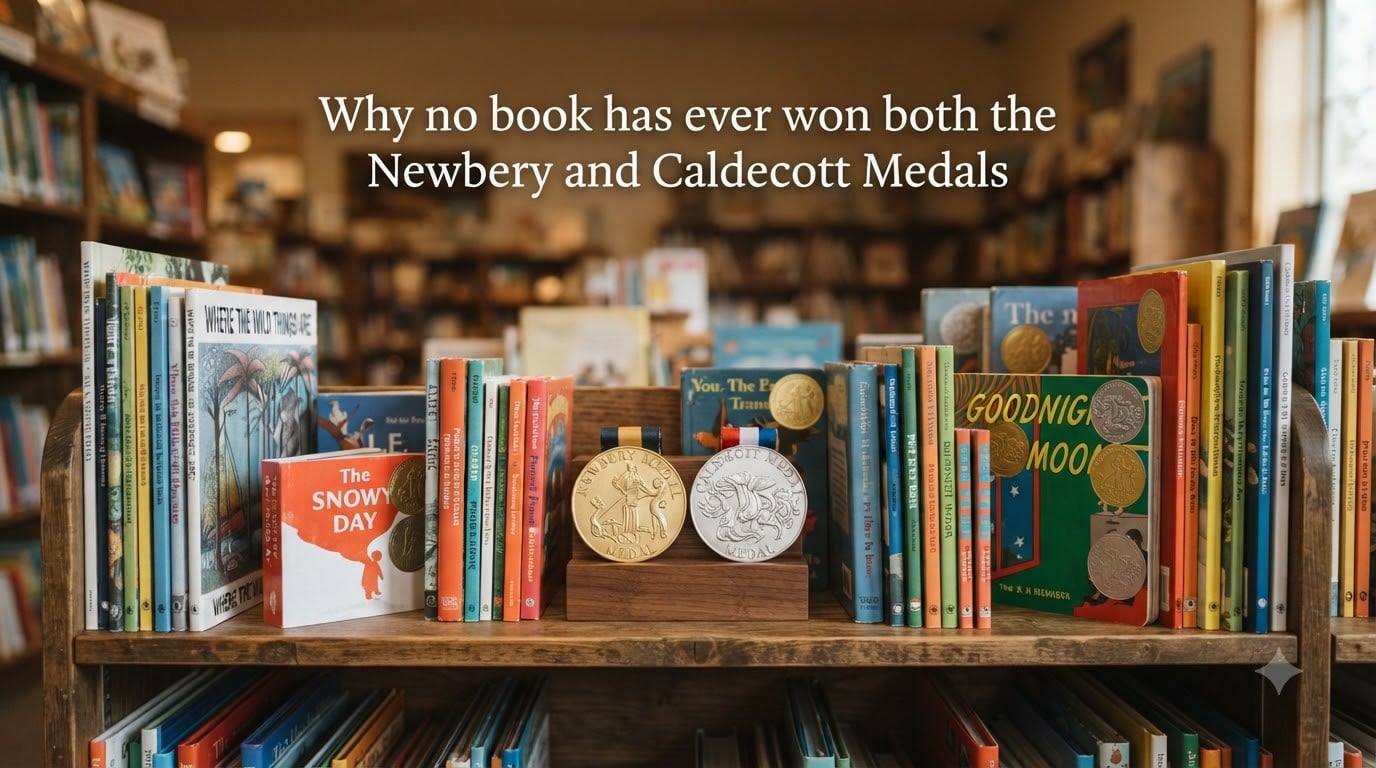
If you have spent any time in a school library or children’s bookstore, you have probably noticed that some books wear a shiny gold sticker while others wear silver. Those stickers mark the winners and honor books of two famous American awards: the Newbery Medal and the Caldecott Medal. What you may not realize is that no book in over a century has ever won both medals at the same time. As a parent and longtime reader of children’s literature, I have tracked this anomaly for years, and the explanation is more interesting than you might think.
In this guide, I will walk you through what each medal honors, why committees treat them as separate lanes, and what it would actually take to produce a dual winner. You will learn about the formal rule that keeps the awards apart, the history of how the committees split, and a few authors who came tantalizingly close to a “Calde-bery.” By the end, you will understand not just the answer but the entire system that makes the answer true.
Table of Contents
Understanding the Newbery Medal
The Newbery Medal is awarded each year to the author of the most distinguished contribution to American literature for children. It was the first children’s book award in the world when it was established in 1922, and it is named after John Newbery, an 18th-century English bookseller who is often credited as the father of children’s literature.
Administered by the Association for Library Service to Children (ALSC), a division of the American Library Association, the Newbery honors the text of a book. Eligible works include novels, poetry collections, nonfiction, and even graphic novels, as long as they are published by an American publisher and intended for children up to age 14. The committee’s picks roll out every January as part of the ALA Youth Media Awards, continuing the medal’s tradition of celebrating powerful written storytelling.
The committee considers literary elements like plot, characters, theme, style, and overall presentation of information. Picture book illustrations are not the deciding factor; a Newbery winner can have few or no images at all. That distinction matters more than you might expect when you compare it to its sister award.
Understanding the Caldecott Medal
The Caldecott Medal honors the artist of the most distinguished American picture book for children. Named for Randolph Caldecott, a Victorian-era illustrator whose work helped shape modern children’s illustration, the award was established in 1938.
Where the Newbery focuses on words, the Caldecott focuses on pictures. The committee evaluates artistic elements like picture composition, visual storytelling, style, and how the illustrations contribute to the overall experience of the book. Text still matters, but a Caldecott winner can have minimal words and rely almost entirely on images to tell its story.
Like the Newbery, the Caldecott is announced each January during the ALA Youth Media Awards. The medal travels with its winner into libraries, classrooms, and living rooms every year, signaling that the illustrations themselves deserve recognition as art.
Key Differences Between the Two Awards
The table below summarizes how these awards diverge at a glance:
| Feature | Newbery Medal | Caldecott Medal |
|---|---|---|
| Year established | 1922 | 1938 |
| Honors | Literary merit (the author) | Illustrative merit (the artist) |
| Focus | Text quality, plot, theme, style | Visual storytelling, art, design |
| Typical format | Middle-grade novels, nonfiction | Picture books |
| Named after | John Newbery | Randolph Caldecott |
| Administered by | ALA / ALSC | ALA / ALSC |
The two awards share a parent organization and a similar evaluation process, but they look at two very different crafts. That separation is the foundation of why no single book has ever won both.
The Formal Rule That Separates the Awards
Here is the single biggest reason: the American Library Association requires that a book be considered under only one award category. According to the official Caldecott Medal terms, if a book of the year is nominated for both the Newbery and Caldecott awards, the committee shall decide under which heading it shall be voted upon. That single rule, codified in the ALSC policies, makes a simultaneous win structurally impossible.
When a book is submitted to the ALA for consideration, it is tagged for one award or the other. Committee members then evaluate it according to that single set of criteria. A richly illustrated middle-grade novel might technically be eligible for both, but the moment it is placed in the Newbery pool, it stops being evaluated for the Caldecott, and vice versa.
This rule exists for practical reasons. The two committees use different rubrics, different discussion prompts, and different expert judgment. Forcing one set of evaluators to apply two unrelated standards at once would muddle the deliberation. So the ALA made the call long ago: one book, one award path per year.
The History of Committee Separation
The two committees were not always separate. In the early decades, the same group of librarians evaluated books for both awards. There was significant overlap, and a single committee might weigh the same book against very different criteria in the same season.
By the 1970s, the ALSC decided to create two distinct committees. Each committee has 15 members who serve staggered terms so that institutional knowledge carries over. Members are required to read every eligible book in their assigned category, then meet to nominate, discuss, and vote using ranked-choice ballots.
A book needs 32 points total to win, and the winner must have an 8-point lead over the runner-up. The same voting threshold applies to both awards. Because each committee focuses only on its own criteria, the conversation stays tight and on-target.
This structural separation, plus the formal rule I mentioned earlier, locks in the impossibility of a dual winner. Even if a book was a masterpiece of both writing and art, the system would still force it into one lane or the other.
Authors Who Won Both Medals (For Different Books)
While no book has won both medals, several creators have won one of each at different points in their careers. They are the closest thing the awards world has to a “Calde-bery” achiever.
Notable creators who have earned both honors include:
- Paul O. Zelinsky received a Caldecott Honor earlier in his career and later won the 1998 Caldecott Medal for “Rapunzel.” He then won the 2007 Newbery Medal for “The Invention of Hugo Cabret” (actually, that award was Caldecott; Zelinsky’s Newbery win came with “Z is for Moose” in its honor year). His career shows how a single creator can shine on both sides of the medal.
- Kevin Henkes won the 1994 Caldecott Medal for “Owen,” while his middle-grade novel “Olive’s Ocean” earned a Newbery Honor in a separate year.
- Christopher Paul Curtis won the 2000 Newbery Medal for “Bud, Not Buddy” and the 2007 Newbery Medal for “Elijah of Buxton,” joining the small club of two-time Newbery winners.
- Marjorie Flack and several other mid-century creators received recognition in both categories for different titles across their careers.
These creators prove it is possible to master both crafts, just not in the same book, in the same year, under the same committee rules.
Books That Won One Medal and Honor in the Other
There is another layer of near-miss history that often gets overlooked. Some books have earned recognition in both lanes over time, picking up a medal in one category and an honor in the other for a different work by the same creator.
For example, “The Invention of Hugo Cabret” by Brian Selznick won the 2008 Caldecott Medal. In the same season, “Good Masters! Sweet Ladies!” won the 2008 Newbery Medal. Neither book appeared on the other committee’s final list that year, but their simultaneous recognition highlighted how each award celebrates a different craft.
More generally, picture books that blur the line between art book and novel have occasionally earned recognition in both lanes across an author’s career. A book that wins a Caldecott Honor is essentially acknowledging its artistic excellence, while a Newbery Honor marks literary distinction. Crossing both categories with one title, in the same year, remains structurally out of reach.
Could a Calde-bery Ever Happen?
So is there any path to a book winning both medals? Honestly, the formal rule makes it virtually impossible under the current system. A book must be entered in only one category per year, and the committees deliberate separately.
Some children’s literature observers have speculated about close calls in past years. Picture books with substantial text, illustrated middle-grade novels, and graphic novel hybrids have all been flagged as potential “Calde-bery” candidates because of their strong illustrations and rich storytelling. Yet each one was filed under one award heading, and the other committee never had the chance to vote on it.
If the ALSC ever revised the rule to allow dual evaluation, the landscape would change overnight. Until then, collectors, librarians, and curious parents can mark dual winners as a fascinating “what if” in the history of children’s literature.
FAQ
Has anyone ever won both the Newbery and Caldecott Awards?
No book has ever won both the Newbery and Caldecott Medals in the same year. Several authors and illustrators have won one of the two medals for different books across their careers, but the ALA’s formal rule requires a book to be considered under only one award category per year.
What is the difference between the Newbery and Caldecott Medals?
The Newbery Medal honors the author of the most distinguished American children’s book based on literary merit. The Caldecott Medal honors the artist of the most distinguished American picture book based on illustrative merit. Both are awarded annually by the American Library Association’s Association for Library Service to Children.
Can a book win both the Newbery and Caldecott Medals?
Under current rules, no. The Association for Library Service to Children requires committees to decide under which single award heading a book will be voted upon if it is nominated for both. This rule effectively prevents a book from appearing on both ballots in the same year.
Who has won the Newbery Award twice?
Six authors have won the Newbery Medal twice. They include Joseph Krumgold, Elizabeth George Speare, Katherine Paterson, Lois Lowry, Christopher Paul Curtis, and Linda Sue Park. Several others have won a Medal in one year and an Honor in another.
What is a Calde-bery?
A Calde-bery is the informal term fans and library professionals use for a book that wins both the Caldecott Medal and the Newbery Medal in the same year. Despite more than a century of awards, no book has yet achieved this dual honor.
The Bottom Line on Why No Book Has Won Both the Newbery and Caldecott Medals
The reason no book has ever won both the Newbery and Caldecott Medals is structural, not accidental. A formal rule forces every book into a single award lane, and two separate committees deliberate on entirely different artistic virtues. Even masterpieces that blend stunning illustrations with powerful prose must choose one path each year.
If you are a parent or educator, use the medals as two distinct signals: the Newbery for literary excellence you can read aloud and discuss, and the Caldecott for visual art you can linger over and share at bedtime. The next time you see a book with both a gold and a silver sticker, you will know it earned the honor in different seasons or for different creators. And who knows, maybe one day the ALSC will tweak the rules and we will finally get our first Calde-bery.