
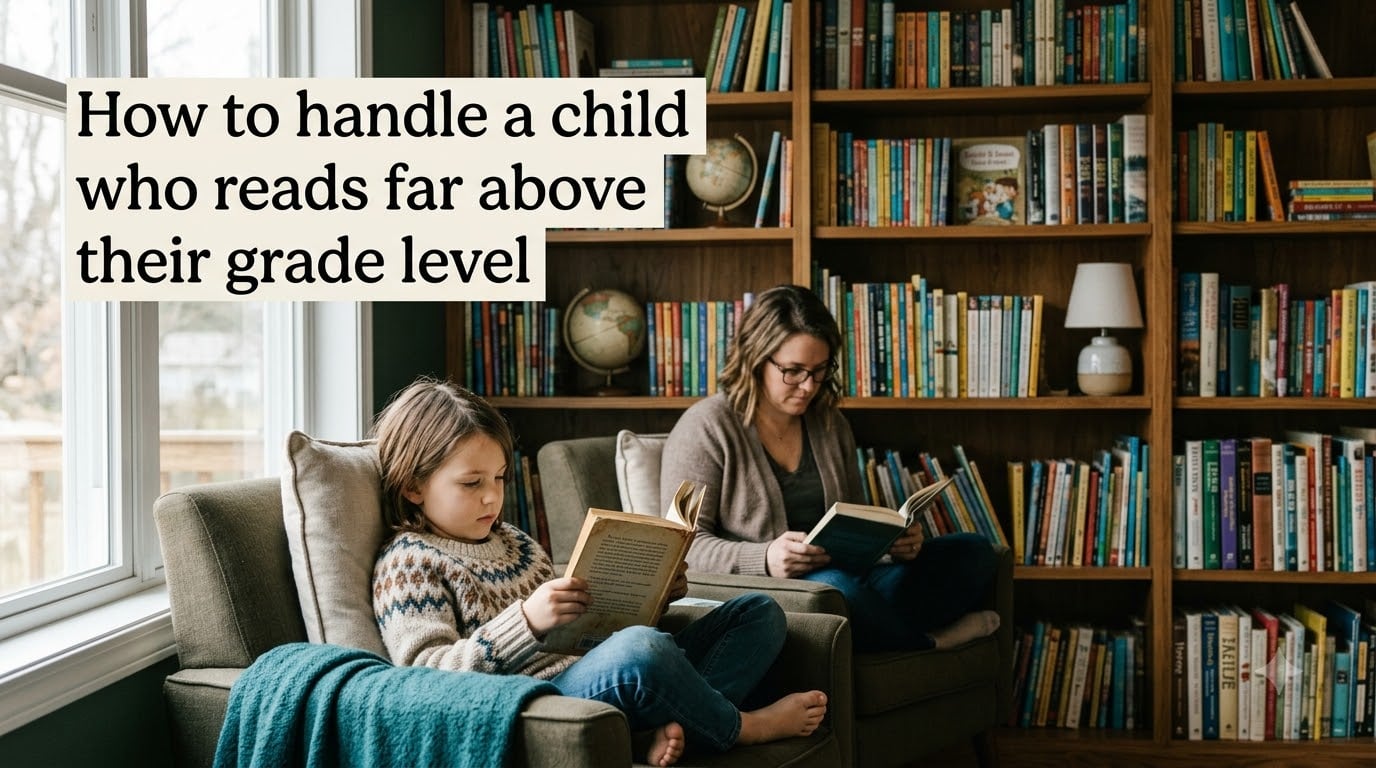
When my daughter came home from kindergarten reading chapter books her older cousin had abandoned, I felt proud. Then I felt confused. The school library had nothing at her level that was also age-appropriate, her teacher seemed unsure how to adjust, and I was fielding questions about war and loss from a five-year-old who had discovered historical fiction.
If you are wondering how to handle a child who reads far above their grade level, you are not alone. Thousands of parents face this exact situation every year, and most feel just as uncertain as I did. The advice out there tends to swing between two extremes: do nothing and let them coast, or push hard and risk burning them out. Neither is right.
This guide walks through what actually works for advanced readers, drawn from research, parent experiences, and classroom-tested strategies. We cover how to identify the situation, challenge your child at home, advocate effectively with teachers, navigate the tricky social-emotional landscape, and recognize when advanced reading might signal something deeper.
Table of Contents
Signs Your Child Reads Far Above Grade Level
Most parents sense something is different before any formal assessment confirms it. The signs go beyond simply reading early or reading well.
Your child might be an advanced reader if they consistently choose books written for children two or more years older, read independently for long stretches without losing focus, decode unfamiliar multi-syllable words with ease, or ask questions about text that show deep comprehension rather than just word-reading.
Other common signs include a vocabulary that surprises adults, an ability to discuss plot and character motivation in detail, frustration when classroom reading feels repetitive, and a preference for nonfiction or complex narratives over simple stories. Some advanced readers also teach themselves to read before formal instruction begins, arriving at school already fluent.
If several of these sound familiar, your child likely reads above grade level. A formal reading level assessment through your school or a private evaluator can tell you exactly how far ahead they are and help guide next steps.
Why Doing Nothing Is Not the Answer
Some literacy experts suggest that schools can simply do nothing special for above-grade-level readers. The logic is that these children will be fine on their own, and teacher attention is better spent on struggling readers. I understand the classroom reality behind this thinking, but as a parent, accepting it without question is risky.
Children who read well above their grade level and receive no differentiation often become bored, disengaged, and sometimes disruptive. More importantly, they stop growing. A child who reads three years above grade level but only encounters grade-level texts is not actually improving. They coast, develop poor study habits because everything comes easily, and sometimes lose their love of reading entirely.
Forum discussions on Reddit reveal this pattern repeatedly. Adults who were advanced readers frequently describe being “insatiably curious” as children but eventually “sucking at school” because they never learned how to work at reading. The boredom that comes from unchallenging material can also lead to behavioral issues that mask the real problem.
The goal is not to push your child into stress. It is to keep them engaged, growing, and connected to the joy that made them love reading in the first place.
Understanding the Three Reading Levels
Before you can effectively support an advanced reader, you need to understand the three types of reading levels that educators use. Knowing the difference between them helps you communicate with teachers and choose the right books at home.
Independent reading level is the level at which a child can read comfortably on their own, understanding at least 95 percent of the words and comprehending the material without help. This is the level for free reading and pleasure. For an advanced reader, their independent level may be several grades above their actual grade.
Instructional reading level is slightly harder. The child understands about 90 to 95 percent of the words and can comprehend the text with some guidance. This is where actual learning and growth happen. A teacher or parent asks questions, introduces vocabulary, and helps the child dig deeper into meaning. Instructional level work is what advanced readers often miss when they are only given grade-level material.
Frustration reading level is where the child understands less than 90 percent of the words. At this level, reading becomes a struggle, comprehension breaks down, and the experience is discouraging. Even advanced readers have a frustration level, and pushing them past their instructional level too aggressively does more harm than good.
The key for parents is knowing where your child falls on this spectrum and making sure they get regular access to instructional-level texts, not just independent-level or grade-level material.
How to Challenge Advanced Readers at Home
You do not need to wait for the school to make changes before supporting your advanced reader at home. Some of the most effective strategies require nothing more than time, conversation, and the right books.
Step 1: Build a rich home library. Stock books at your child’s instructional and independent levels across multiple genres. Include biography, historical fiction, science, poetry, and fantasy. Advanced readers benefit from variety as much as from difficulty.
Step 2: Read together and discuss. Even strong decoders benefit from shared reading. When you read alongside your child, you can pause to discuss themes, ask “why do you think the character did that?”, and explore vocabulary. This pushes comprehension and critical thinking beyond what solo reading develops.
Step 3: Encourage depth over speed. Many advanced readers race through books, consuming them like candy. Encourage them to slow down with at least some texts. Ask them to write a one-paragraph summary, draw a scene, or compare two characters. This builds analytical skills that word-recognition alone does not develop.
Step 4: Connect reading to real-world projects. If your child devours books about space, visit a planetarium or try a backyard stargazing project. If they love historical fiction, find a local museum or documentary that deepens the context. This is essentially Concept-Oriented Reading Instruction in action, and it works at home just as well as in the classroom.
Step 5: Model your own reading life. Let your child see you reading for pleasure and learning. Talk about what you are reading. Children who watch their parents engage with books as adults tend to stay motivated readers themselves.
Step 6: Use audiobooks strategically. Audiobooks let advanced readers access content above their decoding level, exposing them to richer vocabulary and more complex plots. They also develop listening comprehension, which supports overall literacy.
How to Handle a Child Who Reads Far Above Their Grade Level in School
Classroom teachers face real constraints. A typical elementary classroom has readers spanning four or more grade levels, and one teacher cannot create individualized programs for each child. But that does not mean schools cannot do anything. As a parent, your advocacy matters.
Start by scheduling a conversation with your child’s teacher. Approach it collaboratively, not confrontationally. Share specific examples of what your child is reading at home and what they seem ready for. Ask what differentiation options the school offers.
Common classroom strategies that work for advanced readers include literature circles where students read and discuss books above grade level, book clubs that let advanced readers tackle more complex texts together, project-based learning tied to a reading theme, and flexible grouping where your child joins higher-grade reading groups for part of the day.
Some schools offer subject acceleration, where a child goes to a higher grade for reading instruction only. Others use programs like Walking Reading, where students move to different classrooms based on reading level rather than grade. Ask whether these options exist or could be explored.
If the school seems resistant, bring data. A reading level assessment, work samples from home, and a list of books your child has read independently give teachers concrete evidence to work with. Ask questions like: What is my child’s instructional reading level? How is the school differentiating for advanced readers? What can I do at home to support what happens in class?
Remember that advocacy is an ongoing process, not a single conversation. Check in regularly, offer to help, and stay positive. Teachers respond much better to parents who partner with them than to parents who make demands.
Finding Age-Appropriate Books for Advanced Readers
This is one of the hardest challenges parents of advanced readers face. Your eight-year-old reads at a sixth-grade level, but most sixth-grade books deal with themes and content that are not appropriate for an eight-year-old. Reading level and emotional readiness do not always match.
When choosing books for an advanced reader, consider both the reading level and the social-emotional content. A book that is technically easy to read but deals with grief, violence, or complex romantic themes may not be right for a younger child. Conversely, a book with age-appropriate themes but simplistic writing will not challenge them.
One effective strategy is to focus on genres that tend to offer high reading difficulty with age-appropriate content. Classic literature often works well. So does high-quality nonfiction, which can be textually complex without introducing mature themes. Fantasy and adventure series frequently span multiple reading levels while keeping content suitable for younger readers.
Librarians are your best resource here. School and public librarians know which books hit the sweet spot of challenging reading and appropriate content. Tell them your child’s age, reading level, and interests, and they can guide you to books that work.
Avoid the temptation to simply move your child up to young adult fiction too early. Many YA books contain content designed for teenagers. Instead, look for what librarians call “high-low” books (high interest, lower maturity content) and middle-grade novels with sophisticated vocabulary and structure.
The Social-Emotional Side of Being a Gifted Reader
Advanced reading ability can create social and emotional challenges that catch parents off guard. A child who reads three years above grade level may struggle to connect with peers who are reading simple chapter books or picture books.
Some advanced readers experience social isolation because their interests and vocabulary do not match those of their classmates. They may have trouble finding friends who want to discuss the books they love. This can lead to loneliness, especially in the early elementary years.
Gifted readers also sometimes experience what researchers call existential intensity. Books expose them to big ideas, moral dilemmas, and questions about life, death, and fairness long before they have the emotional tools to process those concepts. A child who reads about historical tragedies may develop anxieties that seem out of proportion for their age.
One approach that helps is bibliotherapy, which uses reading and discussion to help children process emotions. When your child encounters a heavy theme in a book, talk about it. Do not avoid the conversation. Help them express what they are feeling and connect it to their own experience.
Also, make sure your child has opportunities to be a kid. Advanced readers are still children. They need play, physical activity, friendships, and downtime as much as any other child. Reading ability does not equal emotional maturity, and treating your child as older than they are can create its own problems.
Warning Signs: When Reading Outpaces Other Skills
Here is something that surprised me and surprises many parents: strong reading does not automatically mean strong writing, strong comprehension, or strong academic performance across the board.
Many advanced readers decode words brilliantly but struggle to write a coherent paragraph. Their reading level assessment looks impressive, but when asked to summarize what they read, they produce vague or scattered responses. This is a real phenomenon that teachers report frequently. A Reddit thread from r/AskTeachers featured a teacher describing a student who read “way above peers” but completely lacked writing and summary skills.
Watch for these warning signs that your child’s reading may be outpacing their other skills: difficulty writing about what they read, trouble summarizing or retelling stories, skipping from book to book without finishing or retaining details, reading words accurately but unable to answer questions about meaning, and avoiding writing tasks entirely.
If you notice these patterns, do not assume your child will grow out of them. Intentional instruction in writing and comprehension can close these gaps, but only if someone addresses them directly. Ask your child’s teacher how they are assessing comprehension, not just decoding, and request support if needed.
This is also why simply handing an advanced reader harder books is not enough. They need instruction in how to think about, write about, and discuss what they read. Challenge without support can actually widen skill gaps over time.
What Is the 3-3-3 Rule for Kids?
The 3-3-3 rule is a simple grounding technique often used to help children manage anxiety, though it is sometimes mentioned in discussions about managing intense or overstimulated gifted children. Here is how it works.
You ask the child to name three things they can see, three things they can hear, and three things they can feel or touch. This sensory exercise brings the child’s attention back to the present moment, interrupting anxious thoughts or emotional spirals.
For advanced readers who experience emotional intensity from the books they consume, the 3-3-3 rule offers a practical tool. If your child becomes upset or anxious after reading something heavy, walking them through this exercise can help them regulate before you process the feelings together. It is not a substitute for deeper conversation, but it is a useful first step when emotions run high.
Understanding Hyperlexia: When Advanced Reading Signals Something More
Most children who read above grade level are simply strong readers. But in some cases, precocious reading ability is a sign of hyperlexia, a condition where children develop advanced word-reading skills early, often alongside differences in language comprehension and social communication.
Hyperlexia is characterized by an intense fascination with letters and numbers, early reading ability that appears before age five, and a noticeable gap between decoding skills and reading comprehension. A child with hyperlexia might read words flawlessly but struggle to understand what those words mean in context.
Other signs of hyperlexia include difficulty with verbal communication relative to reading ability, challenges with social interaction, memorization of words and phrases from books or videos, and reading that develops spontaneously without formal instruction.
Do children outgrow hyperlexia? The reading ability itself tends to persist, but with appropriate support, many children with hyperlexia improve their comprehension and social communication over time. Hyperlexia often co-occurs with autism spectrum disorder, though not always. If you suspect hyperlexia, consult a developmental pediatrician or speech-language pathologist for evaluation.
Knowing the difference between a gifted reader and a child with hyperlexia matters because the support strategies differ. A gifted reader needs harder books and richer discussion. A child with hyperlexia may need targeted comprehension instruction and social communication support alongside their reading development.
FAQs
What to do when a child is reading above grade level?
Provide access to books at their instructional level, encourage discussion about what they read, support writing and comprehension skills alongside decoding, and advocate for differentiated instruction at school. Avoid simply giving harder books without also developing critical thinking and writing abilities.
What is the 3-3-3 rule for kids?
The 3-3-3 rule is a grounding technique where a child names three things they can see, three things they can hear, and three things they can feel. It helps children manage anxiety and emotional intensity by bringing attention back to the present moment.
Do kids outgrow hyperlexia?
The advanced reading ability associated with hyperlexia typically persists, but many children improve their comprehension and social communication skills over time with appropriate support. Hyperlexia often co-occurs with autism spectrum disorder, so professional evaluation is recommended.
How do I know if my child has hyperlexia?
Signs of hyperlexia include early reading before age five, an intense fascination with letters and numbers, a significant gap between word-reading ability and reading comprehension, difficulty with verbal communication, and challenges with social interaction. If you notice these signs, consult a developmental pediatrician or speech-language pathologist.
Conclusion
Learning how to handle a child who reads far above their grade level is an ongoing process. There is no single solution, no perfect book list, and no one conversation with a teacher that fixes everything. But the strategies in this guide give you a foundation.
Start at home with the right books and rich conversations. Advocate at school with data and collaboration. Watch for skill gaps, especially in writing and comprehension. Pay attention to the social-emotional experience of being a gifted reader. And if something seems different about the way your child reads, trust your instincts and seek professional guidance.
Your child’s advanced reading ability is a gift. With the right support, it can become a lifelong source of joy, curiosity, and connection rather than boredom, isolation, or frustration. Keep them reading, keep them challenged, and keep them feeling understood.