
I have watched a 12-year-old who swore he hated reading finish a 300-page novel in three days because the main character looked like him and lived in his neighborhood. That single moment changed how I think about books, identity, and what it really takes to reach struggling readers.
If you have ever asked, “How do diverse books help struggling readers?” you are not alone. Parents, teachers, and librarians across the country are looking for the same answer. The short version is this: when children see themselves and their experiences in stories, they pick up the book, stay in the story, and come back for more. The longer version is even more interesting, and it is what this guide is built to explore.
Below, I will walk you through what diverse books are, why some children become reluctant readers, the research behind representation and reading outcomes, and practical strategies you can use at home or in a classroom right now. Everything here is grounded in published research, classroom experience, and the voices of parents and teachers I have talked to over the past several years.
Table of Contents
What Are Diverse Books and Why Do They Matter
Diverse books are stories that feature characters, experiences, and perspectives from a wide range of racial, cultural, linguistic, economic, religious, ability, family, and gender identities. The phrase covers far more than race alone. It includes books about children with disabilities, kids in single-parent homes, LGBTQ+ youth, immigrants, refugees, and children whose families do not match the picture-perfect nuclear families that dominated children’s literature for most of the 20th century.
For many decades, the children’s book world published stories that almost exclusively reflected the lives of white, middle-class, able-bodied, two-parent households. A 2015 analysis by the Cooperative Children’s Book Center at the University of Wisconsin-Madison found that only about 11 percent of children’s books published that year featured characters of color. That number has improved, but it still does not match the makeup of classrooms in the United States, where roughly 50 percent of public school students are children of color.
This gap matters because every child deserves to find books that feel like home. When a child opens a book and sees no one like them on the page, they learn a quiet but powerful lesson: this story is not for me. That is the moment books stop working as windows to other worlds and start acting as walls between kids and reading itself.
Why Some Children Become Reluctant and Struggling Readers
Before we can choose the right book, it helps to understand what is keeping a child from picking one up in the first place. Struggling readers and reluctant readers are not the same thing, although they often overlap.
A struggling reader is usually dealing with real cognitive or skill-based challenges. Decoding takes longer. Vocabulary gaps make every sentence feel like a wall. Working memory clogs up when the sentences run too long. None of this has anything to do with intelligence. It has to do with how the brain has been taught to process text.
A reluctant reader is a child who can read but chooses not to. Sometimes the two collide. A child who struggles also avoids, and a child who avoids falls further behind. That cycle is the engine of most reading problems.
There are emotional layers on top of the cognitive ones. Children compare themselves to peers. The moment they realize they are reading below grade level, shame often follows. Reading stops being a doorway to adventure and starts being a public scoreboard of where they fall short. I have talked to middle schoolers who would rather take a zero on an assignment than read aloud in class.
Forum threads in communities like r/Parenting and r/childrensbooks echo this again and again. Parents write that their children feel books do not represent their experiences. Standard curriculum novels feel boring or irrelevant. Reading feels like a chore rather than something to enjoy. The social stigma around reading below grade level is real, and it pushes kids away from books at exactly the age when lifelong reading habits are forming.
The Power of Representation in Diverse Books
Representation in books does two things at once, and both matter for reluctant readers. Reading researchers call them mirror books and window books.
A mirror book reflects the reader’s own life back to them. A Black child reading about a Black family, a child with autism reading about a character with autism, or a kid from a low-income home reading about a kid just like them gets to feel seen. That feeling is the on-ramp to engagement. When I worked with a 4th-grade reading intervention group, the highest-circulated books in our classroom library were always the ones where the cover matched the kids in the room.
A window book gives readers a look into a life they have not lived. A white child reading about a child in a refugee camp, or an able-bodied child reading about a friend who uses a wheelchair, builds empathy and curiosity. Window books help all readers understand the wider world, but they are also powerful for reluctant readers. New settings and fresh conflicts can pull a bored reader back into a story.
Identity development is the throughline. Dr. Rudine Sims Bishop, the scholar who gave us the metaphor of books as mirrors, windows, and sliding glass doors, has written that when children cannot find themselves in books, they may develop a negative image of themselves as readers and as people. Diverse books flip that script. They tell a child that their story is worth telling, and that they are worth listening to.
What Makes a Diverse Book Accessible to Struggling Readers
Representation is only half the battle. A diverse book that is too hard for a struggling reader to decode will still sit on the shelf. That is where the concept of high interest, low vocabulary books, sometimes called hi/lo books, comes in.
Hi/lo books are written with controlled vocabulary and shorter sentences, but they tackle mature, age-appropriate themes. The reading level might be third or fourth grade, but the content suits a middle schooler. The idea is simple: respect the reader’s age while respecting the reader’s skill level.
Readability formulas like Lexile, Flesch-Kincaid, Dale-Chall, and Fry all measure similar things. They look at sentence length, syllable count, and word frequency. These formulas are useful guides, not gospel. A book with a 600 Lexile score can still feel hard if the topic is unfamiliar, and a book at 900 Lexile can feel easy if the topic pulls the reader forward.
Other accessibility features matter too. Short chapters give readers a sense of momentum. White space and clear fonts reduce visual fatigue. Illustrations, when they are used, support the text rather than decorating it. Graphic novels, in particular, are a powerful bridge format. They build reading stamina, vocabulary, and visual literacy without the dense paragraph blocks that scare many reluctant readers away.
Forum voices back this up. Parents and teachers on Reddit often recommend graphic novel adaptations of classic novels as a way to ease into longer texts. One parent wrote that graphic novels let her non-reading son build comfort with story structure before he could handle the same stories in chapter form.
What the Research Says About Diverse Books and Reading Outcomes
The case for diverse books is not just anecdotal. One of the most cited studies in this area comes from First Book, a nonprofit that has distributed more than 225 million books to children in need. In their research on diverse classroom libraries, First Book found that increasing access to diverse books increased the amount of time children spent reading.
That finding sounds small, but it is huge. Reading time is the single biggest predictor of reading growth. A child who reads 20 minutes a day will outperform a child who reads 5 minutes a day, even if their skill levels are similar at the start. Anything that gets a child to pick up a book and stay with it is producing measurable gains.
Reading Rockets has covered similar ground. Their work on hooking struggling readers emphasizes that children need books they can read and books they want to read. Both conditions matter. A book that is easy but boring builds no pull. A book that is exciting but too hard builds frustration. Diverse books that match both reading level and lived experience are the sweet spot.
Research out of the International Literacy Association has also noted that students from underrepresented backgrounds show higher engagement when classroom materials reflect their identities. For teachers and librarians, this is a clear directive. Build the library to match the students.
Types of Diverse Books That Work for Reluctant Readers
Not every diverse book will click with every reluctant reader. Format and genre matter as much as content. Here are the categories that consistently land well with this audience.
Graphic novels are the closest thing to a silver bullet that exists in this space. They cover every genre, from fantasy to memoir, and they reward reluctant readers with visual momentum. Series like the Amulet books, New Kid, March, and the adaptations of Percy Jackson have introduced thousands of struggling readers to longer-form storytelling.
Realistic fiction with diverse protagonists lets readers see their own lives reflected with honesty. Books by authors like Jason Reynolds, Kwame Alexander, Matt de la Pena, and Jacqueline Woodson are staples in this category. The stories are age-appropriate but unflinching, and they treat young readers as serious thinkers.
Historical fiction from underrepresented perspectives can pull a reluctant reader through a setting they did not know they cared about. The crossover here is powerful. A child who resists fantasy might be hooked by a story set during the civil rights movement, or by a young immigrant arriving in a new country.
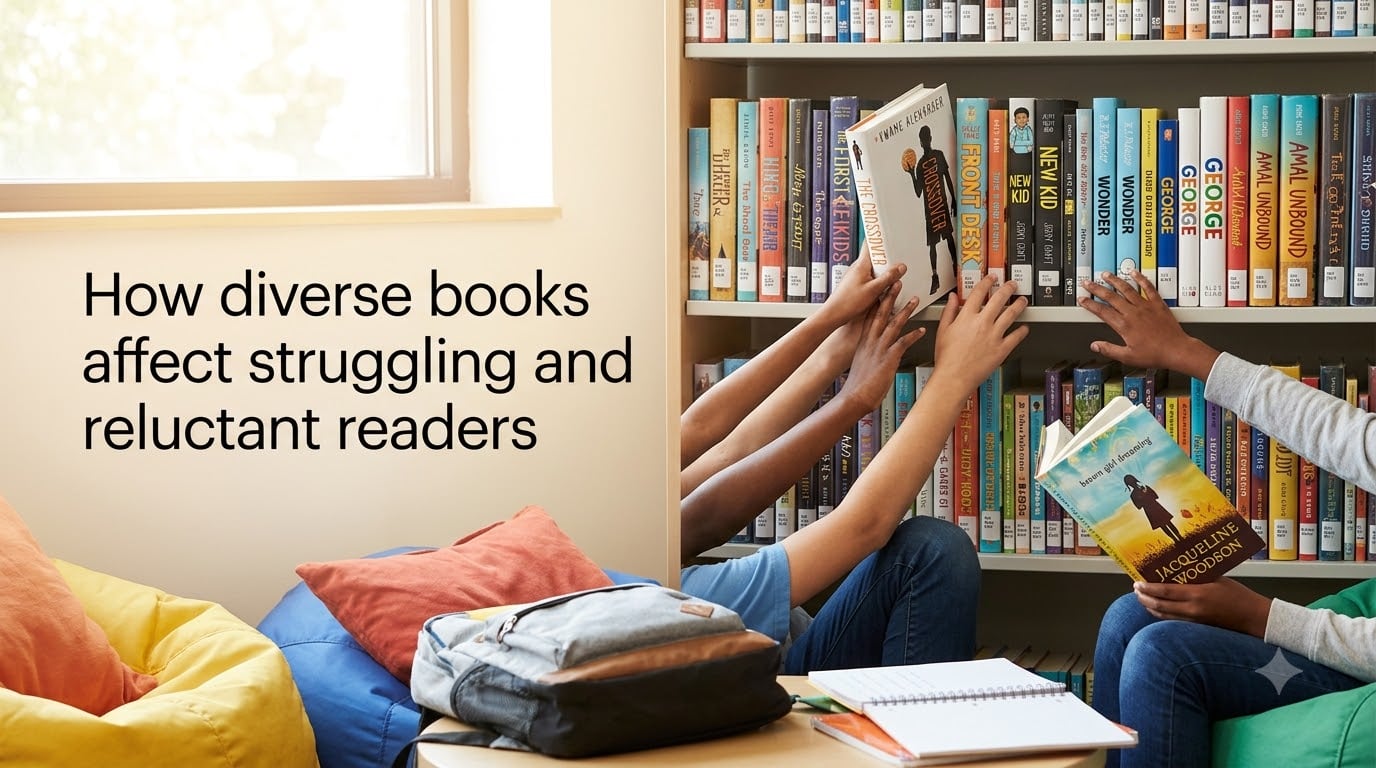
Memoir and verse novels are another strong option. Books in free verse, like The Crossover or Brown Girl Dreaming, look less intimidating on the page, even when the content is rich. They are also a strong fit for older reluctant readers who have outgrown the visual style of graphic novels but still want a faster read than prose.
Practical Strategies for Parents and Teachers
These are the moves I have seen work consistently. None of them require a special budget, and all of them respect the reader.
Let the reader choose. Agency is the most underrated tool in reading motivation. A child who picked the book will pick it up again. A child who had the book assigned will find reasons to avoid it. Build a small, diverse library and let the reader lead.
Match the book to the reader, not the other way around. Look at what the child watches, plays, and talks about. A kid who loves basketball will read a book about basketball that might be a grade level below their reading score. That is a win, not a failure.
Read aloud, even with older kids. The reading level of material a child can understand when read aloud is roughly two grades above what they can read independently. A parent reading a diverse chapter book with a 7th grader is doing serious academic work without the child feeling tested.
Use audiobooks as a bridge. Audiobooks build stamina, vocabulary, and comfort with narrative structure. Many children who listen to stories first will reach for the print version later. This is not cheating. It is a different path to the same destination.
Lower the stakes. Drop the reading logs. Skip the comprehension quizzes. For a reluctant reader, the goal is to rewire the relationship between reading and feeling. That happens through choice, comfort, and small wins, not worksheets.
Bring in a trusted recommendation. Parents, teachers, and librarians all reported the same thing in forum discussions: when a trusted adult hand-sells a book, kids listen. Take the time to read the back covers. Talk up the books you love. Your enthusiasm is contagious.
FAQs
How do diverse books help struggling readers?
Diverse books help struggling readers by building emotional connection to the story. When a child sees a character whose life mirrors their own, they feel seen and are more likely to stay engaged. Research from First Book shows that access to diverse books in the classroom increases the amount of time children spend reading, which is the strongest predictor of reading growth.
Why is representation important for reluctant readers?
Representation is important for reluctant readers because it gives them a reason to care. Readers who do not see themselves in literature often disengage from reading, while those who do see themselves build stronger reading identities. Mirror books also create empathy and curiosity about other lives for readers who do not share the background of the protagonist.
What are high interest low vocabulary books?
High interest low vocabulary books, often called hi/lo books, are books written with controlled vocabulary and shorter sentences but mature, age-appropriate themes. The reading level is often two or more grades below the target age, so the content respects the reader while the text respects their skill level. They are a common tool in reading intervention programs.
How do you engage a reluctant reader?
To engage a reluctant reader, give them choice over what they read, match the book to their interests rather than only their reading level, read aloud together, offer audiobooks as a bridge to print, and lower the stakes by replacing worksheets with conversations. Representation in the books also matters. A child who sees themselves in the story is more likely to pick the book back up.
What books are good for reluctant middle school readers?
Good books for reluctant middle school readers include graphic novels like New Kid and the Amulet series, realistic fiction by authors like Jason Reynolds and Kwame Alexander, verse novels like The Crossover and Brown Girl Dreaming, and historical fiction from underrepresented perspectives. The right format matters as much as the content, and the choice of book should belong to the reader whenever possible.
A Final Word on Diverse Books and Reluctant Readers
Diverse books are not a one-size-fits-all solution, but they are one of the most powerful tools we have for reaching struggling and reluctant readers. The research is clear. Children who see themselves in stories read more, stay engaged longer, and identify more strongly as readers. The classroom library, the home bookshelf, and the librarian’s cart are not decoration. They are infrastructure for literacy.
Start small. Add a few diverse titles to the rotation this week. Hand them to a child with a real recommendation. Watch what happens. If you have a story of your own about a book that reached a reluctant reader, I would love to hear it. The best thing about this work is that the wins are usually quiet, often unexpected, and sometimes invisible until months later when a child who used to hate reading suddenly asks for another book. That is the whole point.