
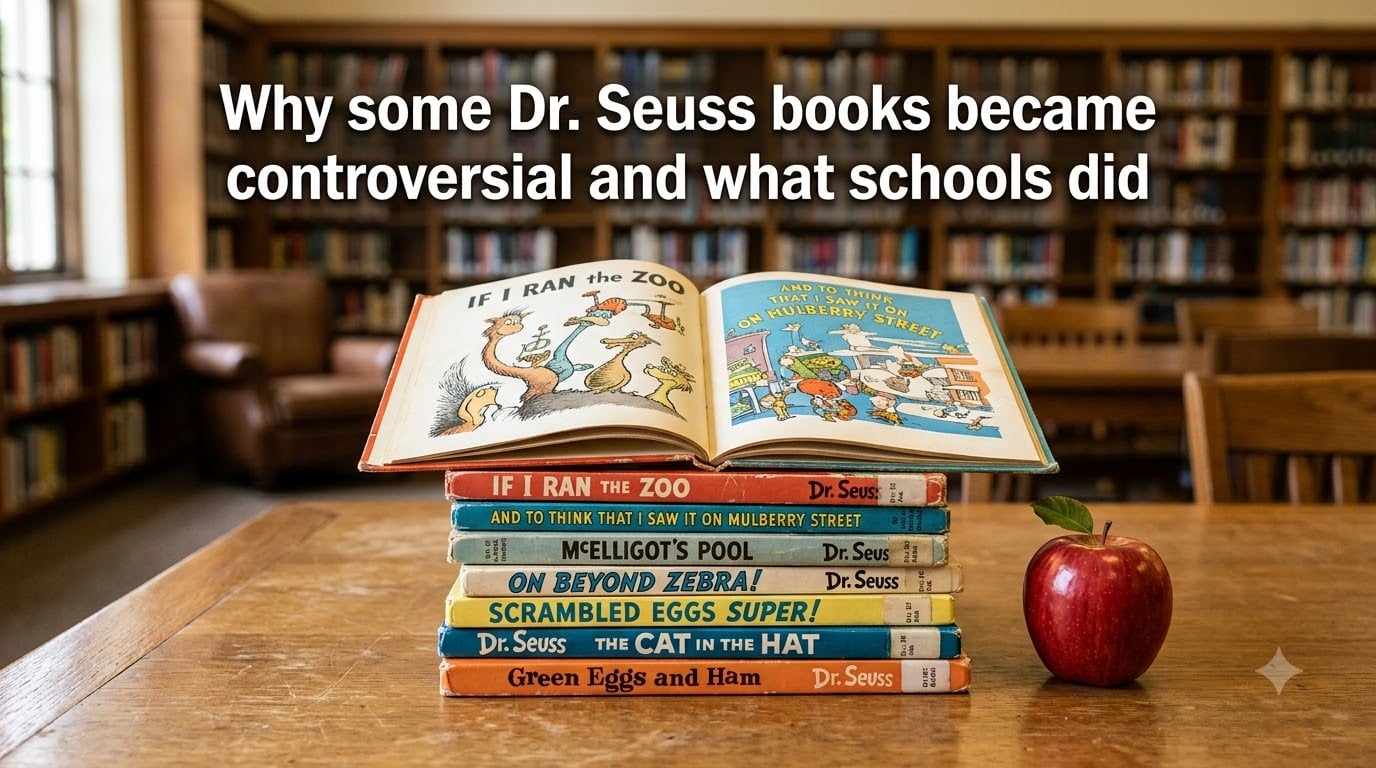
On March 2, 2021, Dr. Seuss Enterprises announced that six titles would stop being published because they contained racist and insensitive imagery. The news surprised many readers who grew up with the Cat in the Hat and the Grinch, but the criticism had been building for decades.
We pulled together the facts on why those Dr. Seuss books became controversial, what schools actually did (a critical distinction from “banning”), and how parents and educators are navigating the topic today. Here’s the full story.
Table of Contents
Why Did Some Dr. Seuss Books Become Controversial?
Theodor Seuss Geisel, better known as Dr. Seuss, drew caricatures rooted in racial stereotypes during the 1930s and 1940s. These images appeared in advertising, political cartoons, and early children’s books, reflecting the biases that were common in American media at the time.
Researchers, including a 2019 study published in the academic journal Research on Diversity in Youth Literature, found that more than 2% of the characters in Dr. Seuss’s children’s books are people of color. The same study noted that nearly all of those characters are depicted using what scholars describe as “anti-Blackness” or through tropes connected to white supremacy.
Common criticisms include exaggerated facial features on African and Asian characters, yellowed or non-white skin tones used to mock specific ethnic groups, and drawings that echo propaganda from the World War II era. Springfield Museums, which operates the Dr. Seuss National Memorial Sculpture Garden, has acknowledged that “he used racially stereotypical images that were hurtful then and are still hurtful today.”
What the Imagery Actually Looks Like?
Many of the controversial images are not obvious to a casual reader. A character drawn with bright yellow skin, oversized lips, or a conical hat may seem playful until you learn that the same drawings appeared in Geisel’s wartime cartoons mocking Japanese Americans, Black Americans, and Jewish people.
Children absorb these visual cues quickly, repetition locking image into memory before a caregiver can intervene. When a child reads the same book over and over, the images become part of their visual vocabulary for the world, which is why many educators feel the imagery matters far more than casual viewers realize.
The Six Dr. Seuss Books Discontinued in 2021
Dr. Seuss Enterprises, the company that manages the author’s estate, announced on the anniversary of Geisel’s birthday that these six titles would no longer be printed:
And to Think That I Saw It on Mulberry Street (1937)
If I Ran the Zoo (1950)
McElligot’s Pool (1947)
On Beyond Zebra! (1955)
Scrambled Eggs Super! (1953)
The Cat’s Quizzer (1976)
The company’s statement said the decision followed “months of discussion” and reflected a review of the entire Dr. Seuss catalog. The books were not yanked from shelves. Existing copies remain available for sale, lending, and reading. Dr. Seuss Enterprises simply stopped producing new editions.
The most-cited examples come from the first two titles. “And to Think That I Saw It on Mulberry Street” includes a character described as a “Chinaman” who eats rice with chopsticks and wears a pointed hat. “If I Ran the Zoo” features a drawing of two characters on a bamboo raft that scholars have said draws on racist tropes from Chinese propaganda posters.
Timeline of the Dr. Seuss Controversy
The story did not begin in 2021. Here is how the conversation built over more than a decade.
2017: The Cambridge, Massachusetts school library made national news when it thanked Melania Trump for a gift of Dr. Seuss books but noted that the librarian had concerns about the imagery in some titles. The librarian pointed out that some Seuss books “depict people in ways that are hurtful and wrong.”
2019: Researchers Katie Ishizuka and Ramón Stephens published their study in Research on Diversity in Youth Literature. The findings pushed the conversation into academic circles and mainstream coverage.
October 2020: A National Education Association (NEA) document quietly shifted focus for Read Across America Day, moving away from centering Dr. Seuss as the face of the celebration. The NEA later confirmed the change was part of a broader push for more diverse featured authors.
March 2, 2021: Dr. Seuss Enterprises announced the publication cessation of six titles. The story became the number one trending topic on Twitter and the lead story on most national news outlets.
2021 through 2026: Schools across the country reviewed their reading lists. Some removed Dr. Seuss titles from Read Across America events, others kept the books but added classroom discussions about the imagery, and many simply moved on to other authors.
What Did Schools and Libraries Do?
Despite headlines calling it a “ban,” no government entity or school district banned Dr. Seuss books. The phrase that surfaces most accurately is “removed from reading lists” or “deemphasized.” This matters because a ban involves legal force, while a reading list decision is a curriculum choice made by educators.
In Loudoun County, Virginia, a viral story claimed the district had banned Dr. Seuss entirely. The district quickly clarified that it had simply directed teachers to “be more inclusive” in their Read Across America activities, not eliminate Seuss. Reddit users and local reporters documented the difference between the rumor and the actual policy.
Around the country, reactions fell into three general patterns:
Curriculum updates: Many districts swapped out Dr. Seuss-centered reading lists for books by authors like Jacqueline Woodson, Ezra Jack Keats, and Grace Lin.
Pair-reading approach: Some teachers kept the books in classrooms but introduced them alongside discussions about stereotypes and historical context.
Preservation in libraries: Public libraries kept the books on shelves, treating them as historical artifacts that some readers may still want to access.
Teachers report being told by new administrators that Dr. Seuss is “racist and inappropriate,” which has caused confusion. The most accurate framing is that the books contain imagery that contradicts modern standards of representation, not that the author himself was beyond redemption.
Dr. Seuss’s Evolution as an Author
The story is not a simple one of a problematic author. Geisel’s work shifted noticeably after the 1950s, and the books most parents remember today were often his later, more inclusive titles.
His 1954 book The Sneetches directly addresses anti-Semitism and discrimination through the story of star-bellied and plain-bellied creatures. Horton Hears a Who! (1954) ends with the famous line “a person’s a person, no matter how small,” which has been read as a defense of human rights and personhood.
The Sneetches in particular is widely taught in classrooms today precisely because it gives young readers a clear framework for talking about exclusion. Some schools now pair the Seuss stories with the discontinued titles to show children how the same author could produce both harmful and healing work.
Biographer Brian Jay Jones, who wrote the definitive Geisel biography, has noted that Geisel’s views evolved over time. He was not immune to the biases of his era, but his later work shows a clear engagement with the Civil Rights movement and the changing moral conversation about equality.
How the Controversy Connects to Read Across America?
Read Across America Day, held each March 2 to match Geisel’s birthday, was long associated with Dr. Seuss almost by default. The NEA, which organizes the program, began shifting away from that single-author focus in 2019 and 2020 as part of an effort to highlight more diverse children’s book authors.
The 2021 announcement accelerated a shift that was already underway. Many schools still mark the day with reading events, but the featured authors now include Maya Angelou, Langston Hughes, and Toni Morrison. Dr. Seuss is not banned from campuses, but he is no longer the automatic centerpiece of the celebration.
For Reading Inaction, this is part of a broader pattern: as families and educators rethink who gets celebrated in children’s literature, the conversation about legacy authors gets more nuanced rather than more punitive.
Should We Still Read Dr. Seuss Today?
Most educators and librarians we have spoken with land on a similar answer: it depends on the book and how you read it. There is no single right answer for every family or classroom.
If you want to share Dr. Seuss with a young reader, consider these approaches:
Skip the six discontinued titles. They are off the press for a reason, and the imagery is genuinely harmful by today’s standards.
Lean on his later inclusive works. The Sneetches, Horton Hears a Who!, and The Lorax are still excellent starting points for conversations about fairness and the environment.
Pair Seuss with diverse authors. Use one Seuss book alongside a book by a Black, Asian, or Indigenous author so your reader sees a wider range of voices.
Use the older books as teachable moments. If you do read one of the discontinued titles, talk openly about what the images mean and why those tropes are problematic.
The goal is not to erase Dr. Seuss from the bookshelf. The goal is to read his work with the same critical eye we bring to any author whose career shaped a century of children’s literature.
Frequently Asked Questions
What are the six canceled Dr. Seuss books?
The six titles Dr. Seuss Enterprises stopped publishing in 2021 are: And to Think That I Saw It on Mulberry Street, If I Ran the Zoo, McElligot’s Pool, On Beyond Zebra!, Scrambled Eggs Super!, and The Cat’s Quizzer. Existing copies are still available for sale and lending.
What are the main criticisms of Dr. Seuss’s books?
Critics point to racist caricatures of African, Asian, and Jewish characters in early Dr. Seuss books. A 2019 study in Research on Diversity in Youth Literature found that over 2% of characters in his children’s books were people of color, and nearly all were depicted using what scholars called racist tropes.
Were Dr. Seuss books actually banned from schools?
No school district or government entity banned Dr. Seuss books. Some districts removed his titles from reading lists or stopped featuring him as the centerpiece of Read Across America Day, but the books remain legal to read, buy, and check out from libraries. The 2021 announcement was a publication decision, not a legal ban.
Is it okay to read Dr. Seuss books to children?
Yes, with care. Most education experts recommend avoiding the six discontinued titles and focusing on later works like The Sneetches, Horton Hears a Who!, and The Lorax. Pairing Seuss with diverse authors is another common approach that broadens what children see in literature.
Why did Dr. Seuss Enterprises stop publishing these books?
Dr. Seuss Enterprises said the six books depicted people in ways that are hurtful and wrong. The decision followed months of internal review and pressure from educators, scholars, and advocates who had been documenting the racist imagery for years.
Conclusion
The Dr. Seuss books that became controversial are a clear case study in how cultural standards shift over time. The six discontinued titles were not removed from schools by force, but they were pulled from publication by an estate that recognized the imagery no longer fits modern expectations of children’s literature.
Schools responded by updating reading lists, swapping out Read Across America features, and in some cases using the older books as conversation starters. Parents today still have a wide range of Dr. Seuss titles to enjoy, and his later works like The Sneetches remain powerful tools for teaching inclusion.
For 2026 and beyond, the most useful approach is to read his work with eyes open: honor the parts of the catalog that still teach fairness, and skip the pages that teach the opposite.