
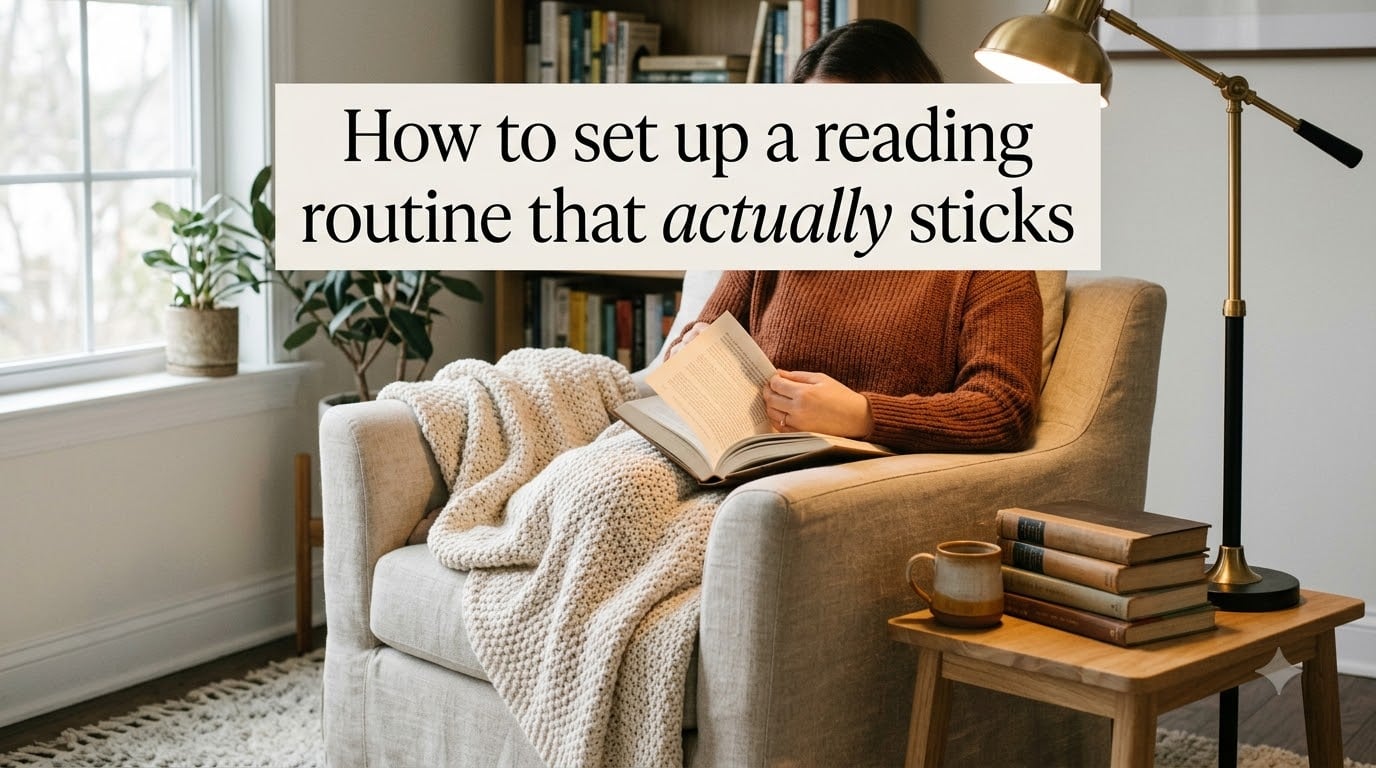
Learning how to set up a reading routine that actually sticks starts with understanding why most attempts fail within the first three weeks. I have tested dozens of reading schedules over the past few years, and every failed routine shared one common flaw: it asked for too much, too soon, at the wrong time.
According to a 2023 study published in the European Journal of Social Psychology, the average time to form a new habit is 66 days, not the 21 days we have all heard about. That gap between expectation and reality is where most reading routines collapse. You commit to an hour a day, miss three days in a row, feel guilty, and abandon the habit entirely.
This guide walks you through the research-backed strategies that actually work. I will share the psychology of habit formation, the 10-page rule that beats time-based goals, habit stacking scripts, and how to recover when life interrupts your routine. By the end, you will have a clear, realistic plan to build a daily reading habit you can sustain for years.
Table of Contents
Why Most Reading Routines Fail?
Most reading routines fail because they ignore the psychological barriers that make reading feel like work rather than pleasure. I belonged to a book club where six out of eight members abandoned their “read 30 minutes a day” goal within a month. The remaining two used completely different strategies.
The common obstacles that break reading habits
The biggest obstacle is decision fatigue. After a long day, your brain does not want to choose between 47 unread books on your shelf. It wants the easy dopamine of scrolling through social media. Reading requires sustained attention, and tired brains resist effort.
Another obstacle is unrealistic expectations. Setting a goal of “read one book per week” sounds inspiring, but it ignores the reality of your work schedule, family obligations, and energy levels. When you inevitably miss a day, the streak breaks, and motivation drops sharply.
Finally, many people choose the wrong books. Starting a reading routine with a dense 600-page novel is a recipe for burnout. Your brain needs early wins to build momentum. Light, engaging books teach your brain that reading feels good, which is the foundation of every lasting habit.
The Psychology of Habit Formation
Every habit, including reading, follows a predictable neurological pattern. Understanding this pattern helps you design a routine that works with your brain rather than against it.
The cue-routine-reward loop
The habit loop has three components: a cue that triggers the behavior, the routine itself, and a reward that reinforces the action. For reading, the cue might be your morning coffee, the routine is opening your book, and the reward is the satisfaction of progress or the pleasure of a good story.
Your brain releases dopamine when it anticipates a reward. That is why the same coffee-and-book combination works every morning. Your brain starts craving the reading session before you even sit down. This is automaticity, and it is the goal of every habit formation strategy.
Why automaticity takes time
Automaticity means your brain performs the behavior without conscious decision. Reaching for your phone in the morning is automatic. Reading for 20 minutes should feel the same way, but only after consistent repetition. Research from University College London found that automaticity develops gradually, with significant variability between individuals.
This is why patience matters. If you give up at three weeks because the routine still feels effortful, you are quitting right before the brain rewires itself. The real work happens in the messy middle phase, between day 20 and day 60, when discipline matters more than motivation.
Start Small With the 10-Page Rule
The fastest way to build a reading routine is to make the initial commitment absurdly small. The 10-page rule is a proven strategy: commit to reading just 10 pages per day, no matter what. On most days, you will read more once you start, but the 10-page floor removes the resistance that kills new habits.
This approach works because it bypasses the negotiation your brain does when facing a big task. “Read for an hour” triggers anxiety. “Read 10 pages” feels manageable. Once you are on page 10, momentum often carries you to page 20 or 30.
Why page-based goals beat time-based goals
Time-based goals like “read 30 minutes a day” create inconsistent results. On some days you read fast and finish chapters. On other days you read slowly, distracted, and feel like you failed. Page-based goals produce consistent progress regardless of speed or comprehension challenges.
For example, a slow reader doing 10 pages per day finishes 3,650 pages per year. That is roughly 12 to 15 books, depending on length. A faster reader covering 20 pages per day hits 7,300 pages, which is 24 to 30 books annually. Either way, you are building a serious reading habit.
How to use the 10-page rule
Step 1: Choose a book you genuinely enjoy. The 10-page rule only works if the content pulls you forward.
Step 2: Set a daily reminder on your phone for the same time each day. Consistency matters more than the specific time.
Step 3: Read 10 pages minimum. Mark them with a bookmark or a tally mark in your phone notes.
Step 4: If you feel like reading more, keep going. If not, stop at 10 and move on with your day.
Step 5: Track your pages in a simple notebook, spreadsheet, or app. Visibility creates accountability.
Find Your Optimal Reading Time
Your reading routine will fail if you attach it to a time when your energy is low. The best time to read is not the same for everyone. I learned this after years of forcing myself to read at night, only to fall asleep on page 3. Switching to morning reading tripled my consistency.
Morning vs evening reading routines
Morning reading works well for people who want mental stimulation before work. Your brain is fresh, your phone is less tempting, and you start the day with a win. Popular figures like Tim Ferriss and Ryan Holiday credit morning reading with their productivity.
Evening reading works well for people who need a wind-down ritual. Reading before bed reduces screen time and signals to your body that it is time to sleep. Just avoid high-stakes thrillers that spike your heart rate. Calmer fiction or nonfiction works better.
Matching reading to your energy levels
Some people have their best focus during lunch breaks, others during commutes on public transit, and still others late at night. The wrong time is the one you keep skipping. Track your reading for two weeks and notice which sessions feel effortless versus forced. Build your routine around the effortless windows.
Use Habit Stacking to Anchor Your Reading
Habit stacking is the practice of attaching a new habit to an existing one. This is one of the most effective strategies in behavioral psychology, popularized by author James Clear in “Atomic Habits.” It works because your brain already has neural pathways for the existing habit, and the new behavior rides along for free.
For example, if you already drink coffee every morning, stack your reading on top. “After I pour my morning coffee, I will read 10 pages of my current book.” The cue is specific, the action is small, and the existing habit provides the trigger you do not have to think about.
Examples of habit stacking scripts
Script 1: “After I brush my teeth at night, I will read 5 pages before bed.” This works for people who want a calm pre-sleep routine.
Script 2: “After I sit down on the train for my commute, I will open my book instead of my phone.” This works for urban commuters with predictable travel.
Script 3: “After I finish my lunch, I will read 10 pages during my break.” This works for office workers with structured midday breaks.
Script 4: “After I put my kids to bed, I will read for 15 minutes before doing dishes.” This works for parents who have limited personal time.
The key is to make the stack obvious and immediate. Do not say “I will read sometime after coffee.” Say “I will read the moment I set my coffee mug down.” Specificity eliminates the friction that derails new habits.
Create a Dedicated Reading Space
Your environment shapes your behavior more than willpower ever will. A dedicated reading space signals to your brain that it is time to focus, and it removes the small friction points that kill reading sessions. You do not need a fancy library. A specific chair, corner, or even a particular cushion can become your reading cue.
The role of environment in habit formation
Behavioral scientists call this “context-dependent learning.” Your brain associates specific cues with specific behaviors. That is why you sleep better in your bedroom than on your couch, and it is why reading in the same spot every day builds the habit faster.
Design your reading space for comfort and minimal distraction. Good lighting matters. A supportive chair or pillow matters. Keeping your current book (and maybe one backup book) within arm’s reach matters. What does not work: reading in bed where you also sleep, scrolling on your phone, and watching TV. Your brain will associate that space with those activities, not with reading.
Keep a small basket or shelf with your current books, bookmarks, reading glasses, and a notebook. The moment you sit down, everything you need is there. No excuses to skip the session because you cannot find your book.
Track Progress and Build Accountability
What gets measured gets managed. Tracking your reading creates a visible record of progress, which triggers the same reward pathways as crossing items off a to-do list. You will not want to break a 30-day streak once you see it building.
Reading trackers and diaries
A reading tracker can be as simple as a notebook with dates and page counts. Some readers use bullet journals, others use apps like Goodreads or Storygraph. The format matters less than the consistency. Pick a system you will actually use, not the one that looks prettiest on Instagram.
A reading diary adds a second layer of value. After each session, jot down a sentence about what you read and what you thought. Over time, this creates a personal record of your intellectual growth. It also helps you remember books years later, which improves retention significantly.
Making reading social
Accountability accelerates habit formation. Share your reading progress with a friend, join a book club, or post weekly updates on social media. The fear of breaking a public streak is a powerful motivator, especially during the first 60 days when motivation is naturally low.
Online communities like Reddit’s r/books, BookTok, and bookstagram accounts provide free accountability partners. You do not have to know them personally. The simple act of posting that you finished another chapter reinforces the habit in your brain.
How to Recover From Reading Slumps?
Every reader hits slumps. Weeks when work explodes, family emergencies hit, or you simply cannot focus. The difference between readers who maintain lifelong habits and those who quit is how they respond to these inevitable interruptions.
Why missing days is normal
Missing days does not erase your habit. Research on habit disruption shows that missing one day has no impact on long-term automaticity. Missing two days in a row slightly increases the risk of dropout. Missing a week or more means you have to rebuild momentum, but the neural pathways are still there.
Do not punish yourself for missed days. Guilt is one of the top reasons people abandon reading routines entirely. The goal is to return to the habit quickly, not to feel bad about the gap.
Strategies to restart your routine
Strategy 1: Lower the bar temporarily. If you normally read 20 pages a day, commit to just 5 pages for a week. This rebuilds the habit without overwhelming your tired brain.
Strategy 2: Switch to a different book. Sometimes a slump signals that your current book is not engaging you. Switch to something lighter, a guilty pleasure, or a book you have been excited about for months.
Strategy 3: Change your reading format. If you have been reading print exclusively, try an audiobook during your commute. If you have been reading on a Kindle, try a physical book. Novelty re-engages your brain.
Strategy 4: Pair reading with a reward. “After I read 10 pages, I will watch one episode of my favorite show.” This creates a positive association even when your motivation is low.
Adapt Your Routine for Different Life Seasons
A reading routine that worked during your quiet single years will fail during a busy season with small children. The mistake most readers make is treating their routine as fixed. Real readers adapt their habits to match their current life circumstances.
Busy weeks and travel days
During crunch periods at work, your routine might shrink from 20 pages to 5 pages, or from a daily habit to three times per week. That is fine. The goal is to keep the neural pathway active, even if the volume drops. A 5-page session is infinitely better than zero pages.
Travel days are another test. Long flights, subway commutes, and waiting rooms are opportunities to read. Keep your Kindle or a physical book in your bag so you are always ready. Audiobooks are perfect for driving and walking, which means you can maintain your reading habit even when your hands are busy.
During major life transitions, like a new baby, a move, or a job change, give yourself permission to pause the routine. Replace it with a simpler goal, like reading one chapter per week, or even just listening to audiobooks. When the transition stabilizes, rebuild your daily habit from there.
Frequently Asked Questions
How to stick to a reading schedule?
Start with the 10-page rule and commit to reading the same time every day. Habit stacking works best: attach reading to an existing habit like morning coffee or your commute. Track your pages in a notebook or app to build a streak. Missing one day is fine, but return to the routine immediately. After 66 days, the habit becomes automatic and requires less willpower.
How to build a reading routine that sticks for children?
Make reading a daily ritual at the same time and place, like before bed. Let children choose their own books to build ownership. Read together for at least 15 minutes, alternating pages or chapters. Use a sticker chart to track progress and celebrate milestones. Model the behavior by reading in front of them, since kids imitate parents more than they follow instructions.
What is the 5 finger rule for books?
The 5 finger rule helps you pick books at the right difficulty level. Open any page of a book and start reading. Every time you encounter a word you do not know, put up one finger. Zero fingers means the book is too easy. Five fingers before you finish the page means the book is too hard. One to three fingers is the right reading level for independent reading.
What is the best time of day to read?
The best time to read is when your energy is highest and distractions are lowest. Most successful readers prefer early morning or before bed because phones are less tempting during those windows. However, lunch breaks and commutes work well for people with structured schedules. Track your reading for two weeks to find your personal peak time.
How to overcome reading slumps?
Lower your daily page count to remove pressure. Switch to a lighter book or a different format like audiobooks. Add a small reward after each session, like a favorite snack or TV episode. Remind yourself that slumps are temporary and missing days does not erase your habit. Most readers recover within a week by being gentle with themselves and returning to the routine.
Building Your Reading Routine for 2026 and Beyond
Setting up a reading routine that actually sticks comes down to three core principles: start absurdly small, attach reading to an existing habit, and be patient through the messy middle phase. The 10-page rule removes the resistance that kills most new habits. Habit stacking anchors your reading to a cue you already follow. Tracking progress builds the streak that keeps you going on tough days.
Your next step is simple. Pick one book you genuinely enjoy. Set a specific time tomorrow, attach it to an existing habit, and commit to just 10 pages. Mark the date in a notebook. That is your Day 1. By Day 66, you will have a reading habit that feels as automatic as brushing your teeth. The book you finish by then will be the first of dozens to come.